The photos don’t do the board justice. I mean, if I do say so myself. The board will be on display at the THIRD OCCASIONAL SURF CULTURE ON THE STRAIT OF JUAN DE FUCA AND THE SALISH SEA EVENT, this Friday, June 30, Port Townsend Library, 6pm.
CHAPTER TWO- SUNDAY, SEPTEMBER 15, 1968
My nine-six Surfboards Hawaii pintail was on the Falcon’s factory racks. I was headed along Neptune, from Grandview, toward Moonlight Beach. The bluff side of Neptune was either garage or gate and fence, or hedge, tight to the road. There were few views of the water. I was, no doubt, smiling, remembering something from that morning’s session.
There had been six surfers out at the preferred lineup for righthanders. They all knew each other. If one of them didn’t know me, the asshole detective’s son, others would clue him in. There was no way the local crew and acceptable friends would allow me to catch a set wave; maybe a wave all of them missed or none of them wanted. No. One of the surfers would act as if he was going to take off on some smaller waves, just to keep me off them.
As the first one in the water, I had surfed the peak, had selected the wave I thought might be the best of a set. Three other surfers came out. Okay. Three more surfers came out. Sid was one of them. A set wave came in. I had been waiting. I was in position. It was my wave. I took off. Sid took off in front of me, ten yards over. I said something like, “Hey!”
Rather than speed down the line or pull out, Sid stalled. It was either hit him or bail. I bailed. Sid said “Hey!” Louder. He looked at me, cranked a turn at the last moment. He made the wave. I swam.
“I didn’t do anything wrong,” I said, back at the lineup. The four other surfers there were laughing with Sid.
“Wrong, Junior; you broke the locals rule.” Sid pointed to the lefts, the waves perceived as not being as good, on the other side of a real or imagined channel. “Local’s rule. Get it?” Trying to ignore the taunts of the others, I caught an insider and moved over.
After three lefts, surfed, I believed, with a certain urgency and a definite aggression, I paddled back, staying prone on my board, tacking back and forth. A wave was approaching, a decently sized set wave. I wanted it.
“Outside!” I yelled, as loud as I could; loud enough that four of them, including Sid, started paddling for the horizon. I paddled at an angle, forty-five degrees from straight out, lined up the wave at the peak. Though the takeoff was late, I made the drop, rode the wave into the closeout section, pulling off the highest roller coaster I had ever even attempted.
There had been no outside set. I kept my back turned to the water as I exited, not daring to look up at the surfers on the bluff, hooting and pointing. Maybe I looked up for a moment as I grabbed my towel, my keys and wallet and cigarettes rolled up in it, tromped up the washout to Neptune Avenue, trying not to smile.
Just before Moonlight Beach, a late fifties model Volkswagen bus, two-tone, white over gray, was almost blocking the southbound lane. Smoke was coming out of the open engine compartment. Black smoke. Three teenagers were standing behind the bus, two young men, Duncan Burgess and Rincon Ronny, on the right side, one young woman, Monica, on the left.
There was more room on the northbound side. I pulled over, squeezed out between the door and someone’s bougainvillea hedge, and walked into the middle of the street, fifteen feet behind the van. “Can I help?”
Duncan, Ronny, and Monica were dressed as if they had surfed but were going to check somewhere else. Those three were wearing nylon windbreakers, towels around their waists. Duncan’s and Monica’s were different, but both were red with white, horizontal stripes that differed in number and thickness. Ronny was wearing a dark blue windbreaker with white, vertical strip, a “Yater” patch sewn on. Each of the three looked at me, and looked back at each other, then at the smoking engine. The movement of their heads said, “No.”
Someone stepped out of an opening in the hedge on the bluff side of the road, pretty much even with me. I was startled. I almost fell back. Three steps before I regained my balance. I stared.
Julia Cole. She was wearing an oversized V-neck sweater, beige boys’ nylon trunks, bare legs, and huarache sandals. She looked upset, more angry than sad. But then… she almost laughed. I managed a smile.
“It’s you,” she said. It was. Me. “Are you a mechanic?” I shook my head, took a step toward the middle of the road, away from her. “An Angel?” Another head shake, another step. She took two more steps, forty-five degrees from straight, toward me. We were close. She seemed to be studying me, moving her head and eyes as if she might learn more from an only slightly different angle. I couldn’t continue to study Julia Cole. I looked past her. Her friends looked at her, then looked at each other, then looked, again, at the subsiding smoke and the growing pool of oil on the pavement. “We saw what you did,” she said. I took a sideways step, my eyes back on her. She smiled. “From the bluff.” Her voice was a whisper when she added, “Outside,” the fingers of her right hand out, but twisting, pulling into her palm, little finger first, as her hand itself twisted. “Outside,” she said again, slightly louder.
“Oh,” I said. “Yeah.”
By the time I shifted my focus from Julia Cole’s face to her right hand, it had become a fist, soft rather than tight. She moved her arm slowly across her body, stopping for a moment just under the parts of her sweater dampened by her bathing suit top. Breasts. I looked back into her eyes for the next moment. Green. Translucent. She moved her hand, just away from her body, up. She cupped her chin, thumb on one cheek, fingers lifting, pointer finger first, drumming, pinkie finger first. Three times. She pulled her hand away from her face, reaching toward me. Her hand stopped. She was about to say something.
“Julie!” It was Duncan. Julie, Julia Cole didn’t look around. She lowered her hand and took another step closer to me. We were very close.
“If you were an… attorney. I could… use an attorney.”
“Oh. No.” I leaned back before I stepped back. “Not yet.”
“Okay, then. You can’t help.” Julia Cole loosened the tie holding her hair. Sun-bleached at the ends, no darker than dirty blonde at the roots. She used the fingers of both hands to straighten it.
“I can… give you a ride.”
“Look, Fallbrook…” It was Duncan. Again. He walked toward us, toward Julia Cole and me. “We’re fine.” He extended a hand toward Julia. She did a half-turn, sidestep. Fluid. Duncan kept looking at me. Not in a friendly way. He put his right hand on Julia Cole’s left shoulder.
Julia Cole was still smiling when I asked, “Phone booth? There’s one at… I’m heading for Swamis.”
A car come up behind me. I wasn’t aware. Rincon Ronny and Monica watched it. Duncan backed toward the shoulder. Julia and I looked at each other for another moment. “You really should get out of the street… Junior.”
“Joey,” I said. “Joey.”
She could have said, “Julie.” Or “Julia.” She said neither.
No one got a ride. I checked out several spots, didn’t surf. The VW bus was gone when I drove back by. Dirt from under someone’s hedge was scattered over the oil, some of it seeping through.
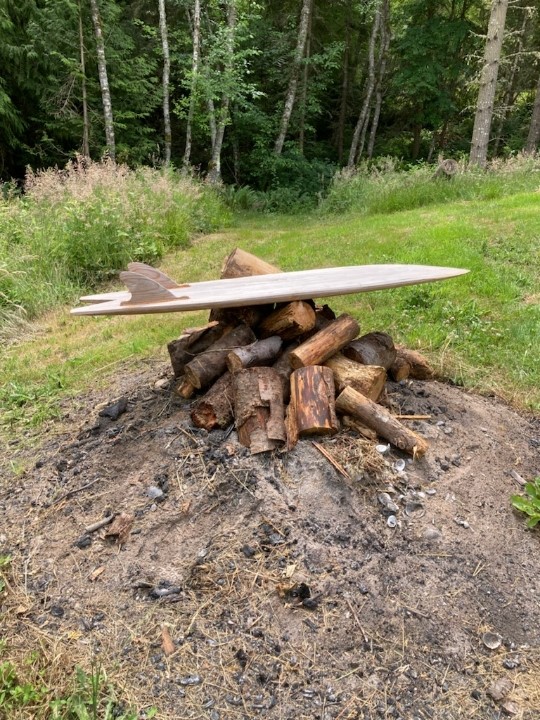
Here’s the story, in photos: Adam “Wipeout” James shaped the board from a cedar slab last year with the intention of sacrificing it on the Summer Solstice, the goal being to improve the waves in the northwest. Those are his two boys posing with the quite obviously rough-shaped board. EMMET (yeah, that’s how they spell it), top, and Calvin, nicknamed Boomer, bottom. Somehow that pagan burning didn’t happen, but this year, yeah. The board was on the fire at Joel’s house, June 21, 2023, ready to go.
BUT, somewhere before dusk, cooler heads (I’m guessing, it was a party, and, though I semi-forced an invitation, I was not there) prevailed. Specifically Chris and Keith. The discussion involved the possibility of painting it up and using it as prop or decoration or something at the upcoming SURF CULTURE ON THE STRAIT OF JUAN DE FUCA AND THE SALISH SEA Event, Friday, June 30, 6pm, Port Townsend Public Library. “Sure.” OKAY, BUT Then, “Why not try it out in some crappy windswell?” Again, not judging the judgment of others. Net result: Numerous wipeouts by the participants, though rumor has it that Aaron actually got a decent ride while totally burning Keith. Rumor. Again, I wasn’t there.
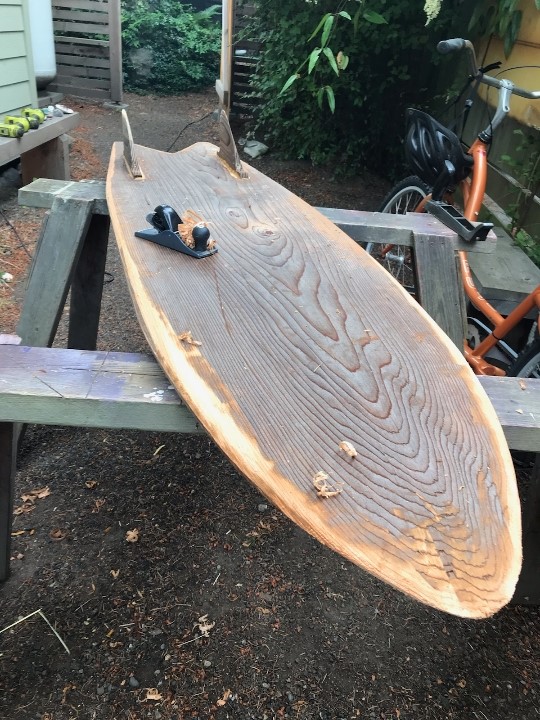
AFTER THE CARNAGE, Keith decided to do some damage control. Whipped out the plane, some glue, started in. He gave up on the sanding. I took over. Last photo, first coat of varnish.
THE CURRENT PLAN IS for me to paint it however I want. THANKS, I would anyway. I do want to preserve the natural cedar look, but… we’ll see. I will post some photos on Wednesday and will have the board ready for the EVENT. There is some discussion on ownership of the board. ADAM, because he supplied the slab and did the initial work, JOEL, because Adam gave it to him, Keith, because he put it back together, Erwin, because I’m going to make it, um, better. Chris, for his efforts in saving it from the pyre, and Aaron, for successfully burning and riding it… no, probably not. STILL, up for debate.
AS FAR AS my recent sit in on the KPTZ blues program with Barney Burke… Errrg! It didn’t go as I had, in my ridiculous and delusional scenarios in which I was smooth and cool and articulate, and my harmonica didn’t jam when I was trying to jam, hoped. Oh, I was cool and chatty when the microphone was not hot. I AM KIND OF THINKING, the quote from Nietzsche about looking too long into the abyss; maybe someone stuck a microphone in his face and asked him to speak to… some unknown and unseen audience, or just… the void. So, yeah, daunting. Scary. I could have done better.
It did affect my decision about speaking at the EVENT.
It’s Wednesday. Swamis day. ON FRIDAY, June 23, I will be on the radio. KPTZ, 91.9 fm, Port Townsend, Washington, Barney Burke’s Blues show, 8 to 10 pm. You can stream it if you’re out of range. I will be talking about the upcoming SURF CULTURE ON THE STRAIT OF JUAN DE FUCA AND THE SALISH SEA EVENT and, maybe, possibly, be reciting some lyrics to blues songs I have written, possibly playing some harmonica. It can’t possibly be as cool as I imagine it could be, but… tune in.
I did a bit of a stall on my second wave. I rode the third wave into the shallows, moved up to the nose, attempted a Hawaiian pullout in the little reform. Copying, emulating; it’s part of learning, of getting better.
Though I claimed I had no surf heroes, Jumper Hayes and Chulo Lopez had been two of mine when I made the switch from Styrofoam surfies and canvas surf mats. June, 1965, just out of Junior High, begging my mom to take me to Tamarack. Jumper and Chulo Lopez were three years older, and were, as expected, not welcoming of even casual contact or communication with kooks.
Sid was outright hostile. Two years older than me, Sid was thousands of waves behind Chulo and Jumper, thousands ahead of me. There were “Watch out for that guy” comments on the beach, everyone watching him when he took off. Sid, obviously proud of his reputation as an asshole, had some undeniably good moves. He had moved up in the local hierarchy when Chulo and Jumper dropped off the scene. Trouble with the law. Stolen avocados. My father was involved. Detective. He did not share details. Unprofessional.
Chulo had come back with a love for Jesus and a definite limp. Now Jumper, as rumored, was back. Damaged.
The sun was clearing the hill behind Swamis, and the trees on the bluff, and was hitting the horizon. The bluff would be a shadow on the waves for several hours. Surfers, checking the waves from the parking lot or the top of the stairs, were silhouettes, backlit. I counted the individuals. Six. Now seven. I looked at the stairs. In the deep shadow, Sid was two stairs ahead of Jumper, almost to the platform. A surfer coming down the stairs stopped.
Or Sid stopped him. The stairs were too far away for me to hear words or see clearly. Body language. Jumper’s head was down. My guess was the other surfer wanted to say something to Jumper, or, at least, some sort of acknowledgement. Sid pushed him aside. Sid and Jumper continued up the stairs. The other surfer went down two steps, turned, raised his free hand in the air, a full-on flipping of the bird. “Eagle.” If he comboed the gesture with a “Fuck you,” it wouldn’t have been loud enough for Jumper or Sid to hear.
…
The shower seemed a bit warmer than the ocean. Still wet, I put my windbreaker on and zipped it up. I put my keys and wallet in an outside pocket. I tucked my board under my arm, flopped my towel and t shirt over it. I looked back at the water as I went up. There were five surfers at the inside peak, six on the outside. I stopped at the landing to zip the jacket down enough to allow me to dig my dad’s lighter and my Marlboros from the inside pocket. I leaned my board against the ‘old men stop here’ rail and lit up. I wasn’t old.
Exactly halfway up the top set of stairs, I could feel the vibration. More surfers. I didn’t look up. I moved to my left. I looked at the bluff, various shades of tan, shadows in the creases on the last of Swamis Point, the calved-off rocks and decomposed sandstone in a pile on the beach. I inhaled. When the vibration became a rocking motion, I turned and blew the smoke toward the middle of the stairway. Dick move.
There were two of them, each carrying a surfboard, but side-by-side, three steps up. Both stopped and let the smoke dissipate. Both looked down at me, my mouth open, lips in an ‘o’ shape. Oh.
I nodded. Neither returned the nod.
We did know each other; Duncan Burgess and Julia Cole, longtime locals, my age. Class of sixty-nine. San Dieguito for them, Fallbrook for me. That my mother and brother and I had just moved to Leucadia did not make me an instantly accepted local.
Julia Cole had her new pink board, almost matching her oversized sweater, under her right arm. There was a strap, something like a guitar strap, beaded, several colors in a Southwest native design, over her left shoulder and attached to her large gray bag. It was almost large enough to carry laundry or sports equipment, but of a heavier material. Leather. Worn and dirtied. She jumped the bag from step to step.
“Julie,” I said. “Duncan.” Neither answered. The silent equivalent of a put-down, loud and shared.
They kept coming down, side-by-side, Julia Cole closer to me, Duncan Burgess on the other rail. I squeezed closer to the outside rail. I had to look at Julie. I wanted to believe she would turn toward me, if only just enough to have me in her peripheral vision. If she did look at me, she would not look away until I did. Not her. Not Julia Cole. They were three steps below me when I said, “Jumper was out.” They kept walking.
After a moment of following them, I looked up the stairs, squinting into the sun. There was someone at the top of the stairs, parking lot level. I lost focus. Rather, I replayed the moments it had taken for Julia Cole to pass. Julie. Her right arm had been around her board, a reddish-brown towel draped and balanced on the board’s rail. The bag, hanging from her left shoulder, had pulled at the neckline of her sweater. She had allowed the bag to rest for a split second on a stair as the cigarette smoke clouded the space between us. She had blinked. She had looked at me. A look of contempt. Or hurt. Serious. Cold. As if I had betrayed her.
I had. In this vision, or version of a vision, I seemed to zoom in on her eyes. Translucent. So green.
I blinked. I shook my head. I had seen Julie’s green eyes before. This was another little mind movie, other images to be stored away. Not too deep.
Julie and Duncan stopped for a moment at the landing. They looked at the lineup. Julie said something to Duncan. Duncan looked around and up the stairs. At me. I inhaled. Heavily. I held the smoke as long as I could and exhaled as hard as I could. With the air as dead as it ever was, in that brief period between the offshore breeze and the onshore updrafts, the cloud hung in the air, as much of it spreading down as up or out. I crushed the cherry between my thumb and pointer finger, flicked it as hard as I could with the use of my middle finger. Julie and Duncan watched the last of the flight of the cigarette butt, down and into the groundcover plants inadequately covering the sandstone, down the steeper drop to the scrub brush above the beach.
Julie and Duncan looked at me, then beyond me, higher up the stairs. I had to look. Again. I squinted against the sun. Again. Someone was sitting, three steps down from the parking lot. The sun, just clearing the trees, was still behind him. He was looking at me, elbows on his knees, a hand on each side of his face. Jumper Hayes. Though his face was in shadow, I still believe he was smiling. He would wait.
I closed my eyes and ran a thousand chaotic scenes, faces and phrases, black and white photographs, red lights and sirens and gunshots, before I stepped away from the railing and started up the upper stairs. “Redemption day, Jody,” Jumper had said, “You’re going with me.”
…
Jumper Hayes, dressed in white pants and a yellow t shirt with “Flowers by Hayes” in semi-psychedelic letters, stood when I got to the stair tread two below him.
“Redemption day?”
“Yes, Jody.” Jumper moved to one side, motioning me to pass by. “I hear you’re going by Joey now.” I may have chuckled. Jumper did chuckle. “I figure we have three possible… suspects… left. Joey.”
Jumper Hayes followed me to the Falcon. Optimum spot. Sid’s van was gone. The pickup was gone. A bright yellow van with two old longboards on top and “Flowers by Hayes” painted on the side was in its place. I set my board on the Falcon’s racks, my towel on the hood. I took the keys out of my windbreaker, unlocked the tailgate, and cranked the window down.
Jumper Hayes walked between my car and the Flowers by Hayes van. He opened the back doors, walked back, pulled my board from the Falcon’s rack. He walked, with a noticeable limp, between our vehicles, with my board over his head. I cranked the back window back up, locked the tailgate, unlocked the driver’s door, and opened it.
I was lighting up a Marlboro when Jumper returned. “I figure… four… Jumper.”
Jumper smiled, leaned close to my face, leaned back, snatched the cigarette from my mouth. “I was told you quit.”
If I was ready to strike, Jumper was ready to defend. He smiled first.
“I did.” I held out the Zippo lighter with the Sheriff’s Office logo for a moment. Jumper nodded. I opened the door, set it on the seat. “But then…” I looked around the Swamis parking lot, stopping for a moment on a 1969 Jeep Wagoneer with fake wood paneling.
“You were brave, Jody.”
“I was a fool, Jumper. Nothing changed.”
“Bravery, foolishness… yeah; but things did. You and Julie, that’s…”
Jumper had an annoyingly sympathetic expression when I spun around. He didn’t drop it. I looked at the two popout surfboards on top of his family business’s van. “You have a… real board… inside?”
“Real in 1967. Before the revolution. Before… Well, since I’m still a Jarhead, technically… guess a Marine doesn’t need a spleen…” Jumper’s laugh was almost apologetic. My smile, in return, went from probably weak to possibly surprised, something short of shocked, before I turned away. Jumper laughed again. He wasn’t apologetic. “I can get us on base. Maybe we can get a few waves at Trestles on the way back home. Hmm?”
“Trestles, huh?”
“San Onofre… at least.”
“San Onofre’s… fine.”
“Fine, then. Illegal to surf Trestles anyway.” Jumper Hayes laughed, pointed at his bright yellow t shirt, pointed at me. I shook my head. He nodded, laughed, and headed toward the van.
Thanks for reading, “SWAMIS,” copyright Erwin A. Dence, Jr. All rights reserved.
The big cultural event is coming up, and I’m going to be pimping it on the local Port Townsend radio station (KPTZ, 91.9, available for streaming on your devices, hearing if you’re anywhere east of Pillar Point and South of North Whidbey Island) next Friday.
FRIDAY NIGHT BLUES with Barney Burke Friday 8-10pm Barney’s been hosting the Friday Night Blues since the launch of KPTZ and he’s always live on the air. He’ll get your feet tappin’ with all kinds of classic blues (and plenty of live tracks) plus a half-dozen soul and R&B tunes. June 23 Longtime Quilcene painter/writer/artist/surfer Erwin Dence sits in with Barney Burke to discuss blues lyrics and local surf-inspired artists and other highlights of the upcoming Third Occasional Surf Culture on the Strait of Juan de Fuca and the Salish Sea event at the Port Townsend Library on Friday, June 30 at 6pm. Having Erwin Dence live in the studio will be one of those fasten your seatbelt moments … more compelling that an NPR driveway moment, even.
Barney texted me he was going to mention me during last Friday’s show. I tuned in too late, missed it, had to go to the archives the next morning. Yeah, good intro, tough to live up to. I will try.
Now, I did go on another show, Ron McElroy’s ‘Free Spin,’ to promote the first SURF CULTURE EVENT, about ten years ago. I was supposed to be on for about seven minutes, I got Ron talking about how he was in a car that went over the cliff at Santa Cruz… and survived. I am a competitive talker. I was on the show for about forty minutes.
THIS TIME, I got the opportunity because Barney Burke and I both once wrote for the Port Townsend Leader, I did some painting for him (how I meet some great folks- and others), and because I sent him the lyrics for fifteen or so blues songs I have written. Blues. SO, YEAH, we’ll see how that goes. I am bringing my harmonica, and I’ll be ready to talk, recite some lyrics, and try hard not to swear, belch, actually attempt to sing, or melt down on air. Yeah, it’s fuckin’ hard for me to keep a civil tongue.
I do have a couple of things I wrote that I plan on reciting at the SURF CULTURE ON THE STRAIT OF JUAN DE FUCA AND THE SALISH SEA EVENT. They were written as songs, but, because I’m pretty good at talking, even reciting, singing… no.
THE DIFFERENCE between reciting and singing is kind of like the difference between speed-walking (possibly still an Olympic event) is with speed walking, both feet are never off the ground at the same time. I will try.
OKAY, HERE IS WHAT I wrote for this Sunday’s post:
EXCUSES
It might actually happen that no one asks you why you missed the last swell window. You, a person who monitors forecasts and buoy readings, who said last time that the next time you’d not miss the chance to maybe, just maybe… score. Even before you got the after-session (as is proper- depending on who they are shared with) reports from several sources and several spots, you knew, while you were doing whatever you were doing in the place of driving and hiking and waiting, that you were missing it. And you were. And you knew it. Confirmed.
There was no one but you to blame, no one but you to hear your explanation of exactly what was more important than loading up, driving out, catching a few waves, maybe after the tide evened out or the swell found its way to where you were waiting, watching, hoping.
Excuses. You give me your list, and I’ll give you mine.
Yeah, my surf rig is dead, and I’m trading out work to get a replacement, and the job is not quite done. No, I’m not willing to take my work rig, with its less than wonderful miles per gallon rating and the current, inexplicable (retail compared to the per barrel crude oil cost) and high price per gallon. Yes, the forecasts are almost always iffy. Winds can wreak a strong swell, tides can be too high or too low, perfect tide and wind conditions can’t beat a swell that angles somewhere else.
Excuses. Here is my quote on people’s excuses: The laziest people have the best excuses.
It’s not laziness. Though I’ve said for as long as I’ve known Trish (55 years) that surfing is the other woman, and that there have been ‘surf or me’ moments, I must add that WORK is the cruel mistress that has most often kept me painting, sometimes on the bluff, with perfect and glassy waves being enjoyed and missed and misridden well within my view.
Oh, and if I’m being this honest, I must add that poor life planning is part of the reason that an old fart still is working. Oh, and laziness-wise, though I’ve done it throughout my work life, I seem to be increasingly unwilling to even talk myself into racing out for a quick session, and back for work. No, I want the all day option.
Or, if I just happen to be working close to some wave possibilities… sure; amazing how one can shake off the tiredness with cold water and a some tantalizing wave possibilities.
Next time, next time, next time…
I’m a couple of days short of getting my new-to-me surf rig.
Yes, it will double as a work rig on those days I don’t need a big boy van full of tools and dropcloths and ladders. WORK RIG. Surf rig. YES! And I’ll go stealth for as long as I can.
As with the anticipation for the next swell window, I can hardly wait.
Thanks to Barney Burke for the opportunity. I’m positive it won’t be as I imagine it, but I’m sure it will be… interesting. REMEMBER to check out realsurfers.net for the remainder of Chapter One of “SWAMIS” on Wednesday, tune into KPTZ 8pm on this coming Friday, and make plans to be at the Library, uptown Port Townsend for the Event, Friday, June 30. Oh, and please respect my copyrights.
There was something almost comforting about the darkness, about not having a horizon to worry about. An oversized flashlight in my hand, the words on the pages of the palm-sized notepad, open and pushed up against the steering wheel; this was all I could really see. Notes, in cop shorthand, detective code. Still, I could hear the steady sound of waves, the rhythm occasionally changed with what had to be an outside set. I had felt, when I pulled into the lot and got out of the car, the push of night wind hit me, pass me, and get lost, dispersed in the vastness beyond the bluff. Offshore. Perfect.
I was in the driver’s seat of my car, mine, the hand-me-down Ford Falcon station wagon, new in 1964. The Falcon was parked in the optimum location in the Swamis parking lot, dead center, front row, facing the bluff. When it got light enough, I would be able to watch the waves wrap around the point. There would be a moment where I would know I would be dropping down the stairs and paddling out. If Swamis was at all decent, it would get crowded.
It was not nearly light enough. I closed the notepad, thumb holding my place, and tried to repeat what I had transposed from a days’ worth of my father’s notes. I opened the pad, reread the third of any pages that had real action, real adventure. A break-in, chase, and arrest. Vista, October 1967. I recited the words. I checked again, for accuracy. Close. Or closer.
I shined the flashlight on the seat beside me. A black metal file box with other note pads and a spare t shirt, for later, three scuffed and dirtied, formerly dirty-orange Pee-Chee binders, three college-ruled notebooks inside each one. I put the notepad into the pocket of the top binder, middle of three. I pulled out the bottom Pee-Chee, opened it, took out the middle notebook. Wire bound, with serrations, tear out pages. Not that I would. I pulled a ballpoint pen from the wire, left a space between the previous day’s notes, wrote, “Free. These are days where freedom and peace and war and revolution are often used in the same sentence.”
I repeated my words. “’Love.’ I should add ‘love,’” I told myself. “People say it, don’t mean it.” I didn’t. I added, “School day. Work day. Not for me. Free! And… it sounds like Swamis is actually breaking. Got my spot. Optimum location. No one else here. Yet.”
Putting the pen back into the binding, adding the notebook to the stack of Pee-Chee binders and notebooks, a waxed cardboard quart of chocolate milk trapped behind them, I reached into the small wooden box of eight track tapes on the driveline hump, fingered my way to the third one down, flipped it to the proper direction, and inserted it in the dash-mounted player.
Legal. At least this one looked legal. The player would work without the car running because the guy I bought it from, Mark, friend of a friend, hooked it up the way my father’s Sheriff’s Office radio had been wired.
Mark claimed if this tape deck was stolen, he hadn’t stolen it. My surf friends Gary and Roger, and several of their friends, claimed he did, and I should have known. “Just don’t let the cops fuck with this one,” Gary said. “Get some better tapes,” Roger added.
I pushed in “Aerial Ballet.”
I was listening, and then I wasn’t. Asleep, perhaps. I didn’t hear the two vehicles pull in, one on either side, didn’t hear the doors close, wasn’t aware two people had met at the front of the Falcon.
Wham!
The flashlight was up, instantly stuck between the spokes of the steering wheel and pointed at the man leaning toward me, straight across the hood, the flat palm of his right hand raised and ready for another slap. The light hit the curve of the fogged-up windshield, bounced back. I turned the flashlight off. I still hadn’t recognized the man.
“It’s still fuckin’ dark, man,” he said. I recognized the voice. Sid. I would have, should have recognized the sound of his van, seven out of eight pistons firing. I must have been asleep.
“Yeah. Dark.” I didn’t recognize that voice. “Okay, Sidney; five waves and I have to go.”
“No, man, I’m doing the delivery. It’s still my job. And… I have some… green stamps I need to… redeem.”
“No. Not today. Man. Five waves and…” I waited for a completion of the sentence. “And, you know what, you aren’t going.”
“No? Just you? Fuck it, then, man; five for you means ten for me.”
Wham! Flat palm on the hood. A different hand. Passenger side. “Break of dawn, DeFreines.” There was humming. Military cadence. “Jody’s got Sid’s surfboard, got his Daddy’s Falcon, too; no sense feelin’ lonely, no sense feelin’ blue.” The cadence continued the with a lighter tapping on the hood. One finger, maybe two.
I filled in the rest in my mind. Silently. “Sound off, one, two; sound off, three four…” I stopped myself. “Jody,” I thought, “He called me Jody.”
“Jody.” A face was at my side window, close to the glass. I was startled into an uncontrollable upper body twitch. Still, I didn’t turn to look until the man was a darker shadow in the dark. “Redemption day, Jody, and… and you’re going with me.” He hit the window with a flat palm. The shadow receded.
Junipero Serra Hayes. Jumper.
I didn’t get out of the car until two metal doors slammed on the vehicle to my right, until Sid’s vague shadow passed. Other cars, headlights on, were coming into the lot from 101.
It was a pickup truck to the left of the Falcon; step-side, late fifties, brownish red and rusty red. Farm truck. I brought up a mental image of where I had seen this truck. Grandview Street, off 101, right hand side. Farmhouse, barn, greenhouses, a little shop with “Flowers by Hayes” over the sliding glass door. Jumper. Junipero Hayes.
Everyone knew Jumper was back in the North County. No one had seen him in the water.
The mid-sixties Chevy van on my right, Sid’s, was a light gray. Factory color. It was jacked-up in the back, with overwide tires, accommodated by Sid having cut the wheel wells and glassed-on the red-primed, flared fenders. No windows. Surfboards Hawaii decal on the driver’s door. Sid. Team rider. Another asshole in the water. Of course, they were friends, Sid and Jumper. Locals.
I opened both driver side doors, tossed a damp beach towel over the back door, used the cover to strip out of my Levis jeans and into my driest trunks. I stuck my towel onto the roof, pulled my wallet out of the jeans, set it on the towel. I grabbed a pack of Marlboros and a Zippo lighter off the dashboard, placed them into the inside pocket of my windbreaker. I folded my boxers in with the Levis, set them on the floor in front of the driver’s seat. I set my shoes, socks already inside them, on top of my Levis. I pulled my latest board, formerly Sid’s board, out of the back of the Falcon, set it on the roof racks. I opened, locked, and closed all the doors, circled the Falcon again, making sure all the doors were locked. I wrapped my keys and wallet into the towel, clutched it to my chest with my left hand, slid the board off the racks with my right hand, stepped away and pivoted it, wax side out, into position under my arm.
I took three breaths and walked toward the stairs.
…
It was still dark enough that the water, other than a silver-green line at the horizon, was more black-and-white than any sort of discernible color. Carrying the surfboard that had, indeed, once belonged to Sid, I took two steps at a time down the top flight of the wooden stair system at Swamis. I stopped on the platform where the stairs made a ninety degree turn and dropped, parallel to the beach, the rest of the way down.
The platform was approximately six feet by eight feet and offered a perfect view of the lineup and the point. Because it was at a particularly steep portion of the bluff, probably sixty feet or more above the beach, galvanized chain link fencing, eight feet high, the metal posts attached to the wooden posts and railings, had been added to two sides of the landing.
The ocean, forty minutes before dawn, was horizontal streaks of grays. Still, Swamis was, obviously, lined up. Someone was getting a ride. New streaks, breaking the plane. Another surfer was on the next wave. My guess was that Jumper Hayes, on a longer board, drawing traditional lines, had been on the first wave. This was Sid. I knew Sid’s style: More turns, more aggressive turns. I could hear hoots between the only two surfers in the water, locals. Not would not have been acceptable behavior for Kooks and non-locals. Rules. Code. Etiquette. Rather rigid, strict; constantly broken, only occasionally enforced; as with all codes.
…
Running my hand along the horizontal railing on the downhill side of the platform, I felt the letters carved into the wood gone smooth with time and thousands of hands. I knew the words. “Old men stop here.” It was true. Not that a seventeen-year-old paid any attention to surfers over twenty-five, and definitely not to surfers over thirty. Old men.
There was movement on the upper stairs. Vibration, just short of rocking. Two more surfers were coming down. Both were laughing, bouncing, hurrying. I pushed closer to the corner, let them pass. I didn’t look at them, they didn’t acknowledge me.
Taking two stairs at a time, I almost caught up with those two surfers at the bottom deck. They were on the beach and running for the water as I got to the lower platform, running like extras in a “Beach Blanket” movie. Kook move. The foundations for the supports of the six step stairway were showing, the winter waves and tides having pushed the sand south. Summer swells would return it. I leapt off the bottom step. Silent hoot.
I stuck my towel in the tangle of roots and dead lower branches of some scrub, six feet or so above the beach and fifteen feet beyond the lifeguard tower. I took off my windbreaker and t shirt, draping the red jacket over the rest of my stuff. There was, I still believed, a code that kept surfers from stealing from other surfers. Still, I wanted my valuables somewhere it was obvious they were there on purpose, somewhere I could possibly see them.
In what had become my pre-surf ritual, I pulled a pack of Marlboros, box, not soft pack, from the windbreaker. I took out the Zippo lighter. Chrome. Freshly filled, new flint. Big flame. I lit up, clicked the lid shut. I ran two fingers over the lighter’s raised logo. “San Diego County Sheriff’s Office.” Gold on chrome.
I inhaled, popped the lid open by hitting a corner on my other hand, and looked at the flame. Smaller. In the brightness I saw, or imagined I saw, red lights, spinning, flashing in three second intervals, coming closer. I blinked, looked to my right. I saw a painted image of Jesus, the red lights distorting his calm countenance. I followed his arm to his fingers, pointing forward, into the lights, into the sun. Blinding. I turned through the brightness and to my left, the vehicle that was the source of the lights. A reflection-distorted image of my father was in the windshield, then the open window. He was very close, passing very slowly. I couldn’t quite focus on his expression. He turned his head away. Forward.
The flashing lights moved past me leaving only the brighter light. I blinked. I popped the lid on my father’s lighter shut. “Ten seconds,” I said. “Maybe eight. Concentrate. Can’t do this.”
My stuff was re-wrapped and re-positioned, my cigarette was still in my mouth, and I was into the ragged line left by the high tide when a surfer on a long board took off from the outside peak. Jumper Hayes. A bit slow on the takeoff and popup, jerky on the bottom turn, he cruised through the first wall and into the slow section. With a series of subtle stalls, he lined up the inside section, and, rather stiffly, shuffled toward the nose. He hung five, pearling and spinning into a Hawaiian pullout. His board skittered in a ways before it was released by the soup and popped up. It must have been Jumper’s fifth wave. He flipped his board over, skeg up. Pulling his board up by a rail, he trudged alongside it through the rocks and eel grass toward the beach, stepping carefully, ready for the holes in the rock ledges.
Yeah, it was Jumper. He was fifty feet or so up the point when a spent wave hit my shins. He pulled the board up under his right arm and stared at me. “You,” I imagined, was the word he almost whispered, I almost heard.
“You.” I looked away. The next wave came in without a rider. Sid, on the wave after that one, made three upper body movements before he hit the trough, cranked a turn that brought him to the top of the wave and five feet down the line. Unweight, half-slide, hit the middle of the wave, crouch, hand in the wave face. Stall, stall, let go and get a partial coverup. A lot of work. Sid. If Sid was showing off for Jumper, it was wasted. Jumper was still staring at me, still moving forward.
Thigh deep, I looked back as Sid, thrashing forward, caught up to Jumper in six inches of water. Sid reached for Jumper’s shoulder. I looked away. For a second. Sid must have said something. Maybe it was just, “Hey!”
I turned back. Sid was in the air, feet over his head. So quick. Down. Sid was on his back. Jumper’s board beside him. Jumper was holding Sid’s board, like a spear, at his friend’s chest. They seemed to be frozen in these positions.
It was a definite “Hey!” Sid was scrambling, crablike, up the curve of the beach. “It’s me! Jumper! Me!”
I froze, my back to the ocean. Though I could still see the two surfers, I replayed what I had just seen in my mind in a sort of double exposure. Reach. Touch. Reaction.
A wave hit me, only temporarily affecting my balance, but wiping the image away. I was back to real time. Jumper raised Sid’s board, twisted away, and threw the board toward the higher beach. The full length of the board landed on a rail, flipped onto the other rail, and landed skeg up. I replayed those movements as I watched the two surfers.
Sid was sitting just above the scalloped high tide line, the fragments of driftwood and seaweed. Jumper was crouching next to him. Jumper may have been crying. I couldn’t tell. I looked away when Jumper, and then Sid, looked in my direction. If I expected anger that I had been a witness, what I saw was more like embarrassment.
Maybe that was more imagined than real. I turned away, threw board and my body into an oncoming wave, and paddled out.
…
REMEMBER, “Swamis” is copyright protected, all rights reserved by the author, Erwin A. Dence, Jr.
INCIDENTALLY, I GOT THIS very interesting comment from JAMES IREDELL MOSS: “My grandma (Ida May Noonan) lived on Noonan Point till her house burned down in 1893. They did not rebuild. Eventually SRF (Self Realization Fellowship) bought the point and established the temple. Now it is called Swamis. I went to San DIeguito with Cheer Critchlow, that is what eventually led me to your site.”
Thanks, James. In researching, and, yes, I have researched, I got Swamis Point listed as NONAME POINT. That it is actually NOONAN POINT is so fantastic. It doesn’t mean I’m changing the title to “Noonan’s,” but I love inside scoop. If you were a classmate of Cheer Critchlow, you and I are contemporaries. I think I had to cut Cheer out of the main manuscript, but I did take a night SPEECH class he was also taking at Palomar. Main memory of that, other than he was way more confident at public speaking than I was: Cheer said he had tried to be a professional surfer, there just wasn’t enough money for such a career. 1969, no; nowadays he would be, as he was in the pretty insular North County surfworld, a star.
Also, the Sid name if not the character is loosely based on a Surfboards Hawaii team surfer whose last name I once knew. He was featured, hanging ten, in a small ad. I did, indeed, look at a board he had thrashed in with the other used boards. “He doesn’t really care where he surfs” was the actual comment. I didn’t buy the board. Fictional Joey does.
SO, OKAY, now that I am burning potential content, Sundays are for content, WEDNESDAYS ARE FOR “SWAMIS.”
MY NOVEL. Erwin’s Opus. It seems like I’ve been working on it forever. Writing, writing, editing, cutting, reworking. With tens of thousands of words sliced and phrasing polished, side stories removed, characters dropped, the timeline shortened, the storyline tightened, a hundred little inconsistencies fixed, I am almost, for at least the fourth time, approaching the end.
DO I have some faith that this version of the manuscript is reader friendly, like, commercial, like, perhaps, some novel you might consider for a casual read?
NO. Put it down to stubbornness, perhaps. My acceptance that I had to make changes to make “Swamis” readable is in a battle with my desire to make the fictional real.
I HAVE DECIDED TO start publishing “Swamis” in serial form on this site. BECAUSE I have committed to doing content on Sundays, I will start with the INTRODUCTION and post pages on WEDNESDAYS.
“SWAMIS” INTRODUCTION
It was a conceit, I now can see, my belief that I had a gift. I could visualize, actually see, in my mind, what I had just witnessed. I could store this visualization, file it with others, bring it back into my mental vision at will. Memories. Not all memories. Important ones. Images of things I’ve seen, audio of words heard. Or overheard.
Ridiculous. We all seem to have this ability. If developed, it becomes a skill. My not realizing my own ridiculousness when I was seventeen may have been to my advantage.
Or maybe that’s just how I remember it.
My father was a detective. “What do you see?” That was always the question. Little things: A bent spoon, spilled milk, eyes that evade, words that contradict. Clues. Evidence. “What does it all mean?” The tougher question. “The greatest theory,” my father would say, “is nothing compared to the tiniest truth.”
Still, I noticed as many of the little things as I could. I tried to notice everything. Partially because I trusted my selected groups of clues, my biased interpretations, even less than I trusted the words and motives of others, I kept notes. Years and years of notes.
If I can’t seem to pull some vague memory out of my files… notes.
Memories, I have come to believe, have lives; a pulse of their own that we, as hosts, can push aside or ignore, try to forget, or try to pretend some memories were not real; we can place a memory in with enough other memories and dreams and fictions and secrets and lies that we can, briefly, convince ourselves that, at some time, in some situation, under some condition, the truth of that repressed memory will not come back to hit us, full force. If the truth of that secret, that lie, is revealed, we fear, our lives will be changed. Full force.
We cannot, continuing my overthinking, completely delete or erase even a pleasant memory, a mundane memory. All memories are somewhere.
I had an image, in some place between dream and awake-ness, of little containers, something to hold a bar of soap on a quick trip. Plastic, lid fitting over a tray. There were many of these containers, some larger than others, moving up and down vertical lines, something more like ropes, three strands, weaved. The containers were white because, supposedly, men lack enough imagination to dream in color. The ropes, I would swear, were greens and reds. The background was definitely black.
It was a dream. I knew that. i did have enough imagination to convince myself that these containers held memories. Why not? There was movement, forces from the side, a wind, possibly, bumping one line into another, that one into the next one. Not chaotic but almost controlled movement. Almost a dance. And there was a beat. Background. The pulse thing. Almost music.
Trying to stay in the dream; trying to hold the moment; I theorized that memories are as much in our blood streams as in our brains; definitely not as cataloged and compartmentalized as we tell ourselves, and definitely not as controlled.
Perhaps, if I opened this one container…
I couldn’t. Or I woke up before I could open it. I was aware of my surroundings. Saturday, December third, two thousand and twenty-two. Briefly aware. I slipped from dream to memory.
I was paddling as hard as I could. A wave, already breaking to my left, was bearing down on me. I felt the wind push the top off the foam on the already lifting surface of the water, the remnants of the larger wave before this one coming up the face. I was aware of the heaviness and the speed of my breathing. I felt the lift and the drop and the weightlessness and the catching of my weight on my board. Instant rebalancing, pressure with my right foot on the inside rail. Swing. I turned. I had to rise, had to go faster. I did. Again, weightless, the low sun flashed off the wave face. Gold, white, too bright. The curve of the wave, yards ahead of me, was impossibly steep, the lip feathering, throwing itself forward, lace and diamonds and rainbows. I had to keep my eyes open. Had to. I was in the tube. I was elated. The very few seconds were magical and terrifying.
The knock down was not as violent as I would have thought. Had I thought. The lip hit me. There was no recovery. My board slipped and skittered and went sideways. It was six feet down to the trough, sideways to upside down to down, six feet of wave pushing me. My body was curling and straightening under the power and the weight, pushed six feet under water, to the bottom, tumbling, caught in the surge, and struggling. Uselessly. I came up fifteen feet over and twenty feet closer to shore. Another broken wave hit me before I could cough out and take in another breath.
Three rides on a day that would become legendary was enough. I stood up in the shallows, the sea grass covered rock ledges that were like ever extending fingers from the cove to the point. I would pick my way to shore, collect my board, and head for the stairs. Three rides. Two on waves other surfers had fallen on, one magic tube ride on a wave that was just mine. Magic. No shame.
No board. I looked around. There were other surfers on the beach, those who had failed and those waiting to build enough nerve to go out. The steep cliff was still in a shadow that extended halfway out to the inside peak. I looked up. There were silhouettes, trees and a line of people, spectators at the stadium. All of them seemed to be pointing out and yelling in unison. I couldn’t quite hear them. Three surfers on the beach joined in. “It’s in the rip! It’s in the rip!”
I had to swim back out. Had to.
The same rip current that had taken my board, down the beach and around the biggest of the waves, created enough of a channel that surfers whose skills did not match the conditions could get to the lineup. Fools and heroes. Just witnessing great surfers on great waves was enough for some of them. Five surfers would back off as another, thirty yards deeper, would scream toward and then under and then past them, Santana winds blowing back fifteen feet from each breaking wave. Occasionally a fool would take off in front of someone who just might make the wave. Fools and heroes and witnesses, spectators with cameras on the bluff.
I had just reached my board. It was floating, right side up, just beyond the regular takeoff spot for the inside peak. Someone yelled, “Outside!” Everyone started paddling, desperately, toward deeper water. A young woman dropped in, two stroke takeoff, on the first wave, fifty yards out and forty yards up the point from me. She seemed to be standing, effortlessly, she and her board separately freefalling to the bottom third of the wave. She landed, toes first, and rebalanced, moving her right foot back. She cleanly and gracefully leaned into the wave, her body stretched, her left arm pointing down the line. Despite the strength of her turn, she seemed to glide up to the top third of the hollow pit. She crouched, tight, disappeared even from my view, in the glare and the gold and the diamonds and lace. She reappeared, sideslipped, put her right hand into the face of the wave, reconnected, and, with the lip of the wave throwing itself out and over her head, and with the biggest smile possible on her face, she looked directly at me and screamed, “Joe-y!”
I screamed, “Ju-lie!” Julia Truelove Cole. Swamis. Tuesday, December second, nineteen-sixty-nine. Fifty-four years ago, as I write this, and… And Julie made the wave.
I am fully awake now. I can visualize all of this in living, vibrant, real-to-life color. It is real to me.
“Swamis” is a memoir, of sorts, memories of Joseph Atsushi DeFreines. “Swamis” is not a surf novel but a surfer’s story. “Swamis” does not fit comfortably in the detective/mystery genre. Writing and rewriting “Swamis” would have been so much easier if the narrator hadn’t been caught up in the back stories and the side stories, the tangents and the overlapping circles. After countless hours remembering and thinking and writing, editing and deleting, of trying to fit what I want to say in some format a reader would recognize, I might have to say “Swamis” is mostly a coming-of-age/romance novel set in a very specific, magical and terrifying time and place.
I apologize in advance for telling too much about minor characters, for side trips into the periphery. I refuse to apologize for the enjoyment I have had, so many years on, opening and reopening those containers. Of those I stories I have deleted: They’re somewhere, some backup file, some thumb drive. Of those I so feared opening: I have opened them now. I had to.
“Swamis” is copyrighted. All rights reserved by Erwin Dence.
Always trying to improve, I have decided (or am deciding) that the advice I gave lip service to years ago was, often, right. My commercial art professor treated drawings we students believed to be high art as sketches, with mistakes that could be improved with the next attempt, or the attempt after that. “Two-Coat” Charlie Barnett (I didn’t call him that until later) was right that two coats of paint is almost always the way to go. Maybe someone should have told me that nothing we write is perfect, even after multiple drafts. Art, life, surfing; ten point rides, ten point anything is rare.
STILL, we try. I tried for years as a sign painter to try to get my block letters perfect, only to be out-performed by computer technology. I try to please my customers by making their house look, well, as good as possible. Some are perfectionists. Great. Here is my line on that: Perfection is very difficult to attain, and impossible to mainain.
SO, and maybe it’s because I’m stubborn, I have put some more time into previous ‘sketches.’
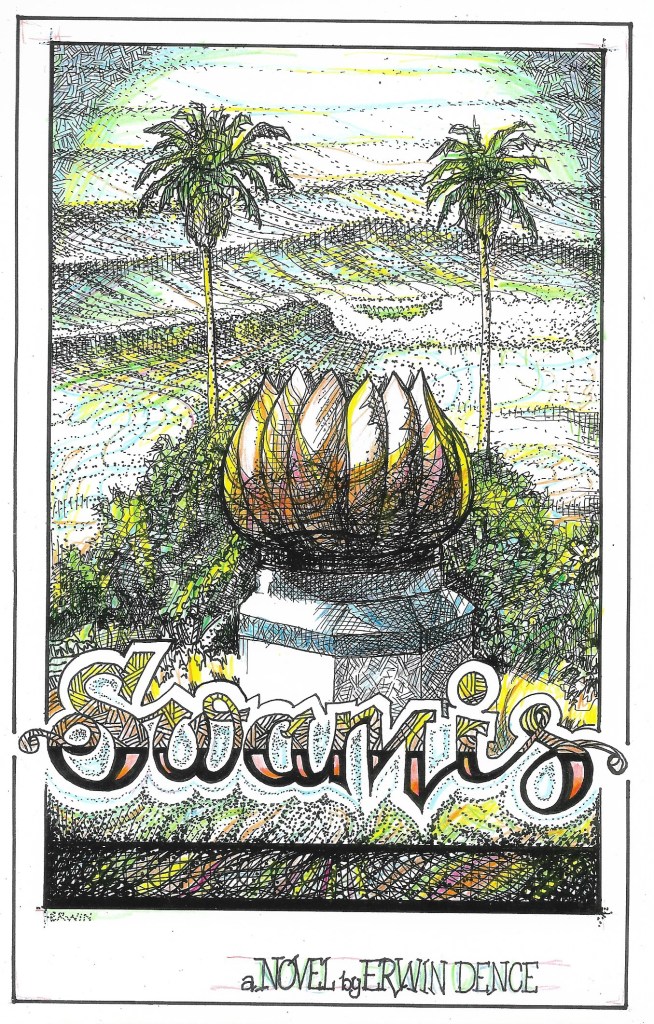
SO, the first image is a possible ORIGINAL ERWIN t shirt design, totally redrawn after my first attempt. Because I draw these in reverse (white and black), I don’t really know how they will look until I go to the PRINTERY in Port Townsend. First one, guy’s arm too long, I didn’t like the lettering. This one… yeah, lettering doesn’t stand out enough. Maybe I’ll… yeah, probably a redraw coming up.
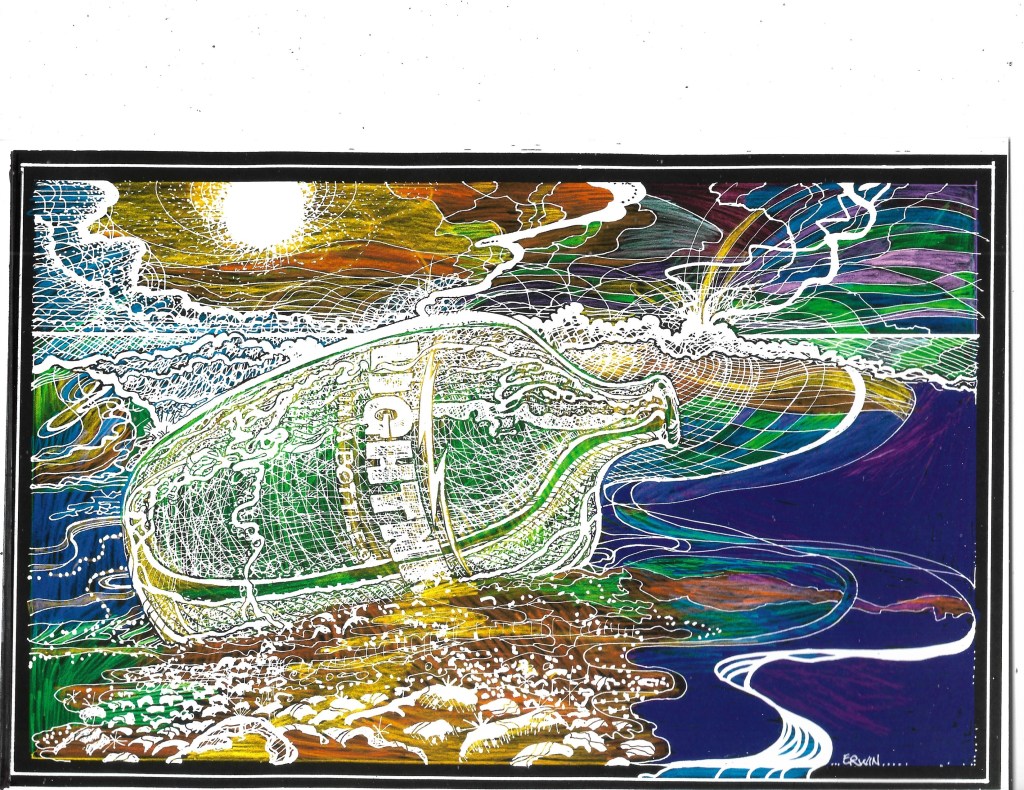
THE BOTTLE. On the top one, I colored in the white lines on the reverse image of the original white and black illustration. Second one, water-color on the original and then reversed. Third one, to show the difference; I used colored pencils on the original. I am quite excited about the process of reversing the color spectrum, but I think I went to yellow on a night sky because I figured out how to get it. Purple, darker the better.
THERE ARE, as always things I like about each of the attempts. Attempts. More to follow.
MEANWHILE, in preparation for the upcoming SURF CULURE ON THE STRAIT OF JUAN DE FUCA AND THE SALISH SEA EVENT, I am trying to get a collection of (the best of) my years of art stuff together and scanned, the hoped-for result a sort of powerpoint thing that can be displayed on one of two screens in the PORT TOWNSEND PUBLIC LIBRARY, 6pm, Friday, June 30.
At least seven other Olympic Peninsula surfer/artists will be displaying their work. I am planning on reciting at least two surf-related poems (actually songs, but I will try not to sing them). Other stuff going on, music, food, readings, are still in the getting-there phase, all under the management of surfer/librarian Keith Darrock.
MORE NEXT SUNDAY.
Remember that I do claim all rights to my work, perfect or not. THANKS, and by all means, get some waves when you can. Perfect or not.








 Real Surfers