This isn’t from the most current big wave event at SWAMIS, but, that doesn’t really matter when it’s the same deal any time the news media (and all your instagram surf-adjacent folks) hypes up an incoming swell; every wannabe hero paddling out at one of the only places one can (easily) make it out in San Diego County on those swells that come down from up here in the Pacific Northwest (just incidentally, totally missing the north shore of the Strait of Juan de Fuca); and… yes, getting out at Swamis is easy; not getting in some other hero’s way as they ride a wave they snaked someone else to get, getting more than three waves in a session, not kooking-it up and crashing on a takeoff with 89 scrappers, 19 actual rippers, and five videographers, 105 cell phone or actual cameras, and all the eyes of a bluff and stairway full of tourists and surfers who claim they got the sickest wave ever (or plan to, once they wax up and have another hit or sip… all trained on you. YOU. You.
Don’t blow it.
Damn! FELL OFF AFTER THE DROP!
YES, I have my own not-quite-a-hero stories; already shared. For years. Swamis, Windansea, Sunset Cliffs, Cardiff, Upper Trestles, La Jolla Cove; pretty much the other accessible spots on big days.
AND
But now, leeward of the swell, I just might have overdosed, self-medicating in the long nights of this amazingly warm winter (not arguing global warming while trying not to sound like I’m indulging in geezer-talk, but 50 degrees plus on any December day; not what it was when we moved up here in 1978, haven’t scraped ice in a while) by watching waves and wave riding on YouTube: Some amazing rides among so much disappointingly bad surfing, almost all of the scare-factor coming from the crowds rather than the waves.
Raw footage? No. Please edit the shit out of whatever you put out there.
I do have a few ISSUES, other than the oversold clickbait headlines/come ons, “20-25 foot Blacks,” for example. I only sometimes appreciate the ‘here I am getting a parking spot, here I am putting on my full wetsuit, booties, gloves, hood, floatation vest, compass.” behind or near the camera commentary, having heard enough “Sick,” “Rad,” “Oh no!” “Come out!” “Kook burned the other kook!” “Look at that one!” “Shit; broke his board and didn’t even make it out!” “Can we get pizza, Daddy!” Yeah, I’m looking, but I frequently fast forward and I almost always turn down the volume on the background music/rap.
HERE IS A QUESTION I felt compelled to text-ask of Trisha’s (and, by marriage, my) nephew, DYLAN SCOTT: Okay, two questions: Are you getting any of those waves? Why the hell are surfers wearing so much gear when the water temperature (I checked) at La Jolla Shores (where he lives) is 62.6 degrees. “WHY, back in my day, water got to 58, you put on your short john and…” Dylan did text back a ‘YES,’ and that it is a bit of overdressing, though he has become fond of booties.
ME, TOO; ever since that time at SEASIDE (not the one in Solana Beach, though I have surfed there) when I got bullheads in my feet walking up toward the… the cove. Wheww, almost said too much.
All this SCREEN SURFING may have affected my dreams. YES. So, last night I had this dream… you know how wave height is often compared to multi story buildings? It’s never, “Whoa, the wave was as big as a rambler in a tract out in the valley!” So, someone is giving this woman on a board close to shore shit for getting in the way. I go out (imagine, IF YOU WILL, Nate Florence or JOB with a POV sequence).
WHEN I GET TO THE LINEUP, there’s this multi-story building (imagine the train station at the entrance to Disneyland- I may have been) that is, evidently, a wave. I turn, I paddle; I’m at the peak, ready to drop in from the turret/tower. AND, looking down from something that magically turns back into the biggest wave my mind/memory can muster, I… CHOKE.
THE GOOD NEWS IS no one caught it on camera. It won’t even be one of those shorts that pop up- 29 seconds of dude who shouldn’t have been out considering the multi-story conditions.
THAT’S MY STORY. Hopefully, in the coming year, you’ll have moments and sessions worth remembering; and, sure, hopefully you have many from this year.
I do hate to mention how close I am to totally finishing the manuscript for “SWAMIS.” I am culturally bound not to say too much about when and where I have surfed recently, or where and when I plan to attempt to find waves next. So, I won’t.
Oh, and HAPPY NEW YEAR to all the real surfers! Yes, I am including kooks and posers and hodads and, of course, geezers. I do plan on posting some new click-worthy stuff on Wednesday. Thanks for reading.
It’s almost a joke between my daughter, DRUCILLA (Dru), and me, that, any time there’s a moon on a movie or advertisement, it is always a full moon.
THE MOON, of course, isn’t a joke. There’s the tides affected by its gravitational pull; important to a surfer, and there is the LUNACY (Moonacy in English, perhaps) caused by the LUNA BELLA, the beautiful moon. And werewolves, of course.
There are ancient PAGAN RITUALS playing homage to the sphere, and, of course non-pagan references such as God giving us “The moon and stars to rule by night…” King James Version, Psalm 136:9.
SPEAKING of pagan-stuff, someone taught TRISH a most-certainly (or not) pagan ritual in which one holds out an open purse or wallet to the full moon and chants (maybe it’s just ‘says’ if it isn’t, like, repeated), “Oh moon, moon, beautiful moon… fill ‘er up, fill ‘er up, fill ‘er up.”
Now, the use of “filling ‘er up” kind of suggests a bit of loosening or democratization or cheapening of some sort of rule- doesn’t bother me one bit.
The followup, with the proper move probably being closing one’s wallet or purse, is to say, “Thank you, thank you, thank you.” Three times; kind of a chant.
THE THING WITH RITUALS of any sort is that, if you connect things that went right for you since the last full moon to the practice, it is almost frightening to miss an opportunity.
THIS PHOTO, the full moon rising over Mount Baker, is quite similar to what I witnessed late (like 4:20- no snide allusion intended) yesterday, though, season and location (I was probably farther out on the Strait, the moon was on the other shoulder of the mountain) were most likely different. And, before the moon got lost in the clouds, with an almost visible trail of light under it, the rising was spectacular.
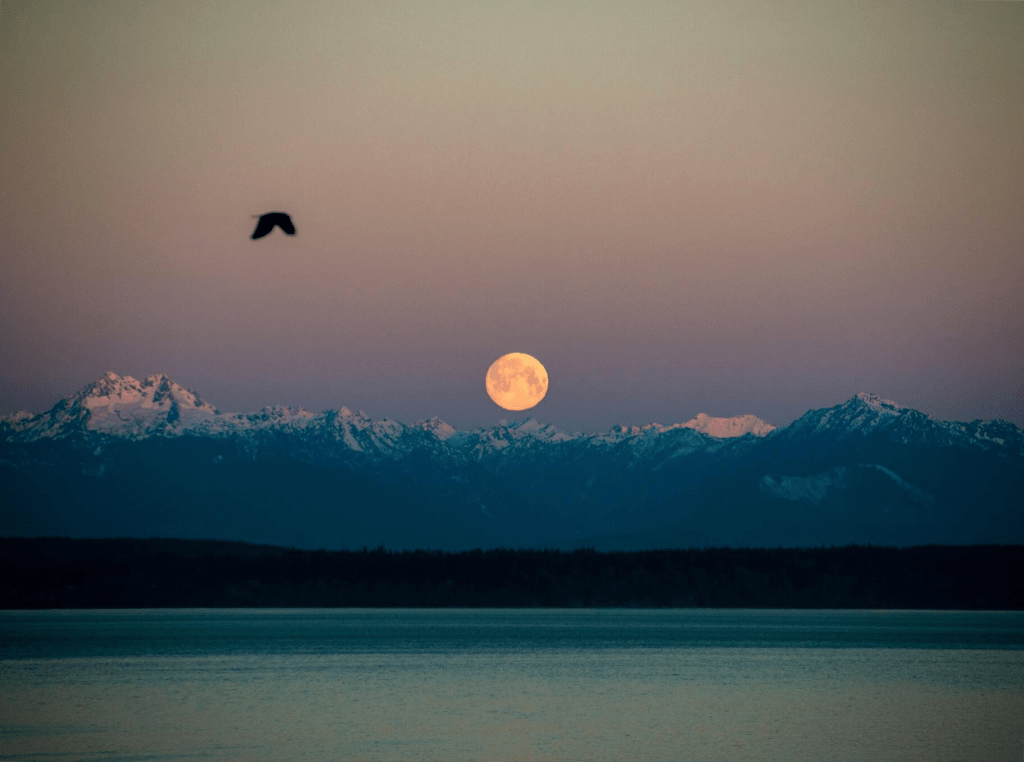
THIS PHOTO, most likely taken from Kitsap County, has the moon setting over the Olympics. I live, probably, on the far right side of the image, between the dark line of the Coyle Peninsula and the ragged edge of the mountains, SURF ROUTE 101 and my place following the bluffs along the Hood Canal, and, heading north, along the beds of ancient fjords, around a couple of bays and… out, north and northwest.
On a recent surf attempt/trip, after witnessing the full moon rising in a clear cold sky the night before, I felt entirely privileged to see the moon in the high trees as I loaded up pre-dawn, and some sightings of the orb as I headed out. I lost it up by the Casino. Damn the luck!
IF YOU ARE A REAL SURFER, you have, I would tend to believe, a certain reverence for and appreciation of the beauty we witness: Sun, clouds, waves from glassy to blown out; but, if you’re a non-surfer, witnessing just how rattled and jazzed and stoked and electrified and excited a surfer can get about even the possibility of decent waves… well, yes, those surfers must be and are, indeed, LUNATICS.
IF YOU MISSED the opportunity last night, I think it’s acceptable to do the little chant tonight also. I have been known to take the full moon time period as it is in the Werewolf canon; three days. Yeah, it is kind of like hedging your bet. THANK YOU, thank you, thank you!
I may actually have some time to finish the manuscript for “Swamis.” I was hoping to have the many-ist edit done by Christmas (last Christmas, the one before that); so, maybe, by New Years. I’ll let you know. Meanwhile, good luck; I’ll be posting on SUNDAY. Oh, and “GO HAWKS!”
…and really, not that much else. I hope everyone is getting some miracle waves, and… yeah, that’s about it. With all the shoreline around the world, a great wave is still a gift. Share a few. Surfers should have a bond built through sharing the experience of actually learning how to deal with a force as powerful and tricky as the ocean. Throw in crowds and rocks and tides and winds, all the variables, and.. yes, there should be a certain es-prit’ de surf… and sometimes it is lacking.
The difference between having a magical session and a go-out where frustration with other surfers, or lack of waves, or one’s own performance leads to anger, is so often, attitude. The mental game is as integral as wave knowledge. I have forgotten to have fun too many times.
My worst surf session, was, by any measure… valuable; in retrospect, great.
We made it past the dark solstice. Waves are in the forecast. Somewhere surfers will be enjoying the magic.
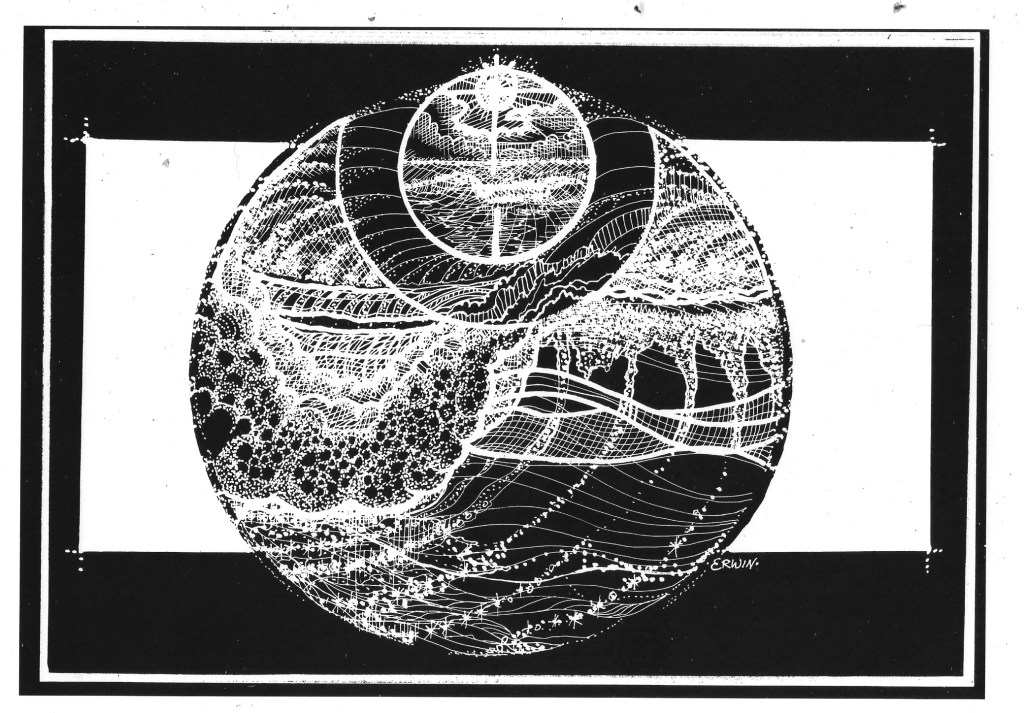
OH, about the ILLUSTRATION: I got this scanned at COHO PRINTING in Port Townsend. RANDY is so, so concerned about making the print better than the original. I totally appreciate it. I have done a color version, maybe a bit to psychedelic; but, since I have it on a thumb drive, I can have more opportunities to get it… better… not perfect… but…
…I do try to keep to some sort of schedule. I have been trying to have potential and actual readers ready for new posts on Sundays and Wednesdays, it’s just that… no, no excuses.
There is an old saying: “Never complain, never explain.” Since I constantly do the first, I should be willing to do the other. I’ve been trying to make up for the time (and money) lost during my recent power surge/outage. I’m still working on figuring out… things.
I did work on my manuscript for “SWAMIS” during my down time, the generator churning outside; picturing the starving artist alone in some freezing Paris garret, desperately trying to make those subtle adjustments that will bring… heat, light, shit like that.
So, power back on, off to do the work that actually pays the bills. Out of town job. While waiting for a submarine (maybe, couldn’t see) to go through the Hood Canal Bridge (forty minute delay in this case), I actually made a list of what changes I need to make to my novel in order for it to make sense, story wise.
BUT, FIRST, because I’m changing the ending a bit, and I’m never quite sure if I might make more changes mid chapter (of course I will), I must write the last seven pages. THEN go back.
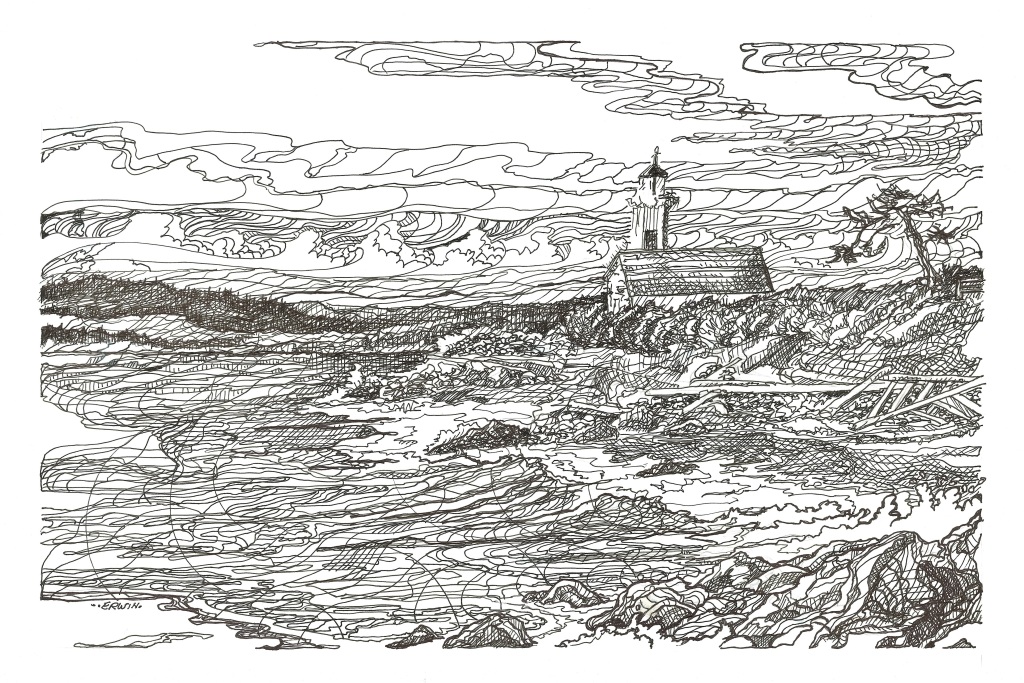
I also have been working on some drawings. I will put one of several possible ORIGINAL ERWIN t shirt designs, and a sort of redo of a little cove/point, with some added, never-happen-in-real-life waves:
Please overlook or forgive my lack of scanning skills. “I’m here to surf” is pretty much my motto. I do have some other designs. If I am going to inv.est in making another run of ORIGINAL ERWIN shirts (and, if you own one… it’s a VERY LIMITED item), I want them to be as good as the ones I’ve already done.
I do plan on going to a print shop this afternoon, and, if I don’t post anything else, I will put up some new illustrations.
MEANWHILE, I’m putting out local surf-related gossip, spreading rumors, trying to verify other things I’ve heard, lots of surfers coming over to the Peninsula and getting skunked is a common one. Very common.
OH, AND I’m also working on a possible shirt design for Washington State’s WEST END. It seems like, out on the rugged coast (and, for some reason, locals don’t seem to include fan favorites HOBUCK and WESTPORT) are not all that enthusiastic about folks cruising in from, you know, non-west. I’m not really involved in this- Yes, I did once try to surf Ruby Beach (so many logs, so many rocks), and yes, I did have a logger/surfer, years ago (late 80s), when I was out at Kalaloch, three children with me, trying to find some gems I could surf as practice for the RICKY YOUNG WESTPORT LONGBOARD CONTEST; tell me where I could find an accessible almost-point break; but, other than a few trips to the cove of vampires, I try to contain myself to the north(er) zone.
SO, self-promoting a bit, do check in on realsurfers.net occasionally, like, just to make sure, hit on it on THURSDAY.
Ikeep telling myself I need, NEED to take more photos. And then I don’t. I don’t have any photos of the four young dudes from JEFFERSON COUNTY PUD who showed up in two big rigs to check out my power pole, their interest extending to the wire and components on their side of the power pole halfway (about 200 feet) down my driveway.
“Four guys?” “Sometime we have eight.”
SO, this was Monday, and the power flash happened very early last Wednesday. SO, that many days of running on a generator. Unsustainable. Way too much noise, inconvenience, MONEY, too many trips to the QUILCENE VILLAGE STORE (luckily only about a mile away) to fill gas cans at, fortunately, better per gallon prices (10 cent discount per gallon for cash) than elsewhere in the vicinity (Chimacum the next closest fuel). BUT, I have learned to pour the gas with minimal splash/waste.
I MUST give thanks to RON REED, an electrical contractor I recently did some work for. He called me back after a novel-length text, agreed that calling the PUD should be my next step. “Then we’ll see. It could just be a loose wire on their end.” “But, I mean, does that… happen?” “More often than you might think.” “Okay.” I had, at this point, already called them, left a message. It was about ten minutes after talking to Ron that a woman, formerly of Quilcene, called me back. “Do they have my phone number?” “I put it in the notes.” “Thanks.”
Just to be helpful, I went down, cleared some blackberry vines away from the area around the pole, and, having told others, including Trish, including myself that I wouldn’t, I looked into the electric box below the meter head. It seemed pretty normal. There were two big ass fuses. Hmmm. Since I had to get more gas and check the mail, I cruised into the local, independant HENERY’S HARDWARE. I talked to LEONARD. “No, don’t have any.” “Shit.” When I pulled up to the end of the driveway, talking to TRISH on the phone (luckily, still hanging at DRU’S place), telling her that, because we, at her urging, had paid a little extra to the IRS, we had received an official letter that, paraphrased, said, “Let’s call it even.” This was amusing, more to me.
THAT’S when the PUD showed up.
This is the burned connection on the neutral line.
The connection was replaced, they checked out the fuses I couldn’t replace without getting them, and scheduling an outage. They were fine. “Go see if this did the trick.” I did. It did. Mostly. I undoubtedly have issues to sort out, but things are working. When I got back to the crew, I shook each member’s hand, said I was as close to crying as I had been in the previous five days (I didn’t- almost), and, of course, asked if any of them SURFED. None did. “Good; we have enough surfers.”
ANOTHER sort of plus: I spent some of my time, in my under-heated living room, working on getting to the end of “SWAMIS.” I have managed to keep it to just over 100,000 words (yeah, that is longer than this post) and I am down to the last seven pages. I can imagine how to make the finale better when I go to work. WORK. Yeah. And I feel grateful to have it.
AS FAR AS SURF, it’s not like I hope there is none if I can’t go, and I do try, and fail, to think about what I might be missing while I am missing it, but… consider even really big but really south swells and their relationship to the mean direction of the Strait of Juan de Fuca; it might save you a skunking. And, as always, figuring out waves, finding that moment at that spot is, like electrical issues, is, possibly, more like… magic.
A few years ago I wrote a series of stories and, yes, poems that I put together in a collection I titled, “Mistaken for Angels.” Yes, I got a copyright. Vanity. Ego. Just in case. As with everything I have written, my plan for a novel or interconnected stories lost some of the connective-ness, random ideas popping in to complicate matters.
The underlying premise was that the story is more important than the telling, the style and the proper adjectives and structure less memorable than the absolute desire each of us has to tell our story.
It’s not my story; it’s fiction; and my remembering this story caused me to search through multiple thumb drives. The current portion of ancient struggles caused me to remember that I had written it; not about a particular place or time, but of many places and many times.
Tragedy begets tragedy.
I was raised to be a pacifist; yet, turning the channel, turning away, I do nothing. Nothing except, perhaps, to try to calm if not control my own confusion, my own outrage, my own anger.
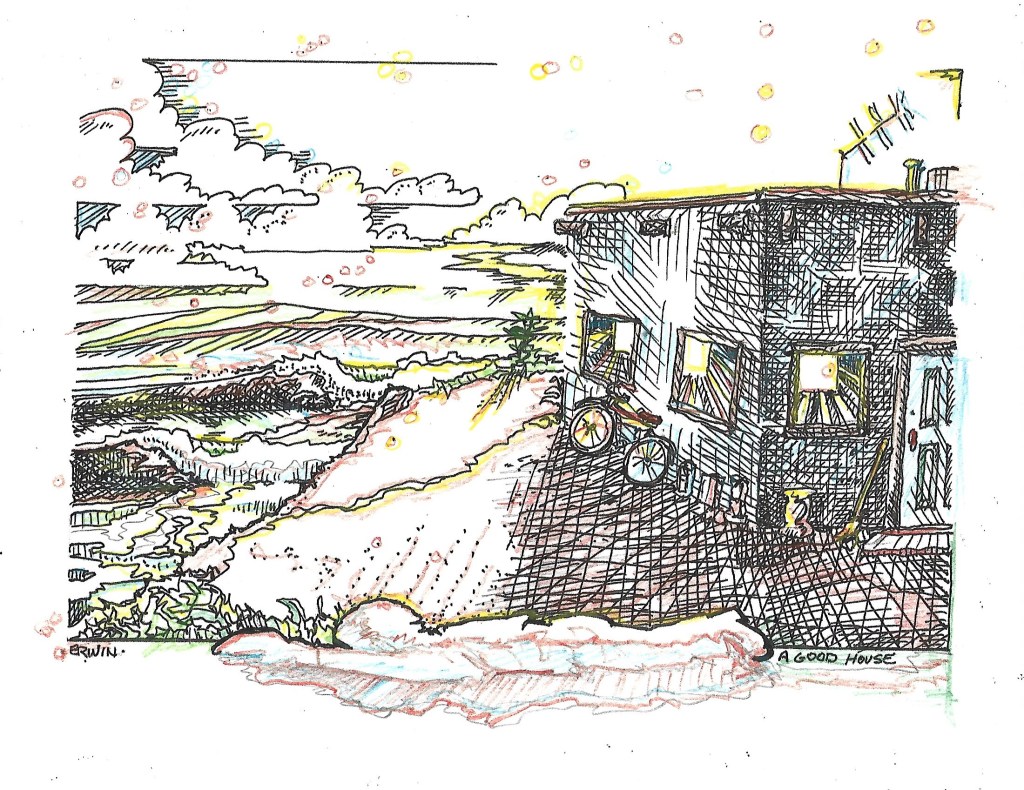
OH, since the location could be anywhere, on this (new) illustration (sketch if you must), I put in some waves in the background, making, possibly, A GOOD HOUSE that much better.
A Good House
We had a good house. This, you see, was the problem. It was, also, too close to the border. Some, those who think themselves brave, who think others will follow them, they call the disputed land on which the good house sits the ‘frontier.’ I call it ‘bloodlands.’ There has always been trouble. Wars go this way, then back; like waves on a lake.
My Father, he went to war- one of the wars- he pushed forward very bravely (so we were told), but came back very broken. The next wave took him for good.
Wave. Yes. Like a wave. We all knew he was already drowned. He was waiting for the next wave to wash his body away from… This is difficult to explain. “No faith left” he would say, staring toward the horizon.
My Mother, she had faith, and, with it, that certainty… I have heard it called fatalism. Ah, fancy term, that. It’s that knowledge that the darkness comes to each of us, to all of us. Fate and faith, they are, I think, related. “To have faith,” my Mother told us, my Sister and me, after our Brothers went, or were taken, made to fight, “you must have faith.”
This means, I think, that you must believe that having the faith sometimes works. Sometimes what we have the faith in, that things will be all right, can happen. I don’t know if I do believe this. My Mother did. Truly.
The snipers had done damage to the troops from our country. That is why they, our Soldiers, took to the houses. “Like a jar of water,” one of them told my Grandfather, who was weak and old, and had survived, he said, by never flying anyone’s flag, never taking a side. The Soldier held my Grandfather’s head against the rocks of the fireplace. He tapped it with a branch meant for the fire. He, the Soldier, explained this thing to my Mother, who, because she refused to cower as her Mother was, obviously was in charge.
He threw his hands apart to describe how a sniper’s bullet reacted with a soldier’s skull. “pheuuuuuuuh!” Then he laughed and let my Grandfather go.
“Okay,” he said, “your land; you don’t care what country it’s in. Fine.”
There was blood on this Soldier’s uniform. It (blood) dries almost black on the green. He smelled of gunpowder and body odor and death. They all carried sometimes multiple guns, and each had what you might call a machete. They called them something that would be more like ‘sword,’ and attributed a certain righteousness to its use. The Soldiers burned the blood from the blades in our fire, ate our food, complained about my Sister’s crying, and waited.
Soldiers, I now know, spend much time waiting. This is where their brains tell them many stories of why they should be afraid. They tell each other that they are not afraid, should not be afraid, they are and must be men. Yet, I could see these Soldiers had fear. Fear, someone else’s, looks like anger. I could feel my own fear. Like the Soldiers, I would hide it. I made my fear look like calmness. I could see everyone’s fear. Except my mother’s. She had the faith. I wanted to have the faith. I was ashamed to have, instead, the fear.
Fear is like a prayer, I think; or, maybe like a heavy, dark blanket, wrapped like a cloak, ready to be cast off, cast off quickly, when it is bravery that is needed.
Bravery, I’m afraid, is the ability to disregard what is known to be right. Bravery is a vicious thing. I no longer wish to be brave.
For some, it is better to be dead than brave.
Sorry. I must laugh a bit. The brave and cowardly are often thrown into the same grave.
“This is a very nice house,” another of the Soldiers said. He stood close to the window, lit a cigarette. “I think,” he said, “after the war, when we are free, I will take this house.” It was then the sniper’s bullet hit his neck. Both sides at once, it seemed. He was still smiling his dirty smile when his head snapped back. He rocked only a bit, and fell, crumpled, beside me where I sat. The cigarette was still in his mouth.
The first Soldier, and the others, ran outside, then away, leaving the dead one, blood splattered on our walls, making pools on our floor. We could hear guns going off, closer, then farther away. We thought, we hoped we were safe.
Briefly, we were.
These were the, it gets confusing; you might call them counter-insurgents. At dawn the insurgents came closer. Same smell, same uniforms (I thought at the time), different caps. They laughed when they saw how poor we were at trying to drag the body out. They kicked at it, shot it several more times, took things from it, threw it onto a truck with other bodies, some not in uniforms.
You can tell when the soul is gone, when a person becomes a body. Less. Almost nothing.
I don’t know where a soul goes. Somewhere better. I have seen those whose souls are gone, their bodies still…walking, eyes too wide open, too squinted down.
We would have been all right if the war had not slowed, the fighting ‘bogged-down’ in the hills; if the troops of our country had not fought so fiercely; if we had not had such a good house.
We had new guests not of our country. They thought themselves of a better country; bigger, older. This was not actually true, the bigger part, except for this short while. How small and pitiful our country must be, they said, to be so easily conquered.
I have no patience to explain why things went wrong. My Sister cried too much. It became night. Perhaps it was the darkness, the length of the nights. One of the soldiers said his grandfather might have worked on the masonry on our house, back when our country was still grand.
“If so,” my Grandfather said, “I would have paid him well. I always paid the workers well. They ate at our table.”
The mason’s Grandson looked at our table, smiled, but not nicely. Another Soldier, suddenly angry, perhaps because of how his Grandfather was treated, because of where his Grandfather took his meals, grabbed my Grandfather and pulled him outside. My Mother knew what this meant, and begged for her Father’s life. The Soldier slapped her for begging. Because she stood at the door and screamed “Butchers, murderers,” my grandmother was also pulled into the darkness. My Sister, holding onto our mother, kept crying. My Mother did not.
This is the fatalism of which I spoke, the belief that all will be tested.
And most fail.
I also did not cry. This is the faith, faith I had because my Mother had faith. The mason’s Grandson pulled my Sister away, shoved her toward me, told me, in my own language (they are really only slightly different) to keep her quiet. He moved his face close to my Mother’s, touched her breast. He said, Whores beg. Are you, then, a whore?” This was to humiliate her further.
I have learned this from war: To kill is not enough for some. To only, to merely kill is not enough to make the anger and the fear and the hatred cease.
“If I must be,” she said.
At this he laughed. “I am also the whore,” he said.
“My Children,” my Mother said to him. It was like a question. He, and the other Soldiers, now back from outside and leaning against our walls, shrugged and laughed together. The mason’s Grandson took his pistol belt off, holding the pistol in his left hand, moving it close to my Mother’s cheek.
“God will send a miracle,” she said to me. “Turn away,” she said.
I almost cried out at this moment. My Sister did. I put my hand over her mouth and prayed that I could have a man’s strength.
Prayers. Excuse me for laughing; just a little. Prayers are not answered as we expect.
It’s rare, I have learned, that a first mortar round can hit precisely. This one did, precisely where it was intended to land, and when I asked for it. The Soldier’s Grandfather had not been a roofer. No, not at all. Ha!
Like a jar of water, burst.
I kicked at his body when it was over, when the others ran, when more mortars rained down on the houses on the frontier.
Of prayer, I should add, speaking of the partial nature of the realization of prayer; my Mother did not survive this…this…I don’t know what they call this. It’s a tide, a tide, and we are the shore. I carved our Family’s name onto the mantel, underneath, to mark a claim when I return. I took the Soldier’s machete. After I’d chopped him with it; splattered his blood with it, I burned his blood from the blade in the fire.
By the time the Peacekeepers came, the roof was already patched, by my Grandfather and me. We also buried my Mother, dragged the soldiers’ bodies away from the house. My Grandparents would not leave. This was their home. That they were not soldiers was honored. That time. My Sister became one of the many refugees. Refuge means safety, of course. I prayed she would be safe. Yes. I told myself she was safe and fed and happy. That was my hope. Perhaps it is partially true. I became, as you know, a Soldier, a brave one, they say. I am still a Soldier; I wait, but I do not fear. I no longer even hate. I know what bravery is.
Oh, I see you don’t believe there could have been two miracles, two dead Soldiers in one house. Well, perhaps I lie. The results would be the same; the dried blood as black. Prayers answered.
When I was captured that first time, taken like a fool during one of the many truces, they called me John Doe number four hundred and thirty-four. I was, I now guess, eleven years old.
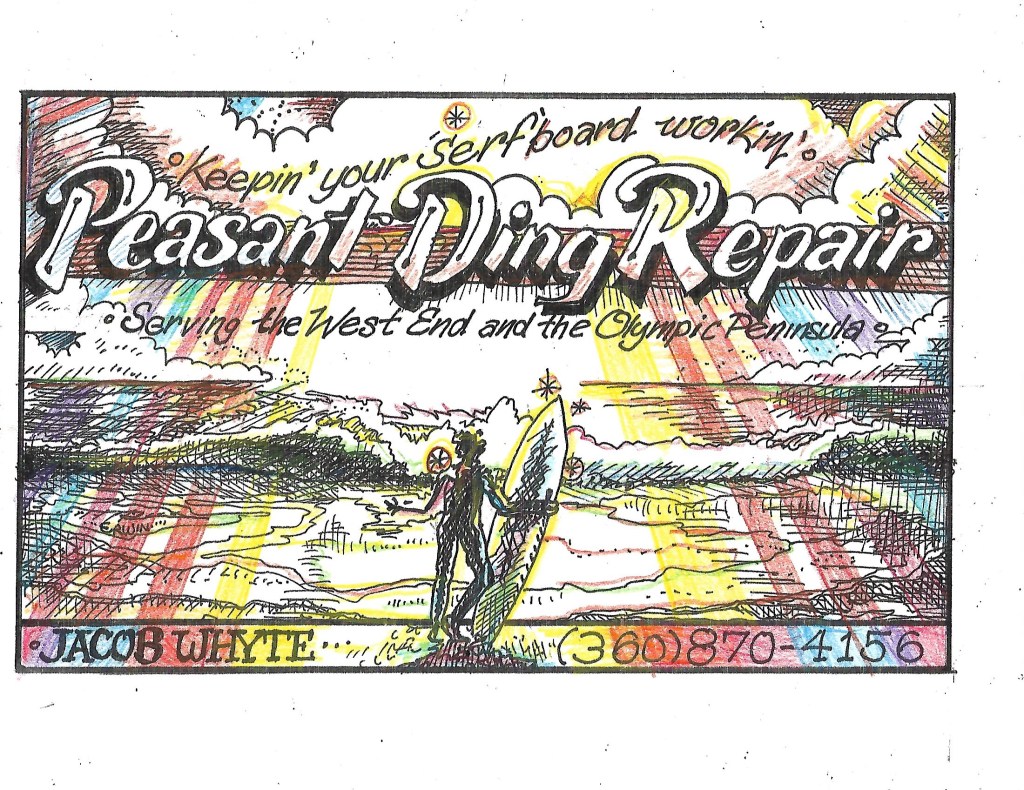
SO, JACOB WHYTE is the son of a cousin of JIM HAMILTON, a very interesting individual (timber-frame house builder/ski patrol/world traveler/more) who lives off Center (Road) and close to SURF ROUTE 101 in Quilcene. Jacob also has an interesting story. He has returned to Forks, Washington after an extended stay in California, Ventura area, during which he worked doing ding repair, most notably (to name droppers) for Channel Islands Surfboards, living frugally (growing his own food, that kind of thing), always, he says, planning to move back home to Washington State’s WEST END.
Now, the PEASANT thing: Jim, in asking (more like hiring/bribing) me to do some artsy stuff for Jacob, pondered the name. “Oh,” I must have said, “Maybe it’s like, you know, peasants, serfs, vassals, that kind of thing; I mean, like an allusion to… that.” “That would be… yeah, maybe that’s it.”
“It isn’t,” Jacob said when I actually got in phone contact, he at a far northwest secret surf location, me in the depths of a housing tract in East Bremerton. Didn’t matter, so much, I’d already done a drawing, black and white, printed a copy and colored it, either suitable as a flyer, or, reduced in size, a too-busy business card. “Yeah, Erwin, maybe the ‘serfboard’ thing is expecting too much of… surfers.” “Okay, how about the ‘serving the West End and the Olympic Peninsula’ part?” “Yeah. Sure.”
I ran a couple of other ideas past Jacob. Mostly about t-shirts; what would be appropriate, assuming surfers on the West End are not necessarily trying to invite more surfers over. I have ideas. LATER. It’s not like I can’t keep a secret.
IN MY CONTINUED attempts to produce a decent drawing of the fictional JULIA COLE, or, actually, a portrait of any woman, I came up with this. Attempts and failures. I should throw away the versions that got me to this one, possibly more useful to depict Julia’s mother, and stick this in some file with the other failed illustrations. BUT, wait, maybe if I just… Yeah, I have some ideas. ALWAYS. And I always want to get… better.
CHAPTER FOURTEEN- MONDAY, MARCH 31, 1969- PART FOUR
The two carpenters were carefully walking between the Karmann Ghia and the edge of the bank. Lee Anne turned toward them. “Joey, this is Monty, lead carpenter on the project.” Monty was sunburned, with a receding hairline and an almost orange Fu Manchu mustache. Early thirties.
Monty stepped in front of Lee Anne’s car, put a hand on the other man’s shoulder. Black, muscular, no older than eighteen or nineteen. “And this is…”
“Not a carpenter. Yet. Helper. Nickname… Digger.” Monty had only left room for his helper to stand on the very edge of the bank.
Lee Anne looked at Digger, shook her head, looked at Monty, and back at Digger. “No. Unacceptable. You have to… insist… on a different nickname.”
“Temporary,” Digger said. “Thought I’d be something like ‘Hammer.’ Nope. Got to earn your nickname ‘round here.” Digger slapped at a pair of gloves folded over his belt. He held out his hands, palms toward me, rubbed two fingers of his left hand across the palm of his right. He slapped his hands together. “Could’a been callin’ me ‘Blisters.’”
Lee Anne extended her right hand but didn’t accept Digger’s. “Blisters,” she said. “Not good, but… better.”
Monty gave Lee Anne a sideways nod and said, “Blisters, then.”
The younger carpenter had been rather boldly checking Lee Anne Ransom out. She looked him off with a quick widening of her eyes and a very stern expression. “Real name, please, for the record.”
Blisters backed up, put his hands out and up, his arms closer to his body. If he was impressed with Lee Anne’s response, he wasn’t apologizing. “Greg,” he said. “Or Gregory.”
“Gregory, then.” She turned back to Monty. “Or Greg?”
“Greg, then,” Monty said. He pointed to the parking lot. “We heard the cop car, didn’t see it ‘til it tried to turn in. It wasn’t the brakes. It was… the gravel. New, like b-bs; no way he wasn’t gonna slide.” He turned toward me before he added, “No way.”
…
The San Luis Rey Riverbed was probably half a mile wide. I had never seen the water more than a stream, a creek, even. The ground Monty and Gregory and Lee Anne and I were standing on was gravel and round river rock, with the usual scrub, some still green but rapidly fading grasses and weeds, and a few stunted trees. Taller trees in the center of the valley were mostly dead. Ghosts. Killed in the cycles of flood and drought. More likely flood. Drowned.
Monty pointed to the stump in the river bottom, probably fifty feet from the base of the fill. “The concrete had been poured. The leftover rebar should’ve been fuckin’ gone.” Though no one asked, he added. “Contractors. Separate. Not our job.”
Lee Anne said, “Separate. Not your job.” She attached a telephoto lens to her camera, aimed it at the road on the east side of the valley, focused it, snapped a photo, and handed the camera to me. “So, after your dad’s accident; the traffic was rerouted… over there. Correct?”
The lens was out of focus for my eyes. I twisted the ring at the base of the lens as Lee Anne had. “Correct.” I turned the camera past the carpenters and toward the journalist. Distorted. Out of focus. I snapped a photo. “Accident.”
Lee Anne took the camera and advanced the film.
…
Gregory and Monty and Lee Anne and I were standing next to the concrete box. There was a galvanized pipe in, another, perpendicular, out. Gregory, now gloved, had a shovel, upright, in his left hand. “You see, all the rebar got pushed out the way by the car… except for one piece. Jammed against the… stump.” He looked at me. “You get me?” I nodded. “They cut it. The… stump. Little later. Fire department.” I nodded. “Like a bullet, it was. Through the door and right through the guy. I seen him, right after. He was alive and all, like he was trying to pull the rebar out. No fuckin’ way.”
“My father… the guy.”
“Yeah.” The shovel handle fell against Gregory as he moved his hands into a prayer position and raised them to his eyes. “Sorry, man. No disrespect.”
Monty stepped between his helper and the stump. “We were trying to get it loose. No way. I’m smacking the stump with a framing hammer, trying to get the rebar loose. Or, even, pull it through the stump. Something.”
“Then this other cop; tall guy, he showed up, slides down the bank, lights up a cigarette. He was laughing, says, ‘Shit, Gunny, your car’s still on its wheels.’”
Monty turned to me. “Wendall. He stops laughing when he comes around, sees the rebar and the… blood. Not that much. Me and… Wendall, second later; we’re at the door. Your dad says, ‘Larry; could you tell Ruth…’ That’s all I got, ‘cause just then this Japanese lady, your mom, she shows up in…” Monty pointed to the Falcon before moving his finger toward the incline from the parking lot. “She slips as she comes off of the grade.”
“I ran over, helped her up.”
“You did, Digger; yes. Greg. Me and Wendall, Greg, too; we tried to keep her back, but she pushes between us, gets in the car on the passenger side. She seemed pretty… calm. Wendall wasn’t. Your dad says, ‘it’s fine, Larry.’ Wendall grabs the shovel.” Monty grabbed the shovel from Greg, thrusting it downward, hard, several times, into the stump until it stuck.
Monty was gasping for breath. “By this time, there’s so many cars, people, up, up on the highway. More sirens. I look in the car. The siren was off, but the light… it had popped off the roof, wire and all. It was still spinning; the engine was still… running. The, uh, your dad, he looks over at me, like maybe he knows me. He don’t.” Monty was breathing in gulps. “He looks at your mom. He says, ‘I always believed I rescued you.’ She reaches over, turns off the, the key, twists around, puts her arm, the same arm… around… him. And your mom kisses him, and she’s got blood… on her.”
Monty caught his breath. Most of it. “Then he, Wendall; he pulls me away from the window, pushes me back. He has this look in his eyes; it’s like he’s shaking his head, but he’s not. It’s just his eyes saying, you know, that it was over.”
The stump, somewhere around fourteen inches in diameter, had been cleanly cut with a chain saw. The part that had been removed was only a few feet away, visible in the heavy-bladed grass in a patch of green that surrounded the concrete box.
I looked at the slide marks and the crushed plants, the track we had come down. I imagined my mother coming down the bank, slipping, having to be helped back up. I imagined her in my father’s patrol car, reaching over, turning the key. I extended my right arm, moved it up until my hand was pointing up and at the highway. I moved my arm to the left, to where my father’s car slipped, sideways, on the new gravel. My flat hand represented the car as it slid, still sideways, to the bottom of the grade, plowing into the ancient river bottom, hitting the pile of rebar, one piece jammed into the stump, penetrating the door and my father like a bullet. I looked into the sun hanging just above the parking lot. I cupped my right hand, moved it, and then the left, above my eyes.
The shadow, the darkness, lasted but a moment. Another blinding light, and the spinning red light, and a vision of my father’s face as I passed him took over. Everything else was gone.
…
I was in shadow when the vision faded. I was on my knees. Gregory was directly in front of me. Monty was gone. I looked up toward the highway. Lee Anne Ransom, still in the light, had her camera aimed at Gregory and me. She waved. Gregory waved back as the reporter got into the Karmann Ghia and pulled away.
Gregory offered his ungloved right hand. I took it with both of mine. “Blisters,” I said as I stood up. “They turn into… callouses.”
“Not soon enough.”
“Gregory. How long?”
“How long you out for? Hmmm. ‘Bout a minute, I’d guess.”
I tried to remember what I had seen, or what I had imagined. Nothing. I remembered nothing. Not at that time. “Was I… shaking. I mean…”
“No, man; it was… weird; you were… it was like you was really… still. Like… church.”
“Did I… say anything?”
Gregory shook his head. I looked at him long enough that the motion turned into a nod. “You said ‘sorry’ a couple a times. Pretty much it. Hey, you good to… drive? I live in Oceanside, but I could…”
I followed Gregory to the corner between the parking lot’s fill and the established fill along the highway. Half-way up, he asked, “Who is… is there a… Julie?” My left foot slipped on the gravel. I caught my balance and continued up to the highway.
THANKS FOR READING. “Swamis” is copyrighted material, All changes are also protected. All rights are reserved for the author, Erwin A. Dence, Jr. THANKS for respecting that.
GOOD LUCK in finding the spot, the time, the right wave. More non-Swamis stuff on Sunday.
Permission to use this photo, here, was given to me by a client, Lana. It is pretty much the (or a) view one might get traveling to or from the Olympic Peninsula to or from Whidbey Island. I liked the shimmer on the ruffled water, the too-deep-to-be-real sky color, and the gauzy clouds aimed toward distant, partially shrouded mountains. AH, THE JOURNEY.
If you are someone who occasionally makes this journey, you can probably identify where this is.
What I get to see is, hopefully, a dark road, one traffic light, more road, more traffic lights, school zones, curvy roads, maybe that one forty mile per hour town, curves,, log trucks, the possibility of waves.
OR, big ass and blinding sun just over the horizon, lighting up every highway sign in front of me, and I’m trying to outrun the glaring sun on a stretch that is basically in line with it.
OR, the sun hitting clouds and that ragged ridge lines of the Easternmost Olympics, and I’m trying to race it to the corner. At one point, a twisting S curve, dropping, easing into the uphill recurve, there is a perfectly framed image, trees on both sides, and a mountain impossibly high (this is one of my favorite descriptions, used because it is true).
OR, MAYBE, thinking of going to Westport or down toward Chinook, where my father lived, the journey could be broken into its parts: Hood Canal, McClary cutoff, watching the power plant stacks go from distant to even to behind, and then the roads, the speed trap town, the lack of reception, and/or, bays and bays and curves, and, as always, THE ANTICIPATION.
BEAUTIFUL.
STILL, any beauty along the way is tangential; nice, but. I go surfing to surf, and though I will surf anything I can catch, getting skunked is disappointing. OH, I should throw in traveling with someone else. Not something I do often; my tendency to get caught in the Sequim vortex too well known, my tendency to avoid long, steep hikes better known, but conversation does shorten the trip, even if you’re the one of three in the back seat. There is a social aspect to surfing, and conversations on the beach are often the highlight of a trip. Again, not as great as great waves.
CHIMACUM TIM let me know, recently, that he went to every spot he knew, paddled out at one as far as he was willing to go on this day, and caught it good “For about forty minutes. How’d you do?” I was lucky (luckier, perhaps), got forty minutes of mediocre waves (realistic analysis) five miles from where I was working. I was quite happy to get them.
OH, and, the last time I was skunked, the conditions were perfect: Tide, wind, lack of clouds, swell angle; just no waves. OTHERWISE…
Enough rationalizing. What’s important, and I’m not, hopefully, sermonizing, is, coming, going, in the water, to remember that each of us has had moments on waves that we long to repeat. The few times I forgot this and allowed myself to be over-frustrated, are regrettable. Not that many.
THANKFULLY.
LOOK FOR the next installment of “Swamis” on Wednesday. I have to admit to still making changes in chapters I have already posted. It’s all to make the manuscript tighter, more readable, hopefully, saleable. If I get to an acceptable end, I will print up some advanced copies. A pre-first edition, limited number, signed, of “Swamis” would make a great gift for the holiday season. SHIT, I better get on it1
Still morning. Still overcast. The Swamis parking lot was now filled, mostly with non-surfers. All the doors to the Falcon were open. Textbooks and notebooks, two surfboards, several towels, and several pairs of trunks were spread on the hood and roof. A partially filled burlap grain sack was positioned just behind the driver’s side back door.
I raised the back seats. With the seat up, I dropped to my knees, leaned in, started placing empty chocolate milk containers, packaging from donettes, bags from Jack-in-the-box, crumpled notebook pages and other trash into the burlap sack. I reached under the front seat. Some things were stuck in the springs. I pulled out a dirty white cotton laundry bag with a drawstring. Fairly heavy. I set it on the hump for the car’s driveline and opened it. The bag had the unmistakable shape of a pistol. There was, inside the bag, a towel with “Back Gate Bowling Alley” in red letters on yellow. Marine Corps colors.
There were also several pages of legal sized paper, folded in half. I tossed them over and onto the front seat.
An inner bag was velvet, royal blue, with a gold pull string. Inside with the pistol, was a small key attached by a wire to a slightly curved piece of metal. Stamped into the key was ‘121.’ Stamped into the metal was, “In case of emergency, break glass.” Several small metal objects dropped to the bottom of the inner bag as I placed it on the back seat cushion. I felt them. “Bullets.” I counted them. “Five. Twenty-two-caliber. Probably.”
The pistol itself was wrapped, properly, in an oil cloth. I spun the cylinder, popped it open. “Empty.” I pulled back the hammer, pushed the barrel down into the seat cushion, pulled the trigger. “Empty.”
There was movement, a silhouette in the driver’s side back window, opposite and above me. In some portion of a second, the pistol was raised and aimed at the window, my left thumb pulling back the hammer. At the very moment I recognized the silhouette in the window as Gary, I pulled the trigger.
Click.
Gary jerked backward and dropped down, nothing but light behind him.
…
For some indeterminate amount of time, I was back on the floor of my father’s patrol car, 1956. So bright. On some level, collapsed on the floor of the Falcon, I had expected an actual gun shot.
…
The sun had won out over the clouds. Gary and I were, quite casually, half-sitting on the hood of the Falcon. I had my feet on the crushed tape player. The partially filled burlap sack was on the hood behind us. The Falcon’s side doors were closed.
“You and Roger… not hanging with the horsie girls at the base stables?”
“Later. Yeah. Definitely.” Gary looked over at the SRF compound wall. “It’s way different, you know, like nothing bad happened there.”
“It looks… cleaner. New grass, plants. Paint. So, like, no, nothing… bad. Someone burned, maybe… alive.”
“Jeez, Joey.” Gary took out a cigarette from a pack of Winstons. He offered me one with a gesture. I declined with a gesture. He knew I was a Marlboro man. “Um, so, if your mom sells the… mini-Ponderosa, where would she move to?” I shook my head. “For you, here, the Swamis parking lot, it would be… perfect.”
“Oceanside makes more sense for her; closer to the base; she has friends there.” I paused. I was thinking about the revolver. “She… we haven’t been to church since the funeral, which is… fine by me. I’m thinking she might want to…”
“You’re thinking you can’t leave your mom alone. With my dad in Vietnam… I get it. And… Stanford’s a long way away. And no surf.”
“I would have gone. My father would have insisted. I’d have failed… Spectacularly.”
Roger was crossing the parking lot with a large, oil-stained piece of cardboard. “I’m taking your spot,” he said, sliding the cardboard under the back of the Falcon.
I lit up a Marlboro with an oversized flame from my father’s lighter, held it out long enough to light up Gary’s Winston. “Overfilled.”
“If Joey lived in Encinitas,” Gary said, as Roger stood up lit his Marlboro with Gary’s cigarette, “Palomar Junior… Junior College; it’s, like, ‘high school with ashtrays.’”
“Sure,” Roger said, “with other dumbasses from Fallbrook, Vista, and… Mexicandido.”
“Palomar. Yeah, there might be some cute surfer chicks from… here.” Gary looked at Roger before looking back at me. “Huh, Joey?” I shook my head.
“Remember, Joey,” Roger said, when your father… I’m sure your mother made him do it; before we went down to Baja; he took us over behind your house. He was, like, ‘if some guy comes up and offers his sister, for sexual… services, says she’s a virgin…’ We were all laughing. Your mom’s looking out the kitchen window. ‘It’s a trap,” he tells us; “you boys should just find a nice girl around here, have sex with her.’ I said…” Roger was laughing. “I said, ‘I’m always looking, Mr. DeFreines, Sir.’ He laughed.”
Gary and I weren’t paying adequate attention. Roger gave up and joined us, gazing over the Falcon at the water glassing off at the horizon, the waves cleaning up, smoothing out.
The distinctive sound of a Volkswagen engine was unavoidable behind us. Not Dickson’s. Quieter. The car stopped. Gary and Roger turned around before I did. The yellow Karmann Ghia’s top was down. Lee Anne Ransom’s sunglasses were up in her hair, her camera up and pointed at us. Click. Click. She took a photo of the smashed tape deck. “Missed the fun, I hear.”
Gary moved one way, Roger the other. Roger walked past Lee Anne’s car, ran a palm across the hood, gave her his signature smile, said “getting my car,” and hustled away.
“I have to go to work,” I said. “Lee Anne Ransom.”
“Better for my byline, Joey. People know I’m a woman. Possibly white. But, hey, this is me… working. But, in case you’re… interested; Langdon just told the Blade Tribune that Chulo Lopez might have had…”
“Marijuana… connections?”
Lee Anne Ransom shut off the engine. “No. Did he?” She didn’t get out of the car. She did look at Gary long enough for him to walk back next to me. “No, Langdon offered a vague allusion to some sort of beef from Chulo’s time in the County work camp. Finding Jesus, according to Langdon, is not always a popular move.” Lee Anne Ransom lifted her camera quickly, not all the way to her face, and took a photo of Gary. “You Gary… or Roger?”
“Do I look like a Roger?”
“You look exactly like a Roger.”
“I don’t want to be in the paper. Okay, Lee Anne Ransom?”
“No photos,” Lee Anne said, “Okay.” Gary looked relieved. “Question, though, Gary; do you know Jesus?”
Gary looked from Lee Anne to me, shook his head, looked back at the reporter. “I’m a… Methodist,” he said, his words aimed somewhere between the Lee Anne and me.
Lee Anne Ransom laughed. She looked in the rearview mirror. Roger, in the Corvair, was behind her. She restarted the Karmann Ghia, dropped her sunglasses over her regular glasses, revved the engine. She pointed at me and mouthed, “You, Joey, you, you, you.” She pointed toward the phone booth near the highway. “Some… reader called the paper, said cops were roughing you up. Well, some Hawaiian dude’s the way he put it. True?” I shook my head. She revved the engine again, popped the clutch, and smiled as she passed us. “Wish I had a photo of that shit.”
Gary grabbed my left forearm. I pivoted, grabbed the burlap sack from the hood of my car with my right hand, and swung it. The bag wrapped all the way around Gary’s torso. “Jesus,” Gary said, dropping his hold. I dropped mine. The bag fell to the pavement.
“She thinks you know something… about Jesus. Do you, Gary?”
Gary closed his mouth tightly and smiled. “Maybe Roger and I can stop by and see you at the San Elijo Market on our way out.”
“No. It’s glassing-off, Gary, and you have Horsie girls… later.” We both blinked. “Sorry about the bag and the, uh gun.”
“What gun?”
I ran over the tape deck when I drove out. Gary and Roger did not stop by the market. I did get to hear, later, about how I would have loved the waves mid-afternoon, how one of the girls from the base stable had asked about me. Driving around the lot and out and down the highway, I tried not to think about what my friends knew about the obvious coded message, “Do you know Jesus?” I was pretty sure “I’m a Methodist” wasn’t the proper response.
…
When I pulled into the lot for the grocery store, careful not to park too close, I looked at the papers I had pulled out from under the seat. Three pages. I unfolded them and straightened them out. “David Cole, C.P.A.” was printed on the top of each of the pages. Numbers. Dates and numbers. I looked at the number on the bottom of the third page. I refolded the papers, moved the contents of one Pee-Chee to another, put the three pages in the empty Pee-Chee, grabbed my blue lunch sack, and headed for the double glass doors.
Two steps away from the doors, seeing my own reflection, I imagined Julia Cole from earlier, her camera moving up and down. “David Cole’s other daughter,” Wendall had said. “Stay away from that one,” Dickson had said, “A regular prick teaser.” Still, my memory, or my imagination, allowed me to zoom in on her face. Angelic? Teasing? Tempting? Innocent. Perfect.
Someone pushed a cart into the exit door. I looked at my watch as the person or persons passed me. I looked at my watch, tapped it, looked again. Three minutes early.
SURF REPORT/FORECAST- Strait of Juan de Fuca- Confusing, inconclusive, ripe for skunkings w/downed or drowned buoys, data reptng neg.sw.ht, inappropriate wind, out of context tidal shifts, sw. direction too this or too that, and, incidentally, or coincidentally, not taking any calls from Surfline asking for eyes-on reports from Hood Canal, Quil and Dabob Bays. If they were local, they would know. @surfLouie says, “avoid the frustration, ferry waits, ferry wakes, back=paddlers and snakes, stay on the city-side where your safe.” @realLouiedon’tsurfnomore says, “Wha? F U fake Louie I’m gonna bring my converted school bus slash Super Sprinter, and sixteen converts, and we’re hittin it! Hard! Softops rule?” I wrote real Louie, asking exactly where and when they were planning on hitting it hard. I shouldn’t have given him my number. I didn’t take his call. Message: “So you want to join the East Fremont Freeballers? Well, kook, you have promise eternal fealty, sign an NDA, submit a photoshopped photo so’s we know you’re cool, oh, and a properly wrecked piss sample, and, yeah, I need all your pass words, and you have to pass a rigorless test, selected from ‘the Bachelor’ and ‘Survivor.’ Erwin, that a girl name, boy name, they name? Not that I care so much? So, bro or ho or tho; you in or you out?”
OUT. Block.
The original manuscript of “Swamis,” and all edits to it are copyright protected, all rights reserved by the author, Erwin A. Dence, Jr. Thanks for reading.
Left to right: Randy Bennett, George South, Abner Agee, Kent Sunday (aka Cheetah), a Tom LeCompte (RIP). Photo courtesy of Abner Agee by way of Tom Burns.
TEXT from TOM: “Back in ’74 when I came up here. I discovered Westport, my locale ever since. Back then, this was the crew. All these guys had tales to tell of the old Grenville days. TODAY only Cheetah still surfs and now lives in Sequim. He spent 30 years in the Coast Guard as a rescue swimmer. The last ten years at Cape Disappointment where he flung himself out of helos on the Columbia River bar to rescue and recover victims. The stories he had!” Has, not to correct Mr. Burns.
Readers of “Surfer’s Journal” are aware that a portion of each issue is devoted to old stories from back in some simpler time; less crowded, for sure; the remembrances, possibly, sanitized, negative aspects edited out, joyful moments, again, possibly, enhanced.
In my advanced age, I’m as guilty of this as anyone. I’m a couple of weeks older than Seahawks head coach Pete Carroll, and really close in age to TOM BURNS. So, yeah, old-ish.
NOW Tom has stories, only some of which overlap with mine. AND YES, he has a story about running into Pete Carroll on a dawn patrol, in some not-distant past, in the parking lot at Westport. “Wait, Tom, Pete surfs?” “Sure. He asked me how the surf was. I said, ‘Well, Pete…'” “Okay. Makes sense.”
What is different about Mr. Burn is that he remembers names, even names of surfers he has met on the Strait. “That guy, ‘Dumptruck Dave…'” “Big Dave.” “What about ‘Tugboat Bill’ and ‘Concrete Pete?'” Yeah, those guys. Haven’t seen either in a while. We’ll run into each other again.” “Sure. Say ‘Hi’ from me. And, hey, what about old…”
Here’s more texting from this week, Tom doing some of his yearly hanging out and surfing down in Southern California, hitting San O and Doheny on 0dark-thirty strike missions: Ya know, Erwin, in my surfing Westport for close to 40 years, the place I held pretty close to my heart died in 1991 when beach erosion took out the bathhouse, the fog horn, and broke through the jetty at the corner, destroying one of the best waves on the coast. After beach nutritionment the break became like today, inconsistent and, like today, as more folks venture into my old locale, I find it hard to find any solace in the place or even the wave that used to exist there. But back in the days, there was no other place I loved to surf more. April ł987, a great day at the jetty. I was riding a 6’9″ Barnfield and bagging rides like this all day on a great swell. Jim Wallace took this pic of me on that day.
When I texted back that I was sitting in a lot overlooking a cove where I first saw waves in Washington State, 1978, and it was almost, almost rideable, Tom texted back that, even in California, “No waves for me today. No swell and a funky wind. It’s San’O tomorrow!” The next day, I drove farther, got skunked. I didn’t bother to tell Tom about it.
POSSIBLY related side story- I had a dream in which, possibly, I was imagining, or changing a scene from my manuscript for “Swamis.” A surfer comes up to some locals, all of them in their mid-teens, in the parking lot, tries to join in, says he just moved into Encinitas. The locals shine him on, quite rudely. When he persists, Duncan or Rincon Ronny, himself a transplant, says something to the effect of: “It takes more than just being local to be a local,” to which the non-accepted surfer says, “Surfing is just like high school… only worse.” Not a scene that’ll make it into some final draft, but the narrator, Joey, whispers if he doesn’t say it out loud, “More like Junior High.” THEN Joey also avoids the newcomer.
I will be posting the last Chapter 12 subchapter on Wednesday. Chapter 13 is way shorter.
MEANWHILE, remember what you can about your surf adventures, maybe the names of some of the folks you run into (not, hopefully,, literally), on the beach or in the water. Then, later… stories.






 Real Surfers