“SWAMIS” Chapter 6, Part Two, and Review

It’s almost Wednesday. TO SAVE TIME that might be spent scrolling, the recap/review, the ‘previously’ the “Swamis” So-far follows. Thanks for reading, or attempting to. I’ll have other content on Sunday, probably with updates on local Olympic Peninsula surfers going elsewhere, Meanwhile, find some waves.

            CHAPTER SIX- PART TWO- TUESDAY, MARCH 4, 1969

 I looked at the mourners as I walked toward the foyer, trying to remember each face. I walked around the borrowed table where our couch would have been. My father’s chair had been moved two feet over from its regular spot, oriented toward the big window rather than the TV in the console. It provided a good place to look at the people in the rooms, foyer, hallway, kitchen, living room.

The oversized lounge chair was, for once, uncovered. The fabric was practical; heavy, gray, with just the faintest lines, slightly grayer. There was, in the seat, a matted and framed portrait I had not seen before, a photograph blown up and touched up and printed on canvas, coated with several layers of varnish. A noticeable chemical smell revealed the coating had not yet fully cured. There it was, my father in his Sheriff’s Office uniform, oversized enough that the portrait was set across the armrests.

The pose was this: Stern expression; arms crossed on his chest, low enough to reveal the medals; just the right amount of cuff extending from the coat sleeves; hands on biceps, a large scar on the palm of my father’s left hand almost highlighted. No ring. My father didn’t wear rings. Rings might have suggested my father might hesitate in a critical situation, might think of his wife and children. White gloves that should have been a part of the dress uniform were folded over my father’s left forearm. Gloves would have hidden the scar.  

            I didn’t study the portrait. I did notice, peripheral vision, others in the rooms were poised and watching for my reaction. I tried to look properly respectful, as if I had cried out all my tears. Despite my father disapproving of tears, I had.

There was an American flag, folded and fit into a triangular-shaped frame, leaning from the seat cushion to the armrest on one side of the portrait. A long thin box with a glass top holding his military medals, partially tucked under the portrait, was next to the flag. If I was expected to cry, or worse; break down, to have a spell or a throw a tantrum, the mourners, celebrants, witnesses, the less discerning among whoever these people were, they would be disappointed. Some, who had never saluted the man, saluted the portrait. This portrait was not the father I knew, not the man the ones who truly believed they knew him knew.

No. I walked past the detectives without looking at them, went down the hallway and opened the door to what was to have been a den but had become storage.  I returned to the living room with two framed photographs pressed against my chest. I did my fake smile and set the portraits on the carpet, face down. I took a moment before I lifted the one on top, turned it over, and leaned it against the footrest part of my father’s chair.

Several self-invited guests moved closer, both sides, and behind me. One of the guests said, “That’s Joe, all right.”

Wendall displaced the person to my right, moved close enough to bump me, said, “Gunner,” and toasted. Others followed suit.

The first, ambered-out photo, was of a younger Joseph DeFreines in his parade garb; big blonde guy in Mexican-style cowboy gear, standing next to a big blonde horse with a saddle similarly decked out with silver and turquoise, holding an oversized sombrero with his hand on the brim. My father’s other arm, his left, was around the shoulders of a smaller man, his sombrero on his head. Both were smiling as if no one else was watching.

There was no wound on my father’s left hand.

“Gustavo Hayes,” a voice said. Another asked, “What’s with Joe in the Mexican outfit?”

I lifted, turned, and leaned the other photo against the footrest. It was a black and white photo. A woman’s voice said, “Oh, Joe and Ruth. Must be their wedding.” Another woman’s voice said, “So young. And there is… something… about a Marine in his dress blues.”

“It was… taken,” Wendall explained, “in Japan, where they… met, color-enhanced… painted… in San Diego.” I looked at the photo rather than at the people. My father’s arm was around his even younger bride. She was in a kimono.

“The colors of the dress,” my mother always said… she said, ‘they are not even close to the real colors.’ She said our memories… fill in the… real colors.”

I had spoken. I wanted to disappear. I was, perhaps, not out of tears.

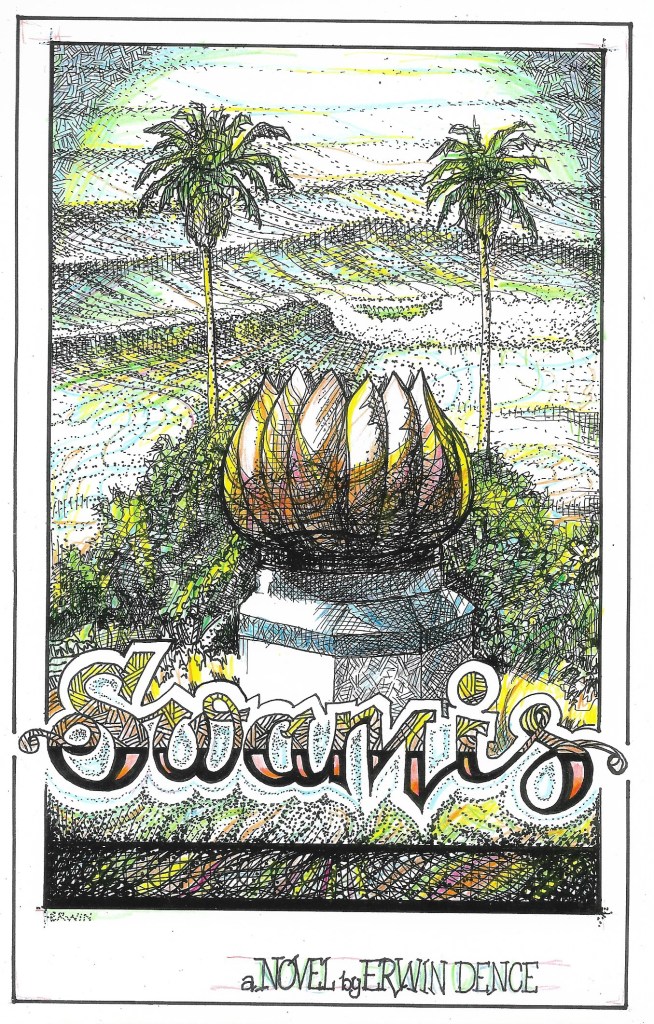
I backed my way through the middle of the semi-circle and to the window. I didn’t look around to connect faces with questions and comments. I was somewhere else, imagining what magical waves were breaking beyond the hills that were my horizon, trying to perfectly reimagine a photo from a surfing magazine.  The view was from across highway 101, above the railroad tracks. across the empty lot just south of the Swamis parking lot.  There were, on the horizon, distant swells on a field of diamonds, already bending to the contours of underwater reefs. To the right there were dark green shrubs and trees, palm trees beyond them. Further to the right, large gold lotus blossoms sat atop the corners of a white stucco wall.

I didn’t bother to consider how long I had been detached from the reality of an event as surreal as this wake, or memorial, or potluck. That was me, detached. Everyone seemed to know this. Damaged. Some knew the story, others were filled in. There had to be an explanation for why I was, so obviously, elsewhere.

Standing at the window, all the conversation was behind me; the clattering and tinkling, the hushed voices telling little stories, the sporadic laughter. 

The yellow van with the two popout surfboards on top pulled out of the driveway, a black Monte Carlo behind it. I didn’t recognize the car. I looked around the living room. Wendall and Dickson were holding court with one of the Downtown Detectives over by the sideboard, a two-thirds gone bottle of some brownish liquor between them. The Downtown Guy finished off Langdon’s bottle of wine, looked at the label, laughed, and moved the bottle next to the other empties. He looked around the room, and laughed again, louder.

I looked back out the window. A black Monte Carlo seemed about right. Oversized, pretentious. An investment, likely purchased before he made Lieutenant up in Orange County.

A yellow Volkswagen Karmann Ghia, top down, was coming up the hill. It passed the Hayes Flowers van. Different yellows; the car’s color softer, warmer, on the orange rather than the green side. There was a woman at the wheel, very colorful scarf over her head, sunglasses. The Monte Carlo stopped. The VW stopped. Langdon. Yeah, it was him. He had an am out the window. The gesture was ‘turn around.’ The woman in the Karman Ghia gave Langdon a brush back with a raised hand, followed, when the Monte Carlo moved on, with the woman’s right hand, up, middle finger out. She moved her arm halfway back down, then up again.

“Yeah,” I imagined myself saying, “Fuck you… with a half twist.” I may have added the half twist at some later recalling of the day. It doesn’t matter, it’s there now.

Deputy “New Guy” Wilson half-leaned into the Karmann Ghia. The woman looked up. She saw me in the window. She pointed. She waved. I took a second, then waved back. Wilson gave me a gesture, hands out, palms up, chest high. As in, “Really?” I mimicked his gesture, palms facing each other. The New Guy let her proceed.

            After several adjustments, the Karmann Ghia was pointed out, getaway position, the passenger side almost touching the two-by-six fencing on the corral. She removed her scarf. Afro. Not huge, but out there enough to make a statement. She looked at her image in the rearview mirror, pushed the sunglasses up into the Afro, prescription glasses remaining.

The woman swiveled in the seat, picked up a thirty-five-millimeter camera with a medium length telephoto attached, used the top of the windshield to stabilize it, and aimed it at me. Snap. Me in the center of the window, my arms out, hands on either side of the opening.

I moved backward and sideways, back into the room, bumping into a man I knew from the PTA or the School Board, somewhere. “It’s that pushy Negro reporter woman,” he said. “Writes for that hippie rag. She did a big… ‘expose’ on the water district. Don’t know how she got past the Deputy.”

            “New guy,” I said, suddenly realizing where I had seen the man’s photo. “The hippie rag published that… expose; favorable rates for certain… constituents, as I recall. The Enterprise didn’t run the story for another two weeks. And… you’re still the… director.”

The Water District Director looked at me for a moment before turning away. “Wendall,” he said, brushing past Mr. Dewey. I didn’t look away quickly enough. Mr. Dewey smiled. He may have mistaken my look for a nod. He was already headed my way. I returned to my spot in the middle of the picture window.

“I heard that, Joseph,” he whispered. “Good one. We need an alternative to the war mongering, corporate loving press.” Mr. Dewey was somewhere over half-sloshed, sloshing some sort of orangish-brown liquor in one of my father’s cut crystal glasses. The North County Free Press. I should make it required reading for my Political Science class.” Mr. Dewey leaned in a little too close to me. “I mean…” I leaned away. “…You read it… right?”

            I tried to correct my overreaction by leaning in toward Mister Dewey as if I was ready to share a secret. “You know, Mister Dewey…” I looked around the room, back to the teacher. “Most of these people do, too.” I whispered, “Also. And… there’s some… nudity. Sometimes. Hippies, huh?”

            Mr. Dewey nodded and went into some forgettable, mumbled small talk. War in Asia, civil rights, threats to the middle class. It was less than a minute later when Mr. Dewey pointed my father’s glass, with Detective Wendall’s whiskey sloshing around in the bottom, toward the photograph of my parents. “Never understood… guy like Joe DeFreines; almost a John Bircher… conservative. He was a Marine… in the Pacific. War hero.” He took another sip. “Korea, too. Also. A war we didn’t win. He fought the Japs, and then, he and your mom…”

            Mr. Dewey seemed to realize he had gone a bit too far with this. He tipped the glass up high enough to get the last of the whiskey, and said, “I have a theory.”

“Well, you are the Political scientist, Mr. Dewey.” I turned away.

Mr. Dewey grabbed my arm. “I think, Joseph, that he wanted all the Okies and all the new people to think he was… one of them.”  

“Or…” I looked at Mr. Dewey’s hand. He dropped it. “It’s tradition though, really. Isn’t it, Mr. Dewey? Kill the men. Take the women.”

Mr. Dewey looked into my father’s glass. Empty. I looked around the room, past the dining room, and into the kitchen as if I was looking for a particular person. I turned back toward the window. Mr. Dewey followed me, setting the glass on the sill.

“You know, Joseph; your father was a busy man.” Mr. Dewey was looking from the unfinished garage to the unfinished fencing. “I’m not teaching summer school this year.” I shook my head a bit, waiting for more. “I have time. That’s… If I had a place like… this, I…”

“Yeah. Needs… time. Work.”

Mr. Dewey tapped on the window. “The Falcon wagon? That yours… now?”

“I am making… payments.” A chuckle stuck in my throat. “Guess so.” Mr. Dewey cleared his throat. “I passed the… driving tests.”

“You. Of course.”

I whispered, “They didn’t ask, I didn’t admit… anything. I am getting… better.”

“Of course, Joseph.” Mr. Dewey turned and looked at the selections of food that were still on the table as three different women brought in an assortment of desserts. He patted my shoulder as fourteen other men and seven women had done, coughed out some whiskey breath, and headed to where my father’s partners, Wendall and Dickson, were filling glasses no one had yet asked for.

“Better,” I whispered to myself and the window and the cars and the property that needed work. “I better be.”

… 

            The reporter woman was standing next to my father’s partners. She declined a drink in a fattish sort of glass, three-quarters full, offered by Dickson. “Smooth,” he said, offering it again with a look that was really a dare. She was asking questions I couldn’t quite hear; questions that seemed to make the detectives uneasy.

            The reporter was holding out a notepad, three quarters of the pages pushed up, and was tapping on the next available page with a ballpoint pen. Dickson made a quick grab for the notepad.  She pulled it back. Quicker. Dickson pulled a very similar, palm-sized notepad from his inside coat pocket, opened it, went through some pages, shook his head, closed the notepad, put it back into the pocket. The reporter closed her notepad.

            “So,” the reporter asked, “The official word is no word?”

            “Correct.”   

            Wendall pulled a pack of Lucky Strike non-filters from his left outside coat pocket, a Zippo lighter with a Sheriff’s Office logo, exactly like my father’s, from the right pocket. He opened the top with a forceful snap on his wrist, looked around the room, pointed toward the kitchen. Partway through, Mrs. Wendall tried to stop him. He pointed to the cigarette and headed to and out the open sliding glass door.

            I moved a bit closer to the reporter and Dickson. “No, Detective Dickson, I am not getting any help from Downtown,” she said, shooting a look toward the Downtown Guy, who returned a wave and followed Wendall. I moved between the pineapple upside down cake and a plate of frosted brownies. I took a brownie. “You could just tell me how an experienced driver could…”

Dickson looked at me. “Could,” he said, downing one of the pre-filled glasses. “Won’t.”

The reporter looked at me, took a glass from the sideboard, downed it in one gulp, stepped toward me. “You,” she said. “Lee Ransom.” She extended a hand before the alcohol she had thrown down her throat forced her to spread her fingers, lean back, and open her mouth wide enough and long enough to emit a totally flat and involuntary, “Haaaauuuuuh.”

I made a quieter version of the sound she had made, leaned back, only slightly, at the waist, and said, “Oh. The Lee Ransom.”

Dickson laughed and said, “Smooooth.”

Lee Ransom moved closer to me. “Oh?” She paused for the exact same length of time as I had. “Meaning?”

            “Oh. As in, I thought Lee Ransom must be…”

            “White?”

            “A… man.”

            “Do I write like a… man?”

            “Yes. A… white… man.” Lee Ransom couldn’t seem to decide if I was putting her on or too foolish to edit my thoughts before I spoke. “New journalism, ‘I’m part of the story’… white… writer. Good, though. I read you… your… stuff.” I looked at Dickson. “He reads it.” I made a quick head move, all the way left, all the way right, and back to Lee Ransom. “They all read it.”

            Lee Ransom may have wanted to chuckle. She didn’t. She extended her hand again and said, “Thank you, Jody.” Dickson snickered.

I took Lee Ransom’s hand, trying to use the grip my father taught me, the one for women. I imagined him, telling me; “Not too strong, not too long, look them in the eye. No matter what they’re wearing… cleavage-wise.” Lee Ransom was wearing a black skirt, knee-length, with a not-quite-black coat, unbuttoned, over a long-sleeved shirt; tasteful, one unbuttoned button short of conservative. I didn’t look at her cleavage or her breasts. I was aware of them.     

“I was hoping to speak to your mother, Jody.”

            “Joey. I go by… Joey.”

            Dickson laughed. “Pet name. Jody.” He laughed again. “Private joke.” Laugh.

            “My friends call me Joey.” I did a choking kind of laugh. “Private joke.”

            Lee Ransom gave me a ‘I don’t get it’ kind of smile.

            “You. My mom. Talking. Probably… not.” I nodded toward the hallway. A woman was leading a couple toward the living room. “Sakura Rollins,” I said, “Since you’re taking notes.”    

“Thank you… Joey.” Lee Ransom tapped on her closed notebook. “She and her husband, Buddy, own a bowling alley. Oceanside. Back Gate Lanes.” She nodded toward the couple. “Gustavo and… Consuela Hayes. Flower people. Poinsettias…. Mostly.”

“Flower people,” I said, looking at Lee Ransom until she did a half-smile, half-head tilt.

Sakura Rollins came into the living room from the hallway, stopping close to Dickson. Mrs. Hayes turned to thank her, taking both of Mrs. Rollins’ hands in hers for a moment. Mr. Hayes exchanged a nod with Dickson, declined a drink, put a hand on his wife’s shoulder, turned her toward the door, walked with her toward the foyer. Neither of them looked to their left and into the living room. The husband walked to his wife’s left, between her and the rest of us. They both bent, slightly, to look at the flowers. The woman rearranged the pots and vases, slightly, before they went onto the porch.

Lee Ransom turned toward Sakura Rollins. Her expression blank, my mother’s best friend shook her head before Lee Ransom could ask her anything.

Theresa Wendall walked up to Dickson from the kitchen, leaned around him to look down the hallway, then looked at Sakura Rollins as if asking for some sort of confirmation. Dickson set down a glass and wrapped his right hand around Mrs. Wendall’s upper arm. She took a breath, gave Dickson a look that I didn’t see, but one that caused him to apply some small pressure pushing his partner’s wife forward as he released his grip.

Sakura Rollins followed Mrs. Wendall down the hallway. Mrs. Wendall stopped, allowing Mrs. Rollins to open the door and announce her. “Theresa Wendall.” Permission. Access. Mrs. Wendall went into my parents’… my mother’s room. Sakura Rollins closed the door, leaned against the wall between that door and the door to Freddy’s room, and pointed toward me, twisting her hand and pulling her finger halfway back.  

Mrs. Rollins met me halfway between the door and the open area. She put a hand on each of my shoulders. “Ikura desuka,” she said, her voice soft and low. “It means… ‘How much does it cost?’ Not in a formal way. Slang. Soldiers. It is… can be… insulting. Thank you for not asking your mother.”

“I didn’t… ask… you.”

“No, and you wouldn’t.” She tilted her head. “Your mother… she so enjoys having someone she can speak… Japanese with.”

I nodded. “She does, Mrs. Rollins, but… but… thank you.”

“Yes. There’s time.” Sakura Rollins released her right hand. “You’re… doing well, Joey.” She pointed toward the living room. “Your parents… strong.” I wanted to cry. “As are you. We are as strong as we need to be. Yes?”

            I backed up, three steps, did a half bow, unreturned, turned, and headed back toward the living room.   

Lee Ransom was declining Dickson’s latest drink offer, a half glass this time. She walked over to my father’s lounger. I followed. “Shrine,” I whispered. She looked closely at the scar on the palm of my father’s left hand. “It’s just… just the one hand,” I said. “Half stigmata.”

Lee Ransom may have smiled as she leaned toward the portrait. I almost smiled when she looked back at me.  

“Swamis” Recap

CHAPTER ONE -Monday, Nov 13, 1968-

Seventeen-year-old JOEY DeFREINES is talking with his court appointed psychologist, DR. SUSAN PETERS. Joey’s father, San Diego County Sheriff’s Office DETECTIVE LIEUTENANT JOSEPH DE FREINES made the deal following an afterschool incident at Fallbrook Union High School during which Joey put his foot on GRANT MURDOCH’s neck. Dr. Peters asks if, once bullied, Joey has become a bully.

TWO- Saturday, August 14, 1965-

13-year-old Joey tries surfing at PIPES. JULIA COLE is out, already accomplished. She says boy surfers are assholes, surfing is hard, and she stays away from cops and cop’s kids.

THREE- Sunday, September 15, 1968-

Joey tricks SID and other locals in the lineup at GRANDVIEW, gets a set wave. Sid burns Joey and tells him he broke the ‘locals rule,’ that being that locals rule.

Joey, driving his FALCON station wagon, comes upon a VW VAN. Locals DUNCAN, MONICA, AND RINCON RONNY are looking at the smoking engine. They are unresponsive if not hostile to Joey, but Julie (to her friends) asks Joey if he’s a mechanic or an attorney. “Not yet,” he says. There is an attraction between Julie and Joey that seems irritating to, in particular, Duncan.

FOUR- Wednesday, December 23, 1968-

Joey has a front row spot at SWAMIS. He has already surfed and is studying, notebooks on the hood of the Falcon. Arriving out of town surfers want the spot. Joey, hassled by one of them, informs BRIAN that he has a history of striking out violently when threatened, and says he’s on probation. Joey has an episode remembering past encounters, witnessed by the out-of-town surfers and Rincon Ronny, who seems impressed and says those kooks won’t bother Joey in the water. “Someone will,” Joey says, “It’s Swamis.”

FIVE- Thursday, February 27ut-

At breakfast at home in Fallbrook, Joseph DeFreines confronts his son (who he calls JODY) about an acceptance letter from Stanford University Joey hid. Joey’s father is also upset with his wife, RUTH, for some reason, and leaves in a huff, saying he’ll take care of it.

Joey and his younger brother, FREDDY, get a ride home from surf friend, GARY, and Gary’s sister, THE PRINCESS. Ruth is loading the Falcon, says she spoke on the phone with DETECTIVE SERGEANT LARRY WENDALL, and says she will, as always, be back. Freddy blames Joey. Their father calls as their mother pulls away. Joey, looking for the keys to his mother’s VOLVO, speaks briefly, somewhat rudely, with his father. Freddy says he’ll wait for their father. The phone rings. It’s ‘uncle’ Larry. Joey runs toward the Volvo.

SIX- Tuesday, March 4, 1968. PART ONE-

There is a post-funeral wake/memorial/potluck at the DeFreines house. Joey, avoiding the guests, is standing in the big west-facing window. MISTER DEWEY, a teacher at Fallbrook High, says he is surprised that Joey’s ex-Marine, ‘practically a John Bircher,’ father is married to a Japanese woman. “Traditional,” Joey says, “Kill the men, take the women.” Mister Dewey expresses interest in the property Joey’s father never had the time to work on.

A delivery van from ‘Flowers by Hayes’ comes up the driveway, guarded, for the wake, by San Diego Sheriff’s Office DEPUTY SCOTT WILSON. The driver of the van is CHULO, a surfer several years older than Joey. Chulo was arrested along with JUMPER HAYES for stealing avocados. Chulo was crippled during the arrest, went to work camp, became a beach evangelist.

Joey has an episode, during which he replays the accident in which, while driving the Volvo, he follows the Falcon and another car around the smoking JESUS SAVES BUS. Joey’s father, in an unmarked car, passes very close to him and pulls off the highway at high speed. JeJ

Chulo was driving the Jesus Saves bus.

Detective Wendall and DETECTIVE SERGEANT DANIEL DICKSON are at a makeshift bar in the living room. ORANGE COUNTY SHERIFF’S OFFICE DETECTIVE LIEUTENANT BRICE LANGDON, dressed in a just out of fashion Nehru jacket and rat-stabber shoes, isn’t popular with the two remaining detectives from the VISTA SUBSTATION, or with the other civilians and deputies from the San Diego Sheriff’s Office.

THERESA WENDALL, putting out food, tries to talk to her husband. He avoids her. Their two boys are running through playing cowboys-and-Indians as Langdon seems to corner Chulo.

SIX- PART TWO- TUESDAY, MARCH 4, 1969

The wake/memorial continues with various guests praising Joe DeFreines. There is a large portrait on display with the scar on Joey’s father’s left hand showing. Joey’s mother, Ruth, is led to her room by GUSTAVO and CONSUALA HAYES. Those seeking to talk with Ruth are vetted by MORIKO ROLLINS. Theresa Wendall is allowed to go in. Reporter for the North County Free Press, LEE RANSOM, gains access to the property, passing by Deputy Wilson by waving at Joey, in the window, with Joey returning the wave. Langdon seems to be following Chulo away from the property. Lee Ransom questions the detectives on information about Joe DeFreines’ accident.

“Swamis” is copyrighted, all rights reserved by the author, Erwin A. Dence, Jr. Thank you for respecting this. See you. Oh, and Fuck Cancer, and remember, Project 2025 wants to take away porn, even, maybe, surf porn.


Recap of “Swamis” plus Ch.6,Part One, plus More

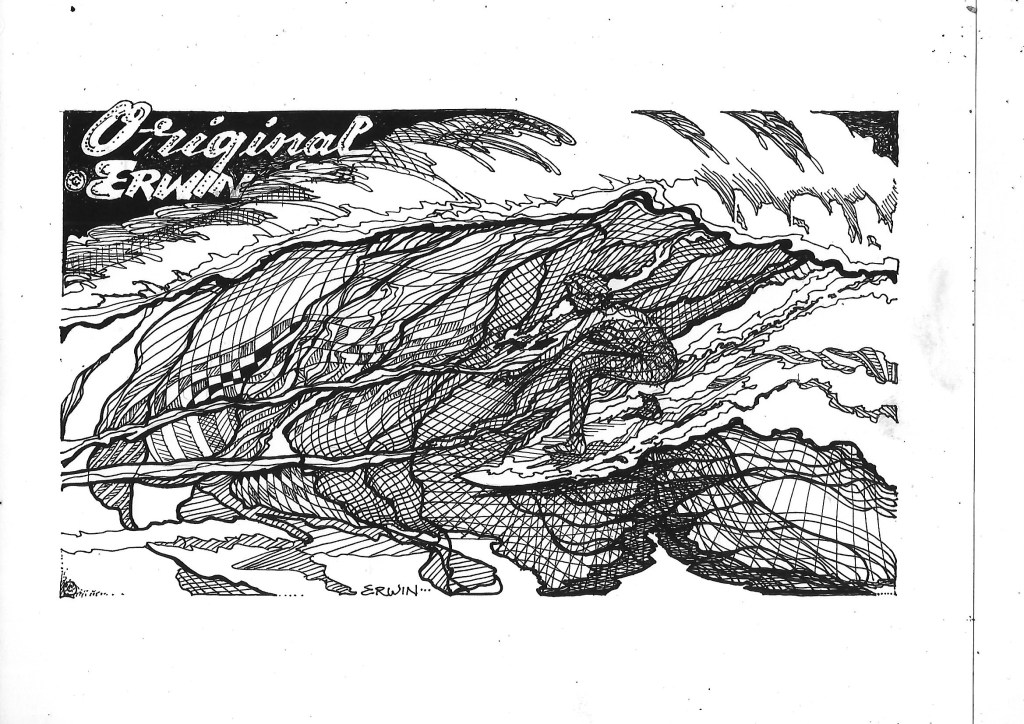
This drawing will, of course, have to be reversed, white-to-black, to go on (future) t-shirts. There are some new hoodies and long-sleeved shirts ready at D&L LOGOS on Monday. I’m pretty excited, as is TRISH. She special ordered one for her, “cost just a little bit more… honey.” “Sure.”

This design, a little larger than the practice ones I had printed. I have to figure out how much they’re costing me, and then… some will be available. I got one xxl, for me, but I may have already sold it.

OKAY, a lot of stuff this week. If your time is limited, SKIP the story. Not classic, all time. Next time… Do read the “Swamis” chapter. Thanks.

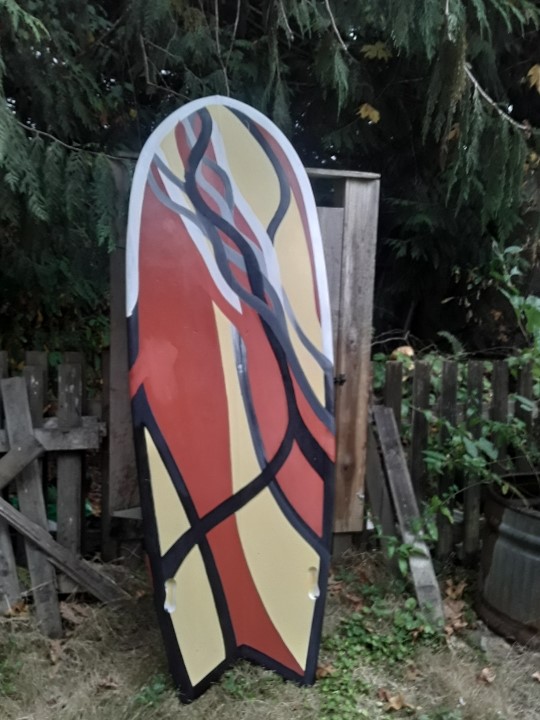
IN the ‘every session’s a story’ catagory… I had to go surfing the other day, last chance before my third eye surgery. I was aware, because, despite the rules, news of waves breaking and being ridden spreads, and I missed opportunities because my once-repaired but re-damaged fin box on my beloved but abused HOBIE needed repair, and I was focused on working and trying to buy another board. BUT, the dude with a board within reasonable driving distance wanted too much (as in, it’s listed for $500, out there for 8 weeks, and he won’t take less) for a board that is actually heavier than mine. SO, I purchase resin, hot cure catalyst, and some glass, cut the box loose, fill the hole with glass and resin, slam it back in, half-glass the whole unit in, fin and all. Foolish, knowing how the small waves and big rocks on the STRAIT eat fins.

I did all this on a painting job, the board on the rack of my VOLVO. It dried, I retied it to the rack AND I was ready for the next day’s pre-dawn takeoff. Enroute, I passed an accident on 112, almost to Joyce, a car on its top in the ditch, and it had been there long enough that there were cones and people with signs, and a lit-up display that read, “Accident Ahead.” It turns out three people, none wearing seatbelts, were hurt, two flown out. SO, maybe I should slow down.

AND I DID, but… you know how straps can be noisy? Mine were, increasingly so. It was a while after I arrived at my destinatiion, three people in the water, that I noticed my board was… Ever see people driving down the road with mattresses poorly tied to the roof? YEAH. But I was lucky. And the waves were what we… okay me, what I call FUN. I knew most of the dawn patrollers, met Ian’s wife (forgot her name- sorry; four syllables- don’t want to guess), and KEVIN, a Port Townsend surfer I had heard about. Iron man, stayed out about four hours straight.

SINCE, evidently, surfing is more dangerous after eye surgery than heavy lifting, I can hold on to memories of a decent session until… next time.

BECAUSE IT IS DIFFICULT to go back and pick up the earlier chapters, I am going to provide a recap of “SWAMIS.” Yes, even the ‘catchup’ is a lot of reading.

“Swamis” Recap

CHAPTER ONE -Monday, Nov 13, 1968-

Seventeen-year-old JOEY DeFREINES is talking with his court appointed psychologist, DR. SUSAN PETERS. Joey’s father, San Diego County Sheriff’s Office DETECTIVE LIEUTENANT JOSEPH DE FREINES made the deal following an afterschool incident at Fallbrook Union High School during which Joey put his foot on GRANT MURDOCH’s neck. Dr. Peters asks if, once bullied, Joey has become a bully.

TWO- Saturday, August 14, 1965-

13-year-old Joey tries surfing at PIPES. JULIA COLE is out, already accomplished. She says boy surfers are assholes, surfing is hard, and she stays away from cops and cop’s kids.

THREE- Sunday, September 15, 1968-

Joey tricks SID and other locals in the lineup at GRANDVIEW, gets a set wave. Sid burns Joey and tells him he broke the ‘locals rule,’ that being that locals rule.

Joey, driving his FALCON station wagon, comes upon a VW VAN. Locals DUNCAN, MONICA, AND RINCON RONNY are looking at the smoking engine. They are unresponsive if not hostile to Joey, but Julie (to her friends) asks Joey if he’s a mechanic or an attorney. “Not yet,” he says. There is an attraction between Julie and Joey that seems irritating to, in particular, Duncan.

FOUR- Wednesday, December 23, 1968-

Joey has a front row spot at SWAMIS. He has already surfed and is studying, notebooks on the hood of the Falcon. Arriving out of town surfers want the spot. Joey, hassled by one of them, informs BRIAN that he has a history of striking out violently when threatened, and says he’s on probation. Joey has an episode remembering past encounters, witnessed by the out-of-town surfers and Rincon Ronny, who seems impressed and says those kooks won’t bother Joey in the water. “Someone will,” Joey says, “It’s Swamis.”

FIVE- Thursday, February 27ut-

At breakfast at home in Fallbrook, Joseph DeFreines confronts his son (who he calls JODY) about an acceptance letter from Stanford University Joey hid. Joey’s father is also upset with his wife, RUTH, for some reason, and leaves in a huff, saying he’ll take care of it.

Joey and his younger brother, FREDDY, get a ride home from surf friend, GARY, and Gary’s sister, THE PRINCESS. Ruth is loading the Falcon, says she spoke on the phone with DETECTIVE SERGEANT LARRY WENDALL, and says she will, as always, be back. Freddy blames Joey. Their father calls as their mother pulls away. Joey, looking for the keys to his mother’s VOLVO, speaks briefly, somewhat rudely, with his father. Freddy says he’ll wait for their father. The phone rings. It’s ‘uncle’ Larry. Joey runs toward the Volvo.

SIX- Tuesday, March 4, 1968. PART ONE-

There is a post-funeral wake/memorial/potluck at the DeFreines house. Joey, avoiding the guests, is standing in the big west-facing window. MISTER DEWEY, a teacher at Fallbrook High, says he is surprised that Joey’s ex-Marine, ‘practically a John Bircher,’ father is married to a Japanese woman. “Traditional,” Joey says, “Kill the men, take the women.” Mister Dewey expresses interest in the property Joey’s father never had the time to work on.

A delivery van from ‘Flowers by Hayes’ comes up the driveway, guarded, for the wake, by DEPUTY SCOTT WILSON. The driver of the van is CHULO, a surfer several years older than Joey. Chulo was arrested along with JUMPER HAYES for stealing avocados. Chulo was crippled during the arrest, went to work camp, became a beach evangelist.

Joey has an episode, during which he replays the accident in which, while driving the Volvo, he follows the Falcon and another car around the smoking JESUS SAVES BUS. Joey’s father, in an unmarked car, passes very close to him and pulls off the highway at high speed. JeJ

Chulo was driving the Jesus Saves bus.

Detective Wendall and DETECTIVE SERGEANT DANIEL DICKSON are at a makeshift bar in the living room. ORANGE COUNTY SHERIFF’S OFFICE DETECTIVE LIEUTENANT BRICE LANGDON, dressed in a just out of fashion Nehru jacket and rat-stabber shoes, isn’t popular with the two remaining detectives from the VISTA SUBSTATION, or with the other civilians and deputies from the San Diego Sheriff’s Office.

THERESA WENDALL, putting out food, tries to talk to her husband. He avoids her. Their two boys are running through playing cowboys-and-Indians as Langdon seems to corner Chulo.

CHAPTER SIX- TUESDAY, MARCH 4, 1969  

It was still early afternoon. I was in the living room, ignoring everything behind me, facing but not really seeing anything out the west-facing window. A Santa Ana condition had broken down, and a thousand-foot-high wall of fog had pushed its way up the valleys. The house was situated high enough that the cloud would occasionally clear away, the sun brighter than ever. The heat and humidity, raised by the number of people in our house, caused a fog of condensation on the plate glass.

Below me, cars were parked in a mostly random way in the area between the house and the separate and unfinished garage, and the corral. Continued use had created a de facto circular driveway up the slight rise from the worn and pitted gravel driveway, across the struggling lawn, and up to the concrete pad at the foot of the wooden steps and front porch.

A bright yellow 1964 Cadillac Coupe De Ville convertible, black top up, was parked closest to the door.  Other vehicles were arranged on the clumpy grass that filled in areas of ignored earth. Later arrivals parked on the lower area. The Falcon was parked close to the county road in keeping with my parking obsession; with getting in, getting out, getting away.

I was vaguely aware of the music coming from the turntable built into the Danish modern console in the living room. Stereo. Big speakers in opposite corners of the room, the volume where my father had set it, too low to compete with the conversations among the increasing crowd, the little groups spread around the room. Some were louder than others. Praise and sympathy, laughs cut short out of respect. Decorum.

Someone had put on a record of piano music; Liberace, or someone. My father’s choice would have been from the cowboy side of country/western; high octave voices capable of yodeling, lonesome trails and tumbling tumbleweeds, the occasional polka. My mother preferred show tunes with duets and ballads by men with deep, resonant voices, voices like her husband’s, Joseph Jeremiah DeFreines.

 These would not have been my father’s choice of mourners. “Funerals,” he would say, “Are better than weddings.” He would pause, appropriately, before adding, “You don’t need an invite or a gift.”

Someone behind me repeated that line, mistiming the pause, his voice scratchy and high. I turned around. It was Mister Dewey. A high school social studies teacher, he sold insurance policies out of his rented house on Alvarado. His right hand was out. I didn’t believe shaking hands was expected of me on this day.

“You know my daughter, Penelope,” he said, dropping his hand.

“Penny,” I said. “Yes, since… third grade.” Penny, in a black dress, was beside Mr. Dewey, her awkwardness so much more obvious than that of the other mourners. I did shake her hand. “Penny, thanks for coming.” I did try to smile, politely. Penny tried not to. Braces.

 I looked at Mr. Dewey too closely, for too long, trying to determine if he and I were remembering the same incident I was. His expression said he was.

When I refocused, Mister Dewey and the two people he had been talking with previously, a man and Mrs. Dewey, were several feet over from where they had been. I half-smiled at the woman. She half-smiled and turned away. She wasn’t the first to react this way. If I didn’t know how to look at the mourners, many of them did not know how to look at me, troubled son of the deceased detective.

If I was troubled, I wasn’t trying too hard to hide it. I was trying to maintain control. “Don’t spaz out,” I whispered, to myself. It wasn’t a time to retreat into memory, not at the memorial for my father. The wake.

Too late.

“Bleeding heart liberal, that Mister Dewey,” my father was telling my mother, ten-thirty on a school night, me still studying at the dinette table. “He figures we should teach sex education. I told him that we don’t teach swimming in school, and that, for most people, sex… comes… naturally. That didn’t get much of a laugh at the school board meeting.”

“Teenage pregnancies, Joe.”

“Yes, Ruth.” My father touched his wife on the cheek. “Those… happen.”

“Freddy and I both took swimming lessons at Potter Junior High, Dad. Not part of the curriculum, but…”

“Save it for college debate class, Jody. We grownups… aren’t talking about swimming.”

  Taking a deep breath, my hope was that the mourners might think it was grief rather than some affliction. Out the big window, a San Diego Sheriff’s Office patrol car was parked near where our driveway hit the county road. The uniformed Deputy, still called “New Guy,” assigned to stand there, motioned a car in. He looked around, went to the downhill side of his patrol car. He opened both side doors and, it had to be, took a leak between them. Practical.

The next vehicle, thirty seconds later, was a delivery van painted a brighter yellow than the Hayes’ Cadillac. Deputy New Guy waved it through. I noticed two fat, early sixties popout surfboards on the roof, nine-foot-six or longer, skegs in the outdated ‘d’ style. One was an ugly green, fading, the other, once a bright red, was almost pink. Decorations, obviously, they appeared to be permanently attached to a bolted-on rack. The van was halfway to the house before I got a chance to read the side. “Flowers by Hayes brighten your days.” Leucadia phone number.

Hayes, as in Gustavo and Consuela Hayes. As in Jumper Hayes.

A man got out of the van’s driver’s seat, almost directly below me. Chulo. I knew him from the beach. Surfer. Jumper’s partner in ‘the great avocado robbery’ that sent them both away, Chulo returning, reborn, evangelizing on the beach, with a permanent limp.

Chulo’s long black hair was pulled back and tied; his beard tied with a piece of leather. He was wearing black jeans, sandals, and a day-glow, almost chartreuse t-shirt with “Flowers by Hayes” in white. Chulo looked up at the window, just for a moment, before reaching back into the front seat, pulling out an artist’s style smock in a softer yellow. He pulled it over his head, looked up for another moment before limping toward the back of the van.

The immediate image I pulled from my mental file was of Chulo on the beach, dressed in his Jesus Saves attire: The dirty robe, rope belt, oversized wooden cross around his neck. Same sandals. No socks.

Looking into the glare, I closed my eyes. Though I was in the window with forty-six people behind me, I was gone. Elsewhere.

I was tapping on the steering wheel of my mother’s gray Volvo, two cars behind my Falcon, four cars behind a converted school bus with “Follow me” painted in rough letters on the diesel smoke stained back. The Jesus Saves bus was heading into a setting sun, white smoke coming out of the tailpipes. Our caravan was just east of the Bonsall Bridge, the bus to the right of the lane, moving slowly.

My mother, in the Falcon, followed another car around the bus. Another car followed her, all of them disappearing into the glare. I gunned it.

I was in the glare. There was a red light, pulsating, coming straight at me. There was a sound, a siren, blaring. I was floating. My father’s face was to my left, looking at me. Jesus was to my right, pointing forward.

This wasn’t real. I had to pull out of this. I couldn’t.

The Jesus Saves bus stopped on the side of the road, front tires in the ditch. The Volvo was stopped at a crazy angle in front of the bus. I was frantic, confused. I heard honking. Chulo, ion the Jesus Saves bus. He gave me a signal to go. Go. I backed the Volvo up, spun a turn toward the highway. I looked for my father’s car. I didn’t see it. The traffic was stopped. I was in trouble. My mother, in the Falcon, was still ahead of me. She didn’t know. I pulled into the westbound lane, into the glare, and gunned it.

When I opened my eyes, a loose section of the fog was like a gauze over the sun. I knew where I was. I knew Chulo, the Jesus Saves bus’s driver, delivering flowers for my father’s memorial, knew the truth.

Various accounts of the accident had appeared in both San Diego papers and Oceanside’s Blade Tribune. The Fallbrook Enterprise wouldn’t have its version until the next day, Wednesday, as would the North County Free Press. All the papers had or would have the basic truth of what happened. What was unknown was who was driving the car that Detective Lieutenant Joseph Jeremiah DeFreines avoided. “A gray sedan, possibly European” seemed to be the description the papers used.

”The San Diego Sheriff’s Office and the California Highway Patrol share jurisdiction over this part of the highway. Detective Lieutenant Brice Langdon of the Orange County Sheriff’s Office is acting as a liaison with the Highway Patrol in investigating the fatal incident.”   

Despite the distractions, what I was thinking was that Chulo knew the truth.

Chulo would be depositing the four new bouquets in the foyer, flowers already filling one wall. I looked in that direction, panning across the mourners. The groups in the living room were almost all men. Most were drinking rather than eating. Most of the groups of women were gathered in the kitchen.

A woman wearing a white apron over a black dress brought out a side dish of, my guess, some sort of yam/sweet potato thing. Because I was looking at her, she looked at the dish and looked at me, her combination of expression and gesture inviting me to “try some.” There was, I believed, an “It’s delicious” in there. Orange and dark green things, drowning in a white sauce.

“Looks delicious, Mrs. Wendall.”

Two kids, around ten and twelve, both out of breath, suddenly appeared at the big table, both grabbing cookies, the elder sibling tossing a powdered sugar-covered brownie, whole, into his mouth, the younger brother giving a cross-eyed assessment of his mother’s casserole.  

“Larry Junior,” Mrs. Wendall half-whispered as she shooed her sons out the door. She looked at her husband, leaning against a sideboard serving as a bar. He followed his boys out the door with the drink in his hand, half-smiled at his wife, as if children running through a wake is normal; and was no reason to break from chatting with the other detective at the Vista substation, Daniel Dickson, and one of the ‘College Joe’ detectives from Downtown. War stories, shop talk. Enjoyable. Ties were loosened and coats unbuttoned, the straps for shoulder holsters occasionally visible.

“Just like on TV” my father would have said. “Ridiculous.”

Freddy, out of breath, came out of the kitchen, weaving through the wives and daughters who were busily bussing and washing and making plates and silverware available for new guests. I handed him two cookies before he grabbed them. He grabbed two more.

“They went thataway, Freddy,” Detective Dickson said, pointing to the foyer.

Freddy pushed the screen door open, sidestepped Chulo, and leapt, shoeless, from the porch to what passed for our lawn, Bermuda grass taking a better hold in our decomposed granite than the Kentucky bluegrass and the failing dichondra.

Chulo, holding a metal five-gallon bucket in each hand, walked through the open door and into the foyer. He was greeted by a thin man in a black suit coat worn over a black shirt with a Nehru collar. The man had light brown hair, slicked back, and no facial hair. He was wearing shoes my father would refer to as, “Italian rat-stabbers.” Showy. Pretentious. Expensive fashion investments that needed to be worn to get one’s money’s worth.

Chulo had looked at me, looked at the man, and lowered his head. The man looked at me. I didn’t lower my gaze. I tried to give him the same expression he’d given me. Not acknowledgement. Questioning, perhaps.

Langdon. He must have been at the funeral, but I hadn’t felt obligated to look any of the attendees in the eye. “Langdon,” one of the non-cop people from the Downtown Sheriff’s Office, records clerks and such, whispered. “Brice Langdon. DeFreines called anyone from Orange County ‘Disneycops.’” Chuckles. “They put people in ‘Disney jail’,” another non-deputy said.

“Joint investigation guy,” one of the background voices said. “Joint,” another one added. Three people chuckled. Glasses tinkled.  Someone scraped someone else’s serving spatula over another someone else’s special event side dish. Probably not the yams.

Chulo took the arrangements out of the buckets and rearranged the vases against the wall and those narrowing the opening to the living room. He plucked some dead leaves and flowers, tossed them in one of the buckets, backed out onto the porch, closed the door. I became aware that I had looked in that direction for too long. Self-consciousness or not, people were, indeed, looking at me. Most looked away when I made eye contact.

“If you have to look at people, look them straight in the eye,” my father told me, “Nothing scares people more than that.”

Langdon looked away first, turning toward the two remaining detectives at the Vista substation, Wendall and Dickson, Larry and Dan. They both looked at Langdon, critically assessing the Orange County detective’s fashion choices. I didn’t see Langdon’s reaction.  

My father’s partners had changed out of the dress uniforms they had worn at the funeral and into suits reserved for public speaking events and promotions, dark-but-not-black. Both wore black ties, thinner or wider, a year or two behind whatever the trend was. Both had cop haircuts, sideburns a little longer over time. Both had cop mustaches, cropped at the corners of their mouths, and bellies reflecting their age and their relative status. Both had changed out of the dress uniforms they’d worn at the funeral

 Wendall was, in some slight apology for his height, hunched over a bit, still standing next to the sideboard that usually held my mother’s collection of display items; photos and not-to-be-eaten-off-of dishes. Dickson was acting as official bartender. The hard stuff, some wine, borrowed glasses. The beer was in the back yard.

Langdon had brought his own bottle. Fancy label, obviously expensive wine, cork removed, a third of it gone. Langdon’s thin fingers around the bottle’s neck, he offered it to Dickson. Smiling, politely, Dickson took a slug and reoffered it to Langdon. Langdon declined. Dickson pushed the bottle into a forest of hard liquor and Ernest and Julio’s finest. Langdon shrugged and looked around the room. Dickson displayed the smirk he’d saved, caught by Wendall and me.

Langdon saw my expression and turned back toward Dickson. The smirk had disappeared. Langdon walked toward me. He smiled; so, I smiled.

“I’ve heard about you,” he said. The reaction I had prepared and practiced disappeared. I was pretty much just frozen. “I see you know…” He nodded toward the foyer. “…Julio Lopez.” Langdon didn’t wait for a response. “From the beach?” No response. “Surfers.” No response. “You and I will have to talk… soon.”

I had to respond. “How old are you, Detective Lieutenant Langdon?”

“I’m… twice your age.” I nodded. He nodded. “College. College… Joe.” He smiled.

I may have smiled as I looked around Langdon at Dickson and Wendall; both, like my father, twelve or more years older than Langdon, this assuming he knew I was seventeen. I did, of course consider why he would know this. Wendall gave me a questioning smile. Dickson was mid-drink. 

“I don’t know if you know this… Joseph: Your father was involved an investigation… cross-county thing, involving… me.”  Langdon was, again, looking straight into my eyes. I blinked and nodded, slightly. “Yes. So… if there is any irony in my being… here, it is that Joseph DeFreines was, ultimately…” Langdon was nodding. I was nodding. Stupidly. “…a fair man.”

Langdon did a sort of European head bow, snap down, snap back, and tapped me on the shoulder.  I had half expected to hear the heels on his rat-stabber shoes click.  

COPYRIGHT STUFF- All rights to original content reserved by author/artist, Erwin A. Dence, Jr.

THANKS, AS ALWAYS, for checking out realsurfers.net. Get some waves when you get the chance! And remember, sharing is… caring; that set bomb you let some kook take and blow the takeoff on… well, that was nice. OH, and, just remembered, the controversy on whether it’s justified to drop in on someone who took your wave continues. I saw it, I tried it. Twice. AND I felt… kind of justified. AND, when two guys dropped in on an alleged backpaddler, I was left outside with undisputed priority. GREAT!

“I just want to get wet,” Other Lies, and “Swamis,” continued

FIRST LIE: “I just want to get in the water,” or any variation on this (purposefully not talking about the folks cruising SURF ROUTE 101 and, I guess, everywhere, with Walmart plastic kayaks, canoes, wavestorms) by someone who actually surfs. Okay, shouldn’t have excluded Wavestormer Troopers, BUT…

…here’s the (a) story: So, three sessions ago, fighting a radically outgoing tide and small, choppy waves, I had one of those go-outs in which I, objectively, SUCKED. Two sessions ago, on a borrowed SUP, same spot, even smaller waves, I, subjectively, did OKAY. Or, at least, better… BUT, tasked with packing a board heavier than my Hobie on a long trek back, and unable to just drag someone else’s board across the soft sand and the scrub, I allowed, for the first time in my career, someone else to pack my board part way. It was his board. I was… grateful.

So, next session I packed in my MANTA board. I had finally coated over the paint with resin, and figured, if the waves were the usual, minimal, I could, at least, jump into a few. The waves lived up to my expectations; minimal. AND, NO, even if I said I just wanted to get in the water, which I didn’t, I would be lying. I wanted o RIP. I always want to rip. I didn’t. I let frothed-out ripper KEITH ride the board. He did rip. I watched. I caught ONE WAVE, belly ride, totally tubed, with enough juice to propel me down the line and into the gravel shelf. YAY!

MANTA and slightly lost Hobbit.

OH, and Keith put a ding in the Manta. That’s one of the costs in surfing. Occasionally getting h orumbled is another. STILL, next time I get wet…

SECOND LIE: “I’m not political.” Add to this, “I am willing to talk.” That part is true. I am working on a project proposal for a guy who is running for the state senate as a republican. So, in discussing the job, politics did come up. I said that, probably, 70 percent of people agree on 75% of things, that where the radical 30%, 15 in each direction, left and right, come together is distrust of the government. The potential client agreed. THEN, because he is also part of the nebulous percentage of people who consider themselves religious (there is a scale on this), I added that we are all raised with certain morals, and, if we go against these, we, in our own minds, sin. So, because we want to consider ourselves ‘good people,’ we try to live up to our own sense of morality.

HE AGREED. What I actually (or also) meant, or meant to imply was, that if a person is raised by a parent who used every device and trick to fuck over people in order to enrich himself, that person’s moral backstop, compass, guidebook, whatever, is… different.

BECAUSE I couldn’t help myself, and, actually, I MIGHT DO MORE, I drew a couple of, possibly, kind of political illustrations. I found out a few things: A LOT of women do not want to see even a negative image of Fred Trump’s son, a NASTY piece of work. I don’t know. Maybe I’m wrong: there might be, like, 15% who think… SHIT, I can’t imagine why they’d have anything other than disgust, AND, if they defend him on some false and thin pretense, I might believe they have an incredibly strong resistance to the gag reflex, and/or are lying.

Again, I am willing to talk.

“SWAMIS.” Since I am serializing the novel, I should recap: 1. Joey is at the court-appointed psychologist’s office; the conversation coming around to whether he has moved from being bullied to being a bully. 2. Joey’s first meeting with Julie at Pipes.

CHAPTER THREE- SUNDAY, SEPTEMBER 15, 1968

My nine-six Surfboards Hawaii pintail was on the Falcon’s rust and chrome factory racks. I was headed along Neptune, from Grandview to Moonlight Beach. The bluff side of Neptune was either garage or gate and fence, or hedge, tight to the road. There were few views of the water. I was, no doubt, smiling, remembering something from that morning’s session.

There had been six surfers at the outside lineup, the preferred takeoff spot. They all knew each other. If one of them hadn’t known about me, the asshole detective’s son, others had clued him in. There was no way the local crew and acceptable friends would allow me to catch a set wave. No; maybe a wave all of them missed or none of them wanted. Or one would act as if he was going to take off any wave I wanted, just to keep me off it.  

As the first one in the water, I had surfed the peak, had selected the wave I thought might be the best of a set. Three other surfers came out. Okay. Three more surfers came out. Sid was one of them. I knew who Sid was. By reputation. A set wave came in. I had been waiting. I was in position. It was my wave. I took off.  Sid took off in front of me, ten yards over. I said something like, “Hey!”

Rather than speed down the line or pull out, Sid stalled. It was either hit him or bail. I bailed. Sid said, “Hey!” Louder. He looked at me, cranked a turn at the last moment. He made the wave. I swam.

“I didn’t do anything wrong,” I said, back at the lineup. The four other surfers there were laughing with Sid.

“Wrong, Junior; you broke the locals rule.” Sid pointed to the lefts, the waves perceived as not being as good, on the other side of a real or imagined channel. “Local’s rule. Get it?” Trying to ignore the taunts of the others, I caught an insider and moved over.

After three lefts, surfed, I believed, with a certain urgency and a definite aggression, I prone-paddled back to the rights, tacking back and forth. A wave was approaching, a decently sized set wave. I wanted it. 

“Outside!” I yelled, loud enough that four surfers, including Sid, started paddling for the horizon. I paddled at an angle, lined up the wave at the peak. Though the takeoff was late, I made the drop, rode the wave into the closeout section, pulling off the highest roller coaster I had ever even attempted.

There had been no outside set. I kept my back turned to the water as I exited, not daring to look up at the surfers on the bluff, hooting and pointing. I did look up for a moment as I grabbed my towel, my keys and wallet and cigarettes rolled up in it, tromped up the washout to Neptune Avenue, trying not to smile.   

Driving, almost to Moonlight Beach, a late fifties model Volkswagen bus, two-tone, white over gray, was blocking the southbound lane. Smoke was coming out of the open engine compartment. Black smoke. Three teenagers were standing behind the bus: Two young men, Duncan Burgess and Rincon Ronny, on the right side, one young woman, Monica, on the left. 

There was more room on the northbound side. I pulled over, squeezed out between the door and someone’s bougainvillea hedge, and walked into the middle of the street, fifteen feet behind the van. “Can I help?” 

Duncan, Ronny, and Monica were dressed as if they had surfed but were going to check somewhere else: Nylon windbreakers, towels around their waists. Duncan’s and Monica’s jackets were different, but both were red with white, horizontal stripes that differed in number and thickness. Ronny was wearing a dark blue windbreaker with a white, vertical strip, a “Yater” patch sewn on. Each of the three looked at me, and looked back at each other, then at the smoking engine. The movement of their heads said, “No.”

Someone stepped out of an opening in the hedge on the bluff side of the road, pretty much even with me. I was startled. I took three sideways steps before I regained my balance.

Julia Cole. Perfectly balanced. She was wearing an oversized V-neck sweater that almost covered boys’ nylon trunks. Her legs were bare, tan, her feet undersized for the huarache sandals she was wearing. She looked upset, but more angry than sad. But then… she almost laughed. I managed a smile.

“It’s you,” she said. It was. Me. “Are you a mechanic?” I shook my head, took another step toward the middle of the road, away from her. “An Angel?” Another head shake, another step. She took two more steps toward me. We were close. She seemed to be studying me, moving her head and eyes as if she might learn more from an only slightly different angle.

I couldn’t continue to study Julia Cole. I looked past her. Her friends looked at her, then looked at each other, then looked, again, at the subsiding smoke and the growing pool of oil on the pavement. “We saw what you did,” she said. I turned toward her. “From the bluff.” Her voice was a whisper when she added, “Outside,” the fingers of her right hand out, but twisting, pulling into her palm, little finger first, as her hand itself twisted. “Outside,” she said again, slightly louder.

“Oh,” I said. “It… worked.”

“Once. Maybe Sid… appreciated it.” She shook her head. “No.”

I shook my head. “Once.” I couldn’t help focusing on Julia Cole’s eyes. “I had to do it.”

“Of course.” By the time I shifted my focus from Julia Cole’s face to her right hand, it had become a fist, soft rather than tight. “Challenge the… hierarchy.”

I had no response. Julia Cole moved her arm slowly across her body, stopping for a moment just under the parts of her sweater dampened by her bathing suit top. Breasts. I looked back into her eyes for the next moment. Green. Translucent. She moved her right hand, just away from her body, up. She cupped her chin, thumb on one cheek, fingers lifting, pointer finger first, drumming, pinkie finger first. Three times. She pulled her hand away from her face, reaching toward me. Her hand stopped. She was about to say something.  

“Julie!” It was Duncan. Julie, Julia Cole didn’t look around. She lowered her hand and took another step closer to me. In a ridiculous overreaction, I jerked away from her.

“I was going to say, Junior…” Julia was smiling. I may have grinned. Another uncontrolled reaction. “I could… probably… if you were an… attorney.”

“I’m not… Not… yet.”

Julia Cole loosened the tie holding her hair. Sun-bleached at the ends, dirty blonde at the roots. She used the fingers of both hands to straighten it.

“I can… give you a ride… Julia… Cole.”

“Look, Fallbrook…” It was Duncan. Again. He walked toward us, Julia Cole and me. “We’re fine.” He extended a hand toward Julia. She did a half-turn, sidestep. Fluid. Duncan kept looking at me. Not in a friendly way. He put his right hand on Julia Cole’s left shoulder.

Julia Cole allowed it. She was still smiling, still studying me when I asked, “Phone booth? There’s one at… I’m heading for Swamis.”

            A car come up behind me. I wasn’t aware. Rincon Ronny and Monica watched it. Duncan backed toward the shoulder. Julia and I looked at each other for another moment. “You really should get out of the street… Junior.”

            “Joey,” I said. “Joey.”

            She could have said, “Julie.” Or “Julia.” She said neither. She could have said, “Joey.”      

No one got a ride. I checked out Beacons and Stone Steps and Swamis. I didn’t surf. The VW bus was gone when I drove back by. Dirt from under someone’s hedge was scattered over the oil, some of it seeping through.

OBLIGATORY COPYRIGHT STUFF: I reserve the rights to any and all of my original works. Please respect this. Erwin A. Dence, Jr. Thanks.

HAPPY LABOR DAY! I do hope you’re getting WET and BARRELED! The next time (and any time) I get in the water, remember, “I’M HERE TO SURF.”

Enduring the Dog Days, and “Tightening”

It’s a sort of positive for me that the summer drought on the Strait of Juan de Fuca coincides with painting season. More like consolation, with even driving to the coast not a guarantee of finding waves. Busy now, it gets crazier in September when people start panicking about getting their castle dolled-up before the rains start getting more consistent. Finding time to devote to my other passions, including drawing and writing, becomes more challenging.

BUT I do have time while scraping and painting and second-coating to think, THINKING, IMAGINING being the most crucial component in each of these activities. Imagine what the drawing COULD look like, imagine WHAT I want to convey.

IT’S A PROCESS. Not dissimilar to house painting, actually. To use the project I am currently working on as an examlple, the homeowner has a vision of what she wants her Victorian home to look like; I have my own ideas. A few color changes later, we do it her way,. with eventual agreement that it works AND it’s what the person paying me wants.

SO… I prep and paint, and it’s never one coat of any color. I paint, and then TIGHTEN UP the paint, picking up missed spots (‘holidays’ in the vernacular), making sure the transitions are crisp and clean, the result being a job I can be proud of and the client will both pay me for and recommend me to others because I did it (right).

BRIEF SURFING INTERJECTION- Having missed one opportunity summer surf, and being pissed because I could have gone and didn’t, I did get a few waves recently. Just enough, with passing fancy rigs with boards on them on a daily basis along SURF ROUTE 101, to cause me to want more. MORE.

TIGHTENING. I am going to a memorial later today for a person I have been bumping into for years on the PORT TOWNSEND. I have a story I told his widow I would tell, and I’m going to try to write it out rather than ramble on in some fashion that might embarrass the others as well as me.

BUT FIRST, “SWAMIS,” the novel I’ve been thinking about, writing, rewriting, tightening for way too long. Having thought about how I needed to tighten a SCENE with the protagonist, JOEY, and the closest character to an antagonist, BRICE LANGDON, I tried to devote a bit of time to it yesterday, but got an urgent text: THE floor guys didn’t show up, could I PLEASE do some painting. PRAYER EMOJI. Shit! Fuck! I made the changes, pulled out the thumb drive. The emergency painting and looking at another project pretty much did the day in. OH, and then thunder and lightening; the weather kind. I went to bed and did not get up early… enough.

ORIGINAL ERWIN NEWS- I paid back some seed money I was loaned by local master builder/climber/skier/hiker/all kinds of other stuff, JIM HAMILTON; the money intended for my investment in getting some t shirts going, which, four months later, I did. Most are gone now. Thanks, Jim. BUT, DWAYNE at D&L LOGOS has been working on a FULL COLOR DESIGN, and I am SOOOO excited to see the results.

DWAYNE did some digital editing and had eight of the image printed up. They are heat-transferred, in a modern, way-better version of the hated ‘iron on’ process. I have to wait to see what the my cost will be. SEVERAL are already promised. WE’LL SEE. I will get back to you on it.

IN A NOT-UNRELATED STORY, I showed my most recent illustration to the clients I met with yesterday, friends of ANNIE FERGERSON, the woman behind the recent documentary about, you know, me. NOW, I REALLY BELIEVED folks would have to have a copy. I had forty printed up, two sizes. I have 38 left, BUT, hey, sales is not what I’m good at.

Although I haven’t given them an estimate, I did get a text back saying, “this would make a great t shirt.” “Open for discussion,” I texted back. I should have included the PRAYER EMOJI, way more convincing when the two hands come together. WE’LL SEE.

ADDING TOO MUCH CONTENT to make the best use of my semi-free minute, here is a poem/song I’ve been working on. THE PROCESS is, again, the IDEA- overhearing a conversation about you; the FIRST DRAFT- this includes singing verses, trying out rhymes. This takes some time; usually when driving to or from a job; harmonica to see if there is a tune. It has to flow. And repetition to make sure I have it memorized. WRITING- Putting it on the thumb drive. REWRITING, EDITING, CHANGING- making sure it tells the story. TIGHTENING, TIGHTENING, TIGHTENING.

AGAIN, THIS is an imagined scene. Fiction. Maybe it’s a song I’ll never sing in public, a poem I’ll never recite; I don’t know; I wrote it and it’s part of the driving song collection, along with favorites by others, the result of many years of song writing.

I HAVE TO GO, and I still have to write something about the late PETER BADAME. Get some waves, huh? See you on the highway. OH, and I do claim and reserve all rights to my work, so…

                                    A PRIVATE CONVERSATION

                                                      an excerpt from some longer story

It was a private conversation, words I was not yet meant to hear,

Thought I’d surprise you at the station, couldn’t have known that I was near.

Your words and tears shared with a stranger, someone you’ve met along the line,

I should have known this was a danger, if I did not the fault is mine,

I’m sorry, so sorry.

You spoke of time apart and sorrow, now… I could barely hear your voice,

You said that love’s something we borrow, said freedom is a frightening choice.

You spoke of hope and disappointment, small victories, great tragedy,

In all the time we’ve been together, you never disappointed me.

Not ever, not ever.

I saw the touch, though at a distance, saw how your fingers were entwined,

You didn’t put up much resistance, offered a kiss, you did decline.

That’s when I walked out of the station, this is my last apology,

You should need no more explanation, perhaps we’ve set each other free.

It’s frightening… so frightening.

But that’s another conversation, a private conversation, a very frightening conversation,

A private conversation

This version: August 9, 2024. Some changes August 17, August 18, 2024. AND YES, I did make a couple of changes after I put it on this page. FLOW.

Doors, Panels, Screens, Artsy Dealies, My Most Recent Obsessions, Eye, Eye, Eye, AND BIG DAVE Stuff

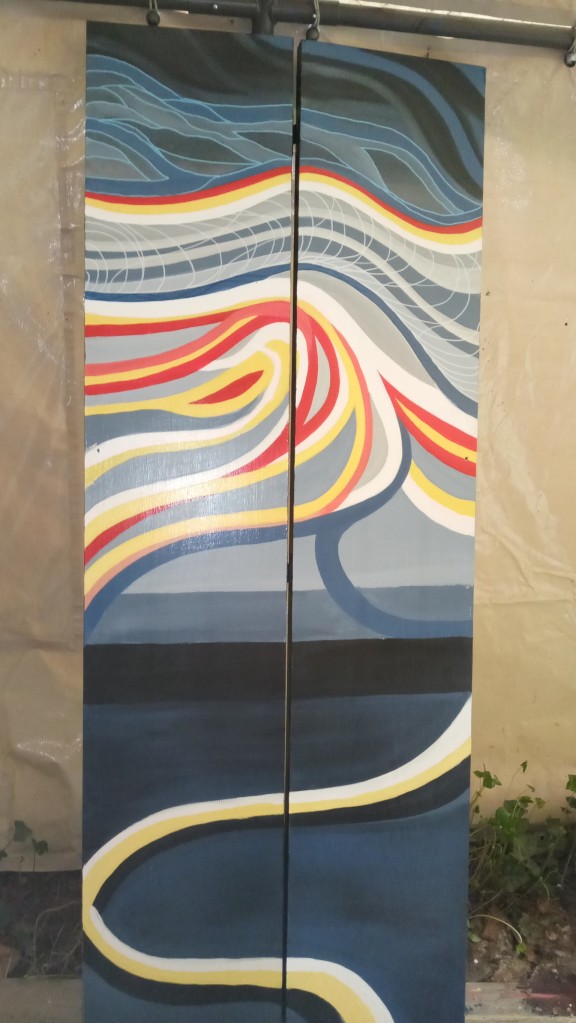
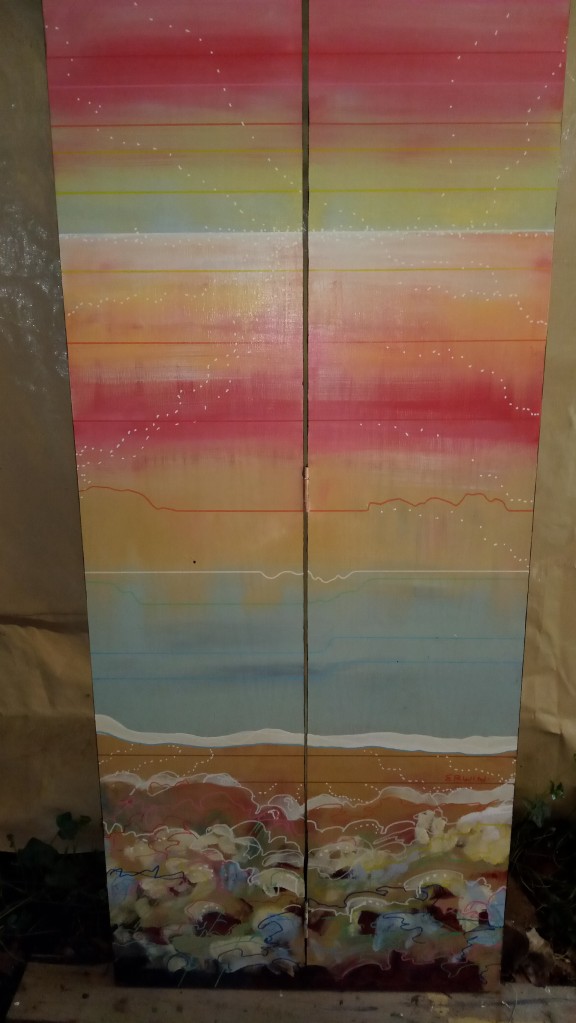
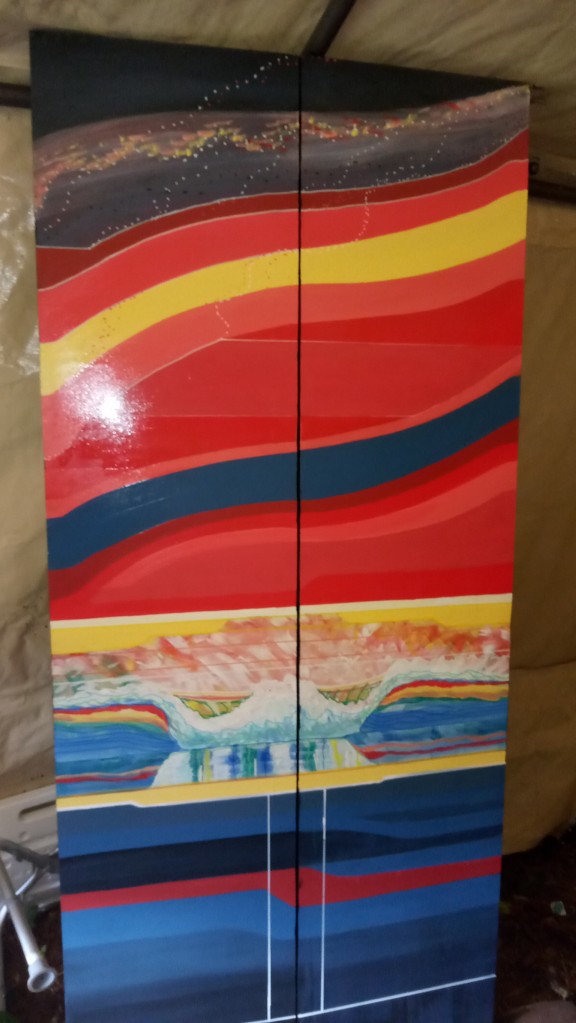
Trish wasI, as always, correct when she said I had become obsessed with these door panels I have been working on; four by-fold doors rescued/salvaged/pack-ratted from some job. My theory was, because everyone has limited wall space for art, these would serve as screens, or even, doors.

Yes, there’s an inside and an outside, and I kind of lost track of what was on one side when I was painting the other side. It wasn’t all, like, thematic. Maybe a little. Obviously I have some sort of fascination with waves. And color. I would start out, get to something that was not what I envisioned and… here’s the obsessive part; I would keep going until l was a high percentage of satisfied. The fear at some point is that I could then screw the whole thing up. A line too far. Or a color. Or… something.

I want to thank Joel and Rachel Carben, owners of the COLAB in Port Townsend, for allowing me to have my art in their space. Although I paint houses for a living, my artistic leanings have been toward drawing.

SO, I am not at all sure what to do with these panels now. Hanging out for three of the monthly Port Townsend ARTWALKS has reinforced my belief that marketing is not my strong suit. Not even close. SO, do I tell myself that the joy of art is in the process? That is true, but… but, but, but…

Captions: Stephen R. Davis approaching the wall of doors at the COLAB;Joel Carben and Steve; a framed painting that caused Steve to comment,”It’s nice that you’re finally going for fine art,”; various panels taken where they were painted (a Costco/White Trash garage). OHHH, and then there’s BIG DAVE.

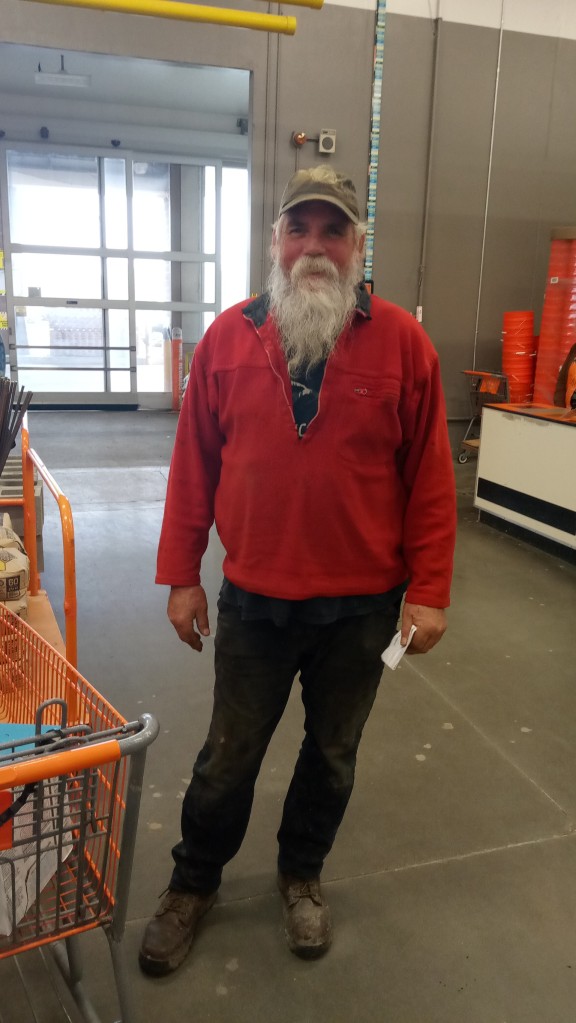
I took this a week or so ago at the Home Depot in Sequim. I had already heard a rumor that Legendary Surfer BIG DAVE RING was giving up surfing due to arthritis in his knees. I did write about this. The rumor was confirmed. *Sort of. Quickly, Dave was raised in Pacific Beach, San Diego, and was part of the pack of “Pier Rats” that included standout, Joe Roper. Dave, currently 66, was fourteen when I moved to PB in late 1971. I was twenty. Not a big talker in the lineup, not a guy who hangs out and chats it up on the beach, part of the reason I found out any info at all is because we have been mistaken for each other, as in: “I read your last thing on your blog,” to Dave, or “I heard you were ripping the other day,” to me.

Most of this was back when Dave was merely rocking a big-ass mustache. We both were riding big boards (Dave a 12′ SUP as a regular surfboard), and we both caught a lot of waves, from the outside, or scrapping for insiders. Dave is a master of the late takeoff and the sideslip, and plows through sections I would dodge..

A notable quote that got back to me was, “I rolled up and the Walrus and the Beast were both out. I went somewhere else. Though I’m almost more comfortable with being referred to as ‘That asshole wavehog, kneeboards on a SUP,” and I’ve been doing my best to increase the size of my mustache, I must agree with those who say Big Dave is the Walrus. Coo coo ca choo, coo coo ca choo.

*Having already, in a pattern that seems to hold true among older surfers, moved from popping up automatically, to knee boarding the takeoff and standing up after the first section, to kneeboarding the entire wave, Dave expressed little interest in belly boarding. “No, but…” I could tell Dave was imagining the perfect pre dawn session, sneaking out, lining up a few bombers.

“It is amazng,” he said, “what I’ve gotten done because I’m not always putting stuff off to go surfing.”

I get it, Dave.

EYE and LEG UPDATE- I’m finally through with the wound care for the gouge on my right calf. Pretty impressive scar. I am going to have my eye checked out on Friday, with surgery to remove the clear oil inside it, hopefully, scheduled for… soon. It isn’t as if I can’t work, it’s just annoying. I sort of attacked a woman in a parking lot the other day because she had a bandage over one eye. “Hey, what happened to you?” Different deal. Worse than mine. Nice conversation. ANYWAY, I did tell Trish that, because of the glare in the water, I might not surf until the oil in my eye is exchanged for (I asked) saline solution, that to be replaced by the proper bodily-produced fluid.

BUT, but, but… when I check the forecast…

Moving on. Back to another of my obsessions. After I post this, my plan is to get back to “Swamis.” I had friends attempt to read earlier versions. I know where I have to make changes, and I have been working on it. That’s my process. Evidently. Obsession, distraction; what we have to do and what we want to do and what we really really want to do.

Good luck with your obsessions.

Additions and Corrections and, Yeah, More

“SWAMIS” UPDATE- Working on it. Here is a quickie flyer for a fictional Newspaper. I can’t say that there wasn’t such a weekly paper back in the time my novel covers, 1969. My guess, yes. I do know, based on a story I heard, later, like 1971, when I went to work in the Big City, San Diego, from an older guy, that there were Free Clinics, or, at least, one. “So, I picked up this hitchhiking Hippie chick, and I’m thinking… you know, free sex and all that, and she says she’s trying to get to the free clinic.”

Also not related, directly: I noticed, on occasional trips south, in the narrow strip that is Mission Beach, a storefront law office that, real or imagined, seemed to offer free services. Hard to imagine that now. Parking, incidentally, was pretty much as bad then as it is now.

If writing, journalism or fiction, or drawing, or any form of art is someone trying to transfer imagination to paper or wood or film or any other medium, images stored and remembered are the critical ingredient.

Although I haven’t quite gotten to THE END of the fourth or fifth rewrite of “Swamis,” I do have plans, beyond it, for the main characters. The storefront law office might be part of that.

MEANWHILE, I am still recovering from cuts and an infection on my leg, the treatment keeping me out of the water for at least the rest of this week. SO, IF THERE ARE WAVES, I won’t be competing for them. GOOD LUCK.

SCREW UP of the day- I did write something, using Microsoft Word, filling in some omissions from my last posting. Halfway through this, I realized I hadn’t copied it. Not wanting to lose what I had, I… well, I’ll get back to you on what is partially “Guilty with an explanation” stuff.

In the “I’M NOT POLITICAL, BUT…” category, something about the delays in the trials of the former president, and the inability of some other citizens to see a grift when it’s reaching into their pockets, caused me to draw… this:

It’s already, liike, last week’s news. Ordinarily I claim all rights to my work, but, this time, in the spirit of freedom, free press, all that, if you want to borrow it… FEEL FREE.

Original Erwins in Progress, “Swamis” Again

Now that I am committed to putting out a new round of ORIGINAL ERWIN t-shirts, I’m going through my past drawings AND doing some new ones. I scanned these two on my printer AND I have two more illustrations that I have to take to a print shop. AS ALWAYS, attempting to go simpler, I fail.

LET’S DISCUSS THE SURF SITUATION on the Olympic Peninsula and the Strait of Juan de Fuca. NOT GOOD. Now, if you’re almost anywhere SOUTH of here, you should be scoring. AND the forecast is not too… thrilling. BUT I do have my HOBIE patched up and I’ve done some work on the MANTA. I’m ready to leap into some wind chop when it… let me check the forecast. Yeah, wind chop. That’s official.

As far as “Swamis” goes, I am committed to what JUST HAS TO BE a final draft before the ridiculously scary act of trying to actually sell the novel. I moved the former first chapter to the end, and though I am dying to write about what fictionally happened to the fictional characters between 1969 and now, I’m going to NOT… not yet.

My hope is that, now that I’ve completely mind-surfed the hell out of plot and characters, I might be able to cut the length down from the current 104,000 thousand words. HERE IS the new prologue and a bit more:

“SWAMIS” A novel by Erwin A. Dence, Jr.

                                    PROLOGUE

            Some events, terror and bliss, mostly, which occurred in seconds, in moments; those almost nothing in the expanse of time; expand, over time, into placemarks; a corner turned, a road taken, a life changed. Magic.

            Half a century after the events, I started writing “Swamis,” as memoir. It no longer is that. This is my fourth full rewrite, with so many discarded words, deleted chapters, all in attempting to turn notes and dreams, images and remembered dialogue, into a story. I have tried to do justice to the various people, characters here, but real people with real lives, who changed mine. There are people who have come into my life, changed it in some way, and gone out. Somewhere. For the most part I do not know where they went, but I do wonder. Wonder.

            The story centers on a very specific time, 1969, in a very specific place, North San Diego County. I was turning eighteen, in love, and the world I wanted swirled and revolved around surfing, and surfing revolved around Swamis.

            My apologies for my writing style. Years of writing briefs, documents. Dry, perhaps, but thorough. A friend’s review of an earlier draft concluded I went for detail and clarity rather than flash and description.

“I don’t use a lot of adjectives in regular speech,” I countered.

“But this is writing,” she said, “The prologue shouldn’t be an apology.”

“Honest.”

“Sure, and it is… your own voice. Yes, it is that, and, as your mother said, ‘the mind fills in the colors.’ Different thing, I know. Photos, stories; it still applies.”

“Not arguing.”

“Not yet. But… ambiguity and bullshit aside, you don’t exactly nail down who the killer was. Or killers were. Some detective novel, Atsushi.”

“It’s in there. And… doesn’t that explain the need for detail and clarity? And, more importantly, I never said it was that… A detective novel. Trueheart.”

“There’s no such thing as a seventeen-year-old detective. Not in real life.”

“It’s in there; that quote; in the text. And… as far as real life goes…”

“From your particular viewpoint.”

“That’s all any of us have.”

 “But… Joey… you called me a friend. ‘A friend’s review.’”

“Just another draft, Julie; I can… change it.”

“To what?”

“Keep reading. It’s in there.”

                                    CHAPTER ONE- MONDAY, NOVEMBER 13, 2023

            “The allure of waves was too much, I’m told, for an almost three-year-old, running, naked into them. If I say I remember how the light shone through the shorebreak waves, the streaks of foam sucked into them; if I remember the shock of cold water and the force with which the third wave knocked me down, the pressure that held me down, my struggle for air; if I say I remember anything other than my mother clutching me out and into the glare by one arm… Well, that would be, this all happening before the accident; that would be… me… creating a story from fragments. Wouldn’t it, Doctor?”

            “Memories. Dreams. We can’t know how much of life is created from… fragments. But, please, Joey; the basketball practice story; I didn’t get a chance to write it down. So, the guy…”

            “Locker room. After. I’m not here because of that… offense.”

            “I am aware. Just… humor me.”

            “He said I had a pretty big… dick… for a Jap. I said, ‘Thank you.’ All the Varsity players came in. Most stood behind him. He said, ‘Oh, that’s right; your daddy the cop, he’s all dick.’ Big laugh.”

“Detective,” I said. “Sorry about your brother at the water fountain, but I’m on probation already… and I don’t want to cut my hand… on your front teeth.’”

            “Whoa! Did that end it? Joey. Joey, are you… You’re remembering the incident.”

            “I tried to walk away. He… Basketball. I never had a shot. Good passer, great hip chuck.”

            “All right. So, let’s talk about the incident for which you are here.”

ALL RIGHTS to all ORIGINAL WORK by Erwin A. Dence, Jr. are reserved by the author/illustrator. THANK YOU for respecting these rights, AND, AS ALWAYS, for checking out realsurfers.net

“Stagefright” and “Swamis”

“And when he gets to the end, he wants to start all over again.” From “Stagefright,” lyrics by Robbie Robertson. Originally performed by The Band.

“I’d rather be clever than funny.” From “Swamis,” spoken by narrator, Joseph Atsushi DeFreines.

Throughout my third (or fourth) total rewrite of my novel I have been thinking that, when I get to THE END, an ending that was vague and unclear as I wrote; knowing that the denouement (I could just say finale) had to be unexpected, clever, AND another character had to die; I also believed that the changes I was making in an attempt to tighten the scope of the story, to focus on fewer characters in a shorter span; all this would tell me how to end “Swamis.”

And, last night, I got to THE END. Again.

EXCEPT, cleverness and conceit and the desire to produce a novel I can unreservedly be proud of continue to collide. IT’S FIXABLE. It just takes more work. Writing this piece this morning is my way of outlining where I have to go. ISSUES:

The events in CHAPTER ONE occur AFTER the timeline of the novel. Prologue that could be epilogue. Perhaps should be. EXPLANATION- I wanted the story to begin with surfing, with establishing JUMPER HAYES as a suspect in the murder of CHULO. I wanted to establish the narrator, JOEY/JODY/ATSUSHI as a non-local outsider longing to be in whatever culture there is in and around Swamis. I wanted to show that Joey had a romantic relationship with JULIA “Julie” COLE, and that the relationship was strained because of something Joey had done. BUT there was hope.

I have been rather insistent that the novel is told from Joey’s PERSPECTIVE, in his voice. It is not my voice. If “Swamis” is memoir, rather than being overly descriptive, Joey insists on clarity.

MY CONCEIT is that, because obsessive note taker Joey has chased down and documented leads, and has discovered who, from street level dealers to wholesalers to money launderers to detectives, was involved in the growth of marijuana as a cash crop in late 60s Southern California; and we, as readers, have the opportunity to be aware of the clues he has collected; when we get to the end, there is no need to further explain. DROP THE FILES and someone else works it out.

NOT THAT SIMPLE.

If I had intended the novel to be more surf/coming-of-age than mystery or ROMANCE, I have not, probably, succeeded. The love between Joey and Julie is the thread that goes outside the other boundaries of “Swamis.”

Speaking of BOUNDARIES; If 100,000 words is my projected boundary, and I kept track along the way, and I have already cut and moved a couple of novel’s worth of chapters and pages, most recently the PROLOGUE- good stuff; I am not ashamed of it, not sure where to put it.

It would definitely be easier to have thought of “Swamis” as two 65,000 word novels. While I am already considering a sequel, possible title, “BEACONS,” I must now see what must be done with CHAPTER ONE. So… Work.

THANKS FOR sticking with me, and… meanwhile, It may or may not be related to all the drawing I have been doing recently, my GORILLA HANDS clutching skinny ass pens and pencils, but I am dealing with this excruciating pain in my right hand that feels like, if I am clutching anything, all the blood in my body is focused on my thumb, and, if I poked, say, the end of it… Yeah; I can imagine how jokes could so easily be made of this. “Too bad it’s your thumb,” “Clutching, you say,” etc.

To provide more opportunity for humor, when I self-diagnosed with the help of the always-reliable internet, it seems the malady is nicknamed “Mommy thumb.” No, it’s because moms seem to suffer with similar symptoms from holding newborns. And no, I don’t see how that compares to my holding cell phones and writing implements. It is, essentially, tendonitis, and yes, when the swelling finally goes down… relief.

ANYway, since I have some actual painting projects coming up, with rest and Ibuprofen and a splint (which, happily, doesn’t seem necessary when typing), my hand’s condition will improve further by the time some actual waves find their way my way. I do hope you are getting the benefits of the atmospheric river.

Check on Wednesday; I may have “Swamis” dialed.


“SWAMIS” Excerpt Plus Flyer/Business Card for…

SO, JACOB WHYTE is the son of a cousin of JIM HAMILTON, a very interesting individual (timber-frame house builder/ski patrol/world traveler/more) who lives off Center (Road) and close to SURF ROUTE 101 in Quilcene. Jacob also has an interesting story. He has returned to Forks, Washington after an extended stay in California, Ventura area, during which he worked doing ding repair, most notably (to name droppers) for Channel Islands Surfboards, living frugally (growing his own food, that kind of thing), always, he says, planning to move back home to Washington State’s WEST END.

Now, the PEASANT thing: Jim, in asking (more like hiring/bribing) me to do some artsy stuff for Jacob, pondered the name. “Oh,” I must have said, “Maybe it’s like, you know, peasants, serfs, vassals, that kind of thing; I mean, like an allusion to… that.” “That would be… yeah, maybe that’s it.”

“It isn’t,” Jacob said when I actually got in phone contact, he at a far northwest secret surf location, me in the depths of a housing tract in East Bremerton. Didn’t matter, so much, I’d already done a drawing, black and white, printed a copy and colored it, either suitable as a flyer, or, reduced in size, a too-busy business card. “Yeah, Erwin, maybe the ‘serfboard’ thing is expecting too much of… surfers.” “Okay, how about the ‘serving the West End and the Olympic Peninsula’ part?” “Yeah. Sure.”

I ran a couple of other ideas past Jacob. Mostly about t-shirts; what would be appropriate, assuming surfers on the West End are not necessarily trying to invite more surfers over. I have ideas. LATER. It’s not like I can’t keep a secret.

  IN MY CONTINUED attempts to produce a decent drawing of the fictional JULIA COLE, or, actually, a portrait of any woman, I came up with this. Attempts and failures. I should throw away the versions that got me to this one, possibly more useful to depict Julia’s mother, and stick this in some file with the other failed illustrations. BUT, wait, maybe if I just… Yeah, I have some ideas. ALWAYS. And I always want to get… better.

CHAPTER FOURTEEN- MONDAY, MARCH 31, 1969- PART FOUR

The two carpenters were carefully walking between the Karmann Ghia and the edge of the bank. Lee Anne turned toward them. “Joey, this is Monty, lead carpenter on the project.” Monty was sunburned, with a receding hairline and an almost orange Fu Manchu mustache. Early thirties.

Monty stepped in front of Lee Anne’s car, put a hand on the other man’s shoulder. Black, muscular, no older than eighteen or nineteen. “And this is…”

“Not a carpenter. Yet. Helper. Nickname… Digger.” Monty had only left room for his helper to stand on the very edge of the bank.

Lee Anne looked at Digger, shook her head, looked at Monty, and back at Digger. “No. Unacceptable. You have to… insist… on a different nickname.”

“Temporary,” Digger said. “Thought I’d be something like ‘Hammer.’ Nope. Got to earn your nickname ‘round here.” Digger slapped at a pair of gloves folded over his belt. He held out his hands, palms toward me, rubbed two fingers of his left hand across the palm of his right. He slapped his hands together. “Could’a been callin’ me ‘Blisters.’”

Lee Anne extended her right hand but didn’t accept Digger’s. “Blisters,” she said. “Not good, but… better.”

            Monty gave Lee Anne a sideways nod and said, “Blisters, then.”

The younger carpenter had been rather boldly checking Lee Anne Ransom out. She looked him off with a quick widening of her eyes and a very stern expression. “Real name, please, for the record.” 

Blisters backed up, put his hands out and up, his arms closer to his body. If he was impressed with Lee Anne’s response, he wasn’t apologizing. “Greg,” he said. “Or Gregory.”

“Gregory, then.” She turned back to Monty. “Or Greg?”

“Greg, then,” Monty said. He pointed to the parking lot. “We heard the cop car, didn’t see it ‘til it tried to turn in. It wasn’t the brakes. It was… the gravel. New, like b-bs; no way he wasn’t gonna slide.” He turned toward me before he added, “No way.”  

The San Luis Rey Riverbed was probably half a mile wide. I had never seen the water more than a stream, a creek, even. The ground Monty and Gregory and Lee Anne and I were standing on was gravel and round river rock, with the usual scrub, some still green but rapidly fading grasses and weeds, and a few stunted trees. Taller trees in the center of the valley were mostly dead. Ghosts. Killed in the cycles of flood and drought. More likely flood. Drowned.  

Monty pointed to the stump in the river bottom, probably fifty feet from the base of the fill. “The concrete had been poured. The leftover rebar should’ve been fuckin’ gone.” Though no one asked, he added. “Contractors. Separate. Not our job.”

Lee Anne said, “Separate. Not your job.” She attached a telephoto lens to her camera, aimed it at the road on the east side of the valley, focused it, snapped a photo, and handed the camera to me. “So, after your dad’s accident; the traffic was rerouted… over there. Correct?”

The lens was out of focus for my eyes. I twisted the ring at the base of the lens as Lee Anne had. “Correct.” I turned the camera past the carpenters and toward the journalist. Distorted. Out of focus. I snapped a photo. “Accident.”

Lee Anne took the camera and advanced the film.

Gregory and Monty and Lee Anne and I were standing next to the concrete box. There was a galvanized pipe in, another, perpendicular, out. Gregory, now gloved, had a shovel, upright, in his left hand. “You see, all the rebar got pushed out the way by the car… except for one piece. Jammed against the… stump.” He looked at me. “You get me?” I nodded. “They cut it. The… stump. Little later. Fire department.” I nodded. “Like a bullet, it was. Through the door and right through the guy. I seen him, right after. He was alive and all, like he was trying to pull the rebar out. No fuckin’ way.”

“My father… the guy.”

“Yeah.” The shovel handle fell against Gregory as he moved his hands into a prayer position and raised them to his eyes. “Sorry, man. No disrespect.”

Monty stepped between his helper and the stump. “We were trying to get it loose. No way. I’m smacking the stump with a framing hammer, trying to get the rebar loose. Or, even, pull it through the stump. Something.”

“Then this other cop; tall guy, he showed up, slides down the bank, lights up a cigarette. He was laughing, says, ‘Shit, Gunny, your car’s still on its wheels.’” 

Monty turned to me. “Wendall. He stops laughing when he comes around, sees the rebar and the… blood. Not that much. Me and… Wendall, second later; we’re at the door. Your dad says, ‘Larry; could you tell Ruth…’ That’s all I got, ‘cause just then this Japanese lady, your mom, she shows up in…” Monty pointed to the Falcon before moving his finger toward the incline from the parking lot. “She slips as she comes off of the grade.”

“I ran over, helped her up.”

“You did, Digger; yes. Greg. Me and Wendall, Greg, too; we tried to keep her back, but she pushes between us, gets in the car on the passenger side. She seemed pretty… calm. Wendall wasn’t. Your dad says, ‘it’s fine, Larry.’ Wendall grabs the shovel.” Monty grabbed the shovel from Greg, thrusting it downward, hard, several times, into the stump until it stuck.

Monty was gasping for breath. “By this time, there’s so many cars, people, up, up on the highway. More sirens. I look in the car. The siren was off, but the light… it had popped off the roof, wire and all. It was still spinning; the engine was still… running. The, uh, your dad, he looks over at me, like maybe he knows me. He don’t.” Monty was breathing in gulps. “He looks at your mom. He says, ‘I always believed I rescued you.’ She reaches over, turns off the, the key, twists around, puts her arm, the same arm… around… him. And your mom kisses him, and she’s got blood… on her.”

Monty caught his breath. Most of it. “Then he, Wendall; he pulls me away from the window, pushes me back. He has this look in his eyes; it’s like he’s shaking his head, but he’s not. It’s just his eyes saying, you know, that it was over.”

The stump, somewhere around fourteen inches in diameter, had been cleanly cut with a chain saw. The part that had been removed was only a few feet away, visible in the heavy-bladed grass in a patch of green that surrounded the concrete box.

I looked at the slide marks and the crushed plants, the track we had come down. I imagined my mother coming down the bank, slipping, having to be helped back up. I imagined her in my father’s patrol car, reaching over, turning the key. I extended my right arm, moved it up until my hand was pointing up and at the highway. I moved my arm to the left, to where my father’s car slipped, sideways, on the new gravel. My flat hand represented the car as it slid, still sideways, to the bottom of the grade, plowing into the ancient river bottom, hitting the pile of rebar, one piece jammed into the stump, penetrating the door and my father like a bullet. I looked into the sun hanging just above the parking lot. I cupped my right hand, moved it, and then the left, above my eyes.

The shadow, the darkness, lasted but a moment. Another blinding light, and the spinning red light, and a vision of my father’s face as I passed him took over. Everything else was gone.

I was in shadow when the vision faded. I was on my knees. Gregory was directly in front of me. Monty was gone. I looked up toward the highway. Lee Anne Ransom, still in the light, had her camera aimed at Gregory and me. She waved. Gregory waved back as the reporter got into the Karmann Ghia and pulled away.

Gregory offered his ungloved right hand. I took it with both of mine. “Blisters,” I said as I stood up. “They turn into… callouses.”

“Not soon enough.”

“Gregory. How long?”

“How long you out for? Hmmm. ‘Bout a minute, I’d guess.”

I tried to remember what I had seen, or what I had imagined. Nothing. I remembered nothing. Not at that time. “Was I… shaking. I mean…”

“No, man; it was… weird; you were… it was like you was really… still. Like… church.”

“Did I… say anything?”

Gregory shook his head. I looked at him long enough that the motion turned into a nod. “You said ‘sorry’ a couple a times. Pretty much it. Hey, you good to… drive? I live in Oceanside, but I could…”

I followed Gregory to the corner between the parking lot’s fill and the established fill along the highway. Half-way up, he asked, “Who is… is there a… Julie?” My left foot slipped on the gravel. I caught my balance and continued up to the highway.

THANKS FOR READING. “Swamis” is copyrighted material, All changes are also protected. All rights are reserved for the author, Erwin A. Dence, Jr. THANKS for respecting that.

GOOD LUCK in finding the spot, the time, the right wave. More non-Swamis stuff on Sunday.

Another Long Chapter from “Swamis”

I probably should have split this into two parts. Thank you in advance for reading. You aren’t required to do it in one sitting. I apologize for annoying ads; it’s because, since I haven’t made any money on this (vanity?) project, realsurfers, I pay the minimum to Word Press. Hence, ads. I inserted a photo of, basically, the view from where Julia Cole’s mother’s house would be, to break up the chapter.

Though the manuscript (not a secret) lacks focus, mostly due to a stubborn desire to make side characters seem real, I have been trying to narrow in on the relationship between Joey and Julia. There’s more of that after the sunset photo.

SIDEBAR, with apology- The professor in a watercolor class I took at Palomar Junior College had a habit of grabbing my work before I was finished. “Done,” he would say. Of one painting I was ready to overwork and ruin, he asked if I loved the woman I was trying to render, his argument being that I should concentrate on shading and form, the pieces, or, since I lacked the skills for truly rendering an image, I could go for something impressionistic.

I don’t believe I’ve over-described Julia Cole, and since the narrator cannot know what she is thinking, we (presumptuously including you) have to rely on how she behaves. Yeah, like the way it should be. Maybe. Do I love Julia/Julie? YES, and if any character has to be real, complicated, vulnerable, tough, for me to consider her properly rendered, it is she. Or is it ‘it is her?’

CHAPTER THIRTEEN- SUNDAY, MARCH 30, 1969

            I didn’t get up early enough to surf. Rather, I didn’t leave early enough. I got onto I-5 from 76, got off at the Tamarack exit. Eight surfers out at the main peak in front of the bathrooms. Too small for Swamis, too crowded at the main peak at Pipes. I passed by the turn that would lead me to the grocery store, drove through the parking lot at Cardiff Reef. There were waves, but they were cut up by the shifting sandbars, chopped up by water flowing out of the lagoon on a big tide shift. Outgoing. Still, surfers were taking off on peaks, bogging down on flat sections the shorter boards couldn’t float over. I never got out of the Falcon, but I did stop, between cars, when a larger set hit the outside peak. The five surfers in the water were caught inside. Even that wave flattened out, split into two weaker peaks, and got wobbly in the outflow from the lagoon.

            Eleven minutes early, I parked the Falcon in the spot closest to the southwest corner, visible from the double door entrance. I grabbed three loose carts, pushed them together, and aimed for the entrance.

Weekends. Easter vacation. Excuses to go to the beach. A higher percentage of the customers at the San Elijo Grocery, Mrs. Tony’s to locals, seemed to be tourists, down or over from somewhere else. The state park across the tracks and the highway, extending along the bluff at Pipes to the lower, flatter area at Cardiff Reef, contributed customers. Suntan lotion and creams for sunburn, floaties and cheap shovel/pail/rake kits contributed to the independent grocery store’s bottom line.  

            Almost all the west, ocean-facing wall was glass. The view was of the road, the railroad tracks, the highway, the four-year old shrubbery that was just beginning to provide privacy for campers at the state park. The windows started at four feet from the floor, allowing for bags of dog food and fertilizer and compost, cheap beach chairs and portable barbecues, and extended twelve feet, four short of the sixteen-foot ceiling. The rolldown shades that only partially mitigated the afternoon glare were up.

The middle of three registers was empty. Mr. Tony was at the first register, his voice and laugh echoing off the exposed trusses and half-painted plywood ceilings, bouncing off the windows. He was just finishing up a story I had heard enough times to whisper the punchline as my boss revealed it to an obvious camper. “Can’t get that at no Piggly Wiggly!” Someone from the southeast was my guess.

            Mr. Tony dropped the smile when he saw me. I dropped my arms to my sides, slightly out from my hips, palms out, to show I was wearing the appropriate clothing: Chinos, sensible shoes, long-sleeved shirt with a collar, no hippie beads. My hair, over my ears for the first time in my life, was slicked back. I would wet it in the customer’s men’s room occasionally.

            I stepped toward the counter, ready to bag groceries. Mr. Tony handed the customer his change, watched me place the items in a bag, then nodded toward the back of the store.

            Halfway down the center aisle, I couldn’t miss hearing Mr. Tony with his next customer. “All these hippies. Kid’s thinking he’s foolin’ me with the hair; figures I’m okay with the duck’s ass, greaser look. Pretty soon the kid’s gonna look like a pachuco. Huh, Guillermo?”

            Mr. Tony and Guillermo both laughed. “Pachuco.”

            The grocery store’s office was behind the wall that held assorted beach and camping gear, tents and sleeping bags, lanterns. A string of Christmas lights, always on, framed the entrance to the storage area. A set of smaller lights framed a hand painted sign hung on the area’s most prominent post. “No public bathrooms.” There was always incoming freight in with the stacks of boxes and partial boxes of non-perishables the Tony’s had gotten a special deal on. Frisbees, hula hoops, tiki torches, garden hoses. Seasonal decorations were also stored there: Plywood Santas, American flags. There was a table for painting the paper signs for bargains and produce prices, bottles of red and green and blue and yellow paint, worn brushes stuffed in dirty water in an oversized pickle bottle.  

The door to the inner office was unpainted and unmarked other than a fading message in grease pencil. “Not a bathroom.” The door was almost always open because Mrs. Tony was almost always there.   

Mrs. Tony was sitting on the far side of her ping pong table desk, straight back from the door. Clear view. She had yelled “Jody” before I entered the storage area. She began moving aside stacks of invoices and customer account cards, each no less than a six inches high, to maintain her view. She looked up at the clock above the door, pulled out my card from the smaller of three stacks to her right, made a note with the pencil she kept in her hair, stabbed between the rollers and bobby pins and a scarf. Mostly red on this day, with white flowers.

“Jody,” she said again, standing up, “Did you see your apron?”

“Oh. I… get my own apron?” She looked at me as if I had said something rather rude or really stupid. “I mean, thank you, Mrs. Tony.”

“Yeah. Go help Doris.” She pointed through the doorway. “Good?” I nodded. I could see my Pee-Chee notebook under a stack of other papers immediately in front of here. She shook her head, waved her pointer finger. “I haven’t gotten a chance yet, Jody.” She glanced at the clock again. I checked it on the way out. 10:03.

Doris, late forties, about the same age as Mr. and Mrs. Tony, was ringing a woman up at the middle register. I walked up, trying to re-tie the cloth string on my new green apron. “Mr. Tony’s at the ‘so glad to see you’ register,” she said as I moved into bagboy position.

I looked over. Tony was talking to and laughing with a man, a bit older, dressed in a gray suit, fedora to match. There were no groceries on the counter.

Doris’ hair was also in curlers and covered with a scarf, hers in several shades of light green. Her customer was wearing a dark dress, with pearls, and what I had heard referred to as a ‘Sunday-go-to-meetin’ hat.’ The woman asked,  “Saving your good hair for your man, Doris?” Doris smiled and kept ringing up the groceries. Quickly, most of the prices memorized.

The woman nodded toward the man with Mr. Tony, both now at the front windows, each with a foot up on a pile of bags of dog food. She looked at the prepared pie on the counter. “We’re skipping the sermon, Doris, but we’re definitely going to the social.” She looked at me. “That’s where you hear all the good shit.” I did a sideways nod, tried to appear both impressed and mildly shocked.

“Right about that, Connie,” Doris said. She and Connie laughed. I nodded. I smiled. “Careful with Connie’s pie there… Jody.”

Connie looked at the name, hand sewn, in white, onto my green apron. “Jody? JODY. I’ve got a niece in Arizona named Jodie. JODIE.” I pinched a spot on the apron below the name. I pulled it forward. I looked down at it, looked back at customer Connie as if I might have grabbed the wrong apron.

Connie looked at Doris, looked at the total on the register, looked toward a tall, thin, metal shelving unit just to the right of the cash register, equidistant between the middle and south register, and attached with two strands of metal rope to a metal I beam post. Three wide, five high, each of the shelves contained an approximately even number of tan colored cards. The shelving unit itself was set on top of three wooden milk crates. With a metal gridwork inside to hold and separate glass containers, the crates were built to interlock when stacked, “Story’s Dairy” and “Fallbrook” was stenciled on the sides of each of the crates.

 Doris stepped toward the shelf. “Pie’s got to pass for homemade… JODY,” Connie said.  ”I have a nice serving dish, out in the car. Should work well enough with the hypocrites and sinners.” I looked at the pie, looked at the shelf Doris pulled the card from. Four down, middle. L-M-N. The pie wouldn’t pass. I nodded at Connie and smiled. She may have missed it. She was adding here initials to the card. “I meant the other hypocrites and sinners, of course, Doris.”  

Mid-day rush. I was rushing between Doris’s counter and Mr. Tony’s; bagging, smiling at the customers; smiling bigger when Tony said something that might not have been deservingly amusing or clever; smiles Tony had to know were fake, smiles few customers bothered to analyze. I nodded at customer comments, most of which didn’t concern the weather, did concern the damn hippies or the damn tourists or the damn surfers. “At least you’re not one of those,” at least one of the customers told me. Smile.

For the third time on this day, Mr. Tony used someone questioning my name as an excuse to break into his version of the Jody Cadence. “Jody’s bagging groceries, bringing carts back, too…”

Mr. Tony stopped, laid his left hand out and open, and toward me, and waited. This was my cue to join in the joke, add another line. This time it was, “At the San Elijo Grocery, the surf’s always in view.”

We did the “One, two, one two” together. Mr. Tony laughed. I tried not to look embarrassed. Part of the job. So glad to see you.

At two o’clock, Mrs. Tony came to the front to relieve Doris. She made sure I saw her shove my Pee-Chee folder into the shelf under the counter. She pulled an oversized watch with half of the wristband from one of the big pockets on her apron, didn’t really look at it. She made sure I got the message. Keep working.

There was a lull around four. I was at Mr. Tony’s register. “Joe DeFreines’s kid,” he was telling this customer, a regular, probably thirty years older than Mr. Tony. “Jo-dy. Joke. Marine Corps cadence, from… Korea.”

The man shook his head. “Army.” Mr. Tony stepped back. “World War Two, Tony, the durn leathernecks stole it. It’s… fact.” The man laughed, took both of his bags from the counter before I could move them to the cart, and held them against his chest. He took two steps, purposefully bumped into me with a shoulder. Friendly bump. “Good man, Joe DeFreines.” He took two steps more steps, and said, without looking around. “Tony’s okay, too, for a fucking Gi-rine.”

“Jo-dy,” Mrs. Tony, at the middle register, said, loudly, sharply, almost like someone calling cattle. Pigs, more like it, emphasis on the second syllable. She was holding my Pee-Chee notebook out and toward me, six customer account cards on top of it. She slid it, several times, toward the credit shelf as I approached. “Lots of regulars on a Sunday,” she said, “putting it on their tabs.” I took the folder. “You might want to learn some of their names.”

“I’m… working on it, Ma’am.”

Mr. Tony stepped toward us. Mrs. Tony gave her husband a message, eyes-only. Back off. He did. I set the Pee-Chee on the counter, spread the tab cards on top of it. Mrs. Tony said, “Ask your mother,” and turned away.

I reshuffled the cards, rearranged them, alphabetically, and put them away as quickly as I could. “It’s a lot of money, Mr. Tony,” I said, tapping the edge of the folder on the slight guardrail at the edge of the counter. “Lost Arroyo Investments. Are you… familiar?”

Mr. Tony looked at the folder rather than at me. He exhaled, popping his lips, slightly. “It’s not dirty. I guarantee you that.” He turned toward his next customer, one aisle away. “You ready, Honey?” She wasn’t. Not quite. Without looking at me, he asked, “You afraid to ask your mom?” Turning toward me, he read my expression correctly.

“Almost four-twenty, Jody,” Doris said as she returned to the middle register. “Your break. Take it or lose it.”

I acted as if I hadn’t noticed that Doris had removed the scarf and curlers and had brushed out her hair. Doris looked as if she wanted a comment. I was bagging, concentrating. Produce, one bag; ice cream, white, insulated bag; several cans of soup, bottom of double bag; one loaf of bread from a local baker, on the top; quart bottle of milk, TV Guide, straight into the cart. I gestured my willingness to push the cart. The older woman at the counter shook her head. Another church goer, I guessed, another dark dress with white pearls.

“Headed that way anyway, Ma’am. Mrs. …?”

“Not Mrs. anything anymore.” I stepped behind the cart. “Jackie, just Jackie.”

“Just Jackie, did you notice Doris’s hair?” Just Jackie turned and said something to Doris I didn’t hear; something Doris, self-consciously primping, pushing up the curls on one side of her face, seemed to appreciate. Doris gave me a different look when Jackie stepped next to me and set her purse into the cart. Embarrassed but appreciative, perhaps.  

            The shades across the front windows were a third of the way down, the sun just at the bottom line, the light half glaring, half insufficiently muted. Jackie kept one hand on the side of the cart as she and I walked. I was one set of windows from the main doors, even with Tony’s register, when I saw Julia Cole enter.

            It would be an over-romanticization if I said that, at just that moment, the sun, full force, dropped below the shade and Julia Cole was bathed in that light. Amber. That is how I saw it; pausing, stopping myself and the cart, and because I stopped, Jackie stopped.

            “I can manage from here… Jody,” Just Jackie said, looking at Julia Cole, looking at me, looking at Mr. Tony at the first register, looking back at me. I blinked, looked at Jackie. She was smiling as if she knew something about sunlight and amber and magic.

            Julia Cole, walking toward me, had her eyes on me. I was only slightly aware of Jackie pushing the cart toward her. Julia’s expression changed when she turned toward Jackie. Surprised, perhaps, at the woman’s expression. Still, Julia appeared to be no more than polite.

Julia Cole moved to her right, out of the glare. She stopped. She did not intend to walk any closer to me.  If it was a dare, I wasn’t taking it. I was replaying the previous seconds.

            Julia Cole was very close. She said something, not quite a whisper. I saw her lips move.

            “Ju-lie!” It was Mr. Tony’s loudest voice. “Surf up or something?” Julia Cole turned toward the voice. “Jody can take off and go if he wants.”

            “No. No, Mr. Tony, it’s not… that.”

            With Mr. Tony and Julia Cole in my periphery, right and left, I saw the silhouette in the alcove at the main doors. Only a hand and arm came out of the shadow. The hand was pointed at me. It twisted and flattened. Fingers out, the hand was pulled back. A summons. Duncan Burgess at the corner of the entrance alcove, just in the light, standing next to Julia Cole’s big gray bag.

            Julia Cole asked me a question. Before I could process, she repeated it. “Can you come outside? I mean, please.”

            I looked at my watch. 4:23. Break time. Ten minutes. I didn’t look around. I did hear Mr. Tony’s voice, mid-range volume-wise. “And how’s Christina and her little one?”

“Margarita. She’s… fine, Mr. Tony. Christine’s…” Julia’s laugh was surprisingly sharp. “Well, you know Christine.”

“Most popular bag girl we ever had.” Julia must have waited for the punchline. “And the worst.” Mr. Tony’s and Julia Cole’s laughs were several octaves apart; but perfectly synced, timing wise.

Julia gave me a look I read as meaning I was to go see Duncan without her.

Reaching under my apron and into my shirt pocket for the pack of Marlboros and the Zippo lighter, I headed for the alcove. I struck the wheel on the lighter at the point where the windows stopped. It flared up. Duncan noticed. I lit up as if this was normal. Duncan picked up Julia Cole’s bag, backed through the right-hand glass door and held it in the open position, allowing me just enough room to pass. I exhaled at precisely that moment.

Dick move.

            Duncan Burgess took a roll of photo paper out of the top of Julia Cole’s bag. He removed the rubber band, put it around his left wrist, unrolled and handed the stack to me. He watched me as I went through the first three pages.

“Contact prints,” he said. “Julie gets them… Palomar. College credits.” I nodded. Duncan looked at the cigarette in my right hand. He stuck out two fingers on his right hand. I allowed him to take the cigarette. I took the stack of photos. “Teacher likes her. Probably a pervert. Photographers. They all are. But… free developing.” Duncan took a drag, blew the smoke just to my left. “Julie takes… a lot of photos.”

Unlike the first three pages, 35-millimeter black and white images from sections of exposed negatives, the fourth, fifth, and sixth pages were almost full-page images of Chulo, in his rough and dirty evangelizing robe, and another man, taller, in a robe, barefoot, his left arm in a sling, leaning to his right on a single crutch. Jumper. The mid-section of the Jesus Saves Bus was behind Chulo and Jumper. The image of Jesus was between them.  

I looked at the second three pages, shuffled the first three in behind them, and studied each of the larger images. “Chulo is smoking,” Duncan said, moving to my right side. I looked at my cigarette between the fingers of Duncan’s left hand. He took another drag. “Next photo…”

In the next photo, Jumper’s crutch was falling away as his right hand was knocking the cigarette out of Chulo’s mouth. “Julie said they’d been arguing. Like, quietly. Check out the third enlargement. See? She zoomed in. Jumper is pulling something from a pocket of his robe, handing it to Chulo.” Duncan put his index finger on the photo. “There. See?”

Duncan took my cigarette out of his mouth and offered to put it in mine. I declined, possibly backing away too quickly. Duncan blew smoke between me and the photo. Dick move. Payback.

“You can’t see it.” It was Julia Cole. She had come out the entrance door and was looking over Duncan’s shoulder and directly at me. I looked away from the photo and looked directly at her. “They weren’t arguing,” she said. “Not exactly. Chulo was… he was crying.” I blinked. Julia Cole blinked.

Chulo, in the last photo, was smiling. And crying. Jumper was smiling. I let go of the papers with my right hand, allowing them to roll up against my thumb.      

“Actually, Julia Cole, I think they both were… crying.”

Julia Cole smiled. I lost focus on Duncan Burgess, directly in front of me, and everything else. “I do think so,” she said. “You’re… right.”

I would like to believe, and still do believe, that Julia and I froze for the same number of seconds. Her eyes were alive, studying mine, and mine, hers.

“Hey, Junior…” Duncan came back into focus. “You gonna help or not?”

“Not.”

I stepped back, handed the roll of photos to Julia. Duncan stuffed the cigarette butt in among many others in the waist-high concrete pipe ashtray at the side of the entrance door. I tapped my watch. “There’s nothing I can do, and… and my break’s over.”

Julia and Duncan exchanged looks. If Duncan looked angry or frustrated, Julia looked disappointed. She held the roll of photos upright, spun it in little circles, looking past it. At me. Disappointed, angry, resolved; then neutral, then a ‘Fuck you, then,’ Julia Cold look.

Duncan moved between Julia and me. He removed the rubber band from his wrist and double wrapped it around the roll of photos, giving Julia Cole a ‘told you so’ look. He turned toward me; moving his face closer, too close, to mine. I didn’t step back. I was trained not to. Duncan made a growling sound as he pushed past me and though the exit door.

Mr. Tony met Duncan ten steps in. Tony gave him the same side hug he had undoubtedly given Julia. “How’s your dad, Yo Yo?”

“No one calls me that, anymore, Mr. Tony, but… he’s, um, better.”

“You’re excited for prom and graduation and all that, I expect.”

“Can’t wait.” Disingenuous.

Mr. Tony slapped Duncan on the back. “Oh, come on, Duncan!”

Julia Cole stepped closer to me to allow a couple, tourists, possibly newlyweds, with matching sunburns, to keep holding hands as they entered the store. She looked past them and at Mr. Tony and Duncan and the couple. The door closed.

“So, Miss Cole, you’re… angry?”

“I had no… expectations. It was Duncan.”

“Oh? But… why does… Duncan… care so much?”

“He has his reasons.”

“You don’t ask.”  

            Julia Cole turned toward me. Her expression said, “I don’t need to” before she did.

            I wanted to keep Julia Cole talking. I wanted her that close to me, close enough that the only thing in my field of vision was her. I was more aware than usual of my pauses, the lapses, the seconds I spent replaying previous seconds, trying to remember, trying to catalog exactly what she said, and how she looked, exactly, when she said it.

            “I had one,” I said. “Yo-yo. Duncan.” Pause. “Sparkly.”

            “We all did. Phase.” Short pause. “Sparkly? Yours?”

            “Mine? Yeah. Sparkly.” Pause. “Walk… walk the dog.”

            “Basic.” Pause. “Good trick. Easy.”

            “Yes. The, um, trick… the one I liked… most, was…” I moved my hand up and down a few times, palm down, then flipped it over, pantomimed throwing the yo-yo over my fingers, then flipping my hand back over. “It’s like… switching stance.”

            Julia Cole was staring. I was a fool. Ridiculous. She smiled. Politely. “It… is.” She held the smile longer than I could comfortably handle. She was studying me. I looked away, politely, allowing her time to drop the smile and continue the studying. “What do… you think?”

            I pointed at the roll of photos. “Chulo smokes. I believe Jumper… maybe he doesn’t. Or… he quit.” I pulled out my father’s lighter. “Zippo. That’s… a guess.”

            “Zippo?”

            “Marine Corps logo. Maybe, if you enlarge it, the image, more…”

            “I will.” Julia looked appreciative in the moment before she looked past me and into the store. I took the opportunity to look at her. When she seemed to sense this, I looked where she was looking.

Duncan and Mr. Tony had moved just beyond the first counter. Duncan pulled folded bills from an inside pocket of his windbreaker. “On account,” he said. Mr. Tony took the cash, pulled out several account cards from the rack, top left box, A-B. He shuffled through them, set one aside, took his pen out of his shirt pocket, wrote something on the card and showed the card to Duncan. He looked past Duncan at Julia Cole and me. I looked away. None of my business. She looked away and toward my car at the far end of the lot, then back at me.

That may have been that lapse, the pause that caused Julia Cole to speak. “I have… other photos. Negatives. I could… How late do you work?”

I refocused on Julia. “Today?”

She didn’t wait through the guaranteed pause. “We saw all the red lights, Swamis, from my, my mom’s house. Cops. Fire engines. We went down. It was… you don’t get it, do you, Junior? That… night. After…”

            I didn’t get it. Julia Cole looked frustrated, even irritated.

            “We saw it. Saw… it. It. Chulo. Portia. Gingerbread Fred was still there. Everything. It was… I just thought… maybe… you… might…”

I wasn’t keeping up. There was something in my mental image file, the view from Swamis and up the hill. It was a photo in an old Surfer magazine. In color. Maybe it was a cover photo. “From my mom’s house” she had said. It would have to be…

“What is… wrong with you?”

Julia Cole moved a hand over her mouth the second after she asked that question. All I could see was the back of her hand and her eyes. All I could hear were the words. “What is… wrong with you? What… is… wrong… with you?”

Three seconds, ten, I have no idea how long I was staring at Julia Cole. She was backing away and into the parking lot. I backed into the edge of the exit door. I took my eyes off Julia Cole, spun around, and pulled it open. Duncan and Mr. Tony both looked in my direction. In twenty-one steps I was even with the counter, with them. I stopped, pivoted, ninety degrees right. “Duncan Burgess, do you know Jesus?”

I pivoted back. I walked to Doris’s counter, everything slightly out of focus, unaware she was speaking. I grabbed a bundle of San Elijo Grocery paper bags, ripped off the paper ribbon that held them together, stuffed as many as I could into a shelf at Doris’s knee.  

            Doris put a hand, flat, on my chest. “So, Joey, I figured, I don’t have a man at home… currently; why not let my hair… down?”

I looked at Doris, tried to smile. I looked to my right. Duncan was gone. Mrs. Tony was at her husband’s register. Mr. Tony slid the account card and Duncan’s cash toward her. “Two-fifty-five on Burgess.” Mrs. Tony opened the register, took the bills from her husband, and began counting them. Mr. Tony looked at me. Mrs. Tony looked at him. Both looked at me before I could turn back toward Doris. What was wrong with me?

Doris looked at Mr. and Mrs. Tony. Her expression was hopeful. That’s what Julia’s expression was. Had been. Hopeful. Optimistic. Temporarily.

            “What is wrong with me,” I whispered.  

“Doris; you look… gorgeous.” Mr. Tony’s body language, the raising of his shoulders, suggested he was suddenly aware the compliment had been in his loud voice. He didn’t turn toward his wife for her reaction. He walked toward the front windows.

Mrs. Tony, walking toward Doris and me with the draw from the other register stuffed in one of the pockets of her faded green apron, stopped and looked at her cashier. She looked over at her husband, a shadow in the glare, as he used the pulley to lower the first of the window shades all the way down. Mrs. Tony touched her own hair, let out an only slightly exaggerated sigh, and pointed at me. “Julie. Beautiful girl, huh Jody.” I couldn’t respond. “The money; ask your mother. Huh?”

“Okay.”

“Okay.” Mrs. Tony turned toward Doris. “You look… nice… Doris. Even… gorgeous.”

“Oh? Oh, I… I was just hoping I’d look… okay.”

“Better than,” Mrs. Tony said.

 …

            It was nearly sunset when I walked across the parking lot. 6:32. Daylight savings time had kicked in and the sun would set, officially, at 7:13. The tourists and inlanders and visitors and customers were all headed elsewhere. The wind was, if anything, slightly offshore. There was time to catch a few waves if I made a quick decision and went somewhere close.

 Something was stuck, face up under the driver’s side window wiper. It was a flyer for an Australian surf movie. “Evolution.” There was one on the bulletin board on the wall between the entrance alcove and the window wall. Or there had been one. Friday, April 4, Hoover High School, seven pm. Saturday, April 5, San Dieguito High.

There was something under the flyer. More pages. Seven. Photo paper. Stiff. Slight curl. Slightly damp. I looked at the images as if they were flash cards, moving each to the back of the deck, going through them again and again. The photos were so dark that the artificial light of camera flash and flashlights and headlights burned out any details: Firefighters and cops, Dickson and Wendall; a woman in a robe holding back Portia. One photo showed the unmistakable anguish on Portia’s face. Another was of someone’s body, burned, against the wall. In another, the body was being covered with something more like a tarp than a sheet. In the last photo, Gingerbread Fred was on his knees, looking up. Up.

            “Tear in the shroud, “I said.

            I couldn’t look at any of these images for more than the time it took to move to the next photo. I couldn’t allow any of these images into my memory, a file too easily pulled. Too late. It was imprinted, permanently. I could describe each of the photos now in more detail than the actual photographs showed.

            That was what Julia Cole had seen, witnessed, photographed. I tried to look again at each of the enlargements. It didn’t work. All I wanted to see, or imagine, were Julia’s expressions when she was trying to tell me about that night; how sincere, raw, honest she looked; how beautiful. All I wanted to do was collapse.

            I didn’t. I went through my ring of keys, separated the one for the Falcon, I rolled up the pages. There was a note on the back of the flyer: “Portia said you are your father’s son, and you might help. I have more…” Out of room, the words went sideways. “…waiting… for you.”

I looked around the lot. Julia Cole wasn’t there. Of course, she wasn’t.

            Vulcan Avenue runs parallel to Highway 101 and the railroad tracks, and in front of the San Elijo Grocery. There were several cross streets. I took one, went up two blocks, turned left. I looked at the houses, looked toward the water. I went up another block, headed south again. I stopped at the middle of three empty lots, the place where the best view would be. Optimal view. Surfer magazine view. Swamis Point.

Two houses farther south, on the uphill side of the street, a VW mini-bus, grey-green, white top, was parked in front of a house. “Julia’s mom’s house,” I said. Partially hidden by the VW and some shrubs, the back of the Jesus Saves bus was parked in the driveway. “Portia said you are your father’s son, and you might help.” I repeated the phrase. “Waiting… for you.” Me.

            A light went on inside the house, behind the sheer curtains. I drove on. I pulled a u turn at the end of the block, coasted by again before I dropped back down to Vulcan and turned right. When I got to D street, I turned left. The Surfboards Hawaii shop was on my right. There were no cars on the block, either side. Several storefront businesses were on my left. David Cole C.P.A. was one of them. No lights. I got to 101 and turned right.

At Tamarack, parked on the bluff, lights to the south to lit the underside of the clouds. There were black lines on a dark ocean in front, breaking from a peak, gray soup to a gray beach. The rights looked better than the lefts. Still, I was replaying phrases. “You are your father’s son.” Portia. “What’s wrong with you?” Julia. “Waiting for you.” I reread the note that had been on the windshield by the light of my father’s flashlight. I straightened the photos, without looking at them, and placed them in a yellow notebook and slid that into a PeeChee.

I stayed on 101 until it curved away from the beach. Carlsbad Liquor was on my right, still open. Baadal Singh’s truck was parked nearby. “Gauloises bleus,” I said, out loud. “Picasso smokes these.” I considered stopping in, possibly buying a pack. I didn’t.

“Swamis” and all revisions are copyright protected, all rights reserved by the author, Erwin A. Dence, Jr, Thanks for respecting this, and for reading,