More to Being Local than Location

Left to right: Randy Bennett, George South, Abner Agee, Kent Sunday (aka Cheetah), a Tom LeCompte (RIP). Photo courtesy of Abner Agee by way of Tom Burns.

TEXT from TOM: “Back in ’74 when I came up here. I discovered Westport, my locale ever since. Back then, this was the crew. All these guys had tales to tell of the old Grenville days. TODAY only Cheetah still surfs and now lives in Sequim. He spent 30 years in the Coast Guard as a rescue swimmer. The last ten years at Cape Disappointment where he flung himself out of helos on the Columbia River bar to rescue and recover victims. The stories he had!” Has, not to correct Mr. Burns.

Readers of “Surfer’s Journal” are aware that a portion of each issue is devoted to old stories from back in some simpler time; less crowded, for sure; the remembrances, possibly, sanitized, negative aspects edited out, joyful moments, again, possibly, enhanced.

In my advanced age, I’m as guilty of this as anyone. I’m a couple of weeks older than Seahawks head coach Pete Carroll, and really close in age to TOM BURNS. So, yeah, old-ish.

NOW Tom has stories, only some of which overlap with mine. AND YES, he has a story about running into Pete Carroll on a dawn patrol, in some not-distant past, in the parking lot at Westport. “Wait, Tom, Pete surfs?” “Sure. He asked me how the surf was. I said, ‘Well, Pete…'” “Okay. Makes sense.”

What is different about Mr. Burn is that he remembers names, even names of surfers he has met on the Strait. “That guy, ‘Dumptruck Dave…'” “Big Dave.” “What about ‘Tugboat Bill’ and ‘Concrete Pete?'” Yeah, those guys. Haven’t seen either in a while. We’ll run into each other again.” “Sure. Say ‘Hi’ from me. And, hey, what about old…”

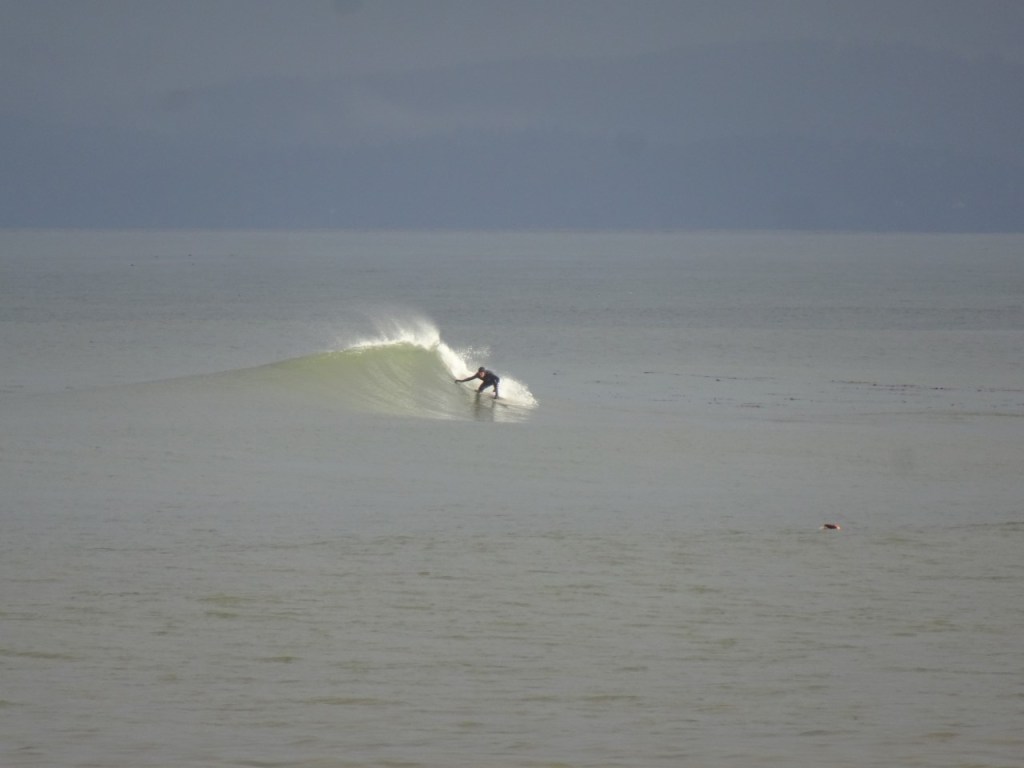
Here’s more texting from this week, Tom doing some of his yearly hanging out and surfing down in Southern California, hitting San O and Doheny on 0dark-thirty strike missions: Ya know, Erwin, in my surfing Westport for close to 40 years, the place I held pretty close to my heart died in 1991 when beach erosion took out the bathhouse, the fog horn, and broke through the jetty at the corner, destroying one of the best waves on the coast. After beach nutritionment the break became like today, inconsistent and, like today, as more folks venture into my old locale, I find it hard to find any solace in the place or even the wave that used to exist there. But back in the days, there was no other place I loved to surf more. April ł987, a great day at the jetty. I was riding a 6’9″ Barnfield and bagging rides like this all day on a great swell. Jim Wallace took this pic of me on that day.

When I texted back that I was sitting in a lot overlooking a cove where I first saw waves in Washington State, 1978, and it was almost, almost rideable, Tom texted back that, even in California, “No waves for me today. No swell and a funky wind. It’s San’O tomorrow!” The next day, I drove farther, got skunked. I didn’t bother to tell Tom about it.

POSSIBLY related side story- I had a dream in which, possibly, I was imagining, or changing a scene from my manuscript for “Swamis.” A surfer comes up to some locals, all of them in their mid-teens, in the parking lot, tries to join in, says he just moved into Encinitas. The locals shine him on, quite rudely. When he persists, Duncan or Rincon Ronny, himself a transplant, says something to the effect of: “It takes more than just being local to be a local,” to which the non-accepted surfer says, “Surfing is just like high school… only worse.” Not a scene that’ll make it into some final draft, but the narrator, Joey, whispers if he doesn’t say it out loud, “More like Junior High.” THEN Joey also avoids the newcomer.

I will be posting the last Chapter 12 subchapter on Wednesday. Chapter 13 is way shorter.

MEANWHILE, remember what you can about your surf adventures, maybe the names of some of the folks you run into (not, hopefully,, literally), on the beach or in the water. Then, later… stories.

A Horrific Tragedy AND “Swamis,” Chapter 12, Part Three

I really can’t take too much of the coverage of the Hamas/Israel War. It seems as if a surge in violence was predictable and is reminiscent of historic struggles worldwide. The outcomes, however, have varied. Watching MSNBC at the top of any hour guarantees more tales of terror. One analyst, representing this or that organization studying and/or promoting world peace said he expects the situation “Will get worse before it gets even worse.”

The gesture humans have for wonder, whether we are defeated, shattered and questioning; or we are grateful for some hoped for, possibly undeserved, unexpected gift, some surprisingly marvelous ride on a miraculous wave, for example, is the same. The sentiments behind the gesture could not be more different. Opposites Answers and solutions are rarely forthcoming.

“SWAMIS,” CHAPTER 12, PART THREE- SATURDAY, MARCH 29, 1969

            All the surfers and non-surfers in the parking lot were in little groups, locals and non-locals, around vehicles or along the bluff. I was writing in a red notebook on the roof of the passenger side of the Falcon. Petey Blodgett and I were the only ones who looked up or over at the stripped-down and noisy red VW bug with flared fenders, primed with red oxide, going down the far side of the lot, counterclockwise, two people inside.

            Petey Blodgett turned toward me, nodded, mouthed “Dickson,” His expression had turned the name into a question. I nodded. He whistled, one sharp, three note blast, and made a sort of ‘circle the wagons’ gesture with both hands. Everyone looked at the VW. The younger kids started loading into the Mercedes. Ronny and Duncan looked at me before, in a pace that didn’t appear as casual as they may have hoped, they headed for the Morris Minor.

Julia Cole stepped into the bluff side lane and followed the VW with her camera. When it got to the far end of the lot, she put the camera into her bag. She said, “Cardiff,” to Petey and grabbed Monica’s arm. They hurried, together, Julia Cole’s bag almost bouncing on the pavement, to Ronny’s car. Duncan held the passenger side door open, allowing both girls into the back seat. 

The two detectives, Wendall and Dickson, got out of the VW. They straightened their suit pants, buttoned their coats, and walked forward, very slowly. Dickson had a portable radio in his left hand. He raised it, said something, and lowered it again.

The Mercedes, with four boys and Petey Blodgett, backed out and pulled forward. The Morris Minor backed out. Julia Cole, passenger side, back seat, looked at me as the car passed. Duncan may have. I was looking at Julia. She didn’t blink, didn’t move her head. Her eyes moved, left to right. Two seconds, maybe, watching me. Watching me not move.

            Two vehicles, almost instantly, moved from the middle row to the front row. Second tier, now first. Three more surfers headed for the stairs.

            With my own fake casualness, I lifted the Falcon’s tailgate, cranked up the back window, locked it. I walked to the driver’s door, opened it. I looked around. I heard three distinct Sirens. One was a two-syllable yelp, the other two sirens, three. A Highway Patrol motorcycle and a patrol car, and one cruiser from the Sheriff’s Office, red lights going on each, were blocking the Swamis lot at 101.

The Mercedes and the Morris Minor pulled quick u turns at the original lot and parked next to each other in the middle row, as close to 101 as the blockade allowed. I got in the Falcon, closed the door, set the tape player on the floorboards, set the red notebook on the dashboard next to my father’s oversized flashlight.

The four boys got out of the Mercedes and started running circles around the car and then around other cars. Ronny and Duncan got out of the Morris Minor. Julia Cole got out and started unstrapping boards on the rack of the Mercedes. Monica got out and loosened the straps on the one board side of Ronny’s racks. Julia placed her board on the rack and reattached the straps. Monica resecured the straps on the Mercedes.

Petey Blodgett got out of the Mercedes when the Sheriff’s Office cruiser pulled in front of his and Ronny’s cars. The Highway Patrol motorcycle pulled in behind them. The officer got off his motorcycle, removed the glove from his right hand, and shook Petey’s hand.

            Wendall and Dickson were hanging back. Wendall stopped at the edge of the bushes. He disguised taking a leak by lighting a cigarette, his back to the south wind. Dickson took several steps into the open area and raised his walkie-talkie. There was a loud squelch. Wendall took the radio from Dickson, said something into it. Squelch. Both detectives looked at me. I lowered my head.

            I pushed down the vertical knob on the front driver’s side door. As I was reaching over to lock the front passenger door, Detective Dickson opened it. He almost threw himself forward and onto the seat. He reached down and put a hand on my tape deck. With some grunting, he pulled himself and my tape deck backwards and out. He ripped out the loose, overlong, taped together wires from the back, set the player on the edge of the roof. He squatted, his eyes level with mine.

“Obviously stolen,” Dickson said before stepping back and standing up. He flicked two fingers toward the obviously stolen tape player, laughed as it fell to the asphalt. He leaned back in, reached for the red notebook. I pulled it toward me.

“Not obviously stolen, Sir. And, if you don’t have a warrant or a compelling…”

            “Suspicion? I do.” Dickson was pretty much out of breath. He, quite awkwardly, dropped to one knee, on top of the tape deck. “Bet you can quote me the law. Huh, Jody?”

            “Not verbatim, Detective… Sergeant Dickson.”

            “With so many of these tape decks getting stolen,” Dickson said, “it’s really hard to figure out who to get them back to.”

            “I would guess so.”

            “No, it’s under control,” Wendall, just outside the driver’s door, said into the walkie-talkie. He tapped the radio’s antenna on the window. Three times. I must have turned toward him too quickly, looked at him too hard. He slid the radio’s antenna across the glass. “Out.”

            Wendall moved with the door as I opened it. He remained just on the other side of it as I got out. He was looking over the Falcon. Deputy Wilson and a very tall Highway Patrol Officer, standing by between the Mercedes and the Morris Minor, were waiting for further instruction. “This isn’t a game, Jody,” Wendall said, still not looking directly at me.

 Monica and Duncan and Julia Cole and Rincon Ronny were taking a cue from Petey, looking quite casual, but they were all, definitely, looking at me.

“Kind of looks like a game, Detective Wendall… Sir.”

“You’re not helping here, Jody.”

            Dickson pushed the tape deck into the traffic lane with a series of short kicks. “So, Jody, sales receipt?”

I didn’t respond. One of the dawn patrol gremmies was hanging on the racks on the Mercedes. Duncan pulled him off, the kid’s legs pumping. Petey was laughing, chatting with the Highway Patrolman, his hand on the Officer’s shoulder. Three of the four boys were sitting or leaning on the hood of Petey’s Mercedes, looking, if anything, bored. Deputy Scott Wilson was looking at Julia Cole. Monica and Duncan and Ronny were looking at Deputy Wilson. As was I.

Julia Cole, her knees bent, was leaning over the hood of the Morris Minor. Her telephoto lens was aimed at Dickson and Wendall and me. Wendall yelled, “Hey!” He threw out both hands, more in front of his body than straight out. He waved the radio. It was a ‘this is serious’ gesture meant for the motorcycle officer and Deputy Wilson. The CHP Officer shook Petey’s hand and signaled his compatriot in the cruiser. He tapped Deputy Wilson, still watching Julia, on the shoulder. The deputy looked at Julia’s friends, all giving him the same smile. He acknowledged this with an expression I didn’t see but could imagine. Busted.

Julia Cole stood up, never taking her eyes off Wendall, Dickson, and me. She held her camera with the telephoto lens facing up and made four upward thrusts with it. An unmistakable gesture.

I chuckled. Wendall chuckled louder. Dickson wasn’t amused. “Stay away from that one, Jody,” he said. “A regular prick teaser.”

“She’s seventeen years old, Detective Dickson. Sir.”

“Yeah,” Dickson said, jabbing his right hand, in a fist, toward me. Close. I didn’t flinch. He turned toward Wendall. “That is David Cole’s daughter, isn’t it, Larry?” Dickson didn’t give Wendall a chance to answer. “David Cole’s… other, older daughter; she’s the slutty one. Right?” Dickson’s expression was more of a sneer when he turned back. “Surfer girls, huh, Jody?”

Wendall set the walkie-talkie on the roof of the Falcon. He pulled the flashlight from the dashboard, smacking the palm of his hand with it several times. “Gunny… your dad, he didn’t like the ones we were issued.” Wendall turned it on, shined it into my eyes. “Not… impressive enough.” He maneuvered the light into the car, shone it onto a light blue lunch sack in the middle of the bench seat, then turned the flashlight off, handed it to me, smiled. “Lunch, huh?”  

I stuck the flashlight back onto the dashboard, took out the light blue lunch sack, set it on the roof. “Habit,” I said. “I could get something at Mrs. Tony’s.”

“When does your shift start?”

“Not yet.”

            Dickson walked over to the tape deck. “You wanna pick this shit up, Jody?”

I stepped toward the back of the Falcon, lit up a cigarette with two matches from a book with “Fallbrook, The Friendly Village” on the cover.

Dickson kicked the tape deck as he walked around the front of my car. “So, Jody, your mother know you smoke?”

I opened the lunch sack. I pulled my father’s lighter, a small tin of lighter fluid, and a tiny cardboard box of flints. “Evidently.” I opened the top of my father’s lighter, flicked the wheel. There was a brief flame. “I’m going to add the fluid… when I get a chance.”

Wendall took out a cigarette from a pack in his coat’s lower right pocket. “I know your mom didn’t supply… those.” He pulled out a matching Zippo, held the side with the Sheriff’s Office logo toward me, and lit my cigarette before lighting his own. Camel, non-filter.

Dickson came closer to me. The Sheriff’s Office cruiser passed us, followed by the Highway Patrol motorcycle. Wendall and Dickson gave very informal salutes. “So, Jody,” Dickson said, looking at the locals, all still hanging outside the two vehicles, “You popular around here with the hippies and the… surfers?”

“Not at all. Is the… show over?”      

“Think so, Jody,” Wendall said, “just making our presence known.”

“To what end, Detectives?”

Wendall puffed up one cheek, coughed, blew out some air. The portable radio on the roof of the Falcon squawked. A woman’s voice, distorted, said, “Wendall, Vista sub, come in.”   

I slid over and grabbed it. “Betty Boop,” I said, “It’s Joey… Jody; lots of fun here at Swamis. Over.”

A man’s voice came over the radio. “Wendall. Is this a joke? Wendall.”

I almost dropped the radio. Dickson shoved me from the side and grabbed it. Wendall took it from him, stepped away. “No. Not a joke. It’s under control. Over.”

“Put the kid on. Over.”

Wendall, shaking his head, stepped toward Dickson and me. Dickson put his hand on my left shoulder and looked over me, toward the cars and the locals. “I’m going to do you a favor, Jody,” Dickson said, removing his hand and smiling as he punched me; short, straight jabs; very quickly, in the solar plexus. Just the way my father taught me. And him.

My cigarette had landed on Dickson’s shoulder with the first punch. I put a hand on his left shoulder, for balance after the third and fourth blows. After the fifth and sixth, Dickson brushed the cigarette off, removed my hand from his shoulder, took the radio from Wendall, held it up to my face and said, “Just say ‘thank you,’ Jody.” He pushed the button.

“Thank you… Sir. Over.”

“Joseph DeFreines, Junior,” the voice on the radio said, “in real life, there are no seventeen-year-old detectives. Over and… out.”

            Dickson turned moved his face close to mine. “Now the show’s over.” Between my breaths, Dickson whispered, “And… you’re welcome.”

Wendall picked the cigarette up, put it back in my mouth. Dickson turned away, yelled, “Yeah. You get that, Missy?” He flipped the bird with both hands, spun his body and his hands around. “Not very… professional, huh, Jody?” I didn’t respond. “But then, how would a hick Barney Fife like me know?”

With no answer that would please Dickson, I shook my head.

Dickson set what was left of the tape deck on the hood of the Falcon. Wendall lit a cigarette with the butt of his last one, looked around the parking lot. I flicked my father’s lighter a few times. No flame. “No flame,” I said, flicking it a few more times.

Both detectives turned away and started walking, slowly, toward Dickson’s VW. I heard the tiny engine of the Morris Minor and the diesel engine in the Mercedes start up. I heard both cars drive away. I hadn’t looked that way. I had been afraid. Now I was angry.

“I have… spoken to someone who was here… that night.” Both detectives stopped and turned toward me. They acted as if they didn’t understand, but both looked toward the compound wall. Wendall grabbed the radio from Dickson and turned it off.  “The East Indian guy. From London. Not the pretty part. The guy who got singed… in the fire.  Wasn’t taken to a doctor. Nephew of the owner of Carlsbad Liquor; the guy you two, or maybe just Langdon, questioned… downtown, for two days. That guy. Baadal Singh.”

This was a reaction caused by anger, I thought, a mistake. Still, I continued, words coming out fast, uncontrolled. “The possible suspect, definite witness… You told him to disappear. I assume you told Gingerbread Fred the same thing.” Wendall and Dickson were both, instantly, angry. I wasn’t displeased. “This must mean… indicate… that you truly believe the killers, in the black car with the loud tailpipes might… return.”

Dickson stepped toward me. Wendall stopped him with a hand, fingers spread, to the chest. “Go on. Jody.”

“Chulo. Was he your… asset; or Langdon’s?”

Dickson was very quickly in my face. “Don’t give a fuck what you truly believe, Jody.”

When Dickson moved his head back, just a bit, I moved my face close to his. “Chulo and Jumper Hayes; when they were arrested, you had to take sides. Butchie Bancroft was… had been your partner. ‘Dickie Bird and Butchie Boy,’ my father said, ‘red on their heads like dicks on dogs.’ I don’t recall whose side you took… Detective Sergeant… Dickson.”   

“I wasn’t there, Jody. I might have knee-capped Jumper fucking Hayes.” Dickson held an aggressive expression long enough to see if I would move back. “Quit your recalling,” he said, taking a step back, checking Wendall’s reaction. He moved his lips back and forth a few times before he smiled. Full teeth. “Butchie was a good cop. He… that time, he went too far.”

Wendall stuck his right arm, cigarette in his hand, between Dickson and me. He pushed Dickson back. “We’re detectives, Jody. We were on your dad’s side in that.”

“Didn’t make me and Larry popular with… anyone, really; takin’ an avocado thief’s side. Especially seeing as everyone knew about the marijuana him and Chulo were stealing from… groves. Bonus for them… and the… landowners. That shit, it got… glossed over.”

Wendall was shaking his head. Not at me. At Dickson. “Butchie wasn’t good for the… the Office. It all blew over. As always. You calm now, Danny?”

            Danny Dickson wasn’t calm. “So, you got that all wrong, huh? Jody.”

            Wendall stepped between his partner and me. “Asset,” he said, “Source.” He didn’t exactly smile. He didn’t nod. His cigarette moved up and down. “Any other theories, Jody?”

“No theories.” There was a pause. “Okay. If Chulo was your… asset… you’d have a better idea who killed him. Still, you have to know who’s involved, locally. Maybe that’s why you’ve let Langdon take over. He doesn’t live here, and… maybe he’s not telling you what he knows.”

Now Wendall seemed the angrier of the two. He broke off eye contact with me just before I would have. He smiled, pointed at me with his cigarette between his first two fingers. “Theories. I am sure you will keep them to… yourself.” I must have looked as if I agreed. “And, Jody, this is all… you’re… you should…” Such pauses were unusual for Wendall. “Your mother and I…”

Full stop. Wendall turned quickly, toward his partner. Dickson dropped his sarcastic smile. Both looked toward me. I wouldn’t allow either the pleasure of reacting.

“Let’s go, Dickie Bird,” Wendall said, walking away. “So glad we took your death trap dune buggy.”

“Undercover, Dickson said, taking a slight detour to push the tape player off the hood of my car. A family station wagon passing by, with three kids in the far back, ran over it. The car stopped. It backed up. A woman stuck her head out the window. Wendall used his badge to wave her on. “Thanks for being here,” she said, the comment aimed at the detective, though she was looking at me. Suspiciously.

“Doing our job, Ma’am.”

Dickson kicked the tape player toward the center of the parking lot, threw his hands out as if he had scored a field goal, and joined his partner, both walking slowly toward the end of the lot, toward where the Jesus Saves bus would have ordinarily been parked.

NOTE: I couldn’t help it. I went back again on previous chapters to keep the continuity, like, accurate.. I am over 100,000 words, but changes now means, hopefully, that I can cut out more later. Yes, I do realize there is a formula successful writers stick to. It’s just… no, I am trying. Thanks for trying to stick with it. “Swamis” and all its variations are protected by copyright. All rights reserved by the author, Erwin A. Dence, Jr.

Peace.

Ahead and Behind- “Swamis” Chapter 12, Part 1

I’m doing the, hopefully, final edit of my manuscript. I am ahead of the chapters I’m posting. But, because Microsoft allows me to go to where I last left off, and because I haven’t had time to write since Wednesday, the file opened to Chapter 12, Part One and… and I just couldn’t help myself. Edit, Edit, Edit.

If you already read this, the changes are subtle. If you haven’t, it is… hopefully, better.

CHAPTER TWELVE- PART ONE- SATURDAY, MARCH 29, 1969

I couldn’t say for certain if I had slept at all. I was outside the house at five. I had my lunch, in its pastel blue paper bag, in one hand, my dad’s big flashlight in the other. The Falcon was pointed toward the road. Getaway position. My new board was inside, my nine-six pintail on the by-this-time rusted-on factory racks. I carefully closed the driver’s side door, rolled the car down the driveway, turned the ignition key, popping the clutch, in second gear, at the county road. I turned on the headlights and retrieved a half a pack of Marlboros from under several Pee-Chee folders, those stacked on top of a four-track tape player, that set in the middle of the bench seat.

Waiting for a truck to pass before I could turn left onto Mission Road, I reached into the inside pocket of my windbreaker for matches. I had considered, briefly, pulling out ahead of the truck. I grabbed the flashlight from the dashboard, shined it on my fogged-up watch. “Should have left earlier.” I passed the truck on the last straightaway before Bonsall.

The wood-sided Mom-and-Pop store in Leucadia, perilously close to the southbound side of 101, didn’t open until six. I parked in the pullout just past it at five-fifty-two. Waiting for the lights to come on inside, I reran the TV coverage from the previous nights through my mind. Images overlapped, words were garbled. I focused on faces. No, just on Langdon, on his face when he said, “Heroes. Some people are.” Langdon’s image froze for a moment. “Can’t help themselves but… to be. Heroes.”

Hostess donettes, frosted, a quart of chocolate milk, a tiny can of lighter fluid, Marlboros, box, not soft pack, and a package of flints. The mom and pop, both at the counter, appeared tired. Pop was going to ask for my ID, but a look from Mom, and he didn’t.

“You. You know how to put those in? The flints?” I didn’t. Pop, only focusing on the logo on my father’s lighter for a moment, installed a flint for me. “You don’t want to overfill,” he said, filling the lighter for me, his wife smiling, watching, making sure I knew that she knew who I was, sending some sort of sympathetic message. I had seen the look before. I responded as I had learned to respond. Thankful. No uncomfortable talking.

“The fluid,” Pop said, “if it gets on you. Your leg, maybe. It… burns.”

Burns.

I pulled into the Swamis parking lot, did a soft left, and looped into a hard right. I stopped the car, shone the headlights on the portion of the wall where Chulo had been killed. It looked the same as it always had. White, not even gray, not even yellowed by the headlights, low or high beams. I backed up and away, made a big lazy arc in the very middle of the empty lot, and pulled into a perfect spot, ten spaces over from the stairs. Optimum location. I leapt out, stood at the bluff. Not loud enough to suggest waves of any height. I exhaled the smoke from my third cigarette of the day. “South wind. Fuck!”

…      

            The Laura Nyro tape re-running the songs from side one of “Eli and the Thirteenth Confession.” It wasn’t the tape. It was the player. Side one of albums from the bargain bin, Leonard Cohen and Harry Nilsson and the Moody Blues, side one of The Doors.   

I looked at my increasingly water-logged diving watch each time another car pulled in, each time car doors slammed, each time a surfer or surfers walked out onto the bluff, peered into the darkness, and decided to go elsewhere. La Jolla shores, perhaps. It was, supposedly, offshore on a south wind.

            It was still an hour before sunrise, overcast, almost drizzly. I stuck my father’s flashlight under my left arm and walked straight across the pavement, across the grass. I followed the Self Realization Fellowship compound toward the highway, toward the forty-five-degree curve to where the compound’s original entrance had been. There were two large pillars, gold lotus topped, an arch between them, the wrought iron gates long secured with long rusted chains.

Two bushes had been replaced with full-sized plants. The soil around them, the grass next to them, were new. It would all blend in. Quickly. I touched the wall. I looked at my hand. Dry. Perfect, as if no one had been burned to death there.

Backing away from the wall. I walked across the wet grass and onto the pavement at the entrance to the Swamis parking lot. This was where the crowd had assembled, where the sawhorses and rope had been. Unlike the still almost pristine compound side, there were cigarette butts and candy wrappers and straws and smashed paper cups on the rough pavement, scattered and stepped on and run over.

Clues, I thought. Killers returning to the scene of the crime, blending in, hanging on the ropes. Missed clues. I pulled out the Marlboro box from the inside pocket of my windbreaker, stuck the third to the last cigarette in my mouth, lit it with a surprisingly oversized flame from my father’s lighter. I turned on the flashlight, held each new clue close I had picked up to the beam.

Cigarette butts. Various brands. Lipstick on two of them. A partial pack of matches. “Carlsbad Liquor. Beer, Wine, and Spirits.” I opened it. “Left-handed,” I said. I pulled out several of the remaining matches. They left a red streak when I tried to light them. “Too wet.”

I put selected cigarette butts and the pack of matches into the Marlboro box. I moved back and forth along the de facto line, established where dead center was. I crouched down to study the patch of debris in front of me. “Menthol.” I picked up a butt with a gray, slightly longer filter. I blinked, possibly from my own cigarette smoke in my eyes. “Different.”  

There was a noise. Slight. Footsteps. Pulling my flashlight out from under my arm with    my right hand, I stood up, right foot sliding back.

“Gauloises Bleaues,” a man, ten feet away, said.

I flipped the flashlight around and into my right hand. The beam hit just below his head.

“Picasso smokes these. Jim Morrison and John Lennon smoke these.” I slid my right foot up and even with my left and lowered the flashlight. The man was holding a push broom. Stiff bristles. “My uncle imports these. I smoke these.” I nodded toward the broom. “You and I spoke… before. You gave me a… sort of… newspaper.”

“I did? Okay. So, no one cleaned… here, behind the… the line.”

“So, you. You. Here. Scene of the crime, eh?”

            “Me? Here? Yeah. I don’t know… why.”

The man took two steps, closer. “Joe DeFreines, Junior. You surf. You work at a grocery store in Cardiff, on weekends.” I leaned back. “I look a bit different than… I did.” He nodded toward the west end of the wall. “Meditation garden.”

             I flashed to that time. Four seconds, at the most. “Swami,” I said.

            “No. Not nearly. Gardener. I was with a Swami.”

The gardener’s beard and hair were tucked into a dark coat. The man’s eyes were almost the only part of his face showing. He had a bandana pulled up and covering most of his face. He had on the type of felt hats older men still wore; probably brown, pulled down around his ears.

“Lost most of my eyebrows. Eyelashes just got a good curling. Singed. Still there.”

“No! Shit!” I took half a step back. “It was… you.”

 “No shit.” The man extended his hands. He had a leather glove, dirtied calfskin, on his left hand. He had a white cotton glove on his right hand. His first two fingers taped together, as were the other two, and, separately, his thumb. The bandaging wrapped around the main part of his hand and was taped at his wrist. Three of his fingers showed stains that were either, I thought, something that had seeped through, ointment or blood. I was staring. “Second degree,” the gardener said, “Flash burns. Fools.”  

I turned and looked toward the highway. There was a late step-side pickup in the spot closest to the telephone booth on the highway side of the original parking lot. There was a three-legged fruit picker’s ladder on the rack over the bed, gardening tools bundled upright against the cab, the handle of a lawn mower hanging over the tailgate.

“You must have gone to the… hospital, Mister… You know my name. Mister…?”

“Singh. Baadal Singh. Baa, like ‘baa, baa, black sheep,’ sing like… sing.” I nodded. Baadal Singh laughed. “No hospital. They keep… records.” This seemed amusing to Mr. Singh. “I was two full days… downtown. Not in a cell. Interview room. Hallway. Just… Dickson calls you Jody.” I nodded. “Your father… sorry about him, incidentally. Wendall, he calls your father Gunny.”

“They both do. Marines. Wendall and my… dad. Not Dickson. Why would they even mention… me?”  

“They didn’t. Downtown detectives. One of them said… I am under the impression he was giving Wendall some… grief. And Langdon, he said…”  

            “Langdon?”

“Langdon. Yes. Fuck him.”

“But, Mister Singh, you were a witness; not a… suspect.”

 “Witness. Yes. Suspects have rights.” Baadal Singh looked at the little pile of cigarette butts and candy wrappers he had pushed close to my feet, then at me. I squatted to look more closely. Baadal Singh lowered the bandana that had been over his nose. “’Nice sunburn’ one of the detectives told me. ‘Hard to tell,” Dickson… said.”

Mr. Singh pushed the broom handle toward me. It leaned against my chest as I turned off the flashlight and stuck it back under my left arm. “Marines, you say?” Mr. Singh pulled the glove from his left hand with his teeth. He pulled back his coat. He took a thin box of cigarettes from the coat’s breast pocket with his bandaged right hand. He laughed. The glove fell to the ground. I slid my right hand down the broom handle and picked up the glove.

Baadal Singh took a cigarette out of the pack. “Gauloisis Bleaues” he said. He showed me a book of matches from the Courthouse Bar and Grill. “Downtown. Langdon treated me to lunch on my… second day. Clientele of lawyers and bail bondsmen and cops and criminals. He told me I would, eventually, be charged with Chulo’s murder.” Though he didn’t laugh, Mr. Singh did smile. He pulled out three matches from the right-hand side with his right hand. “Right-handed,” he said, striking the three matches as one, and lighting the cigarette. “All clues that make me what Langdon called ‘completely convictable.’”

I didn’t react. I was playing back what Mr. Singh had just done. I had, evidently, forgotten to inhale. My Marlboro was down to the filter. I spit it out on the clean part of the asphalt. I stomped on it. Too much information, too quickly. I was starting to hyperventilate.  Baadal Singh put his left hand on my right shoulder. “Chulo wasn’t a Marine, though, was he?”

“Chulo? No.”

 “You’re calm. Right?” I nodded. “This is how real coppers work, Joe. Blackmail. Maybe. Information is currency. You know that.” I coughed and took in a more normal breath. “Langdon… not really the other guys, he wants everything I know in exchange for my temporary… freedom. What I know is there is too much money around. Cash. Fine for small… purchases. Someone needs to… Do you… understand? Good citizens. Businesspeople.”

“I don’t know anything.”

“You’re looking, though. Langdon was right about that. You get enough clues and you… analyze, you imagine.”

 “I don’t… imagine. I… memorize. I… remember. If you knew more about me, you’d know more about why.”

“More. Yes. Some… another day; you’ll have to tell me… more.”

“So, Mr. Singh; you told them what you know?”

Baadal laughed. “Not even close, mate.”

            …

            It was closer to sunrise. I had been talking with Baadal Singh a while. “White pickup,” he said. “Farm truck. Double wheels in the back.”

            “White pickup. Farm truck. Double wheels in the back. Duelies, I think they’re called. The other vehicle, black car, loud muffler. Straight pipes. Made a rumbling sort of sound.”

            “Right. And?”

            “And Chulo had been in the white truck with a Mexican and a tall, skinny, white guy. Chulo had already been beaten. You believe the Mexican and the skinny white guy were taking Chulo to the Jesus Saves bus. But… Mr. Singh, if they had, they would have had to face… Portia. So, they knew her?”

            “Drugs, Joe. You had to have known… that. Portia and Chulo? Marijuana?”

            “I told you, Mr. Singh. I just… didn’t pay attention.” Baadal Singh shook his head. “You weren’t a friend… of Chulo’s?” Baadal Singh shook his head. “So, again; why are you telling me all… any of this?”

            “Because, if I… disappear, I want someone to know the truth.”

            “Not me. Not a good choice.”

            “You’re my only choice, though. So… remember.”

“So, the black car pulled in. Lights off. Two guys jumped out. Also a Mexican and a white guy. There was an argument. Between the two… groups.”

Baadal Singh, with me following, stopped between the phone booth and his truck. “Simon’s Landscaping” was painted on the door.

“Not Simon,” Baadal Singh said. “Not Swami, not Simon.” I shook my head. “The two white guys…” he said, “The one from the car pushes the skinny cowboy dude over here. He says, ‘We have customers lined up. They are serious. Call someone. Now! You need change, A-hole?’ Meanwhile, the Mexican guy… from the black car, he kicks Chulo a few more times, drags him across the parking lot.”

“Where were you, Mr. Singh?”

“Call me Baadal. Please.” Baadal pointed toward the concrete shower/bathroom facility. “Cowardly. Yeah.” Baadal stood by the door to the booth. “So, the… let’s call them gangsters… White gangster is outside, cowboy’s dialing. I see him… he’s kind of ducking, looking up…” Baadal stepped away from the booth, looked across the street, past the railroad tracks, and up the hill. “Not sure if that is relevant.” Baadal turned toward me. “I’m just trying to understand this myself, Joe.”

  “Okay, Baadal. So, whatever was said on the phone, it wasn’t what the gangsters wanted to hear. Obviously. A-hole, he’s still on the phone, right?” Baadal nodded. ”You’re still thinking it was a joke?” Baadal shook his head. “No. The white gangster goes to… your truck?”

“My truck. It was on the highway. Chulo gets dragged all the way to the wall. Skinny white guy… whoever was on the line must have hung up on him. He slams the phone, chases after the white gangster, meets up with him halfway across the lot. The gangster stops, sets a petrol can which he got from my truck… He sets it down, looks way over where the bus is parked. I sneak over to… here, the phone booth. Chulo, he’s… sitting, back to the wall. He sees me. He yells… something.”

“You couldn’t hear him?”

“I could. He’s saying, ‘No! Not her!’ That’s when I, I ran past the two guys and over to the grass. I yelled out that I had called the cops.”

“Had you?”

“No. That’s when the Mexican gangster poured the petrol; my petrol, on him. Chulo.”

Two vehicles pulled into the lot and passed us. I recognized both vehicles. One from Tamarack, one from Swamis. Both had surfboards on the roofs. The second car’s exhaust was louder. “Rumble,” I said.

Baadal Singh shook his head. “Louder.” We both nodded. “I fancied myself a revolutionary back in London. I didn’t run away so much as I was… banished. Sent… here.” Baadal put his right hand over the place where his inside pocket was on his coat. He looked at me for a moment before he flattened his hand as if it was a sort of pledge. I am not a killer, Joe. Remember I told you… the truth.” He smiled. “Not all of it, of course.”

“This isn’t over, is it?”

“This? No. Here is the… a secret part, Joe. I… so stupid. I walked up to Chulo, got down on my knees.” Baadal took a deep breath. “Do you want… to know?” I closed my eyes. I envisioned something I had seen in a magazine, a black and white photo of a Buddhist monk on fire. I opened my eyes. Baadal Singh was close to me. “The white gangster was talking to the cowboy. He said, ‘You know Chulo is a narc. Right?’”

“Narc. Chulo?”

“That’s how the guys from the truck responded.” Baadal Singh didn’t move his head. “At first.” He kept his eyes on me as he half-forced the calfskin glove onto his left hand. I must have looked away for a moment. I might have been elsewhere for a moment. Seconds.

Baadal Singh was somewhere else.

“Mr. Singh. Baadal; may I ask you… why were you at Swamis… that night?”

Baadal reached for his broom, grabbed it in the middle, and moved it up and down several times. “Another time, Joe. You have a lot to… memorize.” Baadal and then I turned toward the latest car pulling into the Swamis lot, Petey Blodget’s once-fancy fifties era four door Mercedes. It had a diesel engine sound and smell. Five boards were in a single stack on a rack, a browned and battered kneeboard on the top of the pile.

My focus shifted to the girl sitting in the middle of the front seat. Julia Cole. Baadal Singh looked up at the palm fronds, swaying in the trees above us. He hit my shoulder with his left hand. “Another time.”  

“Wait. Baadal.”

I wanted more information, but I couldn’t help but follow the Mercedes as it pulled in, clockwise, and backed into a spot two spaces to the left of the Falcon. Kids too young to drive bailed from the back seat. Julia Cole was the second person out of the front door on the passenger side, just behind the guy riding shotgun; Petey’s son. My age. Nicknamed Buzz.  

While the others rushed to the bluff, Julia Cole looked at me through the space between the stack of boards on the roof. At me. Not for very long. Petey was looking at Baadal Singh and I from the driver’s seat. He slowly opened the door, slowly pulled his feet out and onto the pavement. Julia Cole pulled her big gray bag out of the floorboards of the Mercedes. Petey walked toward the bathrooms.

Baadal Singh backed up a step. I took two steps toward him. ‘Gingerbread Fred. Fred Thompson, did you see him?”

“Later. Only. I was… busy.”

“But he saw… them?”

“He did.” Baadal lit up another cigarette with three matches and handed me the empty pack. “And they saw him.”

“Did he seem to… recognize… any of them?”

“You mean, did I?” I nodded. “No one I had seen before. But… I will never forget them.” Baadal Singh moved his face very close to mine. “Since you claim you don’t… imagine. Maybe you… guessed. I am not here… legally. More to it than that. I am, in England, legally… dead.” 

There was no way to hide or disguise my confusion. “They… Langdon, he let you go.”

Baadal Singh chuckled. “Bait. Yes. It’s a game, Joey; but you were right. Langdon did ask me, as you did, why I was at Swamis… that night.” Baadal Singh shook his head as he backed away. “And… if you know more about me you’ll know more about why.” He laughed as he turned away. He turned his head slightly as he let out smoke from the Gauloisis Bleaues cigarette. “Again, Joe, it’s Langdon I lied to; not… you.”

Copyright Erwin A. Dence, Jr.

Hipsters and Kooks and Kids and Swells Gone Awry

HAPPY LABOR DAY, I guess, sorry I’m, like twelve hours late with a Sunday posting. One hour, actually, since I woke up from going to bed early to work on this. I have, since I started working, fifty-four years ago, or so, traditionally worked on Labor Day. Yeah, poor me. I spent most of the accumulated martyr points going surfing when other people were working. Poor them.

YES, I did go on a scientifically based, surf forecast driven, search for surfable waves. And it wasn’t just me. People who surf, folks with all levels of skill and expertise and stoke, head out on three day weekends, value added and backups (traffic, ferry waits, Gorst, Tacoma) avoided (maybe) by starting on Thursday and/or heading back to civilization on Tuesday, pack up their board-bagged quivers and their surf-slick modified rigs, their pop-tops, and roof tents.

NO, I can’t really tell you where I went or what I found, wave-wise. This isn’t a self-imposed rule; there have been, um, reminders that blowing up spots is not in the best interest of someone who lives on the Olympic Peninsula. WHAT I CAN SAY is that, and mostly because we all look at the same forecasts, I did see a lot of CHARACTERS,

THIS ISN’T NEW. And, yes, I might put on my lucky HOBIE shirt, try to do a bit of posturing on the beach, trying, and failing, to look, you know, cool. I mean, as cool as someone who just turned 72 can manage.

YOU DO KNOW. Thought so.

FORECASTS- If one looked beyond the numbers, one could find that the swell numbers were one thing, the overall direction of the waves another. There is a real explanation as to why a long period swell might avoid the (relatively) shallower water and cruise on past the relatively narrow entrance to the Strait. I just don’t have it. And either do the many many enthusiasts who pull into the parking and/or viewing areas for known spots, discuss it among the other members of their crew, and move on. And, of course, on.

BECAUSE I’ve been doing this for so long, spent so much time in pull outs and lots, I almost always run into people I’ve seen in the past. This is usually great; reliving stories, waiting for the swell to change direction slightly, the tide to rise or fall appropriately.

BECAUSE I have seen such a wide variety of surf… people, I thought that I am missing a bet by not taking a few cell phone photos of interesting folks. WHAT really prompted this was seeing this one dude, big, bushy brown beard, distinctive hat, some sort of beverage in one hand, wearing shorts to best show off his calf tattoos, some short of shirt that matched his beard; and he’s cruising across the rocks with his, I’m guessing, sidekick, not as hipsterly dressed, and they’re heading up the beach to determine, I guess, if the waves are actually larger than they appear. Something. I don’t know. They weren’t gone long. Before I could get my shit together and chase them down, they were back in their custom surf rig and moving on.

OPPORTUNITY MISSED. Regroup. I will get a HIPSTER OF THE WEEK thing going soon. MAYBE not every week. ANYWAY, I took a photo of these guys to hold us over.

Okay, so it’s BARRY, whose name I remember because my son Sean’s cat is also named Barry, and who wondered that, not only I didn’t remember him, but the legendary TIM NOLAN also didn’t remember him, specifically, when they crossed paths recently. “I had longer hair,” he said. “Oh. Okay.” Next to him (and I did point out the double beach chair) is… no, not sure of his name. Didn’t get enough clues. Both of those guys had little kids who they would deck out in kid-sized suits and take out to challenge the waves. I did take a photo, but it might reveal the actual spot, and it might look as if there were actual waves. On the right is MIKE, who I’ve seen for years. Same van. I called him STU. No, not Stu, who, coincidentally, I ran into later at what was FRANK CRIPPEN’S surf shop, NORTH BY NORTHWEST, in Port Angeles.

IF I can’t collect photos, I do collect stories. For all the surf enthusiasts who got to if not into the water, you also have stories. Adventures. I tried to wave at all the surf rigs I passed on my way back down Surf Route 101. HEY, I DON”T know, maybe that change in tide and/or angle might have set the stage for someone’s awesome tale.

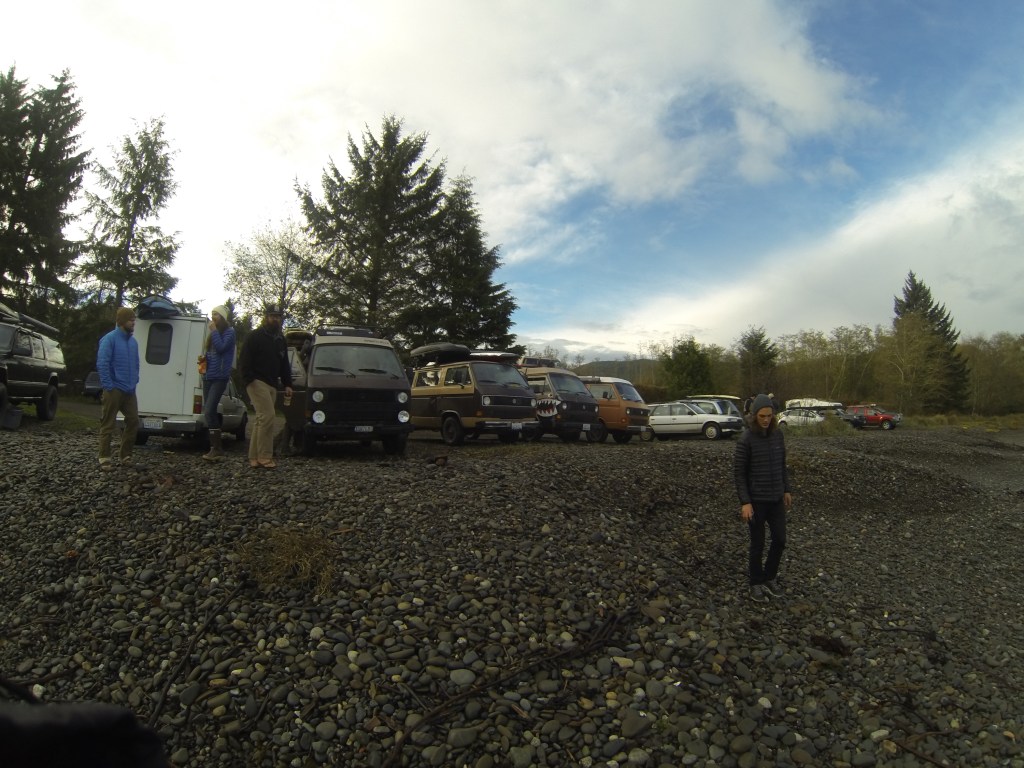
Surf rigs from some not so distant past. I kind of thought Mike’s VW might have been in this shot. I do remember there was one more there before I decided to take the photo. That’s my now-deceased Toyota wagon. I think all these surfers are saying, “Hey, Dude, don’t blow up the spot!” Or, “Hey, man, does this place ever have good waves?” No.

SO, do try to check out realsurfers on Wednesdays for the continuation of “Swamis.”

“Swamis” Chapter 9- Day after Chulo is Murdered

CHAPTER NINE- WEDNESDAY, MARCH 26, 1969      

My room was on the wrong side of the house for late afternoon light. It isn’t like I needed windows for studying. Still, when the phone rang, I closed the two books that were open on the thrift shop desk, pulled out the latest copy of The North County Free Press from under a third book, stuck it inside a Pee Chee folder, and hustled up the hallway.

“DeFreines residence.” Pause. “Roger and Gary?”

In a phone scam we had devised and successfully worked twice before, “Gerry Lopez” meant the waves were good, “Micki Dora” meant they weren’t.  “Jim Morrison” and “Jimi Hendrix” hadn’t worked on two other occasions.

“Joey!” I had to move the handset away. “Accept the charges! Joey!”

“Okay. Thank you, operator.”

Between Gary screaming some indecipherable series of syllables, I heard, “You should… have… been… here.”

 “It can’t be that good, Gary.”

I let the long cord at the back of the phone base drop. The cord unwound as I walked into the living room. I set the base on the top of the stereo console. If I had set it on the coffee table, the cord to the handset would reach my father’s lounger. He designed that way. I walked toward the big window. Four feet short. 

Outside, Freddy was walking backwards, leading Tallulah around the corral, dropping pieces from a leaf of alfalfa. On the phone, Gary and Roger were yelling over each other at me.

“What? Wait; burned up? Swamis? At the wall. Who was it?” Pause. “Okay.” I walked back to the console, turned on the television. “Channel eight?” The TV took a while to warm up. “They’re there?” Pause. “No news. Old movie. Dialing for Dollars. Bob Dale.” Pause. “Detectives? Which detectives?” Longer pause. “Langdon, and… fuck no, he’s not in charge.”

Gary and Roger were both inside the phone booth at the 101 side of the original parking area. Others were waiting to use it. “Roger, how many is ‘an amazing number of people?’” Pause. “That many? And they’re… crowding up to the rope?”

In my imagined image, a hundred people were standing on the asphalt, looking over the rope. Most of the grassy area along the wall to the SRF compound was behind the line. There was, according to Gary, on the wall, twenty feet or so from the Southeast corner, a burn mark that “pretty much matched the gold bulbs on top of the wall. That was where the guy was burned up.”    

“Who?” Pause. “No, of course the cops aren’t saying. I mean, someone’s saying… something.” Gary interrupted Roger. “Someone said… who? ‘Limpin’ Jesus.’ Fuck, man!”

 “Fuck!” I took a breath. “Chulo.” I ran several images of Chulo through my mind: Chulo with the robe and the wooden cross around his neck, Chulo behind the wheel of the Jesus Saves bus, Chulo at the wake, Chulo with Portia in the Swamis parking lot. “Chulo?”

“Chulo. Yeah.” Other voices were demanding time on the phone.

“Call me back. When you get home. When it’s… free.”

Outside the window, Freddy, his face close to Tallulah’s, looked up and flipped me off.

“Good evening, San Diego.” I refocused on the TV screen. “Phillip Reed. I usually cover Criminal Justice… court activities, that sort of thing.” Phillip Reed almost winked, almost smiled. “I will be standing in for a week or so. A little deserved vacation time for our esteemed colleague… the real anchorman. So, to begin: Whoa! Horrific murder overnight at Swamis, a beach park in the North County. We have a crew on site. Film at eleven.”

            …

Our porch light and the weak lamp from the foyer were pretty much all the light. Gary and Roger were practically dancing in and out of my shadow. Our shadows extended down the slope of the yard.

“So, Joey,” Roger said, “There was a station wagon. In the lot. Like, nine passenger size. Painted-out windows. ‘CBS’ and ‘Channel Eight’ were lettered on the side.”

“But it, the murder, it happened… last night?”

Gary shoved Roger out of the light. “Yeah, but there were still a couple Sheriff’s Office patrol cars, a motorcycle from the Highway Patrol, and a tan Buick with a Del Mar Fair decal on the back bumper… Obvious cop car. And the tall detective, he’s…”

“Wendall.”

“Yeah; and the chunky one… he showed up in a stripped-down VW. Practically a dune buggy. Can’t be street legal. He…”

“I’ve seen it. Dickson. But what about… Langdon, Roger; what was he doing?”

“Creepy guy,” Gary said. “Mostly he was walking back and forth, acting like he wasn’t checking everyone out who was hanging on the rope.”

“He did talk to this black chick; not, like, nicely. She has to be the one who… She’s taking photos, maybe she’s talking to, you know, Wendall. And…”

“Langdon wasn’t stoked on that. He was mostly giving your guy, Uncle Wendall, shit.”

I ignored Gary’s comment. Roger stepped in front of him. “So, then, the chick from channel eight… very cute, she and a cameraman, and another dude, they’re over at the bluff.”

“So, of course, we all cruise over there. Everybody did.”

“All the… local surfers… Joey.”

“Roger means… you know who; she was there.”

“I didn’t ask.” Gary moved to one side of my shadow, Roger to the other. “Okay, so she’s there. Julia Cole. Thanks. Her boyfriend… he there, too?”

Roger punched Gary in the shoulder. “Julia Cole. Told you he’d ask. Pay up.”

“I didn’t ask.”

“He didn’t ask.”

“How did she… seem?”

“Hard to say,” Gary said.

“Hard to say, Joey.”

“Joey, you awake?”

“No, Freddy, I am not.”

I opened my eyes. I was on the couch, leaned back, a notebook spilled open on my lap. Other papers and books were spread on the coffee table. The television was on but the sound was off. Freddy moved several more notebooks and sat down to my right.

“Me, neither.” Our mother was just visible in the kitchen. The phone was on the coffee table. “He’s up,” Freddy yelled, half leaning over me. “But are you… awake? I mean, really.”

“Atsushi, the news is…” Ruth DeFreines walked over to the television, turned up the sound. “The news is… bad.”

“Atsushi,” Freddy said, “Mom called you by your Jap-a-nese name. At-su-shi.”

“Middle name, Butt-lick.” Freddy tried to grind his elbow into my right leg. I shoved him away. “Oh, I believe your Jap-a-nese middle name means ‘guy who licks butts.’”

“No, Atsushi.” Freddy shoved me, harder. I stood up and assumed a fighting stance. Freddy laughed. “Hakaru means ‘better son.’” I dropped my hands, slid my feet next to each other, and fell back into the couch. Freddy leaned over me. He whispered, “And also, ‘guy not to be fucked with.’”

“Okay,” I said. We both smiled. I shoved Freddy away.

“Boys.”

“Our top news story…” It was Phillip Reed. “The horrific murder, last night, in Encinitas. You will, no doubt, remember our intern, Pamela Hodges. Well, she’s graduating from San Diego State, and she led a crew up to the North County… today. We now have the film.” Phillip Reed let out a noisy breath. “Stand by.”

My mother was in position, standing in front of the console. Freddy moved to her left, I to her right. The screen went blank for a moment, followed by a shot of the ocean on an obviously sunny and cloudless day.

“Pipes,” I said. “Down from Swamis.”

“It is a very sad day here at a very lovely spot.” It was a woman’s voice. Pamela Hodges. The image panned to the right, north, past the wave line at the beach break, past the waves at the point. The image refocused on a palm tree hanging on the bluff.  

The image abruptly switched to a young woman in a sport coat and skirt, standing, seemingly alone, on the bluff, a microphone too close to her face. Pamela Hodges looked to her left, possibly a signal to the cameraman. “Although the information we’ve received from the Sheriff’s Office detectives is… minimal…” The young woman repeated the eye shift, adding a head nod toward her left. The camera angle stayed on her. “What we do know is…”

            The camera panned away from Pamela Hodges and through a crowd watching her. Someone, off camera, had the onlookers move aside. Still, some were caught looking as the angle zoomed in on the white compound wall at the far end of the parking lot, then continued panning to the right.

            “The Jesus Saves bus,” I said. “It’s usually there.” Stupid. “No, of course. No.”

            Close to the highway end of the wall, three uniformed deputies, out of focus, were standing behind a rope stretched between wooden sawhorses. There was a burn mark, almost matching the gold lotus blossoms on the top of the wall. The scene was as Gary and Roger had described it, as I had imagined it would be.

“Behind this wall is the Self Realization Fellowship. A place of peace and meditation. All that was shattered when, last night…” The image pulled back. The deputies were in focus for a moment. Members of the crowd were in focus for a moment. All strangers, then Gary, Roger, Julia Cole, Duncan Burgess, Rincon Ronny. Pamela Hodges was out of focus for a moment. “Last night a young, so-far-unidentified man, was beaten, positioned near the wall and set alight.”

The image stayed on Pamela Hodges too long. She couldn’t hold the expression. She looked down, let out a breath to keep herself from smiling. She was on TV.

The image switched to Phillip Reed at the station. He did look serious. “We do have some further information. We also have more from Pammy… Pamela Hodges. Pammy just graduated from State… San Diego State… It’s coming up, after these messages.” 

“Phillip Reed.” The phone rang. “He knew your father.” She looked back toward Freddy and me as she walked toward the kitchen. “Too late for… cocoa?”

Freddy elbowed me. “Did you see your ditching-school, dickwad friends?” I nodded. “Gary and Roger? Truant… and smoking.”

I didn’t answer.

As our mother was returning, a mug in each hand, Freddy said, “He’s gone, mom.”

“Leave him alone, Hakaru.”

 I had been gone, replaying the few moments from the coverage: Gary and Roger, front and center as the camera panned and zoomed. Both were smoking. Gary was smiling. Julia Cole, Duncan Burgess beside her, was taking photos of Pamela Hodges and her crew. Julia lowered her camera when Gary, rather than just passing in front of her, stopped. Duncan extended a hand to push Gary further. Gary looked at Julia. Roger looked at the TV camera and lowered his cigarette. Both of my surf friends moved into the crowd.

It was Julia Cole’s expressions that ran through my mind, again and again.

Freddy elbowed me again. “Pammy’s back, Atsushi.”

“The name of the victim, evidently beaten, possibly, according to witnesses from last night, posed in a sitting position next to the wall, has not been released. There is…” Pamela Hodges moved her microphone around in a sort of wave. “There is speculation among the local surfing… community that the victim is… one of them.” The reporter looked to her right. She appeared angry but quickly reset her practiced neutral expression. “Speculation.”

“It was Chulo,” my mother said.

“You get that from Wendall?”

“Larry? No. Someone at the station. Betty Boop… your father called her. Margaret.”

“Why would… Margaret… call?”

“Larry. Wendall. We were supposed to… He had to go on base, anyway. We were going to have lunch. Just at the PX. Snack bar.” I tried not to react. “He didn’t, of course. This. Chulo.”

On the screen, Pamela Hodges took a deep breath. “We do have a witness, someone who was here last night.” The TV reporter turned to her right. There was a space between her and the witness. “Fred Thompson.”

“Gingerbread Fred! Shit!” I didn’t look around to see my mother’s reaction.    

Fred Thompson didn’t move. He looked straight into the camera. Pamela Hodges, also looking into the lens, sidestepped toward him. “Can you tell our viewers what you saw?”

Gingerbread Fred blinked, looked at the microphone in front of him, looked sideways for an instant at Pamela, then looked back at the camera. Intently.

“Fred,” Freddy said, moving closer to my side. “Like me.”

“Not like you, Frederick Hakaru DeFreines,” our mother said, putting a hand on Freddy’s head, “You’ll get a haircut.” She gave Freddy a push, turned and looked at my longer-than-the-dress-code-allowed hair. “Not like you, either.”

Gingerbread Fred moved his hands toward the camera. “Light. Bright light. Poof. In the air.” He paused, blinked several times. “Damn fools. Gasoline, the vapors… they… flash.” He started to cry. “I knew Portia was… waiting. I tried to help. Can’t run… anymore.” Pause. Blink. “They were running. Away… to their car. Black. Lights… out.”

Still looking straight at the camera, Gingerbread Fred Thompson went from a low growl to engine sounds. “Loud muffler.” He got louder. The reporter started to pull the microphone back. Fred moved with it. He didn’t look at her, he looked at us. “The… other guy was on fire.”

Fred threw his hands out to his sides, spreading his fingers. Pamela Hodges stepped back. The camera stayed on Gingerbread Fred, but the field of vision widened. Lee Anne Ransom, behind and to Fred Thompson’s right, was taking photos. Julia Cole, Duncan, Ronny, and Monica were to his right. Petey Blodgett stepped between Ronny and Monica. Fred dropped his hands and took a step back. Petey took two steps forward and, once even, put an arm around Fred’s shoulders. Fred looked at Petey for two seconds, then half spun toward him, his head dropping to Petey’s chest.

“No, no!” Pamela Hodges stepped between the two men and the camera. She was out of focus, the microphone in her left hand, her right hand making a slicing motion across her throat. The image went fuzzy, then black.  

Phillip Reed appeared. “Stand by folks.” He looked to his right. Questioning look. He turned back to the camera, flipped his left hand up. “Okay then, folks, we’re following this drama a bit longer.” The camera stayed on an angry Phillip Reed a half second too long.

Our phone rang. Loud. Freddy and I both jumped. Our mother stepped away and answered it. “You’re, oh, downtown. Yes, Larry, we are watching it. Channel eight.”

On the screen, Deputy Scott Wilson pushed between Julia and Duncan, stepped between Petey and Gingerbread Fred and Pamela Hodges. He turned his back to the camera. A man wearing dark glasses and a black coat with a Nehru collar was just visible, standing behind and between Duncan and Ronny.

“Langdon,” I said, looking at my mother, still on the phone. “Gingerbread Fred.”

“Yes. They…” She put her right hand over the speaker. “Larry says it was a major… mistake, letting him… be… there.” My mother, listening to Larry Wendall for a moment, had a half smile on her face. She took her hand off the speaker. “Langdon’s mistake.”

“No one will know that” I said, loud enough for Wendall to hear.

“No,” she said, repeating Wendall’s word. She dropped her half smile, picked up the phone base, walked toward the dining room.

On the screen, Detective Langdon stood to one side as the locals followed Deputy Wilson and Gingerbread Fred through the crowd. Non-surfers filled in the gaps. Pamela Hodges tried to regain her composure. Lee Anne Ransom stepped into the shot and took several photos of the TV reporter. Pamela flicked her left hand at Lee Anne. A ‘go away’ gesture. Langdon turned and walked away. Lee Anne followed him.

Pamela Hodges let out a big breath, put on a smile. “And now, will this lovely weather continue? Back to Phillip Reed in the studio.” She waved. “Pamela Hodges reporting.”

Ruth DeFreines, without the phone, came back into the living room. She turned the television off, pulled the louvered doors from each end of the opening. She put a hand on her younger son’s head, turned it until his body followed, pushing him toward the hallway.

“Mom,” I asked, “what about… Portia?” My mother stopped. She didn’t turn around. “What did Wendall… Larry, what did he say about… her?”

Ruth DeFreines turned back toward me. She tightened the knot on her silk robe. “She is safe. We must be… patient.”

“Must be?”

“You are not going over there tomorrow, Atsushi. Larry says…”

“Friday?”

“Saturday is the soonest. Earliest. Only because you have to go to work. Mrs. Tony will know all about it by then.”

“I’m sure she will. Saturday.”

OH, Yeah- “Swamis” and all revisions are Copyright protected. All rights reserved by the author. Thanks for reading. Remember to check for other content on Sundays. Check forecast, check out realsurfer.net.

What You Get Out of What You Put In

ROAD TRIPS, it’s all a journey from where we are to where we hope the waves are. Pretty much all of my friends have hit the road recently, to various destinations. And I ventured out on the roads, despite the summer road closures and the annoying number of traffic accidents involving folks, not realizing the journey is part of the story, hitting the road just a bit too fast, too aggressively, and often, stupidly. That’ll fuck up one’s zen. Not mine.

Get there; get waves (or not); enjoy (or not) others in the water, the trails, the parking area; check out some other spots on the way home; go to Costco/Home Depot/QFC (not optional for me) and maybe FRUGALS Drive Through (part of the deal when I had to beg friends to take me with them, before my new stealth rig got roadworthy- not included if I’m alone); get home.

MEANWHILE, and all during and after the trip- We are anticipating, enjoying, assessing, picking out the most relevant waves, rides, interactions in the water, quotes worth repeating (Me, after backing off wave-“Did you really think you were going to make that section?” Guy who yelled at me but didn’t make the section-“I was trying to.”) when we tell the adventure story.

And somewhere, some time, if it’s comparing notes with another surfer who surfed different spots, or with non surfers who ask if we’ve been surfing lately, we will.

Maybe we find waves, maybe we find the sort of experience that enriches us spiritually, purifies us, transports us, changes us into someone… better.

Probably not.

I always have and can’t seem to stop taking mental notes on surf vehicles and Kooks and costumes and first class equipment owned by Kooks in costumes, rather than pretend my best ride was, like, world class, and that an old guy on a thrashed board might have a touch more soul than… yeah, I am working on all that stuff. Despite my pettiness, I can and do appreciate any surfer who gets a great ride. Mostly, faking humility, I’m just happy I can catch some waves and make some sections.

I was looking for an image of surf vehicles stuck in traffic. This photo from Heckle Photography was too cool to pass up.

MY ORIGINAL thought for this piece was what I got out of a recent video of NATHAN FLORENCE. I am a huge fan- more because of his froth/stoke/enjoyment level than that he makes money surfing killer slabs all over the world- he earns his money. Nate and his brother, IVAN, and his support crew, and his mom, and his wife, were at SKELETON BAY in Namibia, long lefts with long walk-backs. Rather than focusing on the rides, he kept track of, and went on about the workout. True enough, very impressive. At one point he had surfed and walked (or ran) a marathon distance. And then he kept going.

After years of surfing before or after work, or taking a break from work, I do try to dedicate an entire day to any surf adventure. During that day, I do try to exhaust my surf lust, build up my wave count. This is, partially, economics- waves per dollar. It is also a sort of reserve, not knowing when my next adventure might happen. No real surfer has even been SURFED OUT.

Still, I could mention surf exhaustion is part of my story. The good kind of exhaustion. In the next chapter…

SPEAKING OF CHAPTERS, I have moved ahead in the latest, hopefully final rewrite of my novel, “SWAMIS.” I will be posting Chapter Nine on Wednesday. Joey’s surf friends Gary and Roger call him from Swamis. Chulo had been killed there the night before.

Film at eleven.

Check it out.

NOW, I usually put something about copyrights with each post. This one, yeah, if you want to take it and say you wrote it for some or any reason, go ahead. OTHERWISE, see you out on the road.

“Swamis” Chapter 5, Part 2- Memorial for Joey’s Father, Spilled Casserole, Mr. Dewey, Lee Ransom

I backed my way through the middle of the semi-circle and back to the window. I didn’t look around to connect faces with questions and comments. I was somewhere else, imagining what magical waves were breaking beyond the hills that were my horizon, running a mental slide show of photos from surfing magazines, little movies of things I had seen. I kept one image a bit longer. It was from above highway 101, above the railroad tracks, across the empty lot just south of the Swamis parking lot. There were the dark green trees, two palm trees beyond them, one of the large gold lotus blossoms on a white stucco wall; and there were distant swells, on that horizon, already bending to the contours of the underwater rocks and reefs, ready to wrap into Swamis.

I didn’t bother to consider how long I had been detached from the reality of an event as surreal as this wake, or memorial, or potluck. That was me, detached. Everyone seemed to know this. Damaged. Some knew the story, others were filled in. There had to be an explanation for why I was, so obviously, elsewhere.

Standing at the window, all the conversation was behind me; the clattering and tinkling, the hushed voices telling little stories, the sporadic laughter. 

The yellow van with the two popout surfboards on top pulled out of the driveway, a black Monte Carlo behind it. I didn’t recognize the car. I looked around the living room. Wendall and Dickson were holding court with someone over by the sideboard, a two-thirds gone bottle of some brownish liquor between them. Langdon was gone. A black Monte Carlo seemed about right. Oversized. Pretentious.

A yellow Volkswagen Karmann Ghia, top down, was coming up the hill. It passed the Hayes Flowers van. Different yellows, softer, warmer than the van’s. There was a woman at the wheel, very colorful scarf over her head, sunglasses. The Monte Carlo stopped. The VW stopped. Langdon. Yeah, it was him. He had an am out the window. The gesture was ‘turn around.’ The woman in the Karman Ghia gave Langdon a brush back with a raised hand, followed, when the Monte Carlo moved on, with the woman’s right hand, up, middle finger out. She moved her arm halfway back down, then up again.

“Yeah,” I imagined myself saying, “Fuck you… with a half twist.” I may have added the half twist with some later recalling of the day. It doesn’t matter, it’s there now.

I had seen Deputy Wilson before, at the Vista substation. He was the latest in a line of deputies identified as “New Guy.” Those who lasted long enough got to be referred to by their last name. A nickname was a higher honor. Wilson didn’t have one that I had heard. I hadn’t caught or bothered to remember his first name.

Wilson half-leaned into the Karmann Ghia once it stopped in the driveway. The woman looked away from the deputy. She saw me in the window. She pointed. She waved. I took a second, then waved back. Wilson gave me a gesture, hands out, palms up, chest high. As in, “Really?” I mimicked his gesture, palms facing each other. The New Guy let her proceed.

            After several adjustments, the Karmann Ghia was pointed out, getaway position, the passenger side almost touching the two-by-six fencing on the corral. She removed her scarf. Afro. Not huge, but out there enough to make a statement. She looked at herself in the rearview mirror, pushed the sunglasses up into the Afro, prescription glasses remaining.

The woman swiveled in the seat, picked up a thirty-five-millimeter camera with a medium length telephoto attached, used the top of the windshield to stabilize it, and aimed it at me. Snap.

            I was in the center of the window, my arms still out. I moved backward and sideways, back into the room, bumping into a man I knew from somewhere; someone from the PTA or the School Board, or somewhere. “It’s that pushy Negro reporter woman,” he said. “Writes for that hippie rag. She did a big… ‘expose’ on the water district. Don’t know how she got past the Deputy.”

            “Wilson. The Deputy,” I said, suddenly realizing where I had seen the man’s photo. “The hippie rag, the expose; favorable rates for certain… constituents, as I recall. The Enterprise didn’t run the story for another two weeks. And… wait; you’re still the director.”

The Water District Director looked at me for a moment before turning away. “Wendall,” he said, brushing past Mr. Dewey. I didn’t look away quickly enough. Mr. Dewey smiled. He may have mistaken my look for a nod. He was already headed my way as I turned back to my spot in the middle of the picture window.

“I heard that, Joseph,” he whispered. “Good one. We need an alternative to the war mongering, corporate loving press.” Mr. Dewey was somewhere over half-sloshed, sloshing some sort of brown liquor in one of my father’s cut crystal glasses. “The North County Free Press. I should make it required reading for my Social Studies class.” Mr. Dewey leaned in a little too close to me. “I mean…” I leaned away. “…You read it… right?”

            I tried to correct my overreaction by leaning in toward Mister Dewey as if I was ready to share a secret. “You know, Mister Dewey…” I looked around the room, back to the teacher. “Most of these people do, too.” I whispered, “Also. And… there’s some… nudity. Sometimes. Hippies, huh?”

            Mr. Dewey nodded and went into some forgettable, mumbled small talk. War in Asia, civil rights, threats to the middle class. It was less than a minute later when Mr. Dewey pointed my father’s glass, with Detective Wendall’s whiskey sloshing around in the bottom, toward the photograph of my parents. “Never understood… guy like Joe DeFreines; almost a John Bircher… conservative. He was a Marine, fought the Japs, big war hero.” He took another sip. “Korea, too. Also. Another war we didn’t win. And then…”

            Mr. Dewey seemed to realize he had gone a bit too far with this. He tipped the glass up high enough to get the last of the whiskey.

“Well, Mr. Dewey, Sir; it’s traditional, really, isn’t it? Kill the men. Take the women.”

Mr. Dewey looked into my father’s glass. Empty. I looked around the room, past the dining room, and into the kitchen as if I was looking for someone in particular; long enough for Mr. Dewey to notice, to feel just a bit more uncomfortable. I turned back toward the window.

“You know, Joseph; your father was a busy man.” I knew he was looking from the unfinished garage to the unfinished fencing. “I’m not teaching summer school this year.” I shook my head a bit, trying to understand. “I have time, that’s all. If I had a place like… this, I…”

“Yeah. Needs… time. Work.”

Mr. Dewey tapped the empty glass on the window. “The Falcon wagon? That yours… now?”

“I am making…” A chuckle stuck in my throat. “Guess so.” Mr. Dewey cleared his throat. “I passed the… driving tests.”

“You. Of course.”

I whispered, “They didn’t ask, I didn’t admit… anything. I am getting… better.”

“Of course, Joseph.” Mr. Dewey turned and looked at the selections of food that were still on the table as three different women brought in an assortment of desserts. He patted my shoulder as fourteen other men and seven women had done, coughed out some whiskey breath, and headed to where my father’s partners, Wendall and Dickson, were filling glasses no one had yet asked for.

“Better,” I whispered to myself and the window and the Falcon and the property that needed time and work.

… 

            The reporter woman was standing next to my father’s partners. She declined a drink in a fattish sort of glass, three-quarters full, offered by Dickson. “Smooth,” he said, offering it again with a look that was really a dare. She was asking questions I couldn’t quite hear; questions that seemed to make the detectives uneasy.

            The reporter was holding out a notepad, three quarters of the pages pushed up, and was tapping on the next available page with a ballpoint pen. Dickson made a quick grab for the notepad.  She pulled it back. Quicker. Dickson pulled a very similar, palm-sized notepad from his inside coat pocket, opened it, went through some pages, shook his head, closed the notepad, put it back into the pocket. The reporter closed her notepad.

            “So,” the reporter asked, “The official word is no word?”

            “Correct.”   

            Wendall pulled a pack of Winston non-filters from his left outside coat pocket, a Zippo lighter with a Sheriff’s Office logo, exactly like my father’s, from the right pocket. He opened the top with a forceful snap on his wrist, looked around the room, pointed toward the kitchen. Partway through, Mrs. Wendall tried to stop him. He pointed to the cigarette in his mouth with the lighter and headed to and out the open sliding glass door.

            I moved a bit closer to the reporter and Dickson. “No, Detective Dickson, I am not getting any help from Downtown,” she said. I moved closer, between the pineapple upside down cake and a plate of frosted brownies. I took a brownie. “You could just tell me how an experienced driver could…” Dickson looked at me. The reporter looked at me, took the glass from the sideboard, downed it in one gulp, stepped toward me. “You,” she said. “Lee Ransom.” She extended a hand before the alcohol she had thrown down her throat forced her to spread her fingers, lean back, and open her mouth wide enough and long enough to emit a totally flat and involuntary, “Haaaauuuuuh.”

I made a quieter version of the sound she had made, leaned back at the waist, and said, “Oh. The Lee Ransom.”

Dickson laughed and said, “Smooooth.”

Lee Ransom moved closer to me. “Oh?” She paused for the exact same time as I had. “Meaning?”

            “Oh, as in, I thought Lee Ransom must be…”

            “White?”

            “A… man.”

            “Do I write like a… man?”

            “Yes. A… white… man.” Lee Ransom couldn’t seem to decide if I was putting her on. “College educated, new journalism, ‘I’m part of the story’… white… writer. Good, though. I read you… your… stuff.” I looked at Dickson. “He reads it.” I made a quick head move, all the way left, all the way right, and back to Lee Ransom. “They all read it.”

            Lee Ransom may have wanted to chuckle. She didn’t. She extended her hand again. “Thank you, Jody.” Dickson snickered. I took Lee Ransom’s hand, trying to use the grip my father taught me, the one for women. I imagined him, telling me; “Not too strong, not too long, look them in the eye. No matter what they’re wearing… cleavage-wise.” Lee Ransom was in black; tasteful, one unbuttoned button short of conservative. I didn’t look at her cleavage or her breasts. I was aware of them.    

“I was hoping to speak to your mother, Jody.”

            “Joey. I go by… Joey.”

            Dickson laughed. “Pet name. Jody.” He laughed again. “Private joke.” Laugh.

            “My friends call me Joey.” I did a choking kind of laugh. “Private joke.”

            Lee Ransom gave me a ‘I don’t get it’ kind of smile.”

            “You. My mom. Talking. Probably… not.” I nodded toward the hallway. A woman was leading a couple toward the living room. “Sakura Rollins,” I said, “Since you’re taking notes.”    

“Thank you… Joey.” Lee Ransom tapped on her closed notebook. “She and her husband, Buddy, own a bowling alley. Oceanside. Back Gate Lanes.” She nodded toward the couple. “Gustavo and… Consuela Hayes. Flower people. Poinsettias…. Mostly.”

Sakura Rollins came into the living room from the hallway, stopping close to Dickson. Mrs. Hayes turned to thank her, taking both of Mrs. Rollins’ hands in hers for a moment. Mr. Hayes exchanged a nod with Dickson, declined a drink, put a hand on his wife’s shoulder, turned her toward the door, walked with her toward the foyer. Neither of them looked to their left, into the living room. The husband walked to his wife’s left, between her and the rest of us. They both bent, slightly, to look at the flowers. The woman rearranged the pots and vases, slightly, before they went onto the porch.

I mouthed, “Flower people.”

Lee Ransom turned toward Sakura Rollins. Mrs. Rollins, her expression blank, shook her head before Lee Ransom could ask her anything.

Theresa Wendall walked up to Dickson from the kitchen, leaned around him to look down the hallway, then looked at Sakura Rollins as if asking for some sort of confirmation. Dickson set down a glass and wrapped his right hand around Mrs. Wendall’s upper arm. She took a breath, gave Dickson a look that I didn’t see, but one that caused him to release his grip.

Sakura Rollins followed Mrs. Wendall down the hallway. Mrs. Wendall stopped, allowing Mrs. Rollins to open the door and announce her. “Theresa Wendall.” Permission. Access. Mrs. Wendall went into my parents’… my mother’s room. Sakura Rollins closed the door, leaned against the wall between that door and the door to Freddy’s room, and pointed toward me, twisting her hand and pulling her finger halfway back.  

Mrs. Rollins met me halfway between the door and the open area. She put a hand on each of my shoulders. “Ikura desuka,” she said, her voice soft and low. “It means… ‘How much does it cost?’ Not in a formal way. Slang. Soldiers. It is… can be… insulting. Thank you for not asking your mother.”

“I didn’t… ask… you.”

“No, and you wouldn’t.” She tilted her head. “Your mother…”

“I have… other questions.”

“Yes. There’s time.” Sakura Rollins released her right hand. “You’re… doing well, Joey.” She pointed toward the living room. “Your parents… strong.” I wanted to cry. “As are you. As strong as you need to be.”

            I backed up, three steps, did a half bow, unreturned, turned, and headed back toward the living room.   

Lee Ransom was declining Dickson’s latest drink offer, a half glass this time. She walked over to my father’s lounger. I followed. “Shrine,” I whispered. She looked closely at the scar on the palm of my father’s left hand. “It’s just… just the one hand,” I said. “Half stigmata.”

Lee Ransom may have smiled as she leaned in toward the portrait. I almost smiled when she looked back at me.

I had to sit on my mother’s little bench on the porch to put my shoes on. Lee Ransom stepped down onto the concrete pad, the part of a sidewalk my father had completed. “Optional today,” I said.

“I… should have,” Lee Ransom said, “to show proper respect.” We both looked at her practical black shoes. She looked toward the many cars parked on the lawn and in the driveway. She pulled her sunglasses down and over her regular glasses. She pointed at the Falcon. “You just… keep the board on top?” I nodded, stood up, jumped off the part of the porch without stairs. “So, Joey; which one of these cars is your mother’s?”

Freddy, a toy revolver in his hand, ran past Lee Ransom, jumped off the porch, swung around me, and fired five shots as the younger Wendall brother ducked behind someone’s car, making a mouth sound with each shot, following the volley with “Got ‘cha!” 

“I think he ducked,” I said as Freddy crouched and hurried down the lawn and took shelter behind the Wendall family station wagon. Wendall’s kid popped up, took a shot at Freddy. “Dick Tracy model. Snub nose 38.” Lee Ransom and I had made it down to the flatter, gravel and bare earth part of the property. She was still looking at the various cars. “I gave it up. Guns. Switched to…” I went into some version of a swashbuckling stance… “Swords.”

The younger Wendall brother ran in front of Lee Ransom and me. She swiveled, threw back her coat, drew two fake pistols from fake holsters, and shot at the kid. Two shots. The younger Wendall kid looked surprised, but instantly grabbed at his chest, both hands, staggered dramatically, and fell to the ground.

“Regular Annie Oakley,” I said.

“Well,” Lee Ransom said, blowing the fake smoke from the end of each fake pistol, “Where I came from, we played cops and robbers with real… cops.” She fake-holstered the fake pistols. “Real guns, too.” She shook her head and laughed.

I was about to tell her I never played the cop, always the robber, but we both turned when we heard someone being slammed up against someone’s car. “Surrender, Jap!”

Larry Junior had Freddy off his feet and pinned against the Wendall’s red station wagon. Freddy dropped his pistol and looked at me with a desperate, ‘You have to help me’ look. Larry Junior’s expression, moved from Freddy to me, was a defiant, “Do something, Jap” look. The younger Wendall kid leapt to his feet. Lee Ransom took a step back, then a few more, in the direction of her car.

Theresa Wendall, carrying a large Corning Ware serving dish with a glass cover in both hands, came out of the front door. Wendall and Deputy Wilson came around from the back of the house. “Lawrence Oliver Wendall, Junior,” Mrs. Wendall said, quite loudly.

Lawrence Oliver Wendall, Junior looked at his mother, stepping off the porch. He looked at his father, throwing a cigarette butt onto the lawn. He looked at Freddy. My brother’s expression had become something close to a smirk. Larry Junior looked at me, just coming around the front of the Buick, left hand out, right hand in a fist. He let go of Freddy.

Theresa Wendall’s high heels failed to make the transfer from concrete to lawn. She fell forward, the dish ahead of her. Launched.

None of this happened in slow motion. All of us on the lawn and the porch were frozen when the Corning Ware dish hit the splotchy lawn, the glass lid skimming like a rock on the water before skidding to a stop on the gravel. The contents of the Corning Ware dish were belching out as it hit on one edge and flipped forward just enough to hit the next edge. Then the next. It landed upright, one-fourth full, amazingly close to the lid.    

A few moments later, in slow motion, I mentally replayed what I had seen. Ten seconds, maybe. I was standing at the hood of the Wendall’s station wagon, my right hand still in a fist.

Everyone else had moved.

Freddy and Larry Junior and Larry’s younger brother were on their hands and knees, scooping food and bits of grass and gravel into the Corning Ware dish, chipped but unbroken.

Deputy Wilson was crouched down but not helping. He was looking at me. “I said, Jody, I notice you have chickens.” He nodded toward an unpainted plywood chicken coop with just enough of a fenced yard for six hens and a rooster.

“Chickens. Yes… we do.” I looked toward the porch, expecting to see a crowd. No one. I looked at our chicken coop, back at Deputy Wilson. “We don’t let them out, Deputy Wilson. Coyotes.”  

Deputy Wilson nodded, stood, straightened the crease in his uniform pants. “Scott,” he said, “Scott Wilson, Jody.” He adjusted the tilt of his hat, turned away, showing his clean hands to the three kids whose hands were lasagna sauce colored.

“Scott,” I said, quietly, “Joey. Joey, not Jody.”

“I worked on cases with… Your father knew his shit.”

I had already looked away, but turned, nodded, and smiled, then turned away again. Polite enough, I thought. Deputy Scott Wilson took the dish from Larry Junior and walked toward the DeFreines family chicken coop.

Theresa Wendall was sitting in the driver’s seat of the station wagon, door open. Her husband was standing between her and the door, leaning over rather than crouching.  Her left hand was on his right arm. She was crying. Detective Larry Wendall removed his left hand from the door and put it on his wife’s left hand. He kept it there for a moment, then lifted her hand from his arm, shifted slightly, and opened the back driver’s side door.

“I can help you turn around. Okay?” Mrs. Wendall didn’t answer. “Theresa?”

Theresa Wendall made the slightest of gestures with her left hand before moving it and clutching the outside ring of the steering wheel. Her husband waited a moment before coming closer. This time he crouched. “I shouldn’t have talked to her, Larry.” It wasn’t a whisper.

“Probably not.”

Deputy Scott Wilson came back with the emptied dish, took the glass lid from the younger Wendall kid, handed it to me. Toward me, as if I should be the one returning it. I looked at the three kids before I took possession of the dish. Both hands.

I approached the station wagon. Theresa Wendall looked past her husband, used the left sleeve of her dress to wipe both of her eyes before regripping the steering wheel. Detective Wendall stood up, stepped back, turned toward me. He looked embarrassed, almost angry. He slammed the back passenger door, reopened it as he passed, turned, and took the dish from me. Lid in one hand, dish in the other. He set them on the roof and turned toward his kids, Freddy, Deputy Wilson, and me. He lit up a cigarette, went around to open the very back door.

“Lasagna and Bermuda grass,” Mrs. Wendall said, breaking into the half-laugh kind of crying.  “Probably improved the taste.” She looked at me for some reassurance, some sort of sympathetic response. I barely knew the woman. Cops’ wives. I knew something about what that meant, what it required. “Your mother,” she said. “I am just so… sorry.”

I have no idea what I look like in these situations. Not cold and uncaring is my hope. Helpless is what I was.

A few moments later, I was over by the Karmann Ghia trying to convince Lee Ransom this wasn’t worth taking notes on or photos of. “Personal,” I said. Larry Junior and the younger Wendall kid were in the red station wagon, now, with some direction from Deputy Wilson, turned and pointed down the driveway. Freddy was leaning into the back seat window. All three kids were laughing.

Only a small percentage of those coming out of the house had to put their shoes back on. Deputy Scott Wilson was back directing traffic. Wendall lit up a cigarette with the butt of his previous one, waved at his children, and headed back up to the house. Theresa Wendall, eye makeup mostly wiped off, waved at me, and because I was standing next to her, Lee Ransom, on her way out. The younger Wendall kid did a finger shoot at Lee Ransom on the way by.

Lee Ransom jerked to one side, shot back. Just one finger gun, this time. She looked at me. “Regular Annie Oakley, huh?” She looked at the horse that was leaning over the barbed wire and over the front seat of Lee’s car.

“Tallulah,” I said. “My mother’s… pet. Mostly.”

“Like the actress; Tallulah Bankhead.”

“Yeah. From the old movies.” I stepped over to the little room adjacent to the covered stall, all constructed of plywood, still unpainted. I pulled out a handful of grain, closed that door, pulled up the plywood cover on Tallulah’s stall. The horse looked at Lee Ransom. Both walked over toward me. “My dad called her Tallulah Bankrupt.”

Lee Ransom held out both hands, cupped together. I transferred the grain. She fed it to Tallulah, the horse’s head through the opening, with me still holding the cover up. I stuck the hinged two-by-two onto the sill to prop the cover as Tallulah ate and snorted, and Lee Ransom giggled.

“Joey, what do you know about… grass; that whole… thing?

I looked back at the house, looked at the cars passing by. I took out a pack of Marlboros from the inside pocket of what had been my dad’s black coat, lit one up with two paper matches. “I’m the wrong person to ask, Lee Annie Ransom. No one tells me… anything.”

Lee Ransom brushed at Tallulah’s mane, ran her hand down the horse’s face, held the horse’s head up. “Someone told me that… if you…” She leaned over, blew a breath into Tallulah’s nostrils. “They’ll remember you.” She let go of the horse, pointed to my pack of cigarettes.

I pushed the pack toward the reporter, took the cigarette out of my mouth to light Lee Ransom’s. I blew some smoke into the stall, inhaled, blew a semi-clean breath into Tallulah’s nostrils. The horse reared back, hitting my face on the way up and back. I reacted. Lee Ransom took a drag on her borrowed cigarette, let out most of the smoke, and observed.

Though I didn’t do anything to Tallulah. I must have looked as if I wanted to. I did… want to. The effects of washing out the stall had rotted out the plywood just enough that my shoe punched through. I had to kick it back and forth several times to get my foot back out.

Lee Ransom came up very close to my face. She blew a very slight bit of breath toward me. Cigarettes and the vague remains of the whiskey, a bit of the skanky cheese and vinegar from a salad. “I don’t fucking believe you. Joey. You see, you observe… everything.”

“No. Not nearly.”

“Enough.” Lee Ransom turned away. “Tallulah, lucky Joey didn’t hit a stud, huh.”

“Lucky.” I turned, started walking toward the Falcon.

“Joey.” I stopped. “When your dad got that… wound… You were there. Correct?”

I stopped, crooked my left leg, butted the cigarette out on the sole of my shoe, turned halfway around, twirling the filter between a finger and thumb. “I was five, as you know, but that is the story.”

“It is. Yes. Your dad saved your life.”

I almost waited too long before responding. “He is… was… it’s his nature to be… heroic.” I turned fully away from Lee Ransom.

“Yeah. And, uh, which car did you say is your mother’s?”

“I didn’t say.”

“No, you didn’t. But, Joey, really, I could use a quote… from you.”

“Make up one. Fine by me.”

Lee Ransom had her camera up and aimed at me. “Half stigmata!” She took a photo.

“Swamis” copyright 2020, Erwin A. Dence, Jr. All rights to the original work and all revisions held by the author.

COMING UP in the next chapter, next Wednesday: Joey and Dangerous Dave confront DUDE/HEAD JERK bullying JULIA COLE at BEACONS.

MEANWHILE, still dealing with bad alternators for my eventual surf rig. I will probably still be whining about it next SUNDAY. Hope you’ve got swell coming your way.

Wednesday at Swamis

Check out Reggie Smart Art by scrolling down. I do plan on posting new stuff on SUNDAYS, but I might just have more stuff to say than one-a-week can handle.

I continue to tighten and refine my manuscript for “SWAMIS.” Every time I am happy with one chapter, I think about how I can cut some fat from another chapter. When I say ‘think,’ I mean obsess. Most of this chopping and hacking involves covering what characters do without going too far into some background on the character.

But first, without too explanation- A few new illustrations:

WAIT! I screwed up and didn’t switch the view on several other drawings. Not being skilled enough to save this and add the corrected images. I guess I’ll have to save them for SUNDAY. SUNDAY!

MEANWHILE, here is a section that comes early in the novel, and is sort of retold a bit later. I already cut a character who was in this chapter. Sorry, man. I did a bit of a combo, taking what I thought was the best of each and making a version that is BETTER.

SO…

I tried to concentrate on the water, listening, studying where the waves peaked, where the best takeoff point might be. Instead, I visualized Sid in the water at Swamis on a sunny, glassy morning. Sitting with four other surfers, Sid was the farthest surfer over, farthest out. The apex of a loose triangle. He watched me push through a wave, kept his eyes on me as I paddled over far enough over to not be in the way if someone caught a right hander, close enough to pick up a wave someone missed or fell early on. Scraps.

Sid motioned to the surfer on his immediate right as a wave approached. The surfer paddled for and caught it. Three-wave set. Sid motioned to another surfer to go on the second, then took the third, and largest wave. I was on the shoulder, forty-five degrees to the waves, sitting back on my board, ready to go. Sid kept his eyes on me, shaking his head. He rode as close to me as he could, cranked his board around in a cutback, spraying me as he passed. I paddled on, out, toward the peak.

Another set came quickly enough that the surfer who missed the previous waves took the first one. I took the second one. Smooth takeoff, I thought, decent bottom turn. I lined up the section, pulled up high on the wave face. I did see Sid down the line. I didn’t expect him to turn, last second, and drop in. I had two choices: Run Sid over or bail.

No choice, really.

“That’s for paddling past me,” Sid said, paddling back out as I stood in chest deep water, my board, broach to the wave, popping up halfway to shore.

“I didn’t break any rules,” I said.

Sid stopped, got off his board. It was floating between us. “Yeah, Kook, you broke the locals rule.” He took in a mouth full of water, spit it across the board at me. He smiled. “Locals rule.” He nodded toward the lefts. “Okay… cowboy?”

“Okay” I said, out loud. I opened my eyes. I was still on the platform. “Ten seconds,” I whispered. “Maybe twelve.”

OH, yeah, remember that all rights to this stuff are claimed by the artist and/or artist and are protected by copyright.

See you SUNDAY!

Nam Siu for You… and more

It’s EASTER SUNDAY and I did not get up before dawn.

Maybe my one-time-only self-promoting text attack last Sunday worked a bit better than I thought. I sent word to every person on my smart phone about some artworks by TIM NOLAN, and, I think, I might have made reference to planning on posting content on Sundays. I DIDN’T MEAN, like, early.

OR maybe the unusually high number of looks is because I’m posting some art work by Olympic Peninsula STYLIST (I considered some other apt descriptors- ripper, reef diver, skatepark regular…still thinking…) NAM SIU.

SO, OKAY, I’ll just…

NAM SIU did send me three photos of him surfing. I selected this one because of the lighting. Mainly. Or the styling.

IN OTHER NEWS:

JAMES ARSULISH, a friend of mine of many years, died on GOOD FRIDAY. I feel compelled to write something about friends we see, occasionally, over many years, like surf friends. Occasionally, with large gaps in between. AND there are friends who move, or pass on. We get the news… eventually. James’ passing was closer than that. I will write about James. For now, I share grief with his family and his extended group of friends. RIP.

BECAUSE I am going to stick to the SUNDAY POSTS with an emphasis on ART and ARTISTS, my plan is to post occasional stories, essays, whatever, about other things on a random Thursday, Friday, whenever, IT’S all on one page… scroll down.

IN “SWAMIS” NEWS: I have been going through the latest edit for a while. I focused heavily on it recently, got to the end, again, and got a copy printed up on, yes, GOOD FRIDAY. 221 pages, somewhere under 97,000 words (not epic length, and down from the 120,000 plus earlier versions), double sided. It cost me (I have the receipt right here) $26.29. MY PLAN WAS, put it in a PEE-CHEE folder (sort of featured in the novel), sell some numbered (max 100), signed, limited editions for… more. A profit.

YES, I do know it’s cheesy and unprofessional and, no, but… do consider the value increase when/if the novel hits it big. MEANWHILE, I have had several people offer to buy a copy, AND I ran into a client at the grocery store whose granddaughter has written many books and might just… help. BUT TRISH is telling me to calm down, not go any crazier.

WHAT MAKES anyone crazy enough to do anything that might be considered art or literature or surfing, anything that can be judged subjectively by judges and judgers, crazier, is self doubt. I have already sort of pushed some folks into reading parts or the first two unexpurgated versions of “SWAMIS.” I won’t get a second chance at a first impression.

I am aware of some of my mistakes. MY HOPE IS that I have now cut out enough of the peripherals, focused enough on the plot. Meanwhile meanwhile, I am going through the paper version, marking things, cutting, changing. I am trying to write a reasonable synopsis, looking up agents I might contact… shit like that. I am not a salesman. This part sucks. TRIPLE MEANWHILE- I somehow can’t help wondering/dreaming/fantasizing what my $26.29 copy, with notes and changes, might be worth.

THANK YOU for checking out realsurfers. REMEMBER all rights to original materials are owned by the person who produced them and are protected by copyright.

OH, AND how about Sunday by… 9:45AM?

Sometimes Stuff Works, And Sometimes…

… less so.

This is my first time attempting to use my (suspect, quality wise) printer/scanner with my borrowed (thanks, Dru) Mac computer. I managed to get these without calling my daughter, but with some YouTube help. Please excuse the sometimes unfortunately placed bits of crap from, I don’t know, somewhere, and the wasted white space because I haven’t mastered the sizing part of all this. I could comment, at length, on each of my latest attempts at… whatever it was I am trying for. I will try not to.

Top to bottom:

“Racing the squall line.” Because I am involved, trying to assist Port Townsend librarian and fully-frothed surfer Keith Darrock in putting together an event, tentatively titled “Inspired by the Salish Sea,” I used the view from Port Townsend. I am inspired to do at least one more with the view surfers on the always languid Strait of Juan de Fuca, desperately looking to the west for any sign of an approaching swell more frequently get, an incoming squall. Worse, another shit weather front.

“The Salish Sea.” Possible title with info for the event or events on the rest of the page.

“Quilcene.” The Quilcene Village Store, quite the hip place nowadays, has several of my drawings in the sort of sitting/coffee area. They have been having a sort of contest to come up with postcards representing the area along Surf Route 101. This is my entry. When I showed it to Trish, she said, “Uh huh… it’s… okay.” This is after she poo-pooed the earlier version with a similar background (Mount Walker), but with a person in the foreground to add more, you know, like, interest. “Creepy,” she said. “Looks like a killer.” Okay, I rubbed him out. Metaphorically.

“Untitled Woman’s Face.” Trish told me I should draw some of the characters for my still-almost-finished novel, “Swamis.” I said, something she already knows, that I have trouble drawing women’s faces. I actually kind of cheated on this one. Googled “How to draw women’s faces.”Some… tracing was involved, just for stuff like, getting the eyes kind of lined up. Guaranteed, the drawing looks very little like the one I tried to copy.

“Inspired by the Salish Sea.” Definitely redrawing this one. The blank space is to allow room for the dates and times and the various speakers. “What I was going for,” every artist or writer (or surfer who just blew ten attempts at a floater) says, was a sort of Victorian, possibly Art Nouveau look. No where close. But… next time…

“Real surfers froth.” Yeah, it’s kind of like post-psychedelic graffiti, totally unreadable. A series of mistakes began when I didn’t allow enough room for the T in FROTH. I thought I kind of fixed that with the overlap. No. Then, when I took the original to the Printery to get reduced, part of the F and part of the H were cut out. Okay. So, maybe some color would help with that. Not really. Still, someday, this will be on some highest bidder’s wall, and when visitors ask about it, he or she will say, “I believe what Original Erwin was going for here was…”

Better. Always.

SWAMIS Note. Adam Wipeout and his family are down there. It is close to Legoland. I got a nice image the other day. Almost no one out, perfect conditions, and… yeah, I’m fine with it. Totally one hundred percent… fine.