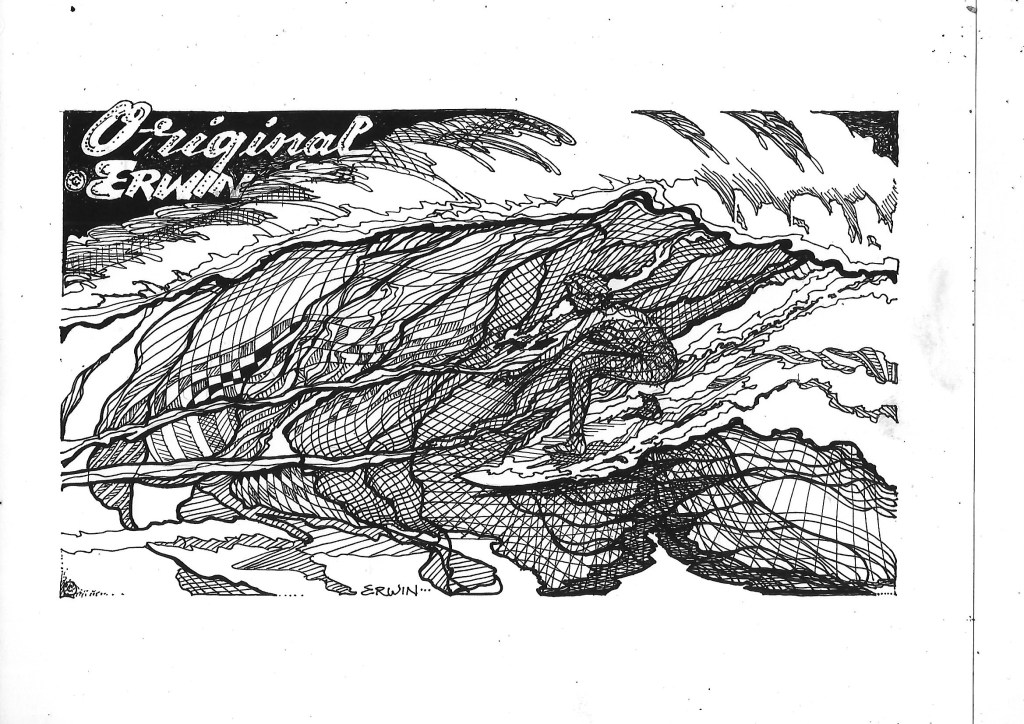
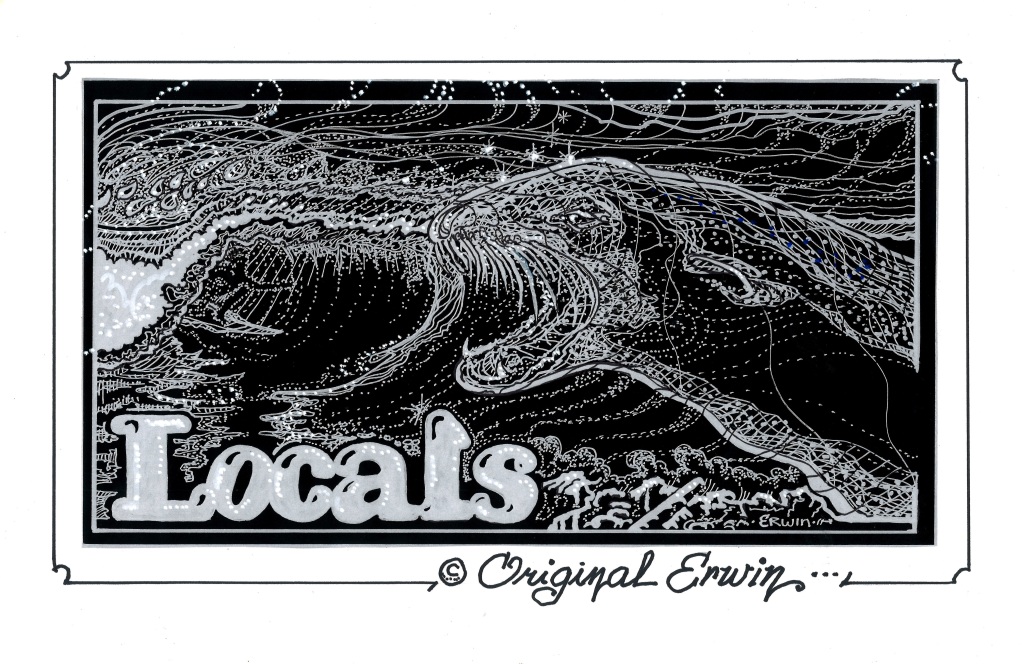
THIS is a silkscreen I did in the 1980s. I’m not apologizing for it being, perhaps, sexist or something bad by today’s standards. It doesn’t go so much with a poem I’ve been working on, but nothing I found in a search did either. I COULD, of course, draw something that does connect better, but… I haven’t.
I AM ALWAYS working on something, art-wise, story-wise, song-wise, otherwise. I have been working recently on a song that starts out, “It was a private conversation, Words I was not yet meant to hear, She had been to long at the station, Couldn’t have known that I was near…”
WHAT I DO is keep working on these songs, and everything I do until it’s… better. SURF-WRITING-WISE, I am always trying to push some comparison between the best moments and music, even dance. Not all dancing is graceful, Stephanie Gilmore style pretty. AND she also incorporates solidly radical, powerful moves into her repertoire. Similarly, there is something esthetically pleasing about a vicious power hack.
MUSIC-WISE, please try to convince me that you don’t have some tune or beat going through your head when you’re paddling for and surfing a wave. If you don’t, well…
Too much explaining.
A Private Conversation
I was coming up the stairway, two bags of groceries pressed against my chest, She was dancing on the landing, third floor, Sun from the distant windows lit her hair on fire, Her shadow moving with her on the sidewall.
Six stairs below her, I leaned against the inside rail.
She was moving to music, music I could not hear.
Her movements made the music real. Slink and slide and step and stop, Step and stop, slink and slide, one arm always at her side, The other, gliding, raised then lowered, Free, and spelling or signing or reflecting, Words or images or memories or dreams, Real to her.
Real to her, private.
Sunset music, light, a tinkling rhythm beat under the woodwinds, Only fleeting hints of nightfall.
I should not have been a witness, Seeing her, dancing, silent, hair on fire, In some soft and private conversation with some distant, absent, loved one.
Loved one, someone else dancing with her on the landing, Sharing her space.
The background, The air and the light and the wallpaper and the paint were as alive as she was, Slinking and sliding and stepping and slowing, Listening, perhaps, briefly, The dance resumed as response.
Her other arm became the free one, Sending the code, The secret, private messages in our most ancient language.
I should not have been there.
I couldn’t face facing her, Couldn’t imagine her trying to explain, Not to some neighbor, some stranger three doors down.
Setting my bags on the third step from the landing, Sitting two stairs below that, Alone in the dark, with vague shadows of someone dancing, Projected on the stairwell wall.
I envied her for dancing, dancing alone in the hallway, Music swirling in her head.
Waiting in the stairwell, Waiting long after her door closed, Long after the light moved up the wall and softened, And darkened, I waited long until her music faded.
My steps up became drums, not heavy, Step, step, step,
If I imagined a saxophone solo, Sad squeaks and missed notes, Looking out the window at a screaming orange sunset, I couldn’t stop myself from sliding one foot across the worn oak floor, And then the other, My grocery bags shifting, side to side, In some rhythm that made some sense… to me.
THANKS FOR READING. Original material, of course, protected by copyright, all rights reserved by the author/artist, Erwin A. Dence, Jr.
AS ALWAYS, IF YOU CAN’T BE NICE, BE REAL.
I FULLY expect to not tell you about a surf session in the next posting. AND, yes, I am still working on my novel, “SWAMIS.”
“SWAMIS” UPDATE- Working on it. Here is a quickie flyer for a fictional Newspaper. I can’t say that there wasn’t such a weekly paper back in the time my novel covers, 1969. My guess, yes. I do know, based on a story I heard, later, like 1971, when I went to work in the Big City, San Diego, from an older guy, that there were Free Clinics, or, at least, one. “So, I picked up this hitchhiking Hippie chick, and I’m thinking… you know, free sex and all that, and she says she’s trying to get to the free clinic.”
Also not related, directly: I noticed, on occasional trips south, in the narrow strip that is Mission Beach, a storefront law office that, real or imagined, seemed to offer free services. Hard to imagine that now. Parking, incidentally, was pretty much as bad then as it is now.
If writing, journalism or fiction, or drawing, or any form of art is someone trying to transfer imagination to paper or wood or film or any other medium, images stored and remembered are the critical ingredient.
Although I haven’t quite gotten to THE END of the fourth or fifth rewrite of “Swamis,” I do have plans, beyond it, for the main characters. The storefront law office might be part of that.
MEANWHILE, I am still recovering from cuts and an infection on my leg, the treatment keeping me out of the water for at least the rest of this week. SO, IF THERE ARE WAVES, I won’t be competing for them. GOOD LUCK.
SCREW UP of the day- I did write something, using Microsoft Word, filling in some omissions from my last posting. Halfway through this, I realized I hadn’t copied it. Not wanting to lose what I had, I… well, I’ll get back to you on what is partially “Guilty with an explanation” stuff.
In the “I’M NOT POLITICAL, BUT…” category, something about the delays in the trials of the former president, and the inability of some other citizens to see a grift when it’s reaching into their pockets, caused me to draw… this:
It’s already, liike, last week’s news. Ordinarily I claim all rights to my work, but, this time, in the spirit of freedom, free press, all that, if you want to borrow it… FEEL FREE.
Now that I am committed to putting out a new round of ORIGINAL ERWIN t-shirts, I’m going through my past drawings AND doing some new ones. I scanned these two on my printer AND I have two more illustrations that I have to take to a print shop. AS ALWAYS, attempting to go simpler, I fail.
LET’S DISCUSS THE SURF SITUATION on the Olympic Peninsula and the Strait of Juan de Fuca. NOT GOOD. Now, if you’re almost anywhere SOUTH of here, you should be scoring. AND the forecast is not too… thrilling. BUT I do have my HOBIE patched up and I’ve done some work on the MANTA. I’m ready to leap into some wind chop when it… let me check the forecast. Yeah, wind chop. That’s official.
As far as “Swamis” goes, I am committed to what JUST HAS TO BE a final draft before the ridiculously scary act of trying to actually sell the novel. I moved the former first chapter to the end, and though I am dying to write about what fictionally happened to the fictional characters between 1969 and now, I’m going to NOT… not yet.
My hope is that, now that I’ve completely mind-surfed the hell out of plot and characters, I might be able to cut the length down from the current 104,000 thousand words. HERE IS the new prologue and a bit more:
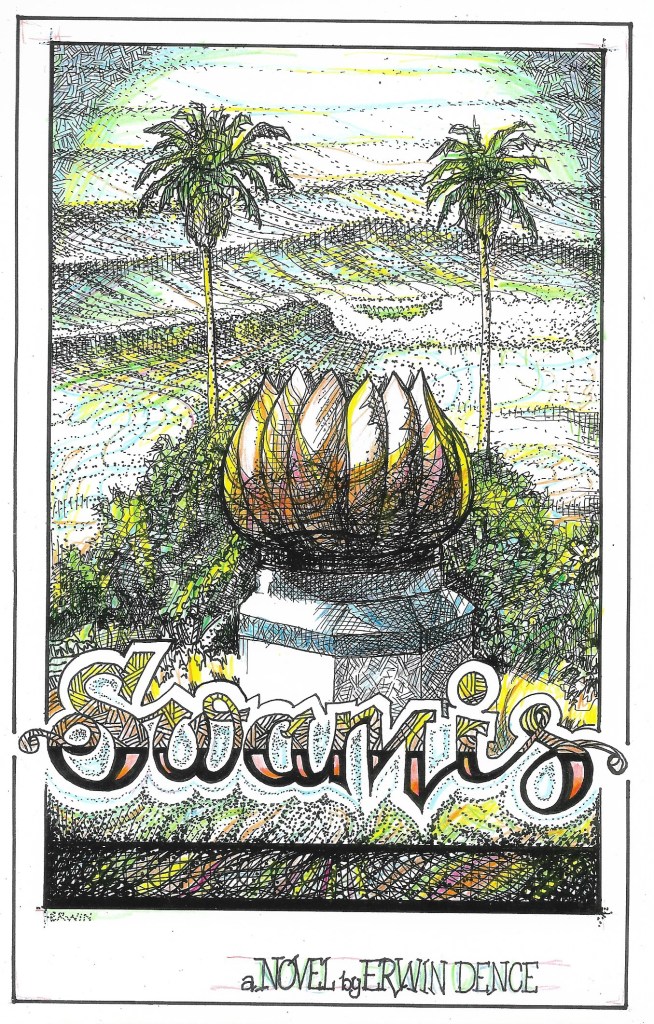
“SWAMIS” A novel by Erwin A. Dence, Jr.
PROLOGUE
Some events, terror and bliss, mostly, which occurred in seconds, in moments; those almost nothing in the expanse of time; expand, over time, into placemarks; a corner turned, a road taken, a life changed. Magic.
Half a century after the events, I started writing “Swamis,” as memoir. It no longer is that. This is my fourth full rewrite, with so many discarded words, deleted chapters, all in attempting to turn notes and dreams, images and remembered dialogue, into a story. I have tried to do justice to the various people, characters here, but real people with real lives, who changed mine. There are people who have come into my life, changed it in some way, and gone out. Somewhere. For the most part I do not know where they went, but I do wonder. Wonder.
The story centers on a very specific time, 1969, in a very specific place, North San Diego County. I was turning eighteen, in love, and the world I wanted swirled and revolved around surfing, and surfing revolved around Swamis.
My apologies for my writing style. Years of writing briefs, documents. Dry, perhaps, but thorough. A friend’s review of an earlier draft concluded I went for detail and clarity rather than flash and description.
“I don’t use a lot of adjectives in regular speech,” I countered.
“But this is writing,” she said, “The prologue shouldn’t be an apology.”
“Honest.”
“Sure, and it is… your own voice. Yes, it is that, and, as your mother said, ‘the mind fills in the colors.’ Different thing, I know. Photos, stories; it still applies.”
“Not arguing.”
“Not yet. But… ambiguity and bullshit aside, you don’t exactly nail down who the killer was. Or killers were. Some detective novel, Atsushi.”
“It’s in there. And… doesn’t that explain the need for detail and clarity? And, more importantly, I never said it was that… A detective novel. Trueheart.”
“There’s no such thing as a seventeen-year-old detective. Not in real life.”
“It’s in there; that quote; in the text. And… as far as real life goes…”
“From your particular viewpoint.”
“That’s all any of us have.”
“But… Joey… you called me a friend. ‘A friend’s review.’”
“Just another draft, Julie; I can… change it.”
“To what?”
“Keep reading. It’s in there.”
CHAPTER ONE- MONDAY, NOVEMBER 13, 2023
“The allure of waves was too much, I’m told, for an almost three-year-old, running, naked into them. If I say I remember how the light shone through the shorebreak waves, the streaks of foam sucked into them; if I remember the shock of cold water and the force with which the third wave knocked me down, the pressure that held me down, my struggle for air; if I say I remember anything other than my mother clutching me out and into the glare by one arm… Well, that would be, this all happening before the accident; that would be… me… creating a story from fragments. Wouldn’t it, Doctor?”
“Memories. Dreams. We can’t know how much of life is created from… fragments. But, please, Joey; the basketball practice story; I didn’t get a chance to write it down. So, the guy…”
“Locker room. After. I’m not here because of that… offense.”
“I am aware. Just… humor me.”
“He said I had a pretty big… dick… for a Jap. I said, ‘Thank you.’ All the Varsity players came in. Most stood behind him. He said, ‘Oh, that’s right; your daddy the cop, he’s all dick.’ Big laugh.”
“Detective,” I said. “Sorry about your brother at the water fountain, but I’m on probation already… and I don’t want to cut my hand… on your front teeth.’”
“Whoa! Did that end it? Joey. Joey, are you… You’re remembering the incident.”
“I tried to walk away. He… Basketball. I never had a shot. Good passer, great hip chuck.”
“All right. So, let’s talk about the incident for which you are here.”
ALL RIGHTS to all ORIGINAL WORK by Erwin A. Dence, Jr. are reserved by the author/illustrator. THANK YOU for respecting these rights, AND, AS ALWAYS, for checking out realsurfers.net
…that’s about it. Oh, yeah; HAPPY VALENTINE’S DAY!
I AM, AGAIN, at the end of the latest complete rewrite of “Swamis.” As in, where an author is supposed to write, in case a lack of more pages isn’t enough, “THE END.” I wrote, “NOT EVEN CLOSE TO THE END.” The current version is, after thousands of words were cut, at a little over 103,000 words. As I explained in an earlier post, I was forced to move the first chapter, which, cleverly, I thought, set in something more like the current time, answered a lot of questions I didn’t want to spell out at the end.
AFTER several attempts to write something concise AND with the all important AWESOME first line, I am pretty much just changing all the chapter numbers on my next go-through. LAST? I hope so. ONE OF THE ISSUES I wanted a new opening chapter to deal with is the writing style of the fictional narrator, JOSEPH DeFREINES, JR, aka Atsushi Defreines, aka Jody, aka Joey.
It sort of comes down to whether, as I’m hoping, the clues JOEY finds along the course of the novel are enough for a reader to draw conclusions. It’s not some conscious attempt at might-be-cool (or another failed attempt at it) AMBIGUITY, but Mr. DeFreines, who, after years as an attorney (alluded to but not overtly stated) writes in a very controlled way, clarity over flash. To that end, I wrote, and will not use, a line like, “I don’t use a lot of adjectives in my regular conversation, why should I do so because I’m writing rather than telling the story.”
WHAT’S CHANGED in my constantly working and editing and thinking about the story, “Swamis,” is that it has become much more a love story, Julie and Joey, tangled in the rush and roar of 1969. I have tried to convince the LOVE OF MY LIFE, TRISH, that it would make a great HALLMARK MOVIE. “Oh, with a guy being burned alive and all that?” “Yes I mean, it’s not gratuitous.”
I might be if Joseph DeFreines used more ADJECTIVES.
With apologies for going on about this, I wrote a sub-chapter, moved it to another place because I didn’t know where to fit it in. The place is now the depository of the latest rounds of cuts. AND, when I asked our daughter, DRUCILLA, to check out something on the laptop I am borrowing from her, she had to comment, out loud, “Oh, ‘Sexy scene,” to which Trish responded, “Really? I might have to read that.”
Sexy Scene for “Swamis”
“No, Julie, it was more you than me… The kissing. I was… more… controlled.”
It was late in the afternoon. There were still three surfers out. Julie and I were on the point end of the lifeguard tower. Our towels had slid into a single pile on the x shaped cross members. “No, Joey. You certainly were not.”
“I certainly tried to be… controlled.”
Julie reached into her big gray bag, unwrapped a top, basically something like a small apron. “Controlled. You… weren’t. But… enthusiastic. Yes.”
“More like surprised.”
“Are you going to… look away?”
“You look away; I’m the one who’s… topless.”
“Yes, you are.” Julie put the palm of her left hand on my chest. “You and your stick out nipples.”
“Nipples?” I crossed my arms over my chest. Julie untied the strap on her bikini top, her left hand holding her top to her chest. She widened her eyes. I turned, untangled my towel from hers, spun around and backed up a bit closer to her, holding the towel up and out in front of both of us. “In case those guys… in the water, have… really good eyesight.”
“Really good? Thanks.”
“Not a… I didn’t mean…”
Julie pressed her body against mine, slid her arms around me, her hands on my chest until she had my alleged stick out nipples between the first two fingers of each hand.
I tried not to inhale. Failed. A deep breath I was afraid to exhale.
“Don’t giggle, Joey.”
“You are.”
“You know it was my birthday…” Julie stopped giggling. “…over the weekend. I’m legal!”
“Congratulations. I’m not… legal… yet.”
“I’m willing to risk it.” Julie took a breath. “If you are.”
The towel dropped away as I spun, slowly, with control, Julie’s arms never fully pulling away, toward Julie, my arms squeezing her closer.
Closer.
I FEEL DUTY-BOUND to now mention that, whether or not I use this for the novel, it is still protected by copyright. Thanks for respecting that.
WIPEOUT UPDATE- This is the EMU Adam “Wipeout” James’s son, EMMETT caught off the Big Island. It was prepared by a chef in Seattle, presumably the woman in the photo. ALSO, and it may be because, like realsurfers.net, Adam and the HAMA HAMA OYSTER COMPANY have a world wide reach, my site got a higher than average number of hits since I posted the photos and story of the Adam’s family vacation. So, thanks.
FRANKENSUP UPDATE- Thanks to Joel Carbon for the apt description. Yes, that is my thumb. Yes, I did need a skil saw to cut the fin box out of the tail section of the first SUP I owned. And chisels, and knives. I filled in the big divot with foam from the same board, used some leftover cloth and some resin given me by Keith Darrock to cover the wound. Oh, and the sawhorses were from Mikel “Squintz” Comiskey, cutting down on possessions before he moved to the Big Island. I am also holding on to binoculars and a trophy he won at the Cape Kawanda Longboard contest a few years ago. I’m using the trophy, a beautiful turned bowl, for my keys, not that I still don’t still misplace them.
SPEAKING OF OLD DUDES WITH BAD MEMORIES, I’m thinking that will be my new excuse for bad lineup behavior when I get back to searching the Strait of Juan de Fuca for waves. “Backpaddling? Oh, sorry, I didn’t notice you.” Yeah, age, along with my wearing earplugs and my hearing being no better than marginal without them.
I DO PLAN on doing more board repair on the HOBIE. I guess I’ve had it for six or seven years, way longer than any other board I’ve ever owned (and thrashed), and ALL I WANT is another six or seven years out of it.
It’s still Winter. Get some waves when you can. And, again, HAPPY VALENTINE’S DAY to all the lovers out there.
INSTANT COMMENTARY from (obvious alias) Frank Lee Darling: “If your taking a swipe at Biden. He doesn’t remember all the good things he’s done. Marmalade Man can’t thinnk of any. Because bone spurs never don anything that wasn’t self serving. That’s it. Connot wait til you book comes out. Probably banned and or burnt in Fla.
“And when he gets to the end, he wants to start all over again.” From “Stagefright,” lyrics by Robbie Robertson. Originally performed by The Band.
“I’d rather be clever than funny.” From “Swamis,” spoken by narrator, Joseph Atsushi DeFreines.
Throughout my third (or fourth) total rewrite of my novel I have been thinking that, when I get to THE END, an ending that was vague and unclear as I wrote; knowing that the denouement (I could just say finale) had to be unexpected, clever, AND another character had to die; I also believed that the changes I was making in an attempt to tighten the scope of the story, to focus on fewer characters in a shorter span; all this would tell me how to end “Swamis.”
And, last night, I got to THE END. Again.
EXCEPT, cleverness and conceit and the desire to produce a novel I can unreservedly be proud of continue to collide. IT’S FIXABLE. It just takes more work. Writing this piece this morning is my way of outlining where I have to go. ISSUES:
The events in CHAPTER ONE occur AFTER the timeline of the novel. Prologue that could be epilogue. Perhaps should be. EXPLANATION- I wanted the story to begin with surfing, with establishing JUMPER HAYES as a suspect in the murder of CHULO. I wanted to establish the narrator, JOEY/JODY/ATSUSHI as a non-local outsider longing to be in whatever culture there is in and around Swamis. I wanted to show that Joey had a romantic relationship with JULIA “Julie” COLE, and that the relationship was strained because of something Joey had done. BUT there was hope.
I have been rather insistent that the novel is told from Joey’s PERSPECTIVE, in his voice. It is not my voice. If “Swamis” is memoir, rather than being overly descriptive, Joey insists on clarity.
MY CONCEIT is that, because obsessive note taker Joey has chased down and documented leads, and has discovered who, from street level dealers to wholesalers to money launderers to detectives, was involved in the growth of marijuana as a cash crop in late 60s Southern California; and we, as readers, have the opportunity to be aware of the clues he has collected; when we get to the end, there is no need to further explain. DROP THE FILES and someone else works it out.
NOT THAT SIMPLE.
If I had intended the novel to be more surf/coming-of-age than mystery or ROMANCE, I have not, probably, succeeded. The love between Joey and Julie is the thread that goes outside the other boundaries of “Swamis.”
Speaking of BOUNDARIES; If 100,000 words is my projected boundary, and I kept track along the way, and I have already cut and moved a couple of novel’s worth of chapters and pages, most recently the PROLOGUE- good stuff; I am not ashamed of it, not sure where to put it.
It would definitely be easier to have thought of “Swamis” as two 65,000 word novels. While I am already considering a sequel, possible title, “BEACONS,” I must now see what must be done with CHAPTER ONE. So… Work.
THANKS FOR sticking with me, and… meanwhile, It may or may not be related to all the drawing I have been doing recently, my GORILLA HANDS clutching skinny ass pens and pencils, but I am dealing with this excruciating pain in my right hand that feels like, if I am clutching anything, all the blood in my body is focused on my thumb, and, if I poked, say, the end of it… Yeah; I can imagine how jokes could so easily be made of this. “Too bad it’s your thumb,” “Clutching, you say,” etc.
To provide more opportunity for humor, when I self-diagnosed with the help of the always-reliable internet, it seems the malady is nicknamed “Mommy thumb.” No, it’s because moms seem to suffer with similar symptoms from holding newborns. And no, I don’t see how that compares to my holding cell phones and writing implements. It is, essentially, tendonitis, and yes, when the swelling finally goes down… relief.
ANYway, since I have some actual painting projects coming up, with rest and Ibuprofen and a splint (which, happily, doesn’t seem necessary when typing), my hand’s condition will improve further by the time some actual waves find their way my way. I do hope you are getting the benefits of the atmospheric river.
I’ve been busy drawing. I have several reasons for doing so. New designs for t shirts, some work for the PORT TOWNSEND PUBLIC LIBRARY’s upcoming SUMMER READ, and, just because I enjoy it.
SO, LET’S SEE HOW MY LATEST scans look on the screen:
THERE ARE MORE, but should save some copyrighted original stuff for next time. WEDNESDAY… MORE! (sorry about the explanation point; not that a show of enthusiasm isn’t appropriate. MEANWHILE, thanks, as always, for checking out realsurfers. See you out on Surf Route 101.
IF I HAVE TO BLAME something for the prolific-ness, it’s the recent far-eeez-ing weather. AND I have been sa-soww-ly getting cal-lose-er finishing my novel, “Swamis.”
Because it’s been preternaturally cold (I looked it up; it could mean ‘extraordinarily’ f’ing cold, as in, yeah, it’s been this cold before… in, like, Canada, Siberia, anywhere east of the Cascade mountains, just not lately), I have had some time, afraid, perhaps, to risk the icy roads (“I’ve heard of Quilcene,” the Facebook site our daughter, Dru, started, and Trish helps monitor; had reports of multiple cars in the ditch… and, perhaps, you remember I totaled a car against a tree in black ice two years ago, and, since, have become, I admit, less willing to assert my mastery over slippery roadways), and, anyway, someone has to run around and make sure no more pipes freeze up; BECAUSE OF ALL THAT, and the fact that folks don’t really think about house painting when it’s like this…
…I have had some time to work on my ART, on my NOVEL, on REALSURFERS.NET, what others always refer to as a BLOG. “I call it a WEBSITE.” “Yeah, you would.” “Yeah, and I do, and what I want to present to the tens of people who see it, is CONTENT.” “Oh. Sure. Content. What do you have?”
I HAD PLANNED to post images of recent illustrations, but, even after Dru switched the images of drawings from PDF to JPEG, they came out looking as if someone had placed a piece of frosted glass over them. SO, nope, I’ll get the originals back and rescanned. AND, though I wrote two pieces I might have used in today’s posting, AND wrote them in Microsoft Word rather than, kinda like LIVE, on the Word Press site, I, in the extended darkness of mid-winter night, under a thick pile of sheets and blankets, the heater set at “Roast,” decided they just weren’t good enough to share with you. WHY? CONTENT.
A drawing I didn’t think good enough to use on a t shirt, but, now that I see it after some time has passed; hmmm… maybe put a border on parts, and… yeah, that might be better.
WE, as consumers of ENTERTAINMENT, are constantly looking for BETTER CONTENT. If a TV channel doesn’t provide it… NOPE. We can scroll through the available options on ROKU, Prime, Netflix, whatever you or I have. NOPE; though I spent too many of my cabin fever hours watching one of those binge-worthy (the producers hoped) series(es?), the ending so rediculus (shit- Word has spell-fix, Word Press doesn’t), that I wanted my time back. I could have been doing something useful, like CONTENT.
YouTube; yeah, I’m a bit of an addict; surfing (I am caught up on Nathan Florence exploits, now fast forward paddling out sequences), politics (some I have watched LIVE, like Hunter showing up for sham committee and MTG acting… trashy, and when NSNBC stopped showing it, I, YES, watched some more on, yes, C-SPAN), some historical stuff that looks interesting (Bigfoot- not historical); OH, and I just discovered that, on my tablet (never on the laptop, but some surf stuff has been moved to the BIG TV), if I watch one of those quickies, I can scroll down and watch another, and then… another..
AND eventually, bored or fed up (which typically suggests some sort of anger), or SATIATED (seems more positive), or just OUT OF TIME, we… quit.
NOW, I do PROMISE new illustrations, several I’m really pleased with, and properly scanned, will be posted on WEDNESDAY. Meanwhile, the polishing of my manuscript continues. And, NOTE; I didn’t stop posting excerpts because they weren’t good enough, it was because the content is still changing. Of all the things I am involved in, in all aspects of life (other than surfing, where, still enjoying the hell out of it, I may have peaked a while back), what I’m striving for is to be… BETTER.
SO, other than all of the above (and Microsoft Word would give me a word count), no real posting today. STAY WARM, find some SURF. Oh, and, as always, thanks for checking out realsurfers..net
This isn’t from the most current big wave event at SWAMIS, but, that doesn’t really matter when it’s the same deal any time the news media (and all your instagram surf-adjacent folks) hypes up an incoming swell; every wannabe hero paddling out at one of the only places one can (easily) make it out in San Diego County on those swells that come down from up here in the Pacific Northwest (just incidentally, totally missing the north shore of the Strait of Juan de Fuca); and… yes, getting out at Swamis is easy; not getting in some other hero’s way as they ride a wave they snaked someone else to get, getting more than three waves in a session, not kooking-it up and crashing on a takeoff with 89 scrappers, 19 actual rippers, and five videographers, 105 cell phone or actual cameras, and all the eyes of a bluff and stairway full of tourists and surfers who claim they got the sickest wave ever (or plan to, once they wax up and have another hit or sip… all trained on you. YOU. You.
Don’t blow it.
Damn! FELL OFF AFTER THE DROP!
YES, I have my own not-quite-a-hero stories; already shared. For years. Swamis, Windansea, Sunset Cliffs, Cardiff, Upper Trestles, La Jolla Cove; pretty much the other accessible spots on big days.
AND
But now, leeward of the swell, I just might have overdosed, self-medicating in the long nights of this amazingly warm winter (not arguing global warming while trying not to sound like I’m indulging in geezer-talk, but 50 degrees plus on any December day; not what it was when we moved up here in 1978, haven’t scraped ice in a while) by watching waves and wave riding on YouTube: Some amazing rides among so much disappointingly bad surfing, almost all of the scare-factor coming from the crowds rather than the waves.
Raw footage? No. Please edit the shit out of whatever you put out there.
I do have a few ISSUES, other than the oversold clickbait headlines/come ons, “20-25 foot Blacks,” for example. I only sometimes appreciate the ‘here I am getting a parking spot, here I am putting on my full wetsuit, booties, gloves, hood, floatation vest, compass.” behind or near the camera commentary, having heard enough “Sick,” “Rad,” “Oh no!” “Come out!” “Kook burned the other kook!” “Look at that one!” “Shit; broke his board and didn’t even make it out!” “Can we get pizza, Daddy!” Yeah, I’m looking, but I frequently fast forward and I almost always turn down the volume on the background music/rap.
HERE IS A QUESTION I felt compelled to text-ask of Trisha’s (and, by marriage, my) nephew, DYLAN SCOTT: Okay, two questions: Are you getting any of those waves? Why the hell are surfers wearing so much gear when the water temperature (I checked) at La Jolla Shores (where he lives) is 62.6 degrees. “WHY, back in my day, water got to 58, you put on your short john and…” Dylan did text back a ‘YES,’ and that it is a bit of overdressing, though he has become fond of booties.
ME, TOO; ever since that time at SEASIDE (not the one in Solana Beach, though I have surfed there) when I got bullheads in my feet walking up toward the… the cove. Wheww, almost said too much.
All this SCREEN SURFING may have affected my dreams. YES. So, last night I had this dream… you know how wave height is often compared to multi story buildings? It’s never, “Whoa, the wave was as big as a rambler in a tract out in the valley!” So, someone is giving this woman on a board close to shore shit for getting in the way. I go out (imagine, IF YOU WILL, Nate Florence or JOB with a POV sequence).
WHEN I GET TO THE LINEUP, there’s this multi-story building (imagine the train station at the entrance to Disneyland- I may have been) that is, evidently, a wave. I turn, I paddle; I’m at the peak, ready to drop in from the turret/tower. AND, looking down from something that magically turns back into the biggest wave my mind/memory can muster, I… CHOKE.
THE GOOD NEWS IS no one caught it on camera. It won’t even be one of those shorts that pop up- 29 seconds of dude who shouldn’t have been out considering the multi-story conditions.
THAT’S MY STORY. Hopefully, in the coming year, you’ll have moments and sessions worth remembering; and, sure, hopefully you have many from this year.
I do hate to mention how close I am to totally finishing the manuscript for “SWAMIS.” I am culturally bound not to say too much about when and where I have surfed recently, or where and when I plan to attempt to find waves next. So, I won’t.
Oh, and HAPPY NEW YEAR to all the real surfers! Yes, I am including kooks and posers and hodads and, of course, geezers. I do plan on posting some new click-worthy stuff on Wednesday. Thanks for reading.
A few years ago I wrote a series of stories and, yes, poems that I put together in a collection I titled, “Mistaken for Angels.” Yes, I got a copyright. Vanity. Ego. Just in case. As with everything I have written, my plan for a novel or interconnected stories lost some of the connective-ness, random ideas popping in to complicate matters.
The underlying premise was that the story is more important than the telling, the style and the proper adjectives and structure less memorable than the absolute desire each of us has to tell our story.
It’s not my story; it’s fiction; and my remembering this story caused me to search through multiple thumb drives. The current portion of ancient struggles caused me to remember that I had written it; not about a particular place or time, but of many places and many times.
Tragedy begets tragedy.
I was raised to be a pacifist; yet, turning the channel, turning away, I do nothing. Nothing except, perhaps, to try to calm if not control my own confusion, my own outrage, my own anger.
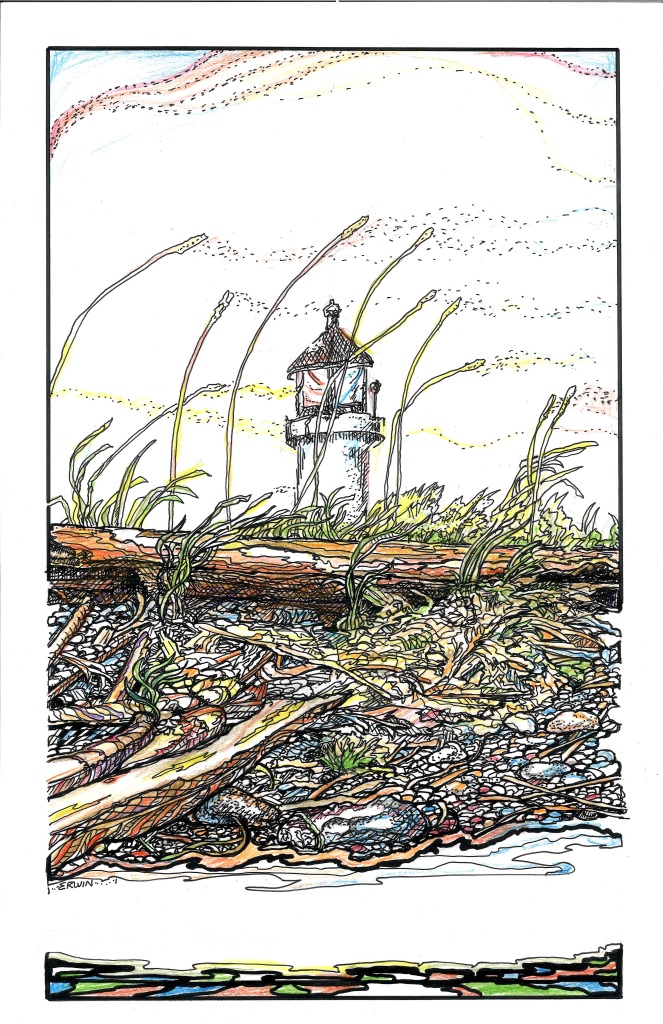
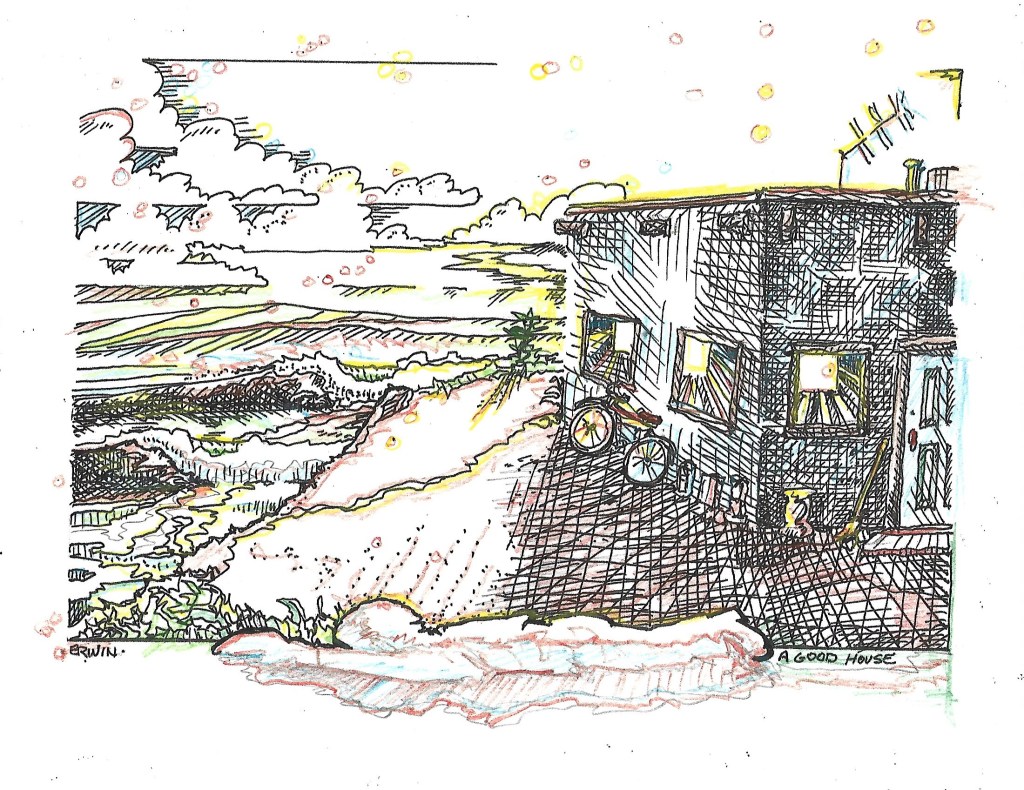
OH, since the location could be anywhere, on this (new) illustration (sketch if you must), I put in some waves in the background, making, possibly, A GOOD HOUSE that much better.
A Good House
We had a good house. This, you see, was the problem. It was, also, too close to the border. Some, those who think themselves brave, who think others will follow them, they call the disputed land on which the good house sits the ‘frontier.’ I call it ‘bloodlands.’ There has always been trouble. Wars go this way, then back; like waves on a lake.
My Father, he went to war- one of the wars- he pushed forward very bravely (so we were told), but came back very broken. The next wave took him for good.
Wave. Yes. Like a wave. We all knew he was already drowned. He was waiting for the next wave to wash his body away from… This is difficult to explain. “No faith left” he would say, staring toward the horizon.
My Mother, she had faith, and, with it, that certainty… I have heard it called fatalism. Ah, fancy term, that. It’s that knowledge that the darkness comes to each of us, to all of us. Fate and faith, they are, I think, related. “To have faith,” my Mother told us, my Sister and me, after our Brothers went, or were taken, made to fight, “you must have faith.”
This means, I think, that you must believe that having the faith sometimes works. Sometimes what we have the faith in, that things will be all right, can happen. I don’t know if I do believe this. My Mother did. Truly.
The snipers had done damage to the troops from our country. That is why they, our Soldiers, took to the houses. “Like a jar of water,” one of them told my Grandfather, who was weak and old, and had survived, he said, by never flying anyone’s flag, never taking a side. The Soldier held my Grandfather’s head against the rocks of the fireplace. He tapped it with a branch meant for the fire. He, the Soldier, explained this thing to my Mother, who, because she refused to cower as her Mother was, obviously was in charge.
He threw his hands apart to describe how a sniper’s bullet reacted with a soldier’s skull. “pheuuuuuuuh!” Then he laughed and let my Grandfather go.
“Okay,” he said, “your land; you don’t care what country it’s in. Fine.”
There was blood on this Soldier’s uniform. It (blood) dries almost black on the green. He smelled of gunpowder and body odor and death. They all carried sometimes multiple guns, and each had what you might call a machete. They called them something that would be more like ‘sword,’ and attributed a certain righteousness to its use. The Soldiers burned the blood from the blades in our fire, ate our food, complained about my Sister’s crying, and waited.
Soldiers, I now know, spend much time waiting. This is where their brains tell them many stories of why they should be afraid. They tell each other that they are not afraid, should not be afraid, they are and must be men. Yet, I could see these Soldiers had fear. Fear, someone else’s, looks like anger. I could feel my own fear. Like the Soldiers, I would hide it. I made my fear look like calmness. I could see everyone’s fear. Except my mother’s. She had the faith. I wanted to have the faith. I was ashamed to have, instead, the fear.
Fear is like a prayer, I think; or, maybe like a heavy, dark blanket, wrapped like a cloak, ready to be cast off, cast off quickly, when it is bravery that is needed.
Bravery, I’m afraid, is the ability to disregard what is known to be right. Bravery is a vicious thing. I no longer wish to be brave.
For some, it is better to be dead than brave.
Sorry. I must laugh a bit. The brave and cowardly are often thrown into the same grave.
“This is a very nice house,” another of the Soldiers said. He stood close to the window, lit a cigarette. “I think,” he said, “after the war, when we are free, I will take this house.” It was then the sniper’s bullet hit his neck. Both sides at once, it seemed. He was still smiling his dirty smile when his head snapped back. He rocked only a bit, and fell, crumpled, beside me where I sat. The cigarette was still in his mouth.
The first Soldier, and the others, ran outside, then away, leaving the dead one, blood splattered on our walls, making pools on our floor. We could hear guns going off, closer, then farther away. We thought, we hoped we were safe.
Briefly, we were.
These were the, it gets confusing; you might call them counter-insurgents. At dawn the insurgents came closer. Same smell, same uniforms (I thought at the time), different caps. They laughed when they saw how poor we were at trying to drag the body out. They kicked at it, shot it several more times, took things from it, threw it onto a truck with other bodies, some not in uniforms.
You can tell when the soul is gone, when a person becomes a body. Less. Almost nothing.
I don’t know where a soul goes. Somewhere better. I have seen those whose souls are gone, their bodies still…walking, eyes too wide open, too squinted down.
We would have been all right if the war had not slowed, the fighting ‘bogged-down’ in the hills; if the troops of our country had not fought so fiercely; if we had not had such a good house.
We had new guests not of our country. They thought themselves of a better country; bigger, older. This was not actually true, the bigger part, except for this short while. How small and pitiful our country must be, they said, to be so easily conquered.
I have no patience to explain why things went wrong. My Sister cried too much. It became night. Perhaps it was the darkness, the length of the nights. One of the soldiers said his grandfather might have worked on the masonry on our house, back when our country was still grand.
“If so,” my Grandfather said, “I would have paid him well. I always paid the workers well. They ate at our table.”
The mason’s Grandson looked at our table, smiled, but not nicely. Another Soldier, suddenly angry, perhaps because of how his Grandfather was treated, because of where his Grandfather took his meals, grabbed my Grandfather and pulled him outside. My Mother knew what this meant, and begged for her Father’s life. The Soldier slapped her for begging. Because she stood at the door and screamed “Butchers, murderers,” my grandmother was also pulled into the darkness. My Sister, holding onto our mother, kept crying. My Mother did not.
This is the fatalism of which I spoke, the belief that all will be tested.
And most fail.
I also did not cry. This is the faith, faith I had because my Mother had faith. The mason’s Grandson pulled my Sister away, shoved her toward me, told me, in my own language (they are really only slightly different) to keep her quiet. He moved his face close to my Mother’s, touched her breast. He said, Whores beg. Are you, then, a whore?” This was to humiliate her further.
I have learned this from war: To kill is not enough for some. To only, to merely kill is not enough to make the anger and the fear and the hatred cease.
“If I must be,” she said.
At this he laughed. “I am also the whore,” he said.
“My Children,” my Mother said to him. It was like a question. He, and the other Soldiers, now back from outside and leaning against our walls, shrugged and laughed together. The mason’s Grandson took his pistol belt off, holding the pistol in his left hand, moving it close to my Mother’s cheek.
“God will send a miracle,” she said to me. “Turn away,” she said.
I almost cried out at this moment. My Sister did. I put my hand over her mouth and prayed that I could have a man’s strength.
Prayers. Excuse me for laughing; just a little. Prayers are not answered as we expect.
It’s rare, I have learned, that a first mortar round can hit precisely. This one did, precisely where it was intended to land, and when I asked for it. The Soldier’s Grandfather had not been a roofer. No, not at all. Ha!
Like a jar of water, burst.
I kicked at his body when it was over, when the others ran, when more mortars rained down on the houses on the frontier.
Of prayer, I should add, speaking of the partial nature of the realization of prayer; my Mother did not survive this…this…I don’t know what they call this. It’s a tide, a tide, and we are the shore. I carved our Family’s name onto the mantel, underneath, to mark a claim when I return. I took the Soldier’s machete. After I’d chopped him with it; splattered his blood with it, I burned his blood from the blade in the fire.
By the time the Peacekeepers came, the roof was already patched, by my Grandfather and me. We also buried my Mother, dragged the soldiers’ bodies away from the house. My Grandparents would not leave. This was their home. That they were not soldiers was honored. That time. My Sister became one of the many refugees. Refuge means safety, of course. I prayed she would be safe. Yes. I told myself she was safe and fed and happy. That was my hope. Perhaps it is partially true. I became, as you know, a Soldier, a brave one, they say. I am still a Soldier; I wait, but I do not fear. I no longer even hate. I know what bravery is.
Oh, I see you don’t believe there could have been two miracles, two dead Soldiers in one house. Well, perhaps I lie. The results would be the same; the dried blood as black. Prayers answered.
When I was captured that first time, taken like a fool during one of the many truces, they called me John Doe number four hundred and thirty-four. I was, I now guess, eleven years old.
I probably should have split this into two parts. Thank you in advance for reading. You aren’t required to do it in one sitting. I apologize for annoying ads; it’s because, since I haven’t made any money on this (vanity?) project, realsurfers, I pay the minimum to Word Press. Hence, ads. I inserted a photo of, basically, the view from where Julia Cole’s mother’s house would be, to break up the chapter.
Though the manuscript (not a secret) lacks focus, mostly due to a stubborn desire to make side characters seem real, I have been trying to narrow in on the relationship between Joey and Julia. There’s more of that after the sunset photo.
SIDEBAR, with apology- The professor in a watercolor class I took at Palomar Junior College had a habit of grabbing my work before I was finished. “Done,” he would say. Of one painting I was ready to overwork and ruin, he asked if I loved the woman I was trying to render, his argument being that I should concentrate on shading and form, the pieces, or, since I lacked the skills for truly rendering an image, I could go for something impressionistic.
I don’t believe I’ve over-described Julia Cole, and since the narrator cannot know what she is thinking, we (presumptuously including you) have to rely on how she behaves. Yeah, like the way it should be. Maybe. Do I love Julia/Julie? YES, and if any character has to be real, complicated, vulnerable, tough, for me to consider her properly rendered, it is she. Or is it ‘it is her?’
CHAPTER THIRTEEN- SUNDAY, MARCH 30, 1969
I didn’t get up early enough to surf. Rather, I didn’t leave early enough. I got onto I-5 from 76, got off at the Tamarack exit. Eight surfers out at the main peak in front of the bathrooms. Too small for Swamis, too crowded at the main peak at Pipes. I passed by the turn that would lead me to the grocery store, drove through the parking lot at Cardiff Reef. There were waves, but they were cut up by the shifting sandbars, chopped up by water flowing out of the lagoon on a big tide shift. Outgoing. Still, surfers were taking off on peaks, bogging down on flat sections the shorter boards couldn’t float over. I never got out of the Falcon, but I did stop, between cars, when a larger set hit the outside peak. The five surfers in the water were caught inside. Even that wave flattened out, split into two weaker peaks, and got wobbly in the outflow from the lagoon.
Eleven minutes early, I parked the Falcon in the spot closest to the southwest corner, visible from the double door entrance. I grabbed three loose carts, pushed them together, and aimed for the entrance.
Weekends. Easter vacation. Excuses to go to the beach. A higher percentage of the customers at the San Elijo Grocery, Mrs. Tony’s to locals, seemed to be tourists, down or over from somewhere else. The state park across the tracks and the highway, extending along the bluff at Pipes to the lower, flatter area at Cardiff Reef, contributed customers. Suntan lotion and creams for sunburn, floaties and cheap shovel/pail/rake kits contributed to the independent grocery store’s bottom line.
Almost all the west, ocean-facing wall was glass. The view was of the road, the railroad tracks, the highway, the four-year old shrubbery that was just beginning to provide privacy for campers at the state park. The windows started at four feet from the floor, allowing for bags of dog food and fertilizer and compost, cheap beach chairs and portable barbecues, and extended twelve feet, four short of the sixteen-foot ceiling. The rolldown shades that only partially mitigated the afternoon glare were up.
The middle of three registers was empty. Mr. Tony was at the first register, his voice and laugh echoing off the exposed trusses and half-painted plywood ceilings, bouncing off the windows. He was just finishing up a story I had heard enough times to whisper the punchline as my boss revealed it to an obvious camper. “Can’t get that at no Piggly Wiggly!” Someone from the southeast was my guess.
Mr. Tony dropped the smile when he saw me. I dropped my arms to my sides, slightly out from my hips, palms out, to show I was wearing the appropriate clothing: Chinos, sensible shoes, long-sleeved shirt with a collar, no hippie beads. My hair, over my ears for the first time in my life, was slicked back. I would wet it in the customer’s men’s room occasionally.
I stepped toward the counter, ready to bag groceries. Mr. Tony handed the customer his change, watched me place the items in a bag, then nodded toward the back of the store.
Halfway down the center aisle, I couldn’t miss hearing Mr. Tony with his next customer. “All these hippies. Kid’s thinking he’s foolin’ me with the hair; figures I’m okay with the duck’s ass, greaser look. Pretty soon the kid’s gonna look like a pachuco. Huh, Guillermo?”
Mr. Tony and Guillermo both laughed. “Pachuco.”
The grocery store’s office was behind the wall that held assorted beach and camping gear, tents and sleeping bags, lanterns. A string of Christmas lights, always on, framed the entrance to the storage area. A set of smaller lights framed a hand painted sign hung on the area’s most prominent post. “No public bathrooms.” There was always incoming freight in with the stacks of boxes and partial boxes of non-perishables the Tony’s had gotten a special deal on. Frisbees, hula hoops, tiki torches, garden hoses. Seasonal decorations were also stored there: Plywood Santas, American flags. There was a table for painting the paper signs for bargains and produce prices, bottles of red and green and blue and yellow paint, worn brushes stuffed in dirty water in an oversized pickle bottle.
The door to the inner office was unpainted and unmarked other than a fading message in grease pencil. “Not a bathroom.” The door was almost always open because Mrs. Tony was almost always there.
Mrs. Tony was sitting on the far side of her ping pong table desk, straight back from the door. Clear view. She had yelled “Jody” before I entered the storage area. She began moving aside stacks of invoices and customer account cards, each no less than a six inches high, to maintain her view. She looked up at the clock above the door, pulled out my card from the smaller of three stacks to her right, made a note with the pencil she kept in her hair, stabbed between the rollers and bobby pins and a scarf. Mostly red on this day, with white flowers.
“Jody,” she said again, standing up, “Did you see your apron?”
“Oh. I… get my own apron?” She looked at me as if I had said something rather rude or really stupid. “I mean, thank you, Mrs. Tony.”
“Yeah. Go help Doris.” She pointed through the doorway. “Good?” I nodded. I could see my Pee-Chee notebook under a stack of other papers immediately in front of here. She shook her head, waved her pointer finger. “I haven’t gotten a chance yet, Jody.” She glanced at the clock again. I checked it on the way out. 10:03.
…
Doris, late forties, about the same age as Mr. and Mrs. Tony, was ringing a woman up at the middle register. I walked up, trying to re-tie the cloth string on my new green apron. “Mr. Tony’s at the ‘so glad to see you’ register,” she said as I moved into bagboy position.
I looked over. Tony was talking to and laughing with a man, a bit older, dressed in a gray suit, fedora to match. There were no groceries on the counter.
Doris’ hair was also in curlers and covered with a scarf, hers in several shades of light green. Her customer was wearing a dark dress, with pearls, and what I had heard referred to as a ‘Sunday-go-to-meetin’ hat.’ The woman asked, “Saving your good hair for your man, Doris?” Doris smiled and kept ringing up the groceries. Quickly, most of the prices memorized.
The woman nodded toward the man with Mr. Tony, both now at the front windows, each with a foot up on a pile of bags of dog food. She looked at the prepared pie on the counter. “We’re skipping the sermon, Doris, but we’re definitely going to the social.” She looked at me. “That’s where you hear all the good shit.” I did a sideways nod, tried to appear both impressed and mildly shocked.
“Right about that, Connie,” Doris said. She and Connie laughed. I nodded. I smiled. “Careful with Connie’s pie there… Jody.”
Connie looked at the name, hand sewn, in white, onto my green apron. “Jody? JODY. I’ve got a niece in Arizona named Jodie. JODIE.” I pinched a spot on the apron below the name. I pulled it forward. I looked down at it, looked back at customer Connie as if I might have grabbed the wrong apron.
Connie looked at Doris, looked at the total on the register, looked toward a tall, thin, metal shelving unit just to the right of the cash register, equidistant between the middle and south register, and attached with two strands of metal rope to a metal I beam post. Three wide, five high, each of the shelves contained an approximately even number of tan colored cards. The shelving unit itself was set on top of three wooden milk crates. With a metal gridwork inside to hold and separate glass containers, the crates were built to interlock when stacked, “Story’s Dairy” and “Fallbrook” was stenciled on the sides of each of the crates.
Doris stepped toward the shelf. “Pie’s got to pass for homemade… JODY,” Connie said. ”I have a nice serving dish, out in the car. Should work well enough with the hypocrites and sinners.” I looked at the pie, looked at the shelf Doris pulled the card from. Four down, middle. L-M-N. The pie wouldn’t pass. I nodded at Connie and smiled. She may have missed it. She was adding here initials to the card. “I meant the other hypocrites and sinners, of course, Doris.”
…
Mid-day rush. I was rushing between Doris’s counter and Mr. Tony’s; bagging, smiling at the customers; smiling bigger when Tony said something that might not have been deservingly amusing or clever; smiles Tony had to know were fake, smiles few customers bothered to analyze. I nodded at customer comments, most of which didn’t concern the weather, did concern the damn hippies or the damn tourists or the damn surfers. “At least you’re not one of those,” at least one of the customers told me. Smile.
For the third time on this day, Mr. Tony used someone questioning my name as an excuse to break into his version of the Jody Cadence. “Jody’s bagging groceries, bringing carts back, too…”
Mr. Tony stopped, laid his left hand out and open, and toward me, and waited. This was my cue to join in the joke, add another line. This time it was, “At the San Elijo Grocery, the surf’s always in view.”
We did the “One, two, one two” together. Mr. Tony laughed. I tried not to look embarrassed. Part of the job. So glad to see you.
At two o’clock, Mrs. Tony came to the front to relieve Doris. She made sure I saw her shove my Pee-Chee folder into the shelf under the counter. She pulled an oversized watch with half of the wristband from one of the big pockets on her apron, didn’t really look at it. She made sure I got the message. Keep working.
There was a lull around four. I was at Mr. Tony’s register. “Joe DeFreines’s kid,” he was telling this customer, a regular, probably thirty years older than Mr. Tony. “Jo-dy. Joke. Marine Corps cadence, from… Korea.”
The man shook his head. “Army.” Mr. Tony stepped back. “World War Two, Tony, the durn leathernecks stole it. It’s… fact.” The man laughed, took both of his bags from the counter before I could move them to the cart, and held them against his chest. He took two steps, purposefully bumped into me with a shoulder. Friendly bump. “Good man, Joe DeFreines.” He took two steps more steps, and said, without looking around. “Tony’s okay, too, for a fucking Gi-rine.”
“Jo-dy,” Mrs. Tony, at the middle register, said, loudly, sharply, almost like someone calling cattle. Pigs, more like it, emphasis on the second syllable. She was holding my Pee-Chee notebook out and toward me, six customer account cards on top of it. She slid it, several times, toward the credit shelf as I approached. “Lots of regulars on a Sunday,” she said, “putting it on their tabs.” I took the folder. “You might want to learn some of their names.”
“I’m… working on it, Ma’am.”
Mr. Tony stepped toward us. Mrs. Tony gave her husband a message, eyes-only. Back off. He did. I set the Pee-Chee on the counter, spread the tab cards on top of it. Mrs. Tony said, “Ask your mother,” and turned away.
I reshuffled the cards, rearranged them, alphabetically, and put them away as quickly as I could. “It’s a lot of money, Mr. Tony,” I said, tapping the edge of the folder on the slight guardrail at the edge of the counter. “Lost Arroyo Investments. Are you… familiar?”
Mr. Tony looked at the folder rather than at me. He exhaled, popping his lips, slightly. “It’s not dirty. I guarantee you that.” He turned toward his next customer, one aisle away. “You ready, Honey?” She wasn’t. Not quite. Without looking at me, he asked, “You afraid to ask your mom?” Turning toward me, he read my expression correctly.
“Almost four-twenty, Jody,” Doris said as she returned to the middle register. “Your break. Take it or lose it.”
I acted as if I hadn’t noticed that Doris had removed the scarf and curlers and had brushed out her hair. Doris looked as if she wanted a comment. I was bagging, concentrating. Produce, one bag; ice cream, white, insulated bag; several cans of soup, bottom of double bag; one loaf of bread from a local baker, on the top; quart bottle of milk, TV Guide, straight into the cart. I gestured my willingness to push the cart. The older woman at the counter shook her head. Another church goer, I guessed, another dark dress with white pearls.
“Headed that way anyway, Ma’am. Mrs. …?”
“Not Mrs. anything anymore.” I stepped behind the cart. “Jackie, just Jackie.”
“Just Jackie, did you notice Doris’s hair?” Just Jackie turned and said something to Doris I didn’t hear; something Doris, self-consciously primping, pushing up the curls on one side of her face, seemed to appreciate. Doris gave me a different look when Jackie stepped next to me and set her purse into the cart. Embarrassed but appreciative, perhaps.
The shades across the front windows were a third of the way down, the sun just at the bottom line, the light half glaring, half insufficiently muted. Jackie kept one hand on the side of the cart as she and I walked. I was one set of windows from the main doors, even with Tony’s register, when I saw Julia Cole enter.
It would be an over-romanticization if I said that, at just that moment, the sun, full force, dropped below the shade and Julia Cole was bathed in that light. Amber. That is how I saw it; pausing, stopping myself and the cart, and because I stopped, Jackie stopped.
“I can manage from here… Jody,” Just Jackie said, looking at Julia Cole, looking at me, looking at Mr. Tony at the first register, looking back at me. I blinked, looked at Jackie. She was smiling as if she knew something about sunlight and amber and magic.
Julia Cole, walking toward me, had her eyes on me. I was only slightly aware of Jackie pushing the cart toward her. Julia’s expression changed when she turned toward Jackie. Surprised, perhaps, at the woman’s expression. Still, Julia appeared to be no more than polite.
Julia Cole moved to her right, out of the glare. She stopped. She did not intend to walk any closer to me. If it was a dare, I wasn’t taking it. I was replaying the previous seconds.
Julia Cole was very close. She said something, not quite a whisper. I saw her lips move.
“Ju-lie!” It was Mr. Tony’s loudest voice. “Surf up or something?” Julia Cole turned toward the voice. “Jody can take off and go if he wants.”
“No. No, Mr. Tony, it’s not… that.”
With Mr. Tony and Julia Cole in my periphery, right and left, I saw the silhouette in the alcove at the main doors. Only a hand and arm came out of the shadow. The hand was pointed at me. It twisted and flattened. Fingers out, the hand was pulled back. A summons. Duncan Burgess at the corner of the entrance alcove, just in the light, standing next to Julia Cole’s big gray bag.
Julia Cole asked me a question. Before I could process, she repeated it. “Can you come outside? I mean, please.”
I looked at my watch. 4:23. Break time. Ten minutes. I didn’t look around. I did hear Mr. Tony’s voice, mid-range volume-wise. “And how’s Christina and her little one?”
“Margarita. She’s… fine, Mr. Tony. Christine’s…” Julia’s laugh was surprisingly sharp. “Well, you know Christine.”
“Most popular bag girl we ever had.” Julia must have waited for the punchline. “And the worst.” Mr. Tony’s and Julia Cole’s laughs were several octaves apart; but perfectly synced, timing wise.
Julia gave me a look I read as meaning I was to go see Duncan without her.
Reaching under my apron and into my shirt pocket for the pack of Marlboros and the Zippo lighter, I headed for the alcove. I struck the wheel on the lighter at the point where the windows stopped. It flared up. Duncan noticed. I lit up as if this was normal. Duncan picked up Julia Cole’s bag, backed through the right-hand glass door and held it in the open position, allowing me just enough room to pass. I exhaled at precisely that moment.
Dick move.
Duncan Burgess took a roll of photo paper out of the top of Julia Cole’s bag. He removed the rubber band, put it around his left wrist, unrolled and handed the stack to me. He watched me as I went through the first three pages.
“Contact prints,” he said. “Julie gets them… Palomar. College credits.” I nodded. Duncan looked at the cigarette in my right hand. He stuck out two fingers on his right hand. I allowed him to take the cigarette. I took the stack of photos. “Teacher likes her. Probably a pervert. Photographers. They all are. But… free developing.” Duncan took a drag, blew the smoke just to my left. “Julie takes… a lot of photos.”
Unlike the first three pages, 35-millimeter black and white images from sections of exposed negatives, the fourth, fifth, and sixth pages were almost full-page images of Chulo, in his rough and dirty evangelizing robe, and another man, taller, in a robe, barefoot, his left arm in a sling, leaning to his right on a single crutch. Jumper. The mid-section of the Jesus Saves Bus was behind Chulo and Jumper. The image of Jesus was between them.
I looked at the second three pages, shuffled the first three in behind them, and studied each of the larger images. “Chulo is smoking,” Duncan said, moving to my right side. I looked at my cigarette between the fingers of Duncan’s left hand. He took another drag. “Next photo…”
In the next photo, Jumper’s crutch was falling away as his right hand was knocking the cigarette out of Chulo’s mouth. “Julie said they’d been arguing. Like, quietly. Check out the third enlargement. See? She zoomed in. Jumper is pulling something from a pocket of his robe, handing it to Chulo.” Duncan put his index finger on the photo. “There. See?”
Duncan took my cigarette out of his mouth and offered to put it in mine. I declined, possibly backing away too quickly. Duncan blew smoke between me and the photo. Dick move. Payback.
“You can’t see it.” It was Julia Cole. She had come out the entrance door and was looking over Duncan’s shoulder and directly at me. I looked away from the photo and looked directly at her. “They weren’t arguing,” she said. “Not exactly. Chulo was… he was crying.” I blinked. Julia Cole blinked.
Chulo, in the last photo, was smiling. And crying. Jumper was smiling. I let go of the papers with my right hand, allowing them to roll up against my thumb.
“Actually, Julia Cole, I think they both were… crying.”
Julia Cole smiled. I lost focus on Duncan Burgess, directly in front of me, and everything else. “I do think so,” she said. “You’re… right.”
I would like to believe, and still do believe, that Julia and I froze for the same number of seconds. Her eyes were alive, studying mine, and mine, hers.
“Hey, Junior…” Duncan came back into focus. “You gonna help or not?”
“Not.”
I stepped back, handed the roll of photos to Julia. Duncan stuffed the cigarette butt in among many others in the waist-high concrete pipe ashtray at the side of the entrance door. I tapped my watch. “There’s nothing I can do, and… and my break’s over.”
Julia and Duncan exchanged looks. If Duncan looked angry or frustrated, Julia looked disappointed. She held the roll of photos upright, spun it in little circles, looking past it. At me. Disappointed, angry, resolved; then neutral, then a ‘Fuck you, then,’ Julia Cold look.
Duncan moved between Julia and me. He removed the rubber band from his wrist and double wrapped it around the roll of photos, giving Julia Cole a ‘told you so’ look. He turned toward me; moving his face closer, too close, to mine. I didn’t step back. I was trained not to. Duncan made a growling sound as he pushed past me and though the exit door.
Mr. Tony met Duncan ten steps in. Tony gave him the same side hug he had undoubtedly given Julia. “How’s your dad, Yo Yo?”
“No one calls me that, anymore, Mr. Tony, but… he’s, um, better.”
“You’re excited for prom and graduation and all that, I expect.”
“Can’t wait.” Disingenuous.
Mr. Tony slapped Duncan on the back. “Oh, come on, Duncan!”
Julia Cole stepped closer to me to allow a couple, tourists, possibly newlyweds, with matching sunburns, to keep holding hands as they entered the store. She looked past them and at Mr. Tony and Duncan and the couple. The door closed.
“So, Miss Cole, you’re… angry?”
“I had no… expectations. It was Duncan.”
“Oh? But… why does… Duncan… care so much?”
“He has his reasons.”
“You don’t ask.”
Julia Cole turned toward me. Her expression said, “I don’t need to” before she did.
I wanted to keep Julia Cole talking. I wanted her that close to me, close enough that the only thing in my field of vision was her. I was more aware than usual of my pauses, the lapses, the seconds I spent replaying previous seconds, trying to remember, trying to catalog exactly what she said, and how she looked, exactly, when she said it.
“I had one,” I said. “Yo-yo. Duncan.” Pause. “Sparkly.”
“We all did. Phase.” Short pause. “Sparkly? Yours?”
“Mine? Yeah. Sparkly.” Pause. “Walk… walk the dog.”
“Basic.” Pause. “Good trick. Easy.”
“Yes. The, um, trick… the one I liked… most, was…” I moved my hand up and down a few times, palm down, then flipped it over, pantomimed throwing the yo-yo over my fingers, then flipping my hand back over. “It’s like… switching stance.”
Julia Cole was staring. I was a fool. Ridiculous. She smiled. Politely. “It… is.” She held the smile longer than I could comfortably handle. She was studying me. I looked away, politely, allowing her time to drop the smile and continue the studying. “What do… you think?”
I pointed at the roll of photos. “Chulo smokes. I believe Jumper… maybe he doesn’t. Or… he quit.” I pulled out my father’s lighter. “Zippo. That’s… a guess.”
“Zippo?”
“Marine Corps logo. Maybe, if you enlarge it, the image, more…”
“I will.” Julia looked appreciative in the moment before she looked past me and into the store. I took the opportunity to look at her. When she seemed to sense this, I looked where she was looking.
Duncan and Mr. Tony had moved just beyond the first counter. Duncan pulled folded bills from an inside pocket of his windbreaker. “On account,” he said. Mr. Tony took the cash, pulled out several account cards from the rack, top left box, A-B. He shuffled through them, set one aside, took his pen out of his shirt pocket, wrote something on the card and showed the card to Duncan. He looked past Duncan at Julia Cole and me. I looked away. None of my business. She looked away and toward my car at the far end of the lot, then back at me.
That may have been that lapse, the pause that caused Julia Cole to speak. “I have… other photos. Negatives. I could… How late do you work?”
I refocused on Julia. “Today?”
She didn’t wait through the guaranteed pause. “We saw all the red lights, Swamis, from my, my mom’s house. Cops. Fire engines. We went down. It was… you don’t get it, do you, Junior? That… night. After…”
I didn’t get it. Julia Cole looked frustrated, even irritated.
“We saw it. Saw… it. It. Chulo. Portia. Gingerbread Fred was still there. Everything. It was… I just thought… maybe… you… might…”
I wasn’t keeping up. There was something in my mental image file, the view from Swamis and up the hill. It was a photo in an old Surfer magazine. In color. Maybe it was a cover photo. “From my mom’s house” she had said. It would have to be…
“What is… wrong with you?”
Julia Cole moved a hand over her mouth the second after she asked that question. All I could see was the back of her hand and her eyes. All I could hear were the words. “What is… wrong with you? What… is… wrong… with you?”
Three seconds, ten, I have no idea how long I was staring at Julia Cole. She was backing away and into the parking lot. I backed into the edge of the exit door. I took my eyes off Julia Cole, spun around, and pulled it open. Duncan and Mr. Tony both looked in my direction. In twenty-one steps I was even with the counter, with them. I stopped, pivoted, ninety degrees right. “Duncan Burgess, do you know Jesus?”
I pivoted back. I walked to Doris’s counter, everything slightly out of focus, unaware she was speaking. I grabbed a bundle of San Elijo Grocery paper bags, ripped off the paper ribbon that held them together, stuffed as many as I could into a shelf at Doris’s knee.
Doris put a hand, flat, on my chest. “So, Joey, I figured, I don’t have a man at home… currently; why not let my hair… down?”
I looked at Doris, tried to smile. I looked to my right. Duncan was gone. Mrs. Tony was at her husband’s register. Mr. Tony slid the account card and Duncan’s cash toward her. “Two-fifty-five on Burgess.” Mrs. Tony opened the register, took the bills from her husband, and began counting them. Mr. Tony looked at me. Mrs. Tony looked at him. Both looked at me before I could turn back toward Doris. What was wrong with me?
Doris looked at Mr. and Mrs. Tony. Her expression was hopeful. That’s what Julia’s expression was. Had been. Hopeful. Optimistic. Temporarily.
“What is wrong with me,” I whispered.
“Doris; you look… gorgeous.” Mr. Tony’s body language, the raising of his shoulders, suggested he was suddenly aware the compliment had been in his loud voice. He didn’t turn toward his wife for her reaction. He walked toward the front windows.
Mrs. Tony, walking toward Doris and me with the draw from the other register stuffed in one of the pockets of her faded green apron, stopped and looked at her cashier. She looked over at her husband, a shadow in the glare, as he used the pulley to lower the first of the window shades all the way down. Mrs. Tony touched her own hair, let out an only slightly exaggerated sigh, and pointed at me. “Julie. Beautiful girl, huh Jody.” I couldn’t respond. “The money; ask your mother. Huh?”
It was nearly sunset when I walked across the parking lot. 6:32. Daylight savings time had kicked in and the sun would set, officially, at 7:13. The tourists and inlanders and visitors and customers were all headed elsewhere. The wind was, if anything, slightly offshore. There was time to catch a few waves if I made a quick decision and went somewhere close.
Something was stuck, face up under the driver’s side window wiper. It was a flyer for an Australian surf movie. “Evolution.” There was one on the bulletin board on the wall between the entrance alcove and the window wall. Or there had been one. Friday, April 4, Hoover High School, seven pm. Saturday, April 5, San Dieguito High.
There was something under the flyer. More pages. Seven. Photo paper. Stiff. Slight curl. Slightly damp. I looked at the images as if they were flash cards, moving each to the back of the deck, going through them again and again. The photos were so dark that the artificial light of camera flash and flashlights and headlights burned out any details: Firefighters and cops, Dickson and Wendall; a woman in a robe holding back Portia. One photo showed the unmistakable anguish on Portia’s face. Another was of someone’s body, burned, against the wall. In another, the body was being covered with something more like a tarp than a sheet. In the last photo, Gingerbread Fred was on his knees, looking up. Up.
“Tear in the shroud, “I said.
I couldn’t look at any of these images for more than the time it took to move to the next photo. I couldn’t allow any of these images into my memory, a file too easily pulled. Too late. It was imprinted, permanently. I could describe each of the photos now in more detail than the actual photographs showed.
That was what Julia Cole had seen, witnessed, photographed. I tried to look again at each of the enlargements. It didn’t work. All I wanted to see, or imagine, were Julia’s expressions when she was trying to tell me about that night; how sincere, raw, honest she looked; how beautiful. All I wanted to do was collapse.
I didn’t. I went through my ring of keys, separated the one for the Falcon, I rolled up the pages. There was a note on the back of the flyer: “Portia said you are your father’s son, and you might help. I have more…” Out of room, the words went sideways. “…waiting… for you.”
I looked around the lot. Julia Cole wasn’t there. Of course, she wasn’t.
…
Vulcan Avenue runs parallel to Highway 101 and the railroad tracks, and in front of the San Elijo Grocery. There were several cross streets. I took one, went up two blocks, turned left. I looked at the houses, looked toward the water. I went up another block, headed south again. I stopped at the middle of three empty lots, the place where the best view would be. Optimal view. Surfer magazine view. Swamis Point.
Two houses farther south, on the uphill side of the street, a VW mini-bus, grey-green, white top, was parked in front of a house. “Julia’s mom’s house,” I said. Partially hidden by the VW and some shrubs, the back of the Jesus Saves bus was parked in the driveway. “Portia said you are your father’s son, and you might help.” I repeated the phrase. “Waiting… for you.” Me.
A light went on inside the house, behind the sheer curtains. I drove on. I pulled a u turn at the end of the block, coasted by again before I dropped back down to Vulcan and turned right. When I got to D street, I turned left. The Surfboards Hawaii shop was on my right. There were no cars on the block, either side. Several storefront businesses were on my left. David Cole C.P.A. was one of them. No lights. I got to 101 and turned right.
At Tamarack, parked on the bluff, lights to the south to lit the underside of the clouds. There were black lines on a dark ocean in front, breaking from a peak, gray soup to a gray beach. The rights looked better than the lefts. Still, I was replaying phrases. “You are your father’s son.” Portia. “What’s wrong with you?” Julia. “Waiting for you.” I reread the note that had been on the windshield by the light of my father’s flashlight. I straightened the photos, without looking at them, and placed them in a yellow notebook and slid that into a PeeChee.
I stayed on 101 until it curved away from the beach. Carlsbad Liquor was on my right, still open. Baadal Singh’s truck was parked nearby. “Gauloises bleus,” I said, out loud. “Picasso smokes these.” I considered stopping in, possibly buying a pack. I didn’t.
“Swamis” and all revisions are copyright protected, all rights reserved by the author, Erwin A. Dence, Jr, Thanks for respecting this, and for reading,