We have to, occasionally, scroll. My fault. I haven’t figured out how to tighten the borders on Drucilla’s Mac.
BY WAY OF EXPLANATION:
The ORIGINAL ERWIN LOGO thing came from trying to simplify my drawing style, such as, I’m often afraid, it is. Yes, I am planning on doing some more t-shirts as soon as I pay my taxes. I tried to make both sides of the wave match, then went to THE PRINTERY in Port Townsend, had Steven do the reversal/blue thing. I was so excited that I didn’t really perfectly align the reflection part. Close.
BECAUSE the SAILBOAT RACING THE SQUALL drawing was already being copied, a version came out blue (and reversed).
THE SALISH C tugboat illustration is the subtle color version, the colors all the more subtle(ized) by the vagaries of multiple copiers and printers and computer screens. Subtle and Simple are so fucking hard (I can say fucking because, so far, no one has told me not to. Still, I’m fucking cutting back… damn it).
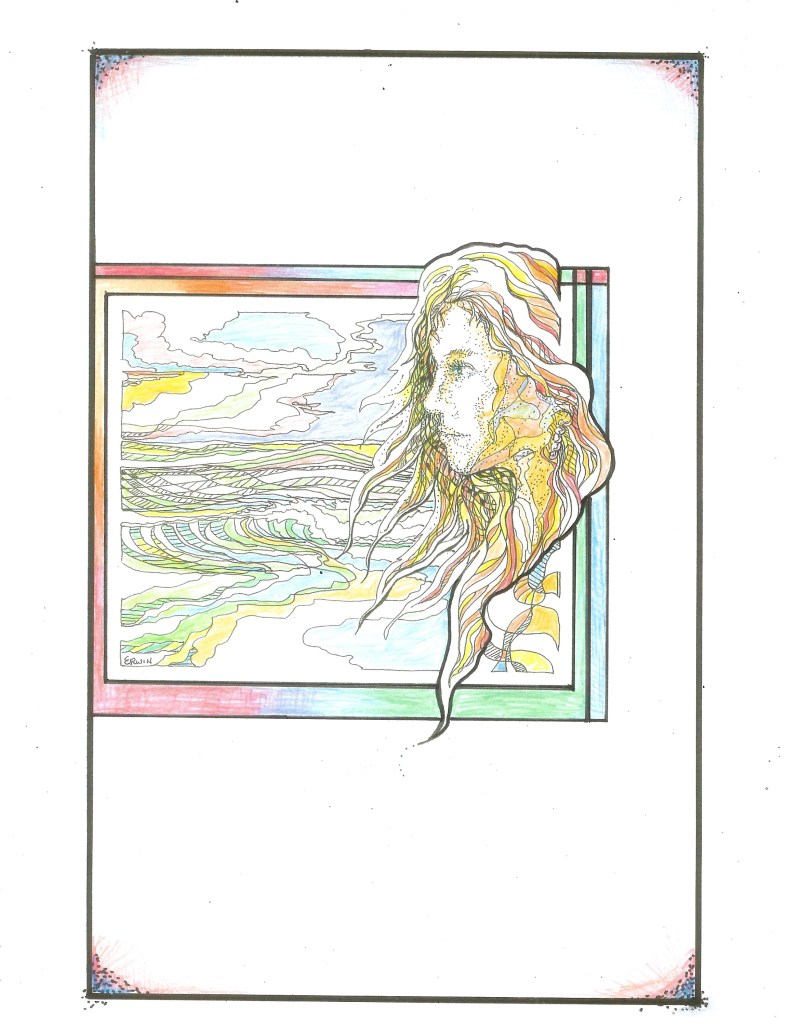
THE YOUNG WOMAN illustration is another attempt to draw women without overdrawing. It is another possible cover or title page for “SWAMIS.” I have Dru working on adding some perfect non-hand-drawn lettering. She has, but, because I don’t know how to sign in to her acrobat account, it is unopen-able on her computer. It would be able to be opened on the laptop Trish is hanging on to, but then I would probably have to fucking (sorry) find it. AND YES, I’m so so close to finishing the final go through on the manuscript, trying so hard to keep it around 95,000 words.
FANTASY POINT. Here’s the point: Two local artists, JESSE JOSHUA WATSON (I insist on calling him Jesse Merle Watson- easier for me to remember) and STEPHEN R. DAVIS have done paintings of fantasy point breaks. I’m competitive.
I would put Jesse’s version up, but I would have to contact him and… and, anyway, no one wants anyone to believe any rendering or abstraction of lineups that don’t actually exist (yeah, maybe Indonesia or Surfer’s Journal) might be real. BUT, both Stephen and Jesse surf, so we do share similar inspirations. Maybe… okay, I’ll call someone who might have Jesse’s number. Meanwhile, google him. I DIDN”T SAY my interpretation is better. To quote another surfer/writer: “I wouldn’t say ‘better,’ I would say ‘different.’ ” I will gladly accept DIFFERENT.
PLEASE REMEMBER, all the rights to all original works on realsurfers.net are owned by someone.
I FIRST HEARD about the hole in the clouds from an ex-military, ex-commercial pilot. It was a while ago and some of his details are a little lost in the clouds of time, but he flew enough over the Puget Sound/Salish Sea/Strait of Juan de Fuca area that he took note of how, in inclement/stormy/normal-for-here weather, there seems to be a hole in the clouds. Here is where I may be romanticizing the story a bit: His wife, evidently, on a recreational flight, pointed to the hole in the clouds and said, “I want to live there.”
AND SO… they bought a place on high bank overlooking Discovery Bay, with a view toward Protection Island and the waters beyond. The wife wasn’t around when I worked for the guy. I won’t go to far into making up some story as to why she wasn’t.
I thought I had saved an image from the Doppler radar that showed the blue hole fairly clearly. Please accept this substitute image
THE BLUE HOLE, SPECIFICALLY
From above, the hole in the clouds over the Salish Sea has been observed often enough to be named. The blue hole. It is not, of course, clouds being clouds, constant in size or location, but it does consistently appear, somewhere around Protection Island. The blue hole can be seen from the curving road that skirts and rises above Discovery Bay. Look to the northeast. In the distance you just might see streams of light through a tear in the patchwork quilt.
If you are in the water or on land, a ring of ominous clouds around you, open sky above, the blue hole name also makes sense. If you see it once, you will look for it again. If you believe the phenomenon to be magical, some real-world Shangri-la… sure.
It isn’t magic, it is magical.
Rain shadows and rain forests, flood and drought, weather anywhere is confusing and complicated. Simplified, the earth seeks balance. The changes in the atmospheric pressure, the relative weight of the air above the earth, are paralleled with the changes in temperature between land masses, land and ocean masses calls for rebalancing. The constant rebalancing brings the movement of air. Wind. Mountains to oceans, cold to hot, warm to warmer, oceans to mountains. Bigger differences, stronger winds.
Too complicated, too confusing, there are professionals to track the changes, to tell us what to expect in weather and wind, to explain the blue hole.
Winds. We are all victims of and beneficiaries of winds; soft or harsh, breezes or gales. Winds can dry our clothes or tear them off the line, propel a boat, or, along with wind-driven waves, sink it. It seems illogical that winds from the north, the Fraser River Valley, particularly, can bring heat, even excessive heat, in the summer, and bitter, freezing cold in the winter.
They do.
The blue hole is caused by updrafts; a collision of winds split from a single source, a storm front approaching landfall from somewhere in the vast Pacific; from the Aleutian Islands, from the waters off Japan, even from the waters off New Zealand. Jet streams and rivers of ocean current add to the chaos.
The surface level winds, butting against the land, take the easier routes, the water, the corridors between the Olympic and Cascade Mountains. Sea level.
Islands and bridges, points of land and bays and inlets formed by rain and ancient ice are mere obstructions. Waves from the wind batter them and wrap around them.
The winds on the southern route go through the Chehalis Gap, into and up the Puget Sound. Whether the winds are southwest or southeast, the net direction is north. Hitting the obstructions of Whidbey and other Islands, the winds bend to the wider and more open area to the west. The Salish Sea. East winds, net direction West.
The winds on the northern route wrap around Cape Flattery and push down the Strait of Juan de Fuca. Southwest becomes west. Again, even with winds blowing across or against the flow, the net direction is east.
Collision. Updraft. The blue hole. Specifically. Still, it is… magical.
I wrote this piece for a still in the planning phase event or series of events in conjunction with the Port Townsend Library. I decided to post it here because it seems the “INSPIRED BY THE SALISH SEA” events or events might still be a ways off. Surfer/librarian Keith Darrock is the contact point with the Library. Since there is some time, and because I have worked with and keep working with people who have some interesting relationships with the local waters (not just surfers), I am trying to contact them and invite their participation.
My goals are a bit different than Keith’s. In addition to a live event or events, I am kind of pushing for some sort of hold-in-your-hands thing, a pamphlet, perhaps, with art and essays and poetry. It is totally unclear how the thing would be funded, but it would give some folks who don’t want to chat it up live and in person a chance to say… whatever. Several artist friends (and I) are working on Salish Sea appropriate art. If you have a short piece or art to contribute, Keith would be the guy to get a hold of. Google him, or, I guess, the PORT TOWNSEND PUBLIC LIBRARY.
Thanks, as always, for checking out realsurfers.net. Please remember that I claim all rights to my writing and… not this time, but to my illustrations as well. “Swamis” update- Working on the final go-through before whatever the next step is. Shit, I better get on it. Or maybe I’ll…
OH, WAIT… here’s a thought based on several recent surf trips/adventures: You can choose to be disappointed. Or… not.
CAUTION: This post contains references to people and practices from the last century.
I have a home/office landline and two cell phones. One, the smart phone, cracked glass and blown out speakers, is for business, mostly, texts and notes and contacts; oh, and it does have internet, so, if I want to look at a camera or at selected buoys, maybe check out the doppler, I can kind of do it. The other phone is my (and Trish hates the greeting that goes with it in the odd instance that I don’t answer, either because it set itself to mute- not my choice, ever, or I am actually on the device, chatting) Super Secret Stealth Surf Phone. It’s a dumb flip phone, the kind they market to old people.
There is one contact on this device, Miller Paint, that isn’t a family member or a surfer. And there aren’t, like, that many surfers.
And, of the surfers on the contact list, there are probably only three that I would call if I want to team up (as in they drive) to go in search of some rideable waves, and/or to report on conditions, bad or ridiculously bad, should I be as some spot that actually has cell service.
YET, I DO WANT TO KNOW.
And so do you.
“Waist to chest, groomed, lined-up? And, you say, you’re waxed up and, oh, you’re totally dressed in tight, form-fitting rubber and ready to slip into a few, didn’t catch that… A frame peaks and curvasious barrels? One moment please, while I connect you.”
THERE HAS BEEN, lately, and as always, some discussion as to who is telling what to whom. Sharing images is also a topic in conversations that take place during the long lulls between short windows of possible wave action. If your cousin’s surfer buddy from work in East Seattle gets a photo of someone ripping up a side-chopped two footer at any beach that has, in the distant background, some chunk of land that may or may not be Canada… well, who the hell sent that out?
PARTY LINES LEAD TO PARTY WAVES. Yeah, I get it. Back when I started realsurfers.net, 2013 (Yeah again, like ten years! of self indulgent content), I thought it was fine to write about how I surfed this spot until the wind got on it, then cruised over to this other spot, rode a few, then checked out this spot and that one on the way back home. I DID HEAR ABOUT IT from the few readers who, desperate for surf related stuff, stumbled across my… irk… blog.
“Hey,” I surfer asked a friend of mine with him in the water, “Is that the old guy (on the beach trying to put on my wetsuit) who posts shit on the internet?” “You mean… Erwin?” “I don’t know his name, but he’s got that gay website.”
The site is not, basically, gay; though I did, in the interest of inclusion, decide not to call it “Strait Surfing.” And, gay or not, thanks for checking it out. AND NO, I no longer name any spots, or even tell when I might have found some rideable waves. It’s all about the info, the intel. We are all (another sixties reference here, “Spy vs. Spy” from “Mad Magazine,”) trying to piece together enough info on tides and angles and periods and spots to make a reasonable gamble on heading on a surf expedition at a certain time.
WHAT WE HAVE, among surfers who want to find waves, locals and non-locals and way-not-locals, are CIRCLES OF INFLUENCE; maybe you are in my contact list, most likely someone not in mine is in yours. And, NEWS GETS AROUND.
BEFORE I Apologize for my past sins… Just coincidentally, watching some old Dylan on YouTube because, well, I love Dylan’s work, and because the latest podcast of “Nate and Koa’s Podcast” hasn’t shown up, and I came across a video pieced together by “Swingin’ Pig” from two live performances in 1966. It was “Ballad of a Thin Man,” and, because I wasn’t all that stoked on watching it, I hit on the ‘Comments.” Usual stuff, but in there was a reference to the line, “You should be made to carry around a telephone.” The commenter thought this was Dylan foretelling the future. I checked the official lyrics this morning (because I care) and found the lyrics were changed to “You should be made to wear earphones.”
It’s ear buds, Bob; but… hey.
Dylan, of the era, photo by Jerry Schatzberg
ANYWAY, I DO PROMISE to continue to contain if not curtail my gossiping and snitching on whatever super awesome sessions at some unnamed spot I happen to accidentally survive, and I apologize for telling ____ that _____ told me he, ______ was surfing at ______ with _____ and ________ a ______ ago, when, as you now tell me, you were working and totally missed it.
MEANWHILE, I got to the end of the manuscript for “SWAMIS” again, fourth time, and it’s under 100,000 words, and, rather than going through it again (not a rewrite), I am choosing to provide good if non-specific content for folks kind enough to check it out. OH, and if you want to be on the contact list of my super secret stealth surf phone, call me.
This is my first time attempting to use my (suspect, quality wise) printer/scanner with my borrowed (thanks, Dru) Mac computer. I managed to get these without calling my daughter, but with some YouTube help. Please excuse the sometimes unfortunately placed bits of crap from, I don’t know, somewhere, and the wasted white space because I haven’t mastered the sizing part of all this. I could comment, at length, on each of my latest attempts at… whatever it was I am trying for. I will try not to.
Top to bottom:
“Racing the squall line.” Because I am involved, trying to assist Port Townsend librarian and fully-frothed surfer Keith Darrock in putting together an event, tentatively titled “Inspired by the Salish Sea,” I used the view from Port Townsend. I am inspired to do at least one more with the view surfers on the always languid Strait of Juan de Fuca, desperately looking to the west for any sign of an approaching swell more frequently get, an incoming squall. Worse, another shit weather front.
“The Salish Sea.” Possible title with info for the event or events on the rest of the page.
“Quilcene.” The Quilcene Village Store, quite the hip place nowadays, has several of my drawings in the sort of sitting/coffee area. They have been having a sort of contest to come up with postcards representing the area along Surf Route 101. This is my entry. When I showed it to Trish, she said, “Uh huh… it’s… okay.” This is after she poo-pooed the earlier version with a similar background (Mount Walker), but with a person in the foreground to add more, you know, like, interest. “Creepy,” she said. “Looks like a killer.” Okay, I rubbed him out. Metaphorically.
“Untitled Woman’s Face.” Trish told me I should draw some of the characters for my still-almost-finished novel, “Swamis.” I said, something she already knows, that I have trouble drawing women’s faces. I actually kind of cheated on this one. Googled “How to draw women’s faces.”Some… tracing was involved, just for stuff like, getting the eyes kind of lined up. Guaranteed, the drawing looks very little like the one I tried to copy.
“Inspired by the Salish Sea.” Definitely redrawing this one. The blank space is to allow room for the dates and times and the various speakers. “What I was going for,” every artist or writer (or surfer who just blew ten attempts at a floater) says, was a sort of Victorian, possibly Art Nouveau look. No where close. But… next time…
“Real surfers froth.” Yeah, it’s kind of like post-psychedelic graffiti, totally unreadable. A series of mistakes began when I didn’t allow enough room for the T in FROTH. I thought I kind of fixed that with the overlap. No. Then, when I took the original to the Printery to get reduced, part of the F and part of the H were cut out. Okay. So, maybe some color would help with that. Not really. Still, someday, this will be on some highest bidder’s wall, and when visitors ask about it, he or she will say, “I believe what Original Erwin was going for here was…”
Better. Always.
SWAMIS Note. Adam Wipeout and his family are down there. It is close to Legoland. I got a nice image the other day. Almost no one out, perfect conditions, and… yeah, I’m fine with it. Totally one hundred percent… fine.
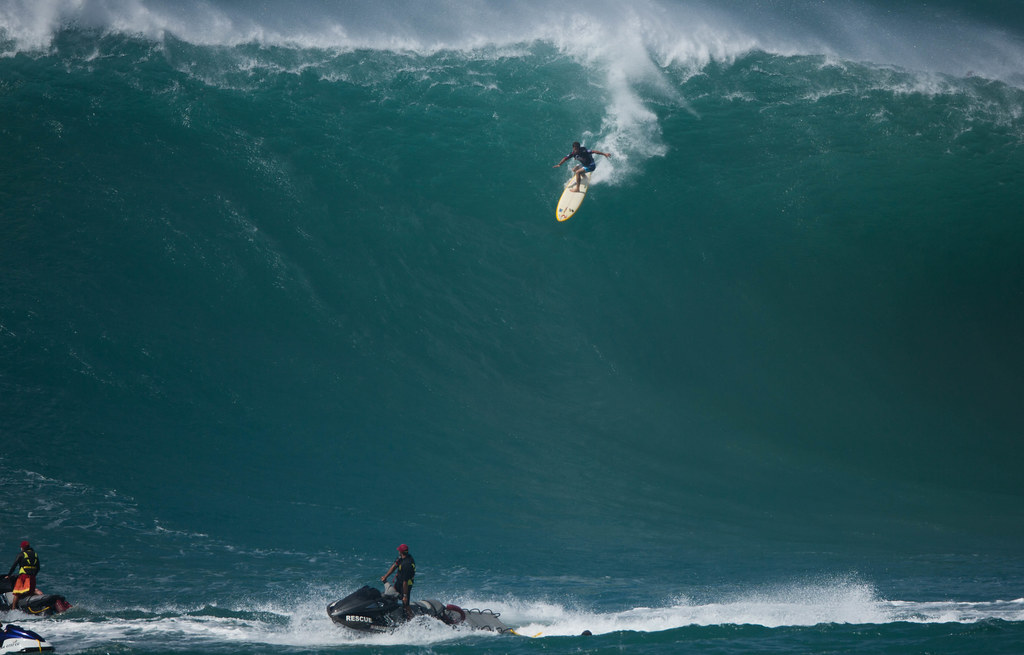
I MAY HAVE, finally, gotten enough EDDIE to fill my craving for something I have sworn, repeatedly, sometimes with actual swear words, never to really care about: SURFING BIG ASS WAVES. It may have helped that I did go surfing in the week since I sat, transfixed, kiddy cornered to our big ass flat screen (No, don’t care if your is bigger, Dick), listening to commentary by Kaipo (from the WSL- hope he still has a job there) and the two guys who did the color work for the recent DA HUI SHOOTOUT, which I also watched a shit load of, and somehow, with one participant in that event knocked unconscious and having to be resuscitated and at least two other surfers seriously injured, made riding PIPELINE seem somehow boring. Thanks, Kaipo.
THERE WAS NO WAY the Eddie could or would be boring. That a lifeguard, LUKE SHEPARDSON, getting a time deduct for his time surfing, won the event seemed almost poetically fitting.
AND/BUT I didn’t just watch the live coverage. OH, no, I checked out videos by and/or about all of my Hawaii favorites during the past week, last YouTube vicarious surf trip, last night. YEAH, like NATHAN FLORENCE, KOA ROTHMAN (one with both of them together), MASON HO, and, because YouTube obviously has me dialed in, I was offered and perfectly willingly clicked on more stuff from MARK HEALY and ELI OLSON. And maybe a few others I don’t want to check my search history to verify.
BUT WAIT… So many people I ran into over the past seven days, some with only a tangental connection to surfing, had to ask me if I watched THE EDDIE. Oh, yeah; want to discuss it? I did. Yes, since I just thought of it, I did enjoy the commercials from the TV Station in Hawaii (KHON2) that was airing the event. No, they probably do have as many ads as mainland channels for various charities, and for pills and vitamins and products to make any body part smell great, but if they took a day off from that to show some surf related products, thank you.
I SHOULD confess that it was often me who brought up the subject.
THERE WAS, as I alluded to, a day between last week’s BINGE and today’s (possible) start to the WSL’s version of a PIPELINE contest (which I will follow), a full day adventure, dark to dark, with STEPHEN R. DAVIS, seeking waves. It took two days of bleaching and pressure washing to get down from that buzz-worthy experience, my froth, no doubt, amplified by the dull hangover from the EDDIE.
SO, THIS MORNING, searching Google for an appropriate photo to purloin (doesn’t sound as nefarious as steal), I chanced upon some stuff from BEACH GRIT, almost always satirical, and always clever commentary by CHAS SMITH and DEREK RIELLY. So, I just had to get their take on (what else,) the EDDIE. And, of course, between them, they also skewered other surf related sites, QUIKSILVER (who formerly sponsored the EDDIE, missed out on this bonanza), and the easy target of the WORLD SURF LEAGUE.
GOOD STUFF, though I’m always a bit hurt that my friend and librarian/surf ripper/zealot, KEITH DARROCK, believes Chas Smith is just SOO great. So radical. I mean, yes, Chas is smoking in his online image, and I just someone, choosing breathing without coughing over coolness, who used to smoke, but… Now, it isn’t that I don’t agree with Keith, it’s just that I’m… competitive.
OKAY, I have almost worked on this long enough to find out if the PIPELINE contest is going to run today. I am also working on some drawings and very, very close to writing the final chapter, the grand conclusion of “SWAMIES.” OH, AND, YES I have watched some videos of the actual spot filmed during the recent FIFTY YEAR SWELL (fifty-three if you go back to the one in December of 1969). MY COMMENT: They always seem to focus on the outside peak. It doesn’t usually connect all the way through. Certain tides. Now, the inside peak…
This is one of the paintings realsurfer and real artist Stephen R. Davis has been producing during, and particularly since his epic battle with Lymphoma. Not that it’s over. Steve is offering limited edition prints and posters and cards of this and other paintings. I asked him to send me the image and the contact info so others can get in on purchasing some of his work. I don’t really communicate with him on ‘social,’ BUT I will get the connections sorted out.
MEANWHILE, I am perilously, dangerously close to finishing the manuscript for “SWAMIS.” I mean, like, today if I don’t get distracted by rumors of waves. THE ISSUE is, how to sell these things, also including ORIGINAL ERWIN t shirts and, yeah, I have some art works of my own (less so with my dark-of-winter obsession with finishing the novel.
BUT, and this is related, my daughter, Drucilla, also engaged in her own battle with cancer (Fuck Cancer), is getting back into the work mode, AND she has skills in setting up some platform on which Steve (and our mutual artist friend, Reggie) can market our work.
AS FAR AS the selling “SWAMIS,” I have some ideas. First among them, as I try to find an agent, is offering a limited edition version, printed on regular paper, and contained in a Pee-Chee folder, a critical item in a 1960s students’ life, and something that is a part of the “Swamis” narrative. With pockets on both sides of the folder, a reader could easily slide pages read from one to the other. AND I would include artwork I have done in connection with the manuscript. ALL NUMBERED AND SIGNED, of course.
AS WITH Stephen’s contact info: I will have to get back to you on that.
SOB, sob, why, God, why does a team like… sob… I just wanted… they were ahead at halftime. I mean, yeah, I know the Seahawks weren’t supposed to win, but…” unattributed quote.
Trish and I were watching the Wild Card game over at our daughter’s house. The Seahawks were behind by ten point by the end of the first quarter. I promised I would turn it off and go to the market if the 49ers got another touchdown. Halftime, the Seahawks were ahead. YEA!
Trish, before the kickoff, turned the volume down. Biased coverage. I was listening to the radio version, Steve and Dave. Properly biased. Trish did turn the volume up at halftime, just to see what the Fox Sports experts, who had all agreed the Seahawks were outmatched and would lose, had to say. “Wait until the second half,” was pretty much their message. Volume off.
Partially because their commentary was behind the TV, and partially because it’s thrilling to hear Steve Raible when the Hawks do something amazing, not so much fun when they’re sucking wind. So, no sound except Trish, face at her laptop screen, saying, “I can’t look,” “We’re bad luck,” “Oh! San Francisco’s the greatest. All world! (Sarcasm),” and my loud-but-appropriate grunts of disapproval, or my less frequent and multiple-syllable shrieks of celebration.
With no other distracting sounds, and hope still hanging by some vague remembrance of every sport movie ever made and a few miracle comebacks, it became easy to notice that there are a hell of a lot of commercials during sixty minutes of football.
Early in the fourth quarter, I did notice there were other folks rather aimlessly wandering the produce aisles, or lining up for fried chicken, people who one would never imagine actually playing football, but all in various amounts of Seahawks garb, heads down, possibly still wondering if Geno had connected of a few more long bombs. and, no doubt, happy that they (we) had beaten the crowd that waited until the inevitable San Francisco celebration, with interviews featuring the all world winners.
This isn’t sarcasm. It is sardonic (sarcasm where the speaker’s pain is just too obvious) commentary.
Oh, I did see, while checking out (saved thirty cents on a thirty dollar total), a guy in the line one over wearing a Seattle Kraken shirt. And later, my friend, Stephen R. Davis, who actually did play ice hockey, told me the Kraken just defeated Boston, and that’s a big deal, and… No, not switching my allegiance. Maybe. No; I’ve said I would before. But, added to all this, the San Diego Chargers, who were once my team to root for, were killing it in their game. And then, comeback by the… I don’t know, one of those southern teams. Miracle. Sure. Why not?
MY POST GAME ANALYSIS: Underdog, Over-dog; it’s better to be the Big Dog. And, since I am kind of thinking about, and planning to write about surf heroes, I should relate this to SURFING.
YES, older surfers do like to say, “Back in my day, the best surfers got the best waves,” that kind of thing that runs contrary to sharing and caring, the kind of easily-said aphorisms that run into the reality of limited waves and increasing crowds. NOW I am thinking about PARTY WAVES and DOG SLED TEAMS. If you’re in front, there’s an expectation you will leave lots of room for the other surfer; if you’re in back, you’re dealing with the wake and chandeliers, wondering if there’s an opportunity for a go-behind. AND NOW I’m kind of wondering (and trying not to wonder or care) which teams are playing today, and, by extension, who I want to root for.
AND NOW, realizing I should have taken off for a money-making opportunity half an hour ago, I am wondering when I will get to surf next.
I got the dog image from GOOGLE. All other content is copyright protected and is the property of Erwin A. Dence, Jr. NOT THAT I WON’T SHARE IF YOU ASK NICELY.
This selfie of Reggie Smart has nothing to do with the rest of the content of this post. The caption could be, “Not enjoying the view.”
Surf Heroes
WE SHOULD, perhaps, set some boundaries on where we rank surfers we hold in high esteem… and why we position them where we do. The SURFER EVALUATION SPECTRUM (SES) would go from a low point of ‘Insufficient evidence to make a judgement (so we have to believe the surfer in question is a total kook), through ‘maybe the surfer is better in better waves,’ past ‘not a Kelly or a Stephanie,’ to the ‘holy shit, total John John/Dane/Carissa/fill in your own names’ category.
OKAY, so we have a rough scale on surf performance as one of the factors each of us might use to determine if a particular surfer is worthy of our being appreciative of, a fan of, a follower of, a worshipper of… whoever. Surfer, surf hero, surf god. Small g.
This already becomes difficult because we, and this is me assuming you and I rate other surfers in a similar way, the COOLNESS FACTOR (CF) must be included in our assessments, because, yes, it is unavoidable. While a certain self-confidence dealing with mundane situations is an important element (ie; stylishly handling waves that are not ‘of consequence’), casualness under difficult conditions and circumstances is… well, it’s another consideration.
There must be, or there should be a mathematical equation to quantify the CF. EXAMPLE- A few years ago, a surf contest in France in heavy conditions saw everyone just getting annihilated. Except for… John Florence. He was, like, comfortable. So, like nine on the coolness, nine on the challenging conditions. 9/9. OH, that’s, if my math is correct, ONE. I would also place Felipe Toledo’s performance at Jeffry’s Bay, with two airs on one wave that put him deep in the pocket, a ONE.
BUT WAIT, that’s still performance related. Maybe I have watched too many World Surf League (WSL) contests, too may YouTube videos. While most surfers can be as arrogant and rude as they can away with, and back up with quality surf riding, in order to be a professional, sponsored surfer, one has to develop a public persona that is gracious, humble, generous, grateful; all those qualities that are, perhaps detrimental for someone whose job it is to out-perform everyone else in their bracket. But they are good for the IMAGE. For the fans.
The YouTube video (live stream, actually) that brought this sort of fakieness to mind was of a kid’s contest at Trestles. Ten and twelve-year-olds, some of them sons or daughters of former professional surfers, others with paid coaches, all working on their resumes, refining the moves the judges are looking for. Rehearsed after-heat interviews, sponsors’ gear on display.
I can’t help thinking of the contest at Malibu, 1967. My sister went. I saw the article in “Surfer.” Miki Dora, pretty much flipping-off the judges. Arrogant. Cool. I saw live action of Andy Irons in a boat at a contest. Paraphrasing, “Why are you talking to me. Talk to the winners.” Both of those surfers had flaws, Andy tragically so. Gerry Lopez, as cool under pressure as anyone, admits to some of his. Wave Hog. I forgive him. Dane Reynolds says he’s only won (something like) one contest, ever. Honesty. Nice.
There might just be something to be appreciated in realness.
HAMARTIA- I looked up ‘heroic flaw.’ Evidently all the really cool heroes have one. Or more. Maybe lesser heroes have lesser flaws. NO, I am not even thinking about some formula.
It just might be that what we are looking for, hero-wise, is someone to emulate. In surfing and in life, we copy, we practice, we keep what works for us, and try to avoid what doesn’t. Eventually, whether we are happy with it or not, we develop our own style, our own identity. We peak at some point on the surfing and the coolness and the decent human being scales. And we keep going. The thing about surfing, and life, is that none of us are 9/9 all the time. Or even a decent percentage of all the time.
SORRY, I’m off track. I think. I start writing. It all changes. I wanted to say that I have had a few surf heroes in my many years of surfing. Bucky Davis, local surfer from Fallbrook, was probably my first hero. When I was fourteen, he was coolness personified. That changed. Less hero, more real. Real is better. GEEZ, that’s the whole story. I’ll get to Bucky another time. OKAY, like, pretty soon. I am pretty busy trying to finish my “Swamis” manuscript, so I can sell it. If writing is a humbling process, selling something is more so. We’ll see.
LOCAL HEROES, MAGAZINE HEROES, SURF CONTEST HEROES, YOUTUBE HEROES. In retrospect and in conclusion, I have to say my spot on the Surfer Evaluation Spectrum is ‘appreciative of.’
One last thing (because I’m still… thinking): At some breaks, the bigger, outside set waves are not always the ones that line up best. Roll throughs. In passing up some of these waves, I have called out to others in the lineup, “Go on, be a hero.”
I posted this late at night, and woke up knowing I had to make it clear that these are sections cut out of the manuscript. This material does go along with the storyline, and is, itself, edited. I can’t seem to stop myself.
I say “these” because I also did some moving of paragraphs. Joey in the parking lot:
Chulo knew the truth.
The truth is Chulo jerked the wheel and moved over far enough that the Jesus Saves bus went into the ditch. I stopped. I backed up, ready to go around the bus and see what happened with my father. Chulo had a better view. He motioned me on. I knew it was fucked up, that I was in more trouble. I knew my mother was ahead of me and had seen her husband pass her. I knew my father would be fine. Angry, but fine. He was always fine.
I am not offering excuses. My father hated excuses. “There is no such thing as a good excuse.” Second part. “Even the best excuse is a bad reason.”
…
Nine-twenty-seven. Time in the sun had not cleared the water from my watch. It had converted it into fog on the inside of the glass. I was dressed for work; chinos, a light blue shirt with a collar, short-sleeve, not yet tucked-in, off-white Levis cords, slightly bent-over-at-the-heel leather shoes. My surfboard was inside the Falcon at an angle, the nose against the back of the passenger side of the front seat. I moved the notebooks from the towel but left them on the hood. I draped the towel over the board. My trunks were half-hung on the fin of my board. I pulled up the tailgate, rolled up the back window, and locked the back door.
The red notebook, with two pages for February 27, 1969, on the hood, was still open, but face down. I stuck my hand under one side and flipped it closed.
I looked around to see which car full of tourists or families who sometimes went to the beach, or which surfers, looking for a first or second session, might want my spot. Surfers, three, in the car, four boards on the rack, stickers on the window from Chuck Dent and Harbour. L.A. surfboards. No, not them. I pulled a green apron from the back of the front seat, passenger side. A circular logo with “San Elijo Grocery” and “Cardiff by the Sea” and “Since 1956” was silkscreened in white. “Jody” was stitched on the front, pocket high on the left chest side, in yellow. I put the apron on, let it hang, and walked to the edge of the bluff.
Choppy. Crowded. I looked down at the stairs. Julia Cole and Duncan Burgess were two stairs above the landing, their boards leaning against the fencing at the ninety-degree corner. Julia had her omnipresent gray bag on the deck and her camera resting on the railing. She was aiming a telephoto lens toward the surf break.
Duncan, not too involved in the camera work or what was happening in the water, looked up and at me. I didn’t step back. Duncan tapped Julia Cole. She shook him off, he tapped her again, she looked around and up. I stepped back from the bluff.
I looked up, toward but not into the sun. Just for a second. Just long enough that I saw a few blinks of red. I took another step back, blinked. Okay.
There was the truth of what happened on the road just east of the Bonsall Bridge. There was what I saw in flashbacks: The low sun in my eyes, the red, spinning light and the car coming straight at me. My mind, I theorized, might put events that passed by so quickly into slow motion, into crystal focus.
It didn’t. Rather, it hadn’t.
I flipped the red notebook open, looked at what I had written. I closed the red notebook. It didn’t matter. Everything else I wrote in there for February 27 was a lie. For the next four days I wrote nothing. Mourning. Excusable.
I thumbed through the pages for the days before February 27. Notes and little sketches of cartoon teachers and classmates, cartoon waves, psychedelic lettering for various surf spots. “Grandview.”
That was enough. I visualized. I would be happy enough to admit I was merely remembering if it wasn’t that, eyes open or closed, I could see what I had seen. If it wasn’t reliving the moments, it was more than just remembering.
…
Nine-thirty-nine. I set the red notebook down on the towel and turned back toward the water. I looked at my watch, walked over to the bluff. A set of waves, four, ruffled the horizon. The waves moved toward the point, each one growing in the rough water beyond the fields of kelp. The first wave cleaned up, picked up sparkles along the top edge and a sky-reflecting line two-thirds of the way down the face. A darker horizontal line, the wave’s true color, widened, lengthened, moved up, became a shadow version of the true color, as the wave steepened, and a definite peak formed. Another bright line, reflecting the flat, clean water inshore, appeared, three-fourth of the way up the wave. The lines became other shapes, irregular, but balanced and moving. The dark line became almost black, the topmost line almost white. Energy against gravity, tripped by underwater fingers of ancient rock. Explosion. Shades of green and blue on crazed white, the true wave color moving down the line, the explosion following it.
One of four surfers in the water paddled for the second wave, pulling with two even strokes, pushing off and up as she and the board dropped down. She. It had to be Julia Cole; smooth, graceful, goofy-foot. At the bottom of the wave, her legs compressed, her upper body straight, she raised her right arm and leaned back. Her left arm low, her right hand and arm were tracing the shape of the wave as she moved up into a position high on the wall. She shifted to more of a parallel stance and crouched. The wave, at the highest point, just below the lip, was almost transparent. Julia Cole was flying.
Julia Cole.
…
There are an infinite number of ways to tell any story. So many choices. This is undoubtedly my biggest problem in completing “Swamis.” Somewhere between a sketch and a rendering is a novel.
I’m getting there.
“Swamis.” copyright 2020. Erwin A. Dcnce, Jr. All rights for original work in realsurfers.net are held by the author/artist.
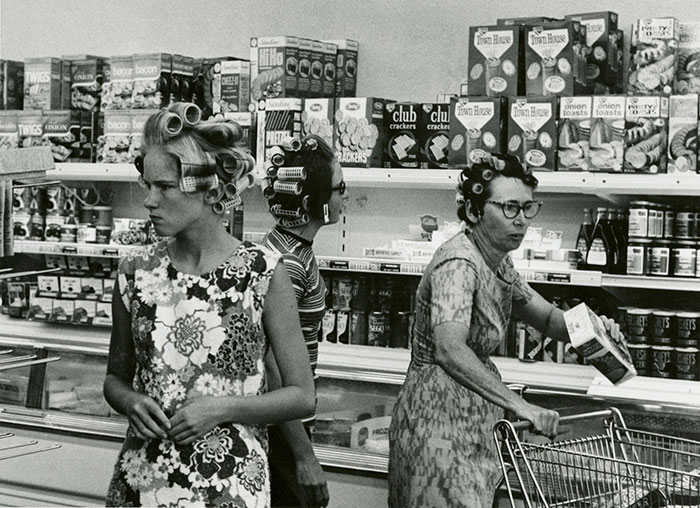
Shoppers saving their ‘good hair’ for later. I do love this photo. Not mine, but…
UPDATE- There will be a paddle out on Sunday, January first to honor and celebrate the life of real surfer Omar Jamaludin. It will be held at a break Omar and many of us consider our (favorite or a favorite) spot. No, not H****ck.
I am, finally, getting to the end of where I have now decided “Swamis” should end. While I have been actively, consciously trying to cut down or cut out anything that doesn’t further the main plot, I found myself with ninety thousand words and needing more than ten thousand more. THIS EXCERPT is from a chapter in which Joey is working at the fictional San Elijo Grocery Store, known as Mrs. Tony’s to the locals. There was, in the late sixties, a grocery store there, across the railroad tracks and highway 101 from the San Elijo State Beach. It featured a high wall of windows facing the view. I do recall Phil Harper and Ray Hicks and I, well into a week or so of camping and surfing, going into the market, and my becoming aware that I was probably close to maximum sun exposure. So, chocolate milk and Hostess donettes, back across the street.
The in store information is largely from Trish working at the Quilcene Village Store in Quilcene (in the 1980s) while it was known, by locals, as “Mary’s Village Store.” It was easy to get credit, easy to put purchased items on your tab. Mary also accepted, from the right customers, post-dated checks. And, she did some payday lending. Ten bucks on Monday was repaid with eleven on Friday. And, as the fictional Mrs. Tony and other checkers do in the manuscript, Mary and other checkers (not Trish) wore their hair in curlers at work, saving their ‘good hair’ for their men at home.
So… Swamis- a Sunday in March of 1969. Joey redefines is the narrator.
I was getting faster, steadily, at the register. I had already memorized most the prices on the most frequently purchased items, read others, only guessed on a couple; always, as instructed, ‘guessing up.’ And I was smiling, and sliding the goods, and bagging, and loading the carts, and responding positively to whatever clients said; I was making change and putting new balances on old tabs.
By my lunch break, 2:20, each of the Tonys told me I would get faster. Eventually.
Just before what was supposed to be my afternoon break, 4:20, I checked out one customer, Sylvia Crawford, whose account card featured a red line under the balance. Sylvia Crawford, then I, looked over at Mr. Tony. He mouthed ‘okay,’ with a smile, followed by a bit of a stern look for Sylvia Crawford. Her expressions went from relief to a purposefully awkward smile, one meant to, if not conceal, to acknowledge the awkwardness and thereby lessen her embarrassment. She had offered no explanation of why she was behind, or when she would try to catch up. I was grateful for that. I just smiled. Neutral smile. As instructed.
After my smoke break, I held up a three-person line to get Mrs. Tony when a guy with a rather full cart slid a Traveler’s Cheque across the counter. “Where you from?” Mrs. Tony asked him. When she found out it was Arizona, she said, “Sure. Too hot there already, that’s my guess.” She took over checking out his purchase. I did the bagging and the moving of items from counter to bag to cart.
“Now, Jody,” Mrs. Tony said, the Arizona guy still there, “If this was an out of state check, you’d have to say ‘no.’ With a ‘sorry,’ of course.”
“What if, Mrs. Tony, he had been from, say, Minnesota?”
“I’d have said, ‘sure, still too cold there’s my guess.” Arizona Guy and Mrs. Tony both chuckled. Still, her look told me I could have stayed quiet. Should have.
When Arizona Guy and the three other customers were gone, she said, “Jody. I know you’re smart. What you aren’t is better. None of us is better than our customers.” She put her right pointer finger high on my nose. She slid the finger down slowly and held it there for a moment. “They might want to tell us their business. Selling them… stuff, that’s ours. Got that, huh?
“Yes, Ma’am.”
“Huh?”
“Got it.”
…
At about 5:45, I rang up purchases for a guy in his mid-twenties. He had a clean shirt on, but there were some grease stains on his hands and forearms, and he was wearing dark blue mechanic’s work pants and hard leather shoes. He held out a check made out to Jack Jacobs, and flipped it over. Jonathan Jacob, Junior’s signature was at the top, “pay to the order of Richard Haber” below it, and a signature, “Richard Haber” below that.
“That’s me,” he said. “Richard Haber. Two-party check. I already signed it over.” Richard Haber flipped the check over and set it on the counter. “Jackie Jacobs says you do this all the time.”
I smiled, took the check, pointed at Mr. Tony at the first register as I walked away.
Mr. Tony looked at the check, looked at Richard Haber, who was busily bagging his own groceries. “Don’t recognize him.” That was in Mr. Tony’s version of a whisper. In his loudest, announcement voice, Mr. Tony said, “Mrs. Tony, can you come to check out stand two?”
Richard Haber, Mr. Tony, several other customers, and I all looked around for Mrs. Tony. “Friend of John Jacobs, Junior,” Mr. Tony said in his normal-but-still-loud voice. “Jackie Boy Jacobs.”
Richard Haber had loaded the groceries into a cart by the time Mrs. Tony almost ran down the cereal and bread aisle and to the middle register. Her apron and scarf were off, and her hair was out and brushed. Only two clips on her bangs remained. She had makeup on, far less than what she would describe as ‘whorish’ on another woman. Her lipstick, however, was color I had overheard her refer to in a conversation with Doris as Revlon red.
“Almost closing time,” Mrs. Tony said, more to me than to Richard Haber, “It’s Sunday.” She took the check in her left hand. “Better start sweeping up, Jody. I mean, Joey.”
The oversized dry mop and the other clean up items were already staged against and in the very middle of the front windows. On my walking away from the middle register, and with several gestures from Mrs. Tony, two of the customers who had been waiting moved over to her husband’s line.
“No. Sorry, kid,” Mrs. Tony told Richard Haber, in a low-but-not-low-enough voice, “Jackie Boy Jacobs stiffed Mr. Tony and me good.” Richard Haber waited as Mrs. Tony walked over to the file cabinet, pulled a card out from the bottom of the ‘H-I-J’ stack. She held the full card, three red lines under the last entry, by the top edge, hitting it against her left forearm as she walked back to the register. Don’t know what you did for him, but…”
Mrs. Tony pointed at pieces of paper suspended on strings above the filing cabinet until Richard Haber followed her eyes. “Bad checks,” she said, “Never could collect. I used to have a board… with names of cheats and deadbeats, over on the back of the register… so’s people could see them. Some guy from the County, a detective. He…” Mrs. Tony looked at me, the message being to return to her register. I leaned the mop against the cabinet. “He said naming names might be what’s called, ‘bad form.’ But, Richard Haber, I still got every one of the names…” She tapped her forehead. “…Up here.”
Mrs. Tony put Jonathan Jacobs, Junior’s check on the top row of keys on the register. She looked at the total for the items on the counter, hit a key, opening the drawer. She took out five dollars and sixty-five cents, moved it all into her left hand, and said, quietly, “Or you can try the bank. Tomorrow. Or… maybe, if you see Jackie boy, see if he’ll come in and… honor his debt.”
“I need more money than that,” Richard Haber said. He removed several items from the bags, set them on the counter: A half-gallon of milk, a loaf of bread, a medium sized jar of peanut butter.
“Tell you what, Richard,” Mrs. Tony said, ringing-in the items, sliding them backwards on the counter, “take the bottle of Red Mountain… on me… and Mr. Tony. And, good news, you’re out of it. Lesson learned.” She looked at me, mouthed ‘lesson learned.’ I nodded.
Richard Haber wasn’t halfway to the door when one of the customers from Mr. Tony’s line, probably about their ages, late forties, headed back toward Mrs. Tony’s and Doris’s and, for a few hours, so far, my register. “Quitting time, Lenny; me and my mister are… going out.” Lenny smiled, turned back toward Mr. Tony’s register. “I got my hair undone, my lips painted up, and…” She kicked her right foot out toward Lenny, half-whispered, “Got my ‘chase me, catch me, fuck me’ pumps on,”
“You do look… delectable, Loretta.”
Loretta La Rosa shook her head, turned toward me. “You didn’t hear that part, Jody… I mean, Joey.” I shook my head. “So, Joey… Miss Cole? Huh?”
I shook my head again and started loading the items Richard Haber couldn’t afford into an empty cart.
“Swamis” is copyrighted and, as is all original material in realsurfers.net, the property of the author, Erwin A. Dence, Jr. All rights are reserved.