Not Depressed, but…

…there is a lot to be depressed about. I’m sure you don’t need a list, but we could start with, mostly because surfing is the main thrust of realsurfers, the fact that the surf is one foot ON THE COAST. Oh, it is, like, 17 seconds; due, perhaps, to the hurricane that grew at an astounding and historic rate and slammed the shit out of Acapulco. So, there’s some hope, On the coast, MEANWHILE, it’s 25 degrees and clear at my house, fifty feet above sea level, probably twenty feet under water during the Ice Age. Under ice, rather, in an ancient fjord between the Olympics and the Hood Canal. Not such a big deal except that I am headed to Bremerton to try to finish an exterior paint job.

If I were to allow myself to get depressed by this or the unknowns of approaching winter, it would be because I’m ignoring all the other tragedies and horrors going on in the world: Wars I can’t help but compare (not politicizing, just thinking) to our own western, manifest destiny, expansion. It is Sunday, and there is football, if I turn on the right channel.

Even blocking out the distant wars, it is difficult to not, occasionally, perhaps when trying to pull out of the grocery store, think about how many of us are treading water, trying to pay the rent, trying to keep the heat on, and how many people have given up and gone under.

Despite being somewhat aware of social wrongs and injustices, I freely admit to being quite hypocritical. Thoughts and prayers are no more effective coming from me, a guy who will drive two blocks to avoid eye contact with pretty much anyone holding any sort of sign than from any politician tracked down and compelled to comment on the last or next mass shooting.

I didn’t write the following piece because I was depressed. Or, perhaps, in my sleep, I allowed myself to not ignore, but to follow some twisting dream logic. I have, because I am basically chickenshit, only shared this piece with my friend, Stephen Davis. He says it’s the best thing I’ve ever written. Yeah, so, Steve and I have different opinions on a lot of things, and it isn’t like he’s read that much of my stuff, but…

Like a Hermit Crab, Like Coyotes

It was a found sleeping bag that she spread out and flattened, just out of the rain, on someone’s, a stranger’s, stoop. She wanted this timely gift to be her cocoon; goose down and polyester and cotton; she longed to be wrapped, swaddled, insulated; to wake up as someone else. Someone better.

            Pushing herself in, the smell was of mildew, and urine, and other people’s body odors, other people’s sexual encounters, of that odor of the pores trying to rid the body of poisons: Alcohol, hatred, anger, desperation.

            She took breaths in through her mouth. This didn’t lessen the coldness in her feet and in her face, each breath almost burning, burning the way whiskey can burn, or vodka. She pulled the top over her head and pulled at the zipper, useless, frozen two-thirds of the way up. She was breathing her own breath. Unbearable. She pulled at her hair. Dry, wispy even.

            This wasn’t her. Not the person she believed she was. No. She remembered that person. She remembered why she was no longer that person. Compromises, mistakes, confidently rushing into situations she was warned against, instructed against; stubbornly defending her positions, her choices, as the right positions and choices; angrily striking out at those who questioned her right to make her own mistakes.

            Now she blamed others for not trying harder, for not being more convincing.

            It just couldn’t be all her fault. Not entirely. If she could have another chance. If she could just roll herself down the stairs, across the sidewalk, into the gutter, the water could wash her down. The water, the open water, wasn’t that far away.

She loved the water. Floating, challenging the waters holding her up and laughing at the clouds holding her down.  

            If she could, she thought, yes, now, if she could submit herself to the judges, the preachers and the teachers, the analyzers and the purveyors of the hypothetical, the gatekeepers of the straight and the narrow, the high and the mighty; if she could admit she was wrong and they were right. If she could, she would.

            Yes. Now.

            She heard, at some distance, in the heavy drizzle, in the out-of-focus light from homes and streetlights, in the squish and rumble of passing cars, someone say, “I’m sorry.”

            “I’m sorry, too,” she thought. “I’m sorry,” she whispered. “I’m sorry,” she said. “I’m sorry,” she yelled.

            There were responses. Other doorways. Other partial shelters. All of them sounded like “I’m sorry.”

            The rain and another long night let up by sunrise. She was gone. The sleeping bag was still there, pushed into the shrub where she had found it. I crawled out of the back seat of my car on the curb side. I took a whiz into the gutter. I walked across the sidewalk and up the three cement steps, pulled out the bag. I pulled the zipper open as I walked back. I spread it, inside out, over the roof of my car.

            I looked around. “I hope it helped,” I whispered. “I’m sorry,” I said.

THANKS for reading, The long term forecast should bring some relief. On the coast. Look for the latest excerpt from “Swamis” on Wednesday.

Photo from the internet, some real estate outfit. Good luck to them. All original work on realsurfers.net is copyright protected. All right reserved by the author, Erwin A. Dence, Jr. If you really need to contact me, check out Erwin Dence Painting Company. I’m sure there’s a phone number. Checked. Yes.

Epic-Ness and Other Subjective Subjects

Here is a quote from the speaker of the U.S. House of Representatives Kevin McCarthy after resorting to using Democratic votes to forestall shutting down the government, kicking the next episode of this ongoing drama to a time closer to Thanksgiving: “You can always count on the American people to do the right thing after they’ve exhausted every other option.” No comment, Kev, not even “Get fucked and go back to the valley.”

Here is a quote from Trish after I bought, with her help (so adept at on-line buying), some new (zip up- a surrender move to bone spurs- like, real ones) booties after using some (pull on) not-totally-worn out models borrowed from Keith after I (you may recall) accidentally threw away a bag containing my wetsuit, vest/hood, booties, and my day-glow leash: “How are you doing with gloves?” My response: “Oh, I don’t really need gloves.”

Here is my right hand after being knuckle-dragged across the ‘rock garden’ at a northwest break:

It isn’t just the cuts. If any exposed skin (including the face) hits the rocks at almost any spot on the Strait, there will be cuts. The bruising is an option not exclusive to, but definitely more common among the thinner-skinned less-young. It may get worse among the actually-old.

Here is the scene: The window of rideable waves was closing, the tide was dropping, and I was looking for one last wave. Or another last wave. Just another wipeout, really, but Cougar Keith, who had been too early for the waves, and too late to ride them during this session, was witness to the whole awkward thing; me rolling around, trying to stand up, getting knocked down several times.

Next time, my new gloves (thanks, Trish), will be on. I will sacrifice feeling the water to not feel the rocks.

Odd to me that as hard as I try to be fluid in the water, I look so embarrassingly dorky trying to get back ashore. When I recounted the session story to Adam Wipeout, someone who “Just knew, he said,

“It wouldn’t be an Erwin session without some blood.”

I do have a photo somewhere on when I decided I didn’t need booties. Again, rocks; big crusty rocks. No one got a photo, though everyone in the lineup noticed, when, in my excitement, I bit my tongue on takeoff on a wave early in a session. Evidently a red mustache is noticeable. Cougar Keith may have been out on that occasion. Witnesses. Accounts vary.

WAIT! This is what I really wanted to write about today: An Objective Look at Subjectivity.

AS I WAS waking up this morning, I guessed that it was 6:24. I looked up at the projected time on the ceiling from the clock radio on Trisha’s side of the bed. 6:26. Wow. My brain is just so… I looked at the non-projected time on the other clock radio. 6:29. Oh. I guess I’m just alway a little ahead. OR…

BEFORE I woke up I had this dream in which I was paddling for a wave. There was a sense of urgency. It was a left, and I took off on the shoulder, had an on-the-wave view of the face and the barrel as I rode it, ending with a Hawaiian pullout on the sand. NEW SCENE- I was walking up to someone who was standing by the open trunk of an older American car. “I got a 6.75,” I said, “might have won the heat if I’d gotten another wave.” “Really?” “Yeah. Why?” “Nothing.” “Oh, you just don’t believe I would ever get a 6.75.” “6.25, maybe.”

That’s when I woke up.

We have all noticed that the best waves and the best rides are the ones we didn’t see. Someone else’s story. EPIC. Sometimes, however, the same dreamy setup gets scored… differently when reported on by multiple witnesses. “Longboardable.” “Chest-to-shoulder, bigger on the sets.” Very popular.

I’m never really sure how to respond to reports of epic-ness that I miss. I am prone to believing the person who downplays size and wonderful-ness. Perfection-ness. One surfer I have respect for says, “So, what? A kook on a perfect wave?” And then there’s the “Have you ever seen ______ breaking, with the indicators going off and big roll-throughs and…” “Yes.”

STILL, the opportunities, real or exaggerated, that we miss sometimes stick with us longer than the sessions and conditions and rides we can exaggerate or embellish into the world of EPIC.

Not that I ever have, but, this one time, surfing Upper Trestles, glassy, knee-to-waist, with no one else out… Yeah, I know, it sounds like I’m lying, even though it was 1975, and it is, objectively, true… If someone else told me this, I would be… skeptical.

Look for the next sub chapter of “Swamis” Wednesday. I am thinking about resentment as it applies to surfing. Meanwhile, may everyone, even kooks, score EPIC.

“Swamis” Edit Continues

I already posted Chapter 12, Part One, twice. And I’ve done more work on it. I thought I was past it, but it just… keeps… pulling me back. This is possibly THE critical point in the story, and I’m trying to, as always, make it more focused, tighter, better. SO, next time.

I have been trying to take a few more photos of surf spot hipsters. Yes, I’m all about fashion. I was impressed by the Wellies/pig boots and the hat. More impressed when someone wears a boonie hat into the water. By impressed, I mean… curious. YES, this is (bad planning on the angle) a well known spot, but, in my defense, there are obviously no waves. As frequently happens, these two dudes went cruising up the beach and around the corner, as if, maybe, there might be rideable waves there. Big rocks, yes, waves… I don’t know, I haven’t made the walk in a while.

I’m heading off to the Seattle side this morning, Dru’s first post-surgery visit. Maybe I will post Chapter 12, Part 2 later. We’ll see. Hope you’re getting waves. Fall is definitely here.

Hawaiian Brian Noji- Finally

My friend Reggie Smart, when I told him I had met the guy who won second at the latest Cape Kiwanda Longboard Classic in the men’s 40-49 category, went through a list of names. “No, Reggie, it’s Brian. I wrote it down.” “Oh, yeah; Hawaiian Brian.” “Sure.”

SO, I finally figured the best way to get a photo from my phone to the site is to do the copy-and-paste.

INCIDENTALLY, if you know Reggie, please put a little pressure on him to compete next year. Reggie catches a lot of waves, knows how to finish off a ride with a move other than a variety of bails.

OKAY, now scroll down and check out my actual Sunday post. And, if you would be so kind, check out the latest (sub) chapter of “Swamis” on Wednesday.

No “Swamis” Wednesday

I have to go (back) to Seattle today. Work. I should be enroute now, 6:33. I spent a week in Seattle the other night. Old joke. It was a day and a half. Three-quarters, more like. I dropped Trish and our daughter off there on a Wednesday. Dru had surgery on Thursday morning and was supposed to come home on Sunday. Nope. Monday. I braved the Sunday retreat from the Olympic Peninsula, the ferry traffic reduced by broken propellers and who-knows what else, the super steep, clutch ruining hills, and confusion a big city can bring on someone so long in the country, and the frustratingly difficult navigation requirements in and between the massive buildings of the Medical-Industrial Complex. We just escaped on a Monday, Dru propped and pillowed in the backseat, Trish driving, me giving navigational tips like, “Just pull a U-ey and get in the fucking ferry lane.” “No. The signs say…” “Okay, maybe there’ll be another boat, like, eventually.” “If I get a ticket…” We missed the ferry anyway. Some sort of 50 car unit pulled into service.

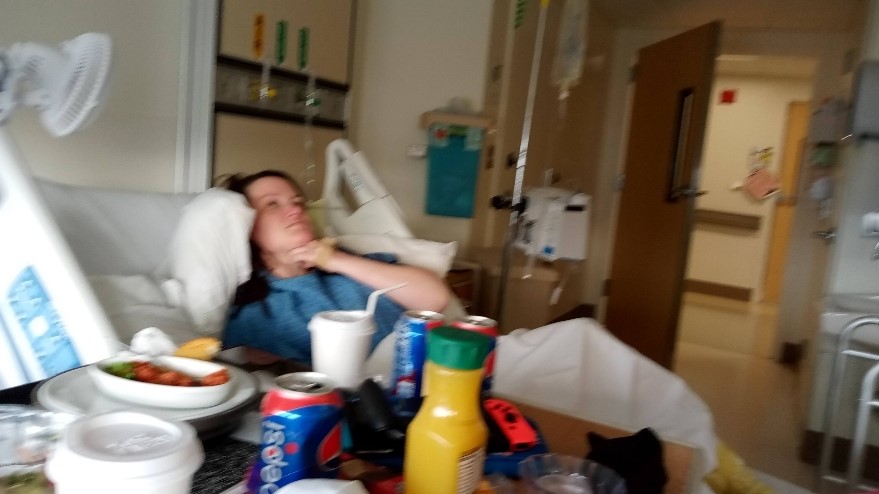
Dru thought it was amusing that she did the ‘double chin photo move.’ Wow, three Pepsis and an unopened container of orange juice. I, no doubt, finished off her hospital food.

With an incredible amount of shuffling and a large number of phone calls, I managed to free up the next day, hoping for a score on the Strait.

If you had to guess, you’d be correct. No score. Following my own advice to at least get a few shots of other searchers, I have these:

Notice the lack of barrelling, spitting waves. One of Dru’s nurses lives in Olympia. I wanted to ask her if she knows surfer Tom Burns. Trish talked me out of it. I was in the water with this guy for a couple of hours, hoping for a couple of waves. He’s from Olympia. “Hell, yes, I know Tom. He’s a wellspring of knowledge about all the wave conditions out here.” “Yeah, that’s Tom,” I said. “And… he remembers names.” I texted ‘Tom Morello’ to myself. The text failed.

SHIT! What also failed is a cool shot of “Hawaiian Brian” Noji, second place finisher in his age group (50-59?) at the recent Cape Kiwanda Longboard Contest in Oregon. I transferred the image from one phone to another and… I did tell him it’d be on my site, and…

…and, as usual, I don’t have time right now. Van to load, ferries to miss.

Sunday.

Chapter 12, Part One- Joey Goes to “Swamis”…

…looking for clues to Chulo’s murder. He talks with witness, possible suspect Baadal Singh. Because each chapter follows a specific day, this day had to be split into three parts.

            CHAPTER TWELVE- PART ONE- SATURDAY, MARCH 29, 1969

I couldn’t say for certain if I had slept at all. I was outside the house at five. I had my lunch, in its pastel blue paper bag, in one hand, my dad’s big flashlight in the other. The Falcon was pointed toward the road. Getaway position. My new board was inside, my nine-six pintail on the by-this-time rusted-on factory racks. I carefully closed the driver’s side door, rolled the car down the driveway, turned the ignition key, popping the clutch, in second gear, at the county road. I turned on the headlights and retrieved a half a pack of Marlboros from under several Pee-Chee folders, those stacked on top of a four-track tape player, that set in the middle of the bench seat.

Waiting for a truck to pass before I could turn left onto Mission Road, I reached into the inside pocket of my windbreaker for matches. I had considered, briefly, pulling out ahead of the truck. I grabbed the flashlight from the dashboard, shined it on my fogged-up watch. “Should have left earlier.” I passed the truck on the last straightaway before Bonsall.

The wood-sided Mom-and-Pop store in Leucadia, perilously close to the southbound side of 101, didn’t open until six. It was parked in the pullout just past it at five-fifty-two. I reran the TV coverage from the previous nights, waited for the lights in the window to go on. Hostess donettes, frosted, a quart of chocolate milk, a tiny can of lighter fluid, and package of flints.

I pulled into the Swamis parking lot, did a soft left, and looped into a hard right. I stopped the car, shone my lights on the portion of the wall where Chulo had been killed. It looked the same as it always had. White, not even gray, not even yellowed by the headlights, low or high beams. I backed up and away, made a big lazy arc in the very middle of the empty lot, and pulled into a perfect spot, ten spaces over from the stairs. Optimum location. I leapt out, stood at the bluff. Not loud enough to suggest waves of any height. I exhaled the smoke from my third cigarette of the day. “South wind. Fuck!”

…      

            The Laura Nyro tape re-running the songs from side one of “Eli and the Thirteenth Confession.” It wasn’t the tape. It was the player. Side one of albums from the bargain bin, Leonard Cohen and Harry Nilsson and the Moody Blues, side one of The Doors.   

I looked at my increasingly water-logged diving watch each time another car pulled in, each time car doors slammed, each time a surfer or surfers walked out onto the bluff, peered into the darkness, and decided to go elsewhere.

            It was still an hour before sunrise, overcast, almost drizzly. I stuck my father’s flashlight under my left arm and walked straight across the pavement, across the grass. I followed the Self Realization Fellowship compound toward the highway, toward the forty-five-degree curve to where the compound’s original entrance had been. There were two large pillars, gold lotus topped, an arch between them, the wrought iron gates long secured with long rusted chains.

Two bushes had been replaced with full-sized plants. The soil around them, the grass next to them, were new. It would all blend in. Quickly. I touched the wall. I looked at my hand. Dry. Perfect, as if no one had been burned to death there.

Backing away from the wall. I walked across the wet grass and onto the pavement at the entrance to the Swamis parking lot. This was where the crowd had assembled, where the sawhorses and rope had been. Unlike the compound side, there were cigarette butts and candy wrappers and straws and smashed paper cups on the rough pavement, scattered and stepped on and run over.

Clues, I thought. Killers returning to the scene of the crime, blending in, hanging on the ropes. Missed clues. I pulled out the Marlboro hard pack from the inside pocket of my windbreaker, stuck the third to the last cigarette in my mouth, lit it with two matches held together. I turned on the flashlight, held each new clue close I had picked up to the beam.

Cigarette butts. Various brands. Lipstick on two of them. A partial pack of matches. “Carlsbad Liquor. Beer, Wine, and Spirits.” I opened it. “Left-handed,” I said. I pulled out several of the remaining matches. They left a red streak when I tried to light them. “Too wet.”

I put selected cigarette butts and the pack of matches into the Marlboro hard pack. I moved back and forth along the de facto line, established where dead center was. I crouched down to study the patch of debris in front of me. “Menthol.” I picked up a butt with a gray, slightly longer filter. I blinked, possibly from my own cigarette smoke in my eyes. “Different.”  

There was a noise. Slight. Footsteps. Pulling my flashlight out from under my arm with    my right hand, I stood up, right foot sliding back.

“Gauloises Bleaues,” a man, ten feet away, said.

I flipped the flashlight around and into my right hand. The beam hit just below his head.

“Picasso smokes these. Jim Morrison and John Lennon smoke these.” I slid my right foot up and even with my left and lowered the flashlight. The man was holding a push broom. Stiff bristles. “My uncle imports these. I smoke these.” I nodded toward the broom. “You and I spoke… before. You gave me a… sort of… newspaper.”

“I did? Okay. So, no one cleaned… here, behind the… the line.”

“So, you. You. Here. Scene of the crime, eh?”

            “Me? Here? Yeah. I don’t know… why.”

The man took two steps, closer. “Joe DeFreines, Junior. You surf. You work at a grocery store, Cardiff, weekends.” I leaned back. “I look a bit different than… I did.” He nodded toward the west end of the wall. “Meditation garden.”

             I flashed to that time. Four seconds, at the most. “Swami,” I said.

            “No. Not nearly. Gardener. I was with a Swami.”

The gardener’s beard and hair were tucked into a dark coat. The man’s eyes were almost the only part of his face showing. He had a bandana pulled up and covering most of his face. He had on the type of felt hats older men still wore; probably brown, pulled down around his ears.

“Lost most of my eyebrows. Eyelashes just got a good curling. Singed. Still there.”

“No! Shit!” I took half a step back. “It was… you.”

 “No shit.” The man extended his hands. He had a leather glove, dirtied calfskin, on his left hand. He had a white cotton glove on his right hand. His first two fingers taped together, as were the other two, and, separately, his thumb. The bandaging wrapped around the main part of his hand and was taped at his wrist. Three of his fingers showed stains that were either, I thought, something that had seeped through, ointment or blood. I was staring. “Second degree,” the gardener said, “Flash burns. Fools.”  

I turned and looked toward the highway. There was a late step-side pickup in the spot closest to the telephone booth on the highway side of the original parking lot. There was a three-legged fruit picker’s ladder on the rack over the bed, gardening tools bundled upright against the cab, the handle of a lawn mower hanging over the tailgate.

“You must have gone to the… hospital, Mister… You know my name. Mister…?”

“Singh. Baadal Singh. Baa, like ‘baa, baa, black sheep,’ sing like… sing.” I nodded. Baadal Singh laughed. “No hospital. They keep… records.” This seemed amusing to Mr. Singh. “I was two full days… downtown. Not in a cell. Interview room. Just… Dickson calls you Jody.” I nodded. “Your father… sorry about him, incidentally. Wendall, he calls your father Gunny.”

“They both do. Marines. Wendall and my… dad. Not Dickson. Why would they even mention… me?”

“They didn’t. Downtown detectives. One of them said… I am under the impression he was giving Wendall some… grief. And Langdon, he said…”  

            “Langdon?”

“Langdon. Yes. Fuck him.”

“But, Mister Singh, you were a witness; not a… suspect.”

 “Witness. Yes. Suspects have rights.” Baadal Singh looked at the little pile of cigarette butts and candy wrappers he had pushed close to my feet, then at me. I squatted to look more closely. Baadal Singh lowered the bandana that had been over his nose. “’Nice sunburn’ one of the detectives told me. ‘Hard to tell,” Dickson… said.”

Mr. Singh pushed the broom handle toward me. It leaned against my chest as I turned off the flashlight and stuck it back under my left arm. “Marines, you say?” Mr. Singh pulled the glove from his left hand with his teeth. He pulled back his coat. He reached into his coat and took a thin box of cigarettes from the coat’s breast pocket with his bandaged right hand. He laughed. The glove fell to the ground. I slid my right hand down the broom handle and picked up the glove.

Baadal Singh took a cigarette out of the pack. “Gauloisis Bleaues” he said. He showed me a book of matches from the Courthouse Bar and Grill. “Downtown. Langdon treated me to lunch on my… second day. Clientele of lawyers and bail bondsmen and cops and criminals. He told me I would, eventually, be charged with Chulo’s murder.” Though he didn’t laugh, Mr. Singh did smile. He pulled out three matches from the right-hand side with his right hand. “Right-handed,” he said, striking the three matches as one, and lighting the cigarette. “All clues that make me what Langdon called ‘completely convictable.’”

I didn’t react. I was playing back what Mr. Singh had just done.

“Joe. Chulo wasn’t a Marine, though, was he?”

I had, evidently, forgotten to inhale. My Marlboro was down to the filter. I spit it out on the clean part of the asphalt. I stomped on it. Too much information, too quickly. I was starting to hyperventilate.  Baadal Singh put his left hand on my right shoulder.

“Chulo? No.”

 “You’re calm. Right?” I nodded. “This is how real coppers work, Joe. Blackmail. Bluemail, maybe. Information is currency. You know that.” I coughed and took in a more normal breath. “Langdon… not really the other guys, he wants everything I know in exchange for… temporary, at least, freedom. What I know is there is too much money around. Cash. Fine for small… purchases. Someone needs to… Do you… understand? Good citizens. Businesspeople.”

“I don’t know anything.”

“You’re looking, though. Langdon was right about that. You get enough clues and you… analyze, you imagine.”

 “I don’t… imagine. I… memorize. I… remember.”

“Yes. Some… another day; you’ll have to tell me the difference.”

“So, Mr. Singh; you told them what you know?”

Baadal laughed. “Not even close, mate.”

            …

            It was closer to sunrise. I had been talking with Baadal Singh a while. “White pickup,” he said. “Farm truck. Double wheels in the back.”

            “White pickup. Farm truck. Double wheels in the back. Duelies, I think they’re called. The other vehicle, black car, loud muffler. Straight pipes. Made a rumbling sort of sound.”

            “Right. And?”

            “And Chulo had been in the white truck with a Mexican and a tall, skinny, white guy. Chulo had already been beaten. You believe the Mexican and the skinny white guy were taking Chulo to the Jesus Saves bus, but if they had, they would have had to face… Portia. So, they knew her?”

            “Drugs, Joe. You had to have known… that. Portia and Chulo? Marijuana?”

            “I told you, Mr. Singh. I just… didn’t pay attention.” Baadal Singh shook his head. “You weren’t a friend… of Chulo’s?”

            “Not… really.”

            “So, again; why are you telling me all… any of this?”

            “Because, if I… disappear, I want someone to know the truth.”

            “Not me. Not a good choice.”

            “You’re my only choice, though. So… remember.”

“So, the black car pulled in. Lights off. Two guys jumped out. Also a Mexican and a white guy. There was an argument. Between the two… groups.”

Baadal Singh, with me following, stopped between the phone booth and his truck. “The two white guys…” he said, “The one from the car pushes the skinny cowboy dude over here. He says, ‘We have customers lined up. They are serious. Call someone. Now! You need change, A-hole?’ Meanwhile, the Mexican guy… from the black car, he kicks Chulo a few more times, drags him across the parking lot.”

“Where were you, Mr. Singh?”

“Call me Baadal. Please.” Baadal pointed toward the concrete shower/bathroom facility. “Cowardly. Yeah.” Baadal stood by the door to the booth. “So, the… let’s call them gangsters… White gangster is outside, cowboy’s dialing. I see him… he kind of ducking, looking up…”

Baadal stepped away from the booth, looked across the street, past the railroad tracks, and up the hill. “Not sure if that is relevant.” Baadal turned toward me. “I’m just trying to understand this myself, Joe.”

  “Okay, Baadal. So, whatever was said on the phone, it wasn’t what the gangsters wanted to hear. Obviously. A-hole, he’s still on the phone, right?” Baadal nodded. ”You’re still thinking it was a joke?” Baadal shook his head. “No. The white gangster goes to… your truck?”

“My truck. It was on the highway. Chulo’s gets dragged all the way to the wall. Skinny white guy… whoever was on the line must have hung up on him. He slams the phone, chases after the white gangster, meets up with him halfway across the lot. The gangster stops, sets the petrol can down, looks way over where the bus is parked. I sneak over to… here, the phone booth. Chulo, he’s… sitting, back to the wall. He sees me. He yells… something.”

“You couldn’t hear him?”

“I could. He’s saying, ‘No! Not her!’ That’s when I, I ran past the two guys and over to the grass. I yelled out that I had called the cops.”

“Had you?”

“No. That’s when the Mexican gangster poured the petrol; my petrol, on him. Chulo.”

Two vehicles pulled into the lot and passed us. I recognized both vehicles. One from Tamarack, one from Swamis. Both had surfboards on the roofs. The second car’s exhaust was louder. “Rumble,” I said.

Baadal Singh shook his head. “Louder.” We both nodded. “I fancied myself a revolutionary back in London. I didn’t run away so much as I was… banished. Sent… here.” Baadal put his right hand over the place where his inside pocket was on his coat. He looked at me for a moment before he flattened his hand as if it was a sort of pledge. I am not a killer, Joe. Remember I told you… the truth.” He smiled. “Not all of it, of course.”

“This isn’t over, is it?”

“This? No. Here is the… a secret part, Joe. I… so stupid. I walked up to Chulo, got down on my knees.” Baadal took a deep breath. “Do you want… to know?” I closed my eyes. I envisioned something I had seen in a magazine, a black and white photo of a Buddhist monk on fire. I opened my eyes. Baadal Singh was close to me. “The white gangster was talking to the cowboy. He said, ‘You know Chulo is a narc. Right?’”

“Narc. Chulo?”

“That’s how the guys from the truck responded.” Baadal Singh didn’t move his head. “At first.” He kept his eyes on me as he half-forced the calfskin glove onto his left hand. I must have looked away for a moment. I might have been elsewhere for a moment. Seconds.

Baadal Singh was somewhere else.

“Mr. Singh. Baadal; may I ask you… why were you at Swamis… that night?”

Baadal reached for his boom. He grabbed it in the middle, moved it up and down several times. “Another time, Joe. You have a lot to… memorize.” Baadal and then I turned toward the latest car pulling into the Swamis lot, Petey Blodget’s once-fancy fifties era four door Mercedes. It had a diesel engine sound and smell. There was a single pile of five boards on a rack, a browned and battered kneeboard on the top of the pile. I shifted my focus to the girl sitting in the middle of the front seat. Julia Cole. Baadal Singh looked up at the palm fronds, swaying in the trees above us. He hit my shoulder with his left hand. “Another time.”  

“Wait. Baadal.”

I wanted more information, but I couldn’t help but follow the Mercedes as it pulled in, clockwise, and backed into a spot two spaces closer to us than the Falcon. Surfers bailed from three of the doors. Julia Cole was the second person out of the front door on the passenger side. The guy riding shotgun was Petey’s son. My age. Nicknamed Buzz. The four kids from the back seat ware all too young to drive themselves.

While the others rushed to the bluff, Julia Cole looked at me through the space between the stack of boards and the roof. At me. Not for very long. Petey was looking at Baadal Singh and I from the driver’s seat. He slowly opened the door, slowly pulled his feet out and onto the pavement. Julia Cole pulled her big gray bag out of the Mercedes as Petey walked toward the bathrooms.

Baadal Singh backed up a step. I took two steps toward him. ‘Gingerbread Fred. Fred Thompson, did you see him?”

“Later. Only. I was… busy.”

“But he saw… them?”

“He did.” Baadal lit up another cigarette with three matches and handed me the pack. “And they saw him.”

“Did he seem to… recognize… any of them?”

“You mean, did I?” I nodded. “No one I had seen before. But… I will never forget them.” Baadal Singh moved his face very close to mine. “Since you claim you don’t… imagine. Maybe you… guessed. I am not here… legally. More to it than that. I am, in England, legally… dead.” 

There was no way to hide or disguise my confusion. “They… Langdon, he let you go.”

Baadal Singh chuckled. “Bait. Yes. It’s a game, Joey; but you were right. Langdon did ask me, as you did, why I was at Swamis… that night.” Baadal Singh shook his head as he backed away. “And… if you know more about me you’ll know more about why.” He laughed as he turned away. He turned his head slightly as he let out smoke from the Gauloisis Bleaues cigarette. “Again, Joe, it’s Langdon I lied to; not… you.”

 -All rights to “Swamis” and changes to the original copyrighted manuscript are reserved by the author, Erwin A. Dence, Jr. Thanks for respecting this.                     

REMEMBER to check out realsurfers.net on Sunday for non-Swamis content.

“Swamis” Detective Langdon on TV

                        CHAPTER ELEVEN- FRIDAY, MARCH 28, 1969

It was just dark enough outside that the window above the kitchen sink reflected the image of my mother and me. I had scraped whatever was left on the three plates we had used into a small, galvanized garbage can, and was putting them into the soapy water. My mother was scrubbing the dishes and placing them into the drying rack. We both looked at our reflection rather than at each other.

“What does Larry say now, Mom?”

“Detective Lieutenant Wendall… temporary promotion… says Detective Lieutenant Langdon is not going back to Orange County anytime soon; not with the death of… Chulo Lopez.”

“No. Too much fun here.”

“Langdon has support. Downtown. Not the Chief. Politicians.” My mother did look at me. “Dishcloth, Atsushi.” Dishcloth. I pulled one from the towel bar, tossed it onto the drying rack. “However, he… Detective Wendall…” We were back to looking at each other in the window. “He says the Sheriff’s Office is no longer pursuing whoever was in the gray car.”

“But he, Wendall, he believes the, our story? The lie?”

“He was at the station. He heard your father talking to Freddy… and you… on the phone. He knew I was… leaving.”

“He got there… before you did. Did he ask… why you came back?”

She shook her head. “He will. Any question, your father would say, that logically should be asked…”

“Will be asked.”

“And we have… the answers.”

I unfolded one of three fresh dry washcloths, laid it on top of the soapy water, pushed it down with a flat palm. “I wish I had gone for pizza. I wish I hadn’t… chased… you.”

My mother tilted her head toward me, but only slightly. I slid the three big plates, three smaller plates, three forks, three knives, three glasses into the water. “Atsushi. People will disregard… so much… to believe what they wish to be true.”   

“It’s on!” It was Freddy, yelling from the short stretch of wall between the kitchen and the living room. “Come on!”

“We will just let them soak,” my mother said, giving me, not my reflection, a look that I understood to mean that there would be no further discussion on what Detective Sergeant Larry Wendall believed or why he chose to believe it. She stopped next to the little table that held the phone, turned toward me. “It is over. Accept it.” I stepped toward her. “Please.” She didn’t give me a chance to argue. “For me.”

…

“You’re missing it,” Freddy Hakaru DeFreines yelled. When our mother and I came into the living room, he was walking backwards from the television to our father’s lounge chair. Phillip Reed, the stand-in News Anchor, was on the screen, sitting at a table. I looked at Freddy. He pointed at the screen with both hands, put them together in a prayer gesture, and fell back into the chair, causing the back to recline, the footrest to pop out. Freddy slid into a position with his shoulders on one armrest, his calves on the other.

“Don’t sprawl, Hakaru.” Freddy ignored the request. “Out! Now!”  

Freddy twisted to straight, grabbed the arms of the chair, and jolted himself forward and upright. He joined me in the space between the coffee table and the console. Our mother sat on the kitchen end of the sofa. Freddy looked at her, walked over, turned up the volume.

Phillip Reed looked directly into the camera. “My guest, Orange County Detective Lieutenant Brice Langdon, has been coordinating with San Diego County’s Sheriff’s Office since the recent and tragic accidental death of our Detective… also a Lieutenant, Joseph DeFreines. And now, with the recent murder… I have to ask, Lieutenant; you have some… history with DeFreines, do you not?”

A second camera angle revealed Langdon sitting across the table from Phillip Reed. Langdon, wearing a black coat and a dark shirt and a plain dark tie, barely reacted to the introduction. He looked directly at the second camera. “Not one that is relevant, Mr. Reed.”

“He is,” my mother said, moving between Freddy and me, “so very… slick.”

“Slick,” I said, “Sleazy.”

“Sleazy slick Orange County dick,” Freddy said.

Phillip Reed continued. “What can you share with our viewers, Detective?”

Langdon managed a bit of a smile. “The California coast is experiencing incredible growth. With this growth comes a need for a more professional approach to law enforcement. The prevailing belief has been, ‘It’s under control.’ It is not. The Sheriff’s Office, out in the County, has had this ‘small town, we all know each other… philosophy.’ Not small town. We don’t know each other.” Langdon shook his head. “Not anymore.”

“Politicians,” my mother said, turning and walking away.

Langdon only looked at Phillip Reed for a moment. “We cannot continue to base our investigations on gossip and rumor.”

“Gossip and rumor, Detective Langdon?” 

“Local law enforcement has been… casual.” Langdon looked a bit frustrated. Briefly. “The unincorporated areas, the Sheriff’s Office’s… jurisdiction; this is no longer… Mayberry.”

“Our mother’s voice came from behind us. “He’s… talking about… your father.”

Freddy and I heard a slam, wood against wood. We both looked around. Our mother walked past us and set a drawer onto the console. She pulled out each of her husband’s badges, showed them to Freddy and me, put them back. There were three of them; his Deputy’s and his Detective’s badges, both silver; his Detective Lieutenant’s badge, gold. Each was mounted on a square of thick, black leather. She lifted the Detective’s badge up again, smelled the leather, held it out as if showing it to the TV screen. To Langdon.

Setting the badge back into the drawer, she pulled out a partial pack of non-filter Winston cigarettes, smelled it, put it back. She took out a Zippo lighter, chrome, with a raised replica of the San Diego Sheriff’s Office logo, with her right hand. She opened the top with her left hand, tried to strike it several times. It didn’t light. She handed it toward me.

I shook my head several times. Freddy held his hand out. She shook her head and placed the lighter, logo facing us, on the console, just above the TV screen.

Langdon continued, “The criminals are becoming ever more sophisticated. Our approach has to, has to become ever more professional.”

Phillip Reed looked at Langdon as if he expected him to say more. Langdon didn’t. “Well, Detective Langdon, here’s how small town we are around these here parts: Gossip, rumor. Detective DeFreines. I interviewed him… many times; even back when he was on a joint task force investigating what the Orange County Sheriff described as ‘an unfortunate incident in which several officers were, perhaps, overzealous.’”

“Good memory, Phillip. Exactly what he said. Overzealous. Yes.” Langdon nodded but kept his eyes on the News Anchor. “It was a while ago. We’ve all… changed.”

Phillip Reed looked directly into the camera. “Joseph DeFreines was a bonified war hero. Marines. In the Pacific; from Guadalcanal on. He served in Korea. Gunnery Sergeant. Most of his… advancement was through field promotions. You understand that… I assume, Lieutenant?”

“I do.”

 “He worked his way up in the Sheriff’s Office. Through the ranks.”

            “One could do that.” Langdon folded his hands on the desk. Exhaled, softly, reset his smile, and added, “In those days.”

“The difference between gossip and news, Detective, according to DeFreines, is two days or two different, independent sources.”

“Or both. Yes. Turn of phrase. He was great at… that.” Langdon stood up. The camera took a moment to adjust. Phillip Reed stood. Langdon said, “I came here to address some of the… gossip.” Langdon sat back down. He looked into the second camera. After a moment, the image switched to that angle.

“As has been reported, the victim of this vicious attack, Julio Lopez, was a sort of street and beach evangelist, and a delivery driver for a Leucadia flower business.” Langdon paused. “It is true that Julio Lopez was present at the accident in which…” Langdon looked over at Phillip Reed, off camera. “…Detective Lieutenant Joseph DeFreines, Gunny to his compatriots, was killed. I stress… accident. Mr. Lopez was a witness. Witness. I believe, Mr. Reed… Phillip, you covered this… accident.”nic

Phillip Reed, off camera, said, “I did.” Ruth DeFreines stepped closer to the console, blocking the screen. She turned, facing her sons. Reed continued, “Automobile accident, east of the Bonsall Bridge. Detective DeFreines went off the road to avoid a head on collision. The road was closed for seven hours.”

“Yes. We have not completed that investigation, but Mr. Lopez was at that scene, yes, and again, a witness. Allow me to address another… rumor, here. Despite the positioning of Julio Lopez’s… body, at the wall surrounding the Self Realization Fellowship compound, and the fire; despite Mr. Lopez having been, as I have stated, a sort of… evangelist, we have found no… religious connection, and none to the ongoing conflict in Vietnam.” 

“Chulo.” The angle went back to Phillip Reed. “His nickname. Chulo.”

“Yes, Mr. Reed. Chulo. Unusual nickname for a… Mexican. Adjective. Pretty.”

“Yes. Unusual. Will you, Detective Langdon, with your… professional approach to law enforcement, tell the viewers that Chulo Lopez’s killer or killers will be brought to justice?”

“They, or he shall be.”

“Mom,” I said, “We have to see this.”

My mother moved down the length of the console, sliding her fingers on the edge.

“You wanted to address the current situation as it relates to… marijuana.”

            The image on the screen switched to a closeup of Langdon. “I have heard… rumors.”

 Mrs. Joseph J. DeFreines mouthed something in Japanese that had to have been a swear, shook her head, and turned off the television. Freddy and I stood up. Both hands on Freddy’s back, she pushed him into the hallway. She turned back, opened her right hand, swung it toward the console.

I picked up the lighter. “Rumors,” I said, popping the top open with my thumb, striking the wheel. It lit this time, burned for a few seconds, and went out.

“Slimy bastard,” my mother said. I popped the top closed with my thumb, set the lighter back on the console. My mother walked back to the console. She slid the two doors that would cover the TV screen. vertical slats, together. The one on the right stuck. She pulled it hard enough that it slammed into the other door. She pushed me away. I was almost to the hallway when I heard the chink, ka-chink sound of my father’s lounge chair. I turned back.

Ruth DeFreines was sitting in her husband’s chair, kicked back, holding my father’s lighter and his detective’s badge. “Atsushi, I plan to sell this place,” she said. “Have to. Hakaru… Freddy will be out of junior high, you are… graduating. He says we should move somewhere near Live Oak Park. What do you think?”

“Mom,” I said, “you’re a detective’s wife; you know where I’d want to live.”

“Widow. And yes, I do… know.” 

I had a confusing series of images going through my mind as I went into the kitchen and finished the dishes. I could only guess what my mother, sitting in her late husband’s lounge chair, was imagining. I did, of course, have more than one theory. I am a detective’s son.

REMEMBER that “Swamis” is protected by copyright. All rights reserved by the author.

Check out some non-Swamis stuff on Sundays.

Internet Outage and (finally) Inage

IT ISN’T AS IF I had some really compelling content to post on Sunday, but not having internet for several days is somewhere north of irritating. No, it’s not like life threatening- I could, and did, find buoy reports (down) and surf forecasts (continued downness) on my phone.

STILL, checking the wires, restarting the router, wondering if some line between me and the towers and the satellites is down, and when it might be back in order.

NOW. Maybe last night. BUT, now I have to go.

Tomorrow, or even later tonight, I will post the next chapter of “Swamis.” I think it’s two days after Chulo is murdered at Swamis, and Joey’s surf friends, Gary and Roger, are sharing the story at Fallbrook High. AND OTHER STUFF, of course, because “Swamis” is overstuffed.

CHECK IT IF YOU CAN. IT’S, LIKE, ONLINE-ONLY

“If You Do Happen To See Jacob…

…tell him he is loved.”

The waves, even on the northwest coast, continue to be weak. At best. Still, people seeking some kind of float are journeying out, past the usual summer road work delays, and behind the usual hordes of leather-bound motorcyclists and the EVers making ‘the loop’ on Surf Route 101, the RVs and the folks with boats and already-blown-up blow-up SUPs, the campers and trailers.

Yeah, it’s summer. I haven’t ventured west yet, but my so-far stealth surf rig is up and running, and I am so, so tempted.

Here’s a story: I should add, non-fiction.

                        If you do happen to see Jacob…

…tell him he is loved.

I came around from the lake side of the house. I was standing at the open back doors of my van, considering whether I should break out another drop cloth. A car on the road that does a half circle on the south side of the lake stopped. It didn’t pull over.

The window on the front passenger side of the car came down. The woman behind the wheel said something. I was too far away to hear. I came up the slight bank and stopped at the edge of the road. “Have you seen a kid come by here?”

There was a blond-haired kid, probably nine or ten, in the back seat, hard to see through the tinted windows, straining on his restraints.

“I was… on the other side.”

The woman was smoking, not inhaling deeply, blowing the whisps out the open window on her side. “He… we had a… disagreement. A thing. He’s fifteen. I’m the stepmom.”

“I’ll keep an eye out. Does he… look like… this kid?”

“No. He’s… he looks native. Big for his age.”

“Not bigger than me?”

“No.”

“What’s his name?”

“Jacob.”

“Oh, like… I need something… I have a hard time remembering names… like Jacob’s ladder.”

“Guess so. Yeah.”

The woman could have driven on. She might have if another car had come up behind her. Though it’s summer, hot and sunny, a major closure on highway 101 has made traffic detour. I took two back roads to get to the lake house, located close to the public fishing dock, across the street from a farm, and adjacent to a small public campground.

The woman started talking about herself. She was a local, she said. She gave her family name.

I knew the name. I had dealings with a man by that name. “Oh. He’s my father.”

Her father had been a contractor. Roofer, mostly. Kind of thuggish. Our dealings had not all been pleasant.

He bad-rapped me, years ago, to a mutual client. I have a tough time forgiving this; mostly I just move on. I don’t forget.

I knew a few things about an uncle who inherited some money, bought a lot of new tools, vehicles, and equipment, and went into business with a couple of other guys. One partner had some health issues and moved to Hawaii. The other had a severe drug issue that was more important to him than completing jobs. The woman’s uncle died before, or just after the money ran out.

“Sad,” I said. “He was a nice guy.” Another uncle was described and written off as “Just… so fat.”

My mind went to someone I had just run into who was dangerously overweight.”

Her father, she said, lighting another cigarette, and her mother, sold the company, got divorced, “He met some woman on the beach. He’s got a seven-year-old. He’s doing the right thing, though, raising him on his own.”

“So… the woman from the beach? Gone?”

“Yeah.”

An SUV with a Costco kayak on top pulled up behind the woman’s car. After a moment, it went around.

“Hey, uh, if I see him… Jacob, I’ll tell him to get his ass over and… I’ll tell him you’re looking for him.”

“Thanks.”

Image ‘borrowed’ from Google. Thanks.

The woman never did ask my name. She wouldn’t know that, thirty years earlier, I had come to this very lake, a first responder with the local fire district, in response to a call for a teenager drowning. Drowning. I know how to swim. I live three miles away. I could beat the ambulance. I could do something. I could…

I couldn’t. The teenage boy wasn’t in the water, floundering. He had been underwater for too many minutes. He was on the beach, dragged by someone. On his back. He was already gone. Obviously. Visibly. He had thrown up. His airway was compromised. There would be no rescue, no heroes.

Still, I would be doing compressions all the way to the hospital, a nurse picked up at Four Corners. Desperate. Futile.

The boy’s mother showed up just after he was pronounced dead. I was headed out the Emergency Room doors, back to the aid car. I looked as the mother’s mouth opened, as her hands went to her face, possibly to block a scream. I looked away.

“If you do happen to see Jacob, please tell him he is loved.”  

If I had seen him, I would have. I didn’t. I had work to do before the sun hit the lake side of the house.

HOPE YOU’RE GETTING SOME WAVES!

REMEMBER to check out the latest installment of “SWAMIS” on Wednesday. This week, Joey goes to the psychologist, has a spell, gets a new board. Or maybe that’s next week. Still, the story continues.

NOTE: Copyright protection claimed on all original work on realsurfers.net. All rights reserved by the author, Erwin A. Dence, Jr. Thanks.

“SWAMIS” Chapter 6, Dangerous Doug, Devil Dogs, Head Jerk at the Beacons Switchback

CHAPTER SIX- FRIDAY, MARCH 14, 1969

Fallbrook Union High School was letting out. Gary and Roger and I were standing in the big dirt parking lot behind the band room. Johnny Dale, in his daddy’s restored 1957 Chevy Nomad station wagon, two girls in the front seat with him, slowed down, then popped the clutch and spun out directly in front of us. Gary, then Roger, then I flipped the asshole off. I used both hands. “Double eagles,” I said.

The next two cars that passed us got three sets of double eagles.

“Friday, March 14,” I said, writing the date into a page about a third of the way through a red notebook sitting on the hood of a yellow 1968 Super Beetle with two surfboards, side by side on the Aloha racks; my bruised and patched nine-six pintail and a brand-new Hansen ten-two. “Finally enough light after school to go to, at least Oceanside. Gary and Roger bailed.”

“We’re not bailing, Joey; we have dates.” Roger mouthed, “Dates” while running his hand along the rail of the board on the rack on the driver’s side.

“With girls,” Gary added. “Friday night! And besides, where is Doublewide Doug?”

“Doug-L-ass has… art seventh period,” Roger said. I nodded, looked at my watch, wrote something in the notebook.

“Why is it,” Gary asked, running his hand down the rail of the Hansen, “that Dingleberry Doug has a new fucking car and a new fucking surfboard?”

“Why is it, Gary, that Joey is such a whore that he’ll ride with Dipshit Doug?”

“Why is it, Joey, that everyone’s getting shorter boards, but your buddy, Ditchdigger Doug, is going aircraft carrier?”

I looked around the lot. “Because, gentlemen, Doug’s… working, one, and his father’s running irrigation for all the… new ranchettes, two, and three, I’m a whore for the surf, and three, again… gas money.” I stepped back from my friends. Both were wearing Levis, Ked’s boat shoes, J.C. Penny’s white t shirts, and nylon windbreakers. As was I. “Why is it that we all don’t have… matching windbreakers like we’re on the Dork Neck Surf Team?” Both gave me ‘fuck you’ looks. “You guys, with the blonde hair and… people who don’t know better might just believe you surf better than I do.”

“Fine with me, Joey. Gary? You?”

“Yeah. Fine, but… Hey, Joey; here comes your date now!”

Doug, varsity offensive lineman, was on the sidewalk, still a distance away, slow running toward us. He had a couple of notebooks under his right arm, his left arm out and ready to straight arm anyone in his path.

“Joey DeFreines, surf slut.” Gary blew a kiss toward Doug with a big arm movement. Roger put both hands out as if expecting a pass. Doug didn’t see it.  Gary’s mom’s Corvair pulled in between us, trailed by its usual puffs of black smoke. Gary’s sister, the Princess, was driving. There was another girl in the front seat, two more in the back. Sophomore girls. Giggling. The Princess peeled out just as Gary went around the back of the car.

“Better remember to put some oil in it, Princess.”

 The Princess honked as she cut another car off, pulled out and onto the side road in a cloud of black smoke.

Doug touched his car, leaned against it, breathing heavily. “Made it!” Neither Gary nor Roger acknowledged Doug. He laid a piece of drawing paper onto the hood. “Check this shit out!” It was a drawing, pastels, of cartoonish people and cars on the side a road. A red light was glowing from beyond and below the cars and people. “Pulled over” was written in the same red as a sort of caption.  

“Where’d you get that?”

“Well, Roger, someone in my art class wanted me to scotch tape it on…” He pointed toward me. “Jody’s locker.”

“Grant Murdoch.”

“Grant fucking Murdoch.”

“Bingo! It’s from one of the pictures of Jody in the Free Press.”  

“Hey, um, Doug-l-as,” Roger said, extending the ‘ass’ part, “Don’t wear that fucking letterman jacket to the beach. Joey wants all the hodads to think he’s from somewhere else.”

“Laguna… specifically,” I said as I rolled up the drawing, using the scotch tape at the corners to secure the roll. “Or San Clemente. Santa Cruz. Just… not… Fallbrook.”

Douglas yanked on the Warrior’s jacket, tossed it, inside-out, onto the hood of his car.

“Oh, and fuck Grant Murdoch,” Gary said as he and Roger turned and headed toward Roger’s stepfather’s Mustang.

…

Doug was driving. I had a book open, paper bag cover with unreadably psychedelic pencil lettering. “Civics” and “Grandview” and “Joey DeFreines.”

“Shit, Jody, I could just cheat off of you.”

“Or… you could… I’ll just give you the… shit I think’ll be on the test.”

“Close your eyes, Jody.” Doug pushed the book back toward my face.

I knew exactly where we were. Three corners west of the little village of Bonsall, the last straightaway before the sharp left and the narrow bridge across the wide valley that held the thin line of the San Luis Rey River. I looked over the book and Doug just in time to see the construction site for a strip mall.

“Building it quick, Jody.”

“Yes. Quick. Doug.

“Um, uh, Jody; you know, my sister… she taught me how to drive. She said, if there’s a truck or something coming… on the bridge… she just closes her eyes.”

“Uh, Doug… no; that’d be… dangerous… Doug. Eyes open. Please.”

We made it across. No vehicles coming our way. A choice had to be made. It was a soft right hand turn and a straightaway or a steep hill. “Which way? Vista or Oceanside?”

“Oceanside’s faster… I think.”

“Faster then, Doug.”

Doug downshifted, made the soft right-hand turn. We were thirty seconds or so along when Doug said, “Um, you know; Gary and Roger call you Joey.” I didn’t look over the Civics book. “Instead of Jody.” I did look over the Civics book. “I’ll call you that if you call me…”

“In the name of world peace,” I said, lowering the book, “I will, in the future, always refer to you as… Dangerous Doug. Okay?”

“And you can tell Gary and Roger that I’m, you know, really good, surfing-wise. Joey.”

I lifted the book back up to my face. “Or… I can give you a dollar for gas… Doug-ie.”

“Oh. No. That’s all right… Jo-ey.”

…

Doug cut off an oncoming pickup truck as he made the thirty-five-degree turn onto the El Camino Real cutoff, southwest, out of the valley. So, no Oceanside. We hit the highway on the other side, merged onto I-5, got off at Tamarack Avenue. High tide. Shorebreak. We didn’t even drop into the lower parking lot. Doug missed the turn for Grandview. So, Beacons. Doug pulled in next to a green-gray VW bus with a white roof.

“Last chance, Doug. Sun’s down in… forty minutes.”

 The tide was fairly high but dropping. There were five surfers out, two of them girls. There were four guys in street clothes on the beach. Two were watching, one was standing, one was doing some sort of surf pantomime, a beer bottle in each hand.

“Jerks,” I said.

Doug opened the trunk on the front of his super beetle. I moved to the bluff, wrapping Doug’s extra towel around me. I turned my shortjohn wetsuit back to outside out, peeled off my Levis and boxers, pulled the wetsuit up partway, wrapped the clothes in the towel, pulled the sleeveless suit up the rest of the way. One arm through, I connected the opposite shoulder with a stainless-steel turnbuckle. Custom, from a sailmaker at Oceanside Harbor. The first one, December of 1965, cost fifteen dollars. Christmas present. This one was seventeen-fifty, plus tax. But they were custom, two weeks from measuring to pick up.

Doug unstrapped the boards. I pulled out a cigarette, showed the pack to Doug. He shook his head. I lit the Marlboro with three paper matches. Throwing my clothes into the trunk, I stashed my wallet, cigarettes, and matches in one shoe, stuffed the other shoe inside that one, slid the shoes under my clothes.

“Yes, Jo… Joey; I will lock the car.”

Halfway down the first section of the path, I saw that the two young women surfers, Julia Cole and her friend, were out of the water. The four Jerks had moved halfway across the sand. The pantomiming Jerk, apparently the leader, the Head Jerk, was saying something to his friends I couldn’t quite hear. They all laughed. Loudly.

“Monica,” Head Jerk said. Loudly. He repeated the word, stretching it to, “Mon-ee-ca. We have some be-er, San-ta Mon-e’-ca.” 

            Monica, her head down, pushed past the Head Jerk, looked the other three Jerks off. The Head Jerk, walking backwards toward the bluff in front of Julia Cole, stopped at the bottom of the trail. Julia Cole stopped; her face very close to the Jerk’s. Monica, three steps up the trail, stopped and looked back. Head Jerk stepped aside.

“Juuu-li-a. Juuuu-lee-ya; you are so cold. Soooo coooold. Ju’-li-a cold.”

Doug and I, boards under our arms, made the turn at the trail’s upper switchback.

“What you think, boys; Monica’a ass, or Juuu-lie’s?” The Head Jerk increased the volume. If any of the boys responded, it was more like growling or laughing than with any discernible words. “Brrrrrrrr. Water’s got to be as cold as you, Juu-lie. And now, I’m wondering, if you’ve got anything on under that wetsuit. I saw… skin.” 

More laughter. One of the three other members of the Jerk Crew said, “Come on, dude; cool it.”

Head Jerk moved both beer bottles to his left hand and shot his right hand out. Pleased that the subordinate Jerk crew member flinched, Head Jerk said, “And don’t fuckin’ call me dude… dude.” He started up the trail. His cohorts hung back, possibly because they saw me, looking quite displeased, and the much bigger Doug, behind me, also displeased.

 Monica and I met at the lower switchback. I stopped. Doug stopped. I stood my board up, holding it with my left hand, and moved to the uphill side.  Doug did the same. Monica nodded, quickly, but looked down as she passed. Julia Cole had an expression as much determined as pissed-off. Defiant. Looking at me, she didn’t seem to adjust her expression one way or the other. I did notice the chrome turnbuckle on one side of her wetsuit was undone and her bare shoulder was exposed. Skin. She noticed I noticed. Another asshole. Another jerk. Her lower lip seemed to pull in, her upper lip seemed to curl. Disappointment. Or anger. Julia blinked. I didn’t. I couldn’t.

Julia Cole passed me and then Doug. “Joey’ll get ‘em,” Doug said. No response.  

I may have been replaying Julia Cole’s expression for the third or fourth time when Head Jerk approached the tight angle at the switchback. I may have missed the first few words he kind of spit at me. I did catch, ‘fuckin’ retard.’ It was in the form of a question.

I replayed his words. “What’s the deal, asshole? Huh? You some sort of fuckin’ retard?”

“Possibly, Dude,” I said. “I do believe, Dude, you owe Julia Cole and Monica… don’t know her last name… a sincere apology.”

“You do,” Doug said. “Jerk.” Doug looked at me. I mouthed, “dude.” He said, “Dude.”

Dude looked past me and at Dangerous Doug in his new O’Neill wetsuit, his custom Hansen leaning against his left shoulder, his spotless white towel over his right shoulder.

“Okay.” Dude looked back down the trail. His cohorts hadn’t moved. “Come on. We have us a fuckin’ farm boy and some sort of retard Gook.”

“Oh, no. Jody; Dude there called you a Gook.”

“Common mistake.”

“Step aside, fuckers!” Neither Doug nor I moved.

“Jody,” Dude said, leaning in way too close to my face. “Girl’s name. Well. Fuck Monica! Fuck Julie fuckin’ Cole. And… fuck you, Jo-dee… And your fat-ass friend.”

“Oh. I’m sorry, Joey. The Jody thing. And… I don’t think Dude is gonna apologize.”

“I wish he would.” I extended my right arm out, my palm toward the Head Jerk. I allowed my board to fall against the bank.

Doug pushed the tail of his board into the decomposed sandstone, laid his board down, carefully, uphill, against the scrub and ice plant on the bluff. He wrapped his towel around his neck and pointed at each member of the Jerk Squad, now partway up the lower portion of the trail. “Devil Dog, assholes! Come on up and help out your friend here. Dude. But, warning, Joey’s a, for real, fucking, by-God, Devil Dog!”

Devil Dog didn’t register with Dude. He looked up the bluff for a moment. I would describe his expression as a sneer. Holding the two beer bottles by the necks, he smashed them against each other. The open one shattered, the remaining beer running down his arm. He held the raw edges up against the palm of my right hand. He was smiling. “Gook!”

I closed my eyes. I imagined an eleven-year-old kid, sneering at me. My opponent. He had padded fabric head gear and a heavy pad on his body, a padded pugil stick in his hands. He was sneering. Other voices were cheering. I could hear myself crying. Big sobs, inhaling between each one. My father’s voice said, “Eyes open, Jody! Open!” The kid in the head gear, still sneering, was about to hit me again, this time with the right-hand end of the stick. I could also see Head Jerk, his beer bottle weapon pulled back. My father’s voice screamed, “Get in there! Jody!” I did. I saw my pugil stick connect, saw the opponent fall back. His sneer gone.

 As was Dude’s.

Both beer bottles were on the path, both now broken. It would be a moment before Dude reached for his nose; before the blood started flowing from there and his upper lip. It would be another few moments before the other three Jerks turned and ran.

“Devil Dog,” Dangerous Doug said.

“Devil Pup,” I said, keeping my eyes on my opponent. “Marines, Dude… may I call you Dude?” There were tears in his eyes, blood seeping between his fingers. “Or… your name? No? Well, Devil pups, Dude; it’s kind of like… summer camp with hand-to-hand combat.”

Doug pulled his towel from his shoulders and handed it to Dude. “Apology, then?” The Head Jerk, Dude, fluffy towel to his face, nodded. “Not to us.” He nodded again. “Promise?” Third nod. “Okay.”

“And, if you would, pick up the glass. Dangerous. Huh, Doug?”

“Dangerous,” Doug said. “Keep the towel. Souvenir.”

When we got to the beach, Dude was still at the same spot, placing pieces of broken glass into Doug’s towel. The other three Jerks were partway up the bluff, climbing through the patches of ice plant.

“You going to cry, Joey?”

“I thought about it.” I looked up at the parking lot. There was a flash off a window on the VW bus. An open door. Julia Cole was behind the passenger side door. It was too far away. I couldn’t see her expression. I could remember hers from earlier.

“We surfing, or what, Jody?”

“I thought, Dangerous Doug… you said you’d call me Joey.”

“We surfing, or what… Joey?”

…

            I left my shoes on the porch, stacked my books on the side table in the foyer. My mother was on the couch, listening to some blues record.  Seventy-eight rpm. The photo of her husband was leaned up against the console. She may have been looking at it as the record ended and another one dropped onto the turn table. “South Pacific,” original Broadway cast.

            She got up, adjusted the record speed, and walked into the kitchen. I followed. “Doug. Who are his… people?” She turned off the oven and pulled out a foil covered plate, set it on the cast iron trivet on the kitchen table. “Would you like milk?”

            “I’ll get it. Doug’s father has the irrigation company. Football player. That Doug.”

            “Irrigation. Football. Doug. You and he… you are… friends, now?”

            “Now? Yeah. Surf friends. It’s kind of… different.”

“Still, it is nice that you have… friends.”

            “It’s just… it’s not me. Surfing’s cool. I surf.” My mother gave me a look I had to answer with, “Yes, mother; friends are… nice to have.” She nodded and walked through the formal dining room and into the living room.

            Freddy ran into the kitchen from the hallway, half pushed me against the counter. “She called,” he said. “The reporter. Asked for you… after I told her mom wasn’t here.”

            “Lee Ransom?”

            “Yeah. Her. Mom was here. Outside, grooming Tallulah.”

             “Okay.”

            “I told her…” Freddy switched to a whisper. “I told her what you told me to say.” I nodded, tried to push past my brother. He put a hand to my chest. “She asked what kind of car mom drives.” I did one of those ‘and?’ kind of shrugs. “She said she asked one of the detectives, and he pointed to a different car than the one someone else had pointed to… not the Volvo.”

            “Which one?”

            “Which car?”

            “Which detective?”

            “Boys!” I looked around Freddy. Our mother was in the dining room. I couldn’t tell from her expression how much she had heard. I had to assume too much.

MEANWHILE, in the real world, I’m cruising around (still cautiously) in my still super secret stealth surf rig, alternator purring properly, new gas filter and fuel additive added (thanks George Takamoto and Stephen R. Davis), waiting for the new hubcaps Trish ordered, and waiting for some waves, even on the coast, somewhere over knee high.

REMEMBER, new content on Sundays.

“Swamis” and revisions to the original work are protected by copyright, all rights reserved by the author.