‘STWAITING.’ Sometimes Getting Skunked is Preferable

‘STWAITING” (add a lisp to get the word right), the fine art of waiting around on the STRAIT OF JUAN DE FUCA for the swell to rotate, or the tide to drop, or rise, or the waves to just get a little bit bigger, a bit more consistent; and then, finally, going out just as the 13th squall blows it all out AND, catching four waves total, you are forced into doing The paddle of shame.

STILL, THERE’S ALWAYS A STORY- But first…

Trisha’s brother’s son, our nephew, DYLAN SCOTT. I sent him an ORIGINAL ERWIN shirt for his birthday and as a house warming present. He sent me a video from SURFLINE REWIND of him at one of his local ENCINITAS spots, D Street. Since I have the non-premium WordPress package, I can’t display it here, but in the clip Dylan tucks into an offshore-enhanced and throaty barrel, doggy-dooring it at the last possible moment, and doing what appears to be, on my phone, a non-claim claim. I did send the video on to the surfers on my stealth phone.

I TOLD this guy that, although it was early, he would, no doubt, be the fashion crusher of the day. It turned out he had a flat tire up the road, and, although he had a jack and a spare, he was waiting for triple A to come from civilization. I guessed he didn’t want to get grease on his poncho.

THE NEXT wanna surf person I saw (should have taken a picture) was suited up and ready to go out. “Really?” “They said it’s supposed to be good,” he said. “Who? Who said?”

TONY AND FIONA are from Vancouver, B.C. where you can get a wavestorm in different, Canada-only colors. Vancouver is kind of like Seattle in that it costs money and takes ferries to get to surf. Evidently it’s cheaper, or as cheap to go to, like, Westport, than it is to go to Tofino. They were camped at LaPush, but left because ‘they’ forecast, like, 16 foot (like, 5 meter) waves, so they left. Quite irritated that my own forecast was proving, possibly, wrong, I gave Tony and Fiona grief, as in, “SO, are you just going to get in everyone’s way when the waves start pumping? How long have you been surfing? Did you go to surf school?” Yes, I sort of apologized, promised to put them on my site with tens of followers in Canada AND throughout the free and unfree world. SO, promise kept. AND, since the waves were so shitty, I have to believe they had a great American time.

THE FADED RAINBOW seems to frame what could be a six foot set at a great distance. It isn’t. It’s a six inch set fairly close. AM I BLOWING UP THE SPOT? My argument is that, if you head out, frothed out by the forecast, expecting epic conditions… well, don’t. As much as I don’t trust forecasts, I think post-casts saying what was rather than what could be, are also dangerous. Since I’m going on years of experience, anecdotal evidence at best, and somewhat relying on actual buoy reports (which are trickier than you might think), and I get skunked… well, there are always waves in WESTPORT.

QUIRKY SCOTT, who does not like his nickname, even when I told him it really means ‘eccentric’, dominated on this day. I am actually a little shocked at how model-like he looks in this photo. NOW, when I say dominated, I mean he caught more tiny waves than any of the other beginning or desperate surfers. I’m in the second category, hopefully.

AT SOME POINT in my paddling for waves that disappeared or disappointed, a woman was staring at me. Wasn’t sure why. It turns out JOSIE (another no photo) heard me talking to Scott, and asked him if I’m that guy who posts stuff on the internet. He said, paraphrasing, “Erwin. Yeah. Tell him you recognize him; it’ll do something for his giant ego.” This wasn’t the first time I’ve been identified, the reaction usually negative. “I like the way you use words,” she said. “Uh, yeah; I know it seems like it’s all stream of consciousness, but, really, I work at, and, yeah, thanks.”

I also, to round out a day of stwaiting, talked to SEAN GOMEZ, Port Angeles teacher and ripper, who got some epic waves recently (I missed it- have friends who didn’t), and to Reggie, who missed out on reportedly epic coast waves in order to make a bunch of money (familiar story for me, newer for Reggie), and saw, on my way home, many more surfers headed to where I had been. “Good luck. They say it’s supposed to be good.”

MAYBE, and this is always the story, it got good after I left.

A photo of a moonset over the unseen Olympics from my front yard. A moment later the full moon was covered by clouds from the latest atmospheric river, a moment later, the moon was back. And then…

NON-POLITICAL STORY: As a decent American, I recycle. I devote what could be a tool shed to saving cardboard and plastic and paper. Enough so that I took half a van load to the QUILCENE transfer station. I’m putting the stuff in the proper bins when this dude comes up to me, looks in my big boy van and says, “Wow, you actually work out of this.” “Yes.” He has spoken to me before, the gist being he’s a painter, ready to work. He actually talks way faster than I do, and had a lot to say about wages and drunk and/or cheap contractors and stoned painters who don’t know shit. “Uh huh,uh huh.”

Somewhere in there he asks me how to register to vote locally. “I, um, got my ballot yesterday. I voted. I… don’t know. You could go to the courthouse, maybe.” “No, man; I don’t want that vote by mail shit. I’m an American. I want to vote in person.” “Well, I think… actually, if you’re voting for Trump, maybe you…” “Damn right I’m voting for Trump.” I tried to dissuade him, but his argument that ‘Kamala isn’t really black’ seemed to be stronger than my ‘Trump is a fucking crook who fucked over every contractor who worked for him’ counter.

He did the violin-playing gesture, usually with ‘cry me a river’ lyrics. I slammed the door to the van, but he, no doubt feeling tough and manly, jumped into his sub compact and drove off. On leaving, I saw MISTER BAKER, former Quilcene Science teacher over by the ‘paper’ bin. “I’m glad to see you survived that encounter,” he said. “Me, too. Yeah. I don’t usually talk politics, but…” “Seems like the last time I saw you, at the Post Office, you were in a heated political… discussion.” “Oh yeah. Mr. Hodgson; he was going on about how he was ‘woke.’ I had to tell him when people like him use ‘woke’ it’s always sarcastically, and if one isn’t smart enough to know being aware of the inequities in society is not a bad thing, one shouldn’t attempt sarcasm. Yeah, and now he’s on the school board and talking about banning books.”

ANYWAY, I didn’t argue with Mr Baker. I do, however, believe he knows where I stand based on the one time I was invited to a cheese and wine (cheese and crackers for me) thingie. And that was before citizen Trump de-evolved into whatever he is now.

IF YOU SEE ME, remind me to take your picture. ANOTHER sub-chapter of “SWAMIS” will be posted on Wednesday, along with whatever fun stuff happens in between. Tensions are only going to get worse between now and election day. Stay cool, surf ’em if you find ’em.

“SWAMIS,” Chapter 6, Part Three, and a bit on They and Them

I haven’t updated my “Previously” recap of my novel, but we’re still at the post funeral memorial or wake for Joey’s father.

I WILL HAVE some photos and comments on my latest session attempt for SUNDAY, but, with elections upon us like a wave we saw on the horizon that is suddenly WAY BIGGER than we were ready for, I, non-political as I am, have some thoughts I’m trying to work through on just why the fuck anyone would vote for the guy, knowing what an absolute example of everything disgusting and vile and hateful any silver-spoon asshole can be. HATEFUL is, possibly, the key. Voters trying to hide behind some phony wall of “Oh, he’s, you know, not all that bad, and anyway…”

IT MIGHT BE that some folks think the guy will punish the “They” and the “Them” these voters hate. They. Them. YEAH, he said he will, and he has thugish backers who have promised to help. ONE PROBLEM might be that, HISTORICALLY, when things go to shit in a country, the whole country gets hit with the shit. AND covered in it.

THERE IS NO AMERICA to save AMERICA. Everyone is an infidel to someone. Everyone is a ‘them’ or a ‘they.’ Good luck, vote your conscience. But first, check to make sure you have one.

THINK IT THROUGH. VOTE BLUE. AND, with this, I apologize for ranting. I would rather talk about surf predictions and post-dictions, and I will. SUNDAY.

                        CHAPTER SIX- PART THREE- TUESDAY, MARCH 4, 1969

I was sitting on my mother’s little bench on the porch, tying my shoes. Lee Ransom stepped down onto the concrete pad, the part of a sidewalk my father had completed. “Optional today,” I said. “Shoes.”

“I… should have,” Lee Ransom said, “to show proper respect.” We both looked at her practical black shoes. She looked toward the many cars parked on the lawn and in the driveway. She pulled her sunglasses down and over her regular glasses. She pointed at the Falcon. “You just… keep the board on top?” I nodded, stood up, jumped off the part of the porch without stairs. “So, Joey; which one of these cars is your mother’s?”

Freddy, a toy revolver in his hand, ran out the door, past Lee Ransom, jumped off the porch, swung around me, and fired five shots as the younger Wendall brother ducked behind someone’s car, making a mouth sound with each shot, following the volley with “Got ‘cha!” 

“I think he ducked,” I said as Freddy crouched and hurried down the lawn and took shelter behind the Wendall family station wagon. Wendall’s kid popped up, took a shot at Freddy. “Dick Tracy model. Snub nose 38.” Lee Ransom and I had made it down to the flatter, gravel and bare earth part of the property. She was still looking at the various cars. “I gave it up. Guns. Switched to…” I went into some version of a swashbuckling stance… “Swords.”

The younger Wendall brother ran in front of Lee Ransom and me. She swiveled, threw back both sides of her coat, drew two fake pistols from fake holsters, and shot at the kid. Two shots from each hand. The younger Wendall kid looked surprised, but instantly grabbed at his chest, both hands, staggered dramatically, and fell to the ground.

“Regular Annie Oakley,” I said.

“Well,” Lee Ransom said, blowing the fake smoke from the end of each fake pistol, “Where I came from, we played cops and robbers with real… cops.” She fake-holstered the fake pistols. “Real guns, too.” She shook her head and laughed.

“I never played the cop, always the… robber.”

We both turned when we heard someone being slammed up against someone’s car. “Surrender, Jap!”

Larry Junior had Freddy off his feet and pinned against the Wendall’s red station wagon. Freddy dropped his pistol and gave me a desperate ‘you have to help me’ look. Larry Junior’s expression, at Freddy and then me, was a defiant ‘do something, Jap’ look. The younger Wendall kid leapt to his feet. Lee Ransom took a step back, then a few more, in the direction of her car, and looked at me.

Theresa Wendall, holding a large Corning Ware serving dish with a glass cover in both hands, came out of the front door. Wendall and Deputy Wilson came around from the back of the house. “Lawrence Oliver Wendall, Junior,” Mrs. Wendall said, quite loudly.

Lawrence Oliver Wendall, Junior looked at his mother, stepping off the porch. He looked at his father. Wendall threw a lit cigarette onto the lawn. He looked at Freddy but did not let go of him. He looked at me, just coming around the front of the car, left hand out, right hand in a fist. He let go of Freddy.

Everyone stopped.

Everyone except Theresa Wendall. Her high heels failed to make the transfer from concrete to lawn. She fell forward, the dish ahead of her. Launched.

None of this happened in slow motion. All of us on the lawn and the porch were frozen when the Corning Ware dish hit the splotchy lawn, the glass lid skimming like a rock on the water before skidding to a stop on the gravel. The contents of the Corning Ware dish belched out she lost control. It hit on one edge and flipped forward just enough to hit the next edge. Then the next. It landed upright, one-fourth full, amazingly close to the lid.    

A few moments later, in slow motion, I mentally replayed what I had seen. Ten seconds, maybe. I was standing at the hood of the Wendall’s station wagon, my right hand still in a fist.

Everyone else had moved.

Freddy and Larry Junior and Larry’s younger brother were on their hands and knees, scooping food and bits of grass and gravel into the Corning Ware dish, chipped but unbroken.

Deputy Wilson was crouched down but not helping. He was looking at me. “I said, Jody, I notice you have chickens.” He nodded toward an unpainted plywood chicken coop with just enough of a fenced yard for six hens and a rooster.

“Chickens. Yes… we do.” I looked toward the porch, expecting to see a crowd. No one. I looked at our chicken coop, back at the Deputy. “We don’t let them out, Deputy Wilson. Coyotes.”  

Deputy Wilson nodded, stood, straightened the crease in his uniform pants. “Scott,” he said, “Scott Wilson, Jody.” He adjusted the tilt of his hat, turned away, showing his clean hands to the three kids whose hands were lasagna sauce colored.

“Scott,” I said, quietly, “Joey. Joey, not Jody.”

“I worked on cases… not really; I watched… you know. Your father knew his shit.”

“Yeah. He… the chickens… lasagna; they’ll eat it. I mean, the… spilled part. Scott.”  Deputy Scott Wilson took the dish from Larry Junior and walked toward the coop.

Theresa Wendall was sitting in the driver’s seat of the station wagon, door open. Her husband was standing between her and the door, leaning over rather than crouching.  Her left hand was on his right arm. She was crying. Detective Larry Wendall removed his left hand from the door and put it on his wife’s left hand. He kept it there for a moment, then lifted her hand from his arm, shifted slightly, and opened the back driver’s side door.

“I’ll help you turn the car around. Okay?” Mrs. Wendall didn’t answer. “Theresa?”

Theresa Wendall made the slightest of gestures with her left hand before clutching the outside ring of the steering wheel. Her husband waited a moment before coming closer. This time he crouched. “I shouldn’t have talked to her, Larry,” she said. It wasn’t a whisper.

“It’s… all right.”

Deputy Scott Wilson came back with the emptied dish, took the glass lid from the younger Wendall kid, handed it to me. Toward me, as if I should be the one returning it. I looked at the three kids before I took possession of the dish. Both hands.

I approached the station wagon. Theresa Wendall looked past her husband, used the left sleeve of her dress to wipe both of her eyes before regripping the steering wheel. Detective Wendall stood up, stepped back, turned toward me. He looked embarrassed, almost angry. He slammed the back passenger door, reopened it as he passed, turned, and took the dish from me. Lid in one hand, dish in the other. He set them on the roof and turned toward his kids, Freddy, Deputy Wilson, and me. He lit up a cigarette, went around to open the very back door.

“Lasagna and Bermuda grass,” Mrs. Wendall said, breaking into the half-laugh kind of crying.  “Probably improved the taste.” She looked at me for some reassurance, some sort of sympathetic response. I barely knew the woman. Cops’ wives. I knew something about what that meant, what it required. “Your mother,” she said. “I am just so… sorry.”

I have no idea what I look like in these situations. Not cold and uncaring is my hope. Helpless is what I was.

A few moments later, I was over by the Karmann Ghia trying to convince Lee Ransom this wasn’t worth taking notes on or photos of. “Personal,” I said. Larry Junior and the younger Wendall kid were in the red station wagon. Mrs. Wendall was attempting to turn the station wagon around with some direction from Deputy Wilson.  Freddy was leaning into the back seat window. All three kids were laughing.

Only a small percentage of those coming out of the house had to put their shoes back on. Deputy Scott Wilson was back directing traffic. Wendall lit up a cigarette with the butt of his previous one, waved at his children, and headed back up to the house. Theresa Wendall, eye makeup mostly wiped off, waved at me, and because I was standing next to her, Lee Ransom, on her way out. The younger Wendall kid did a finger shoot at Lee Ransom on the way by.

Lee Ransom jerked to one side, shot back. Just one finger gun, this time. She looked at me. “Regular Annie Oakley, huh?” She looked at the horse that was leaning over the barbed wire and over the front seat of Lee’s car.

“Tallulah,” I said. “My mother’s. Pet. Mostly.”

“Like the actress; Tallulah Bankhead.”

“Yeah. From the old movies.” I stepped over to the small shed adjacent to the covered stall, all constructed of plywood, still unpainted. I pulled out a handful of grain, closed that door, pulled up the plywood cover on Tallulah’s stall. The horse looked at Lee Ransom. Both walked over toward me. “My dad called her Tallulah Bankrupt.”

Lee Ransom held out both hands, cupped together. I transferred the grain. She fed it to Tallulah through the opening, with me still holding the cover up. I stuck the hinged two-by-two onto the sill to prop the cover as Tallulah ate and snorted and Lee Ransom giggled.

“Joey, what do you know about… grass; that whole… thing?

I looked back at the house, looked at the cars passing by. I took out a pack of Marlboros from the inside pocket of what had been my dad’s black coat, lit one up with two paper matches. “I’m the wrong person to ask, Lee Annie Ransom. No one tells me… anything.”

Lee Ransom brushed at Tallulah’s mane, ran her hand down the horse’s face, held the horse’s head up. “Someone told me that… if you…” She leaned over, blew a breath into Tallulah’s nostrils. “They’ll remember you.” She let go of the horse, pointed to my pack of cigarettes.

I pushed the pack toward the reporter, took the cigarette out of my mouth to light Lee Ransom’s. I blew some smoke into the stall, inhaled, blew a semi-clean breath into Tallulah’s nostrils. The horse reared back, hitting my face on the way up and back. I stopped myself from screaming but kicked a hole in the rotting plywood siding. Lee Ransom took a drag on her borrowed cigarette and let out most of the smoke. I pulled and kicked my foot several times before it was freed from the plywood.

Lee Ransom came up very close to my face. She blew a very slight bit of breath toward me. Cigarettes and the vague remains of the whiskey, a bit of the skanky cheese and vinegar from a salad. “I don’t fucking believe you. Joey. You see, you observe.”

“Only what concerns… or relates… People believe I know… things.”

“Aha!” She was close again. “See? That’s something I… I interviewed, sort of, your father… several times. When people think you know more about them than you do… he told me this… They tell you… more.” Lee Ransom took a double hit on the cigarette, held the smoke in for longer than I would have been comfortable doing. She exhaled slowly, down. “I didn’t know shit about you. Now I do.” She inhaled again, the smoke trickling out as she continued. “Now I know more. And…”

“And?”

“Not enough.” Lee Ransom turned away. “Tallulah, lucky Joey didn’t hit a stud, huh.”

“Lucky.” I took a deeper than usual drag, held it longer than usual.

“Joey. When your dad got that… wound… You were there. Correct?”

I crooked my left leg, butted the cigarette out on the sole of my shoe, turned halfway around, twirling the filter between a finger and thumb. “I was five, and… that is the story.”

“The story is your dad saved your life.”

I almost waited too long before responding. “He is… was… it’s his nature to be… heroic.” I turned fully away from Lee Ransom and walked toward the house.

“Good. Quote. Yeah. Thanks.  But, Joey, which car did you say is your mother’s?”

“I didn’t say.”

“But Joey… Joey.” I turned around. Lee Ransom had her camera up and aimed at me. “Half stigmata!” She took three photos. Snap, snap, snap.

“SWAMIS.” Copyright Erwin A. Dence, Jr. All rights reserved by the author.

Trips and Time and Horses and… Scary Displays

Slightly crooked scan of possible new ORIGINAL ERWIN longsleeve t-shirts. AND I do still have some of my more recent designs with some hoodies. If I get up to Port Angeles, I will add to whatever shirts are remaining at NXNW SURF SHOP. I will update this with the latest sub-chapter of my novel, “SWAMIS” on Wednesday.

JOEL CARBON, Port Townsend surfer, originally from Long Island, sent some shots he took on a recent trip; ROCKAWAY BEACH, evidently, one of the only surf spots in New York, or, at least, the best known. Joel is representing the Olympic Peninsula by wearing a hoody from the HAMA HAMA OYSTER COMPANY.

Worldwide local from Hama Hama, ADAM ‘WIPEOUT’ JAMES sent a few photos from Wyoming. Adam and his family seem to go to their to play cowboy and, evidently, hunt.

I know Montana is the Big Sky state, but Wyoming, with its unofficial state motto being “Equal Rights,” might just believe they deserve a bit of that. This is actually the hunting party headed back to the ranch, but you have to like the look. A little spooky.

SPEAKING OF SPOOKY, I was trying to find my way back to SURF ROUTE 101 from a job in Sequim when I came upon this yard display. WHOA! Not sure what I was looking at, I had to do a u-turn, and then another. I stopped across the street and took a photo, a little concerned that if I stayed too long in my decorated Volvo, it might not be appreciated. SNAP. Shift. Go!

I DO TRY and fail to convince people (well, potential clients, anyway) that I am not political, but, really, is this pro or anti-Trump?

I AM WORKING OUT a concept for an ideal for an essay (chuckling here because of Citizen Trump’s plans for everything other than revenge) on time and dreams and whatever else comes to mind when I actually write the piece.

Here are a couple of the pieces: Wanting to get up early to give me more of a chance to hit some waves, I went to bed early. I woke up at 11:11, time confirmed by the projected light on the bedroom ceiling.. Then I woke up at 1:11, then 4:44. Thankful that the geniuses who created time and divided it into smaller segments, all so we can increase our anxiety just a bit more. Tick, tick, tick; I’m just grateful there no 6:66.

NOW, THE HORSE- I had a dream where I was actually surfing rather than searching for waves that go away when I get closer. I rode a wave, evidently at a beach break, though there was some reference to Windansea earlier, as in me saying to someone who wasn’t in the dream frame, “That’s Windansea over there. Not really breaking. If you look over there (farther away than it is in real life) that’s Big Rock.” ANYWAY, I get something like a GoPro view of a frothy wave, pull out into more froth, look outside to see a broken wave headed toward me. I push through that one, with another bearing down on me. SUDDENLY a white horse comes up beside me out of the foam. “Oh, a sea horse,” I say, possibly out loud. I didn’t check the time on the ceiling.TICK, TICK, TICK. I woke up at 5:25. Thinking I might get another few minutes of sleep, I got out of bed at 5:55.

It is now 8:19 Pacific Standard Time, confirmed by some sort of satellite, though probably not the one that controls the weather and targets trailer parks.

Gotta go! Daylight to burn and hay to make (metaphorically) while the sun shines. When the rain comes and the swells rotate in… that’ll be another story. Hit some waves, share some waves, be nice in the water, and, um, you know, have a good TIME.

“SWAMIS” Chapter 6, Part Two, and Review

It’s almost Wednesday. TO SAVE TIME that might be spent scrolling, the recap/review, the ‘previously’ the “Swamis” So-far follows. Thanks for reading, or attempting to. I’ll have other content on Sunday, probably with updates on local Olympic Peninsula surfers going elsewhere, Meanwhile, find some waves.

            CHAPTER SIX- PART TWO- TUESDAY, MARCH 4, 1969

 I looked at the mourners as I walked toward the foyer, trying to remember each face. I walked around the borrowed table where our couch would have been. My father’s chair had been moved two feet over from its regular spot, oriented toward the big window rather than the TV in the console. It provided a good place to look at the people in the rooms, foyer, hallway, kitchen, living room.

The oversized lounge chair was, for once, uncovered. The fabric was practical; heavy, gray, with just the faintest lines, slightly grayer. There was, in the seat, a matted and framed portrait I had not seen before, a photograph blown up and touched up and printed on canvas, coated with several layers of varnish. A noticeable chemical smell revealed the coating had not yet fully cured. There it was, my father in his Sheriff’s Office uniform, oversized enough that the portrait was set across the armrests.

The pose was this: Stern expression; arms crossed on his chest, low enough to reveal the medals; just the right amount of cuff extending from the coat sleeves; hands on biceps, a large scar on the palm of my father’s left hand almost highlighted. No ring. My father didn’t wear rings. Rings might have suggested my father might hesitate in a critical situation, might think of his wife and children. White gloves that should have been a part of the dress uniform were folded over my father’s left forearm. Gloves would have hidden the scar.  

            I didn’t study the portrait. I did notice, peripheral vision, others in the rooms were poised and watching for my reaction. I tried to look properly respectful, as if I had cried out all my tears. Despite my father disapproving of tears, I had.

There was an American flag, folded and fit into a triangular-shaped frame, leaning from the seat cushion to the armrest on one side of the portrait. A long thin box with a glass top holding his military medals, partially tucked under the portrait, was next to the flag. If I was expected to cry, or worse; break down, to have a spell or a throw a tantrum, the mourners, celebrants, witnesses, the less discerning among whoever these people were, they would be disappointed. Some, who had never saluted the man, saluted the portrait. This portrait was not the father I knew, not the man the ones who truly believed they knew him knew.

No. I walked past the detectives without looking at them, went down the hallway and opened the door to what was to have been a den but had become storage.  I returned to the living room with two framed photographs pressed against my chest. I did my fake smile and set the portraits on the carpet, face down. I took a moment before I lifted the one on top, turned it over, and leaned it against the footrest part of my father’s chair.

Several self-invited guests moved closer, both sides, and behind me. One of the guests said, “That’s Joe, all right.”

Wendall displaced the person to my right, moved close enough to bump me, said, “Gunner,” and toasted. Others followed suit.

The first, ambered-out photo, was of a younger Joseph DeFreines in his parade garb; big blonde guy in Mexican-style cowboy gear, standing next to a big blonde horse with a saddle similarly decked out with silver and turquoise, holding an oversized sombrero with his hand on the brim. My father’s other arm, his left, was around the shoulders of a smaller man, his sombrero on his head. Both were smiling as if no one else was watching.

There was no wound on my father’s left hand.

“Gustavo Hayes,” a voice said. Another asked, “What’s with Joe in the Mexican outfit?”

I lifted, turned, and leaned the other photo against the footrest. It was a black and white photo. A woman’s voice said, “Oh, Joe and Ruth. Must be their wedding.” Another woman’s voice said, “So young. And there is… something… about a Marine in his dress blues.”

“It was… taken,” Wendall explained, “in Japan, where they… met, color-enhanced… painted… in San Diego.” I looked at the photo rather than at the people. My father’s arm was around his even younger bride. She was in a kimono.

“The colors of the dress,” my mother always said… she said, ‘they are not even close to the real colors.’ She said our memories… fill in the… real colors.”

I had spoken. I wanted to disappear. I was, perhaps, not out of tears.

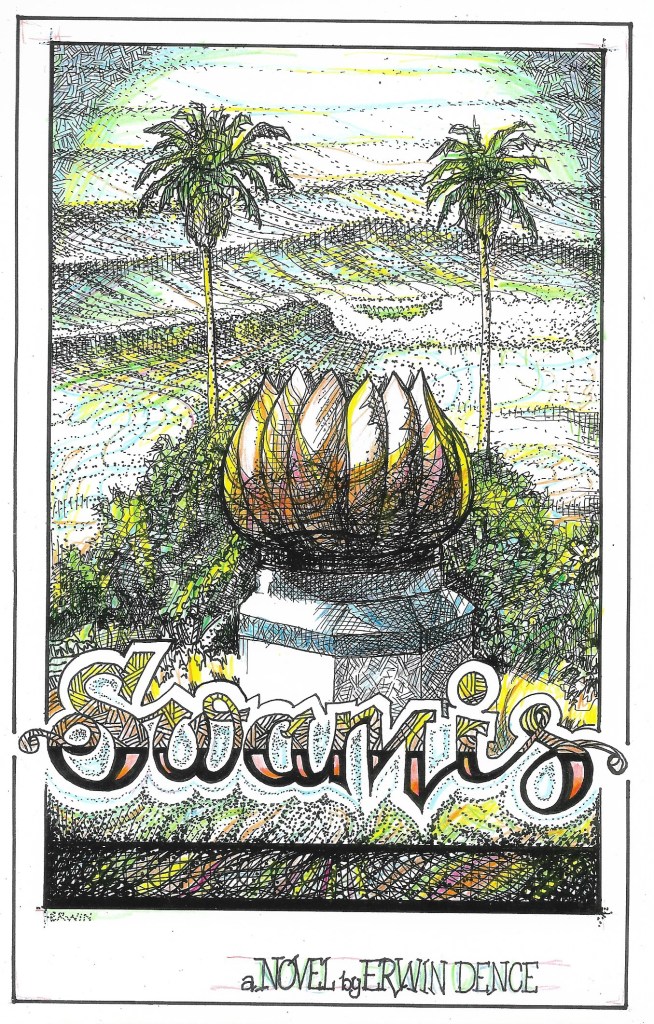
I backed my way through the middle of the semi-circle and to the window. I didn’t look around to connect faces with questions and comments. I was somewhere else, imagining what magical waves were breaking beyond the hills that were my horizon, trying to perfectly reimagine a photo from a surfing magazine.  The view was from across highway 101, above the railroad tracks. across the empty lot just south of the Swamis parking lot.  There were, on the horizon, distant swells on a field of diamonds, already bending to the contours of underwater reefs. To the right there were dark green shrubs and trees, palm trees beyond them. Further to the right, large gold lotus blossoms sat atop the corners of a white stucco wall.

I didn’t bother to consider how long I had been detached from the reality of an event as surreal as this wake, or memorial, or potluck. That was me, detached. Everyone seemed to know this. Damaged. Some knew the story, others were filled in. There had to be an explanation for why I was, so obviously, elsewhere.

Standing at the window, all the conversation was behind me; the clattering and tinkling, the hushed voices telling little stories, the sporadic laughter. 

The yellow van with the two popout surfboards on top pulled out of the driveway, a black Monte Carlo behind it. I didn’t recognize the car. I looked around the living room. Wendall and Dickson were holding court with one of the Downtown Detectives over by the sideboard, a two-thirds gone bottle of some brownish liquor between them. The Downtown Guy finished off Langdon’s bottle of wine, looked at the label, laughed, and moved the bottle next to the other empties. He looked around the room, and laughed again, louder.

I looked back out the window. A black Monte Carlo seemed about right. Oversized, pretentious. An investment, likely purchased before he made Lieutenant up in Orange County.

A yellow Volkswagen Karmann Ghia, top down, was coming up the hill. It passed the Hayes Flowers van. Different yellows; the car’s color softer, warmer, on the orange rather than the green side. There was a woman at the wheel, very colorful scarf over her head, sunglasses. The Monte Carlo stopped. The VW stopped. Langdon. Yeah, it was him. He had an am out the window. The gesture was ‘turn around.’ The woman in the Karman Ghia gave Langdon a brush back with a raised hand, followed, when the Monte Carlo moved on, with the woman’s right hand, up, middle finger out. She moved her arm halfway back down, then up again.

“Yeah,” I imagined myself saying, “Fuck you… with a half twist.” I may have added the half twist at some later recalling of the day. It doesn’t matter, it’s there now.

Deputy “New Guy” Wilson half-leaned into the Karmann Ghia. The woman looked up. She saw me in the window. She pointed. She waved. I took a second, then waved back. Wilson gave me a gesture, hands out, palms up, chest high. As in, “Really?” I mimicked his gesture, palms facing each other. The New Guy let her proceed.

            After several adjustments, the Karmann Ghia was pointed out, getaway position, the passenger side almost touching the two-by-six fencing on the corral. She removed her scarf. Afro. Not huge, but out there enough to make a statement. She looked at her image in the rearview mirror, pushed the sunglasses up into the Afro, prescription glasses remaining.

The woman swiveled in the seat, picked up a thirty-five-millimeter camera with a medium length telephoto attached, used the top of the windshield to stabilize it, and aimed it at me. Snap. Me in the center of the window, my arms out, hands on either side of the opening.

I moved backward and sideways, back into the room, bumping into a man I knew from the PTA or the School Board, somewhere. “It’s that pushy Negro reporter woman,” he said. “Writes for that hippie rag. She did a big… ‘expose’ on the water district. Don’t know how she got past the Deputy.”

            “New guy,” I said, suddenly realizing where I had seen the man’s photo. “The hippie rag published that… expose; favorable rates for certain… constituents, as I recall. The Enterprise didn’t run the story for another two weeks. And… you’re still the… director.”

The Water District Director looked at me for a moment before turning away. “Wendall,” he said, brushing past Mr. Dewey. I didn’t look away quickly enough. Mr. Dewey smiled. He may have mistaken my look for a nod. He was already headed my way. I returned to my spot in the middle of the picture window.

“I heard that, Joseph,” he whispered. “Good one. We need an alternative to the war mongering, corporate loving press.” Mr. Dewey was somewhere over half-sloshed, sloshing some sort of orangish-brown liquor in one of my father’s cut crystal glasses. The North County Free Press. I should make it required reading for my Political Science class.” Mr. Dewey leaned in a little too close to me. “I mean…” I leaned away. “…You read it… right?”

            I tried to correct my overreaction by leaning in toward Mister Dewey as if I was ready to share a secret. “You know, Mister Dewey…” I looked around the room, back to the teacher. “Most of these people do, too.” I whispered, “Also. And… there’s some… nudity. Sometimes. Hippies, huh?”

            Mr. Dewey nodded and went into some forgettable, mumbled small talk. War in Asia, civil rights, threats to the middle class. It was less than a minute later when Mr. Dewey pointed my father’s glass, with Detective Wendall’s whiskey sloshing around in the bottom, toward the photograph of my parents. “Never understood… guy like Joe DeFreines; almost a John Bircher… conservative. He was a Marine… in the Pacific. War hero.” He took another sip. “Korea, too. Also. A war we didn’t win. He fought the Japs, and then, he and your mom…”

            Mr. Dewey seemed to realize he had gone a bit too far with this. He tipped the glass up high enough to get the last of the whiskey, and said, “I have a theory.”

“Well, you are the Political scientist, Mr. Dewey.” I turned away.

Mr. Dewey grabbed my arm. “I think, Joseph, that he wanted all the Okies and all the new people to think he was… one of them.”  

“Or…” I looked at Mr. Dewey’s hand. He dropped it. “It’s tradition though, really. Isn’t it, Mr. Dewey? Kill the men. Take the women.”

Mr. Dewey looked into my father’s glass. Empty. I looked around the room, past the dining room, and into the kitchen as if I was looking for a particular person. I turned back toward the window. Mr. Dewey followed me, setting the glass on the sill.

“You know, Joseph; your father was a busy man.” Mr. Dewey was looking from the unfinished garage to the unfinished fencing. “I’m not teaching summer school this year.” I shook my head a bit, waiting for more. “I have time. That’s… If I had a place like… this, I…”

“Yeah. Needs… time. Work.”

Mr. Dewey tapped on the window. “The Falcon wagon? That yours… now?”

“I am making… payments.” A chuckle stuck in my throat. “Guess so.” Mr. Dewey cleared his throat. “I passed the… driving tests.”

“You. Of course.”

I whispered, “They didn’t ask, I didn’t admit… anything. I am getting… better.”

“Of course, Joseph.” Mr. Dewey turned and looked at the selections of food that were still on the table as three different women brought in an assortment of desserts. He patted my shoulder as fourteen other men and seven women had done, coughed out some whiskey breath, and headed to where my father’s partners, Wendall and Dickson, were filling glasses no one had yet asked for.

“Better,” I whispered to myself and the window and the cars and the property that needed work. “I better be.”

… 

            The reporter woman was standing next to my father’s partners. She declined a drink in a fattish sort of glass, three-quarters full, offered by Dickson. “Smooth,” he said, offering it again with a look that was really a dare. She was asking questions I couldn’t quite hear; questions that seemed to make the detectives uneasy.

            The reporter was holding out a notepad, three quarters of the pages pushed up, and was tapping on the next available page with a ballpoint pen. Dickson made a quick grab for the notepad.  She pulled it back. Quicker. Dickson pulled a very similar, palm-sized notepad from his inside coat pocket, opened it, went through some pages, shook his head, closed the notepad, put it back into the pocket. The reporter closed her notepad.

            “So,” the reporter asked, “The official word is no word?”

            “Correct.”   

            Wendall pulled a pack of Lucky Strike non-filters from his left outside coat pocket, a Zippo lighter with a Sheriff’s Office logo, exactly like my father’s, from the right pocket. He opened the top with a forceful snap on his wrist, looked around the room, pointed toward the kitchen. Partway through, Mrs. Wendall tried to stop him. He pointed to the cigarette and headed to and out the open sliding glass door.

            I moved a bit closer to the reporter and Dickson. “No, Detective Dickson, I am not getting any help from Downtown,” she said, shooting a look toward the Downtown Guy, who returned a wave and followed Wendall. I moved between the pineapple upside down cake and a plate of frosted brownies. I took a brownie. “You could just tell me how an experienced driver could…”

Dickson looked at me. “Could,” he said, downing one of the pre-filled glasses. “Won’t.”

The reporter looked at me, took a glass from the sideboard, downed it in one gulp, stepped toward me. “You,” she said. “Lee Ransom.” She extended a hand before the alcohol she had thrown down her throat forced her to spread her fingers, lean back, and open her mouth wide enough and long enough to emit a totally flat and involuntary, “Haaaauuuuuh.”

I made a quieter version of the sound she had made, leaned back, only slightly, at the waist, and said, “Oh. The Lee Ransom.”

Dickson laughed and said, “Smooooth.”

Lee Ransom moved closer to me. “Oh?” She paused for the exact same length of time as I had. “Meaning?”

            “Oh. As in, I thought Lee Ransom must be…”

            “White?”

            “A… man.”

            “Do I write like a… man?”

            “Yes. A… white… man.” Lee Ransom couldn’t seem to decide if I was putting her on or too foolish to edit my thoughts before I spoke. “New journalism, ‘I’m part of the story’… white… writer. Good, though. I read you… your… stuff.” I looked at Dickson. “He reads it.” I made a quick head move, all the way left, all the way right, and back to Lee Ransom. “They all read it.”

            Lee Ransom may have wanted to chuckle. She didn’t. She extended her hand again and said, “Thank you, Jody.” Dickson snickered.

I took Lee Ransom’s hand, trying to use the grip my father taught me, the one for women. I imagined him, telling me; “Not too strong, not too long, look them in the eye. No matter what they’re wearing… cleavage-wise.” Lee Ransom was wearing a black skirt, knee-length, with a not-quite-black coat, unbuttoned, over a long-sleeved shirt; tasteful, one unbuttoned button short of conservative. I didn’t look at her cleavage or her breasts. I was aware of them.     

“I was hoping to speak to your mother, Jody.”

            “Joey. I go by… Joey.”

            Dickson laughed. “Pet name. Jody.” He laughed again. “Private joke.” Laugh.

            “My friends call me Joey.” I did a choking kind of laugh. “Private joke.”

            Lee Ransom gave me a ‘I don’t get it’ kind of smile.

            “You. My mom. Talking. Probably… not.” I nodded toward the hallway. A woman was leading a couple toward the living room. “Sakura Rollins,” I said, “Since you’re taking notes.”    

“Thank you… Joey.” Lee Ransom tapped on her closed notebook. “She and her husband, Buddy, own a bowling alley. Oceanside. Back Gate Lanes.” She nodded toward the couple. “Gustavo and… Consuela Hayes. Flower people. Poinsettias…. Mostly.”

“Flower people,” I said, looking at Lee Ransom until she did a half-smile, half-head tilt.

Sakura Rollins came into the living room from the hallway, stopping close to Dickson. Mrs. Hayes turned to thank her, taking both of Mrs. Rollins’ hands in hers for a moment. Mr. Hayes exchanged a nod with Dickson, declined a drink, put a hand on his wife’s shoulder, turned her toward the door, walked with her toward the foyer. Neither of them looked to their left and into the living room. The husband walked to his wife’s left, between her and the rest of us. They both bent, slightly, to look at the flowers. The woman rearranged the pots and vases, slightly, before they went onto the porch.

Lee Ransom turned toward Sakura Rollins. Her expression blank, my mother’s best friend shook her head before Lee Ransom could ask her anything.

Theresa Wendall walked up to Dickson from the kitchen, leaned around him to look down the hallway, then looked at Sakura Rollins as if asking for some sort of confirmation. Dickson set down a glass and wrapped his right hand around Mrs. Wendall’s upper arm. She took a breath, gave Dickson a look that I didn’t see, but one that caused him to apply some small pressure pushing his partner’s wife forward as he released his grip.

Sakura Rollins followed Mrs. Wendall down the hallway. Mrs. Wendall stopped, allowing Mrs. Rollins to open the door and announce her. “Theresa Wendall.” Permission. Access. Mrs. Wendall went into my parents’… my mother’s room. Sakura Rollins closed the door, leaned against the wall between that door and the door to Freddy’s room, and pointed toward me, twisting her hand and pulling her finger halfway back.  

Mrs. Rollins met me halfway between the door and the open area. She put a hand on each of my shoulders. “Ikura desuka,” she said, her voice soft and low. “It means… ‘How much does it cost?’ Not in a formal way. Slang. Soldiers. It is… can be… insulting. Thank you for not asking your mother.”

“I didn’t… ask… you.”

“No, and you wouldn’t.” She tilted her head. “Your mother… she so enjoys having someone she can speak… Japanese with.”

I nodded. “She does, Mrs. Rollins, but… but… thank you.”

“Yes. There’s time.” Sakura Rollins released her right hand. “You’re… doing well, Joey.” She pointed toward the living room. “Your parents… strong.” I wanted to cry. “As are you. We are as strong as we need to be. Yes?”

            I backed up, three steps, did a half bow, unreturned, turned, and headed back toward the living room.   

Lee Ransom was declining Dickson’s latest drink offer, a half glass this time. She walked over to my father’s lounger. I followed. “Shrine,” I whispered. She looked closely at the scar on the palm of my father’s left hand. “It’s just… just the one hand,” I said. “Half stigmata.”

Lee Ransom may have smiled as she leaned toward the portrait. I almost smiled when she looked back at me.  

“Swamis” Recap

CHAPTER ONE -Monday, Nov 13, 1968-

Seventeen-year-old JOEY DeFREINES is talking with his court appointed psychologist, DR. SUSAN PETERS. Joey’s father, San Diego County Sheriff’s Office DETECTIVE LIEUTENANT JOSEPH DE FREINES made the deal following an afterschool incident at Fallbrook Union High School during which Joey put his foot on GRANT MURDOCH’s neck. Dr. Peters asks if, once bullied, Joey has become a bully.

TWO- Saturday, August 14, 1965-

13-year-old Joey tries surfing at PIPES. JULIA COLE is out, already accomplished. She says boy surfers are assholes, surfing is hard, and she stays away from cops and cop’s kids.

THREE- Sunday, September 15, 1968-

Joey tricks SID and other locals in the lineup at GRANDVIEW, gets a set wave. Sid burns Joey and tells him he broke the ‘locals rule,’ that being that locals rule.

Joey, driving his FALCON station wagon, comes upon a VW VAN. Locals DUNCAN, MONICA, AND RINCON RONNY are looking at the smoking engine. They are unresponsive if not hostile to Joey, but Julie (to her friends) asks Joey if he’s a mechanic or an attorney. “Not yet,” he says. There is an attraction between Julie and Joey that seems irritating to, in particular, Duncan.

FOUR- Wednesday, December 23, 1968-

Joey has a front row spot at SWAMIS. He has already surfed and is studying, notebooks on the hood of the Falcon. Arriving out of town surfers want the spot. Joey, hassled by one of them, informs BRIAN that he has a history of striking out violently when threatened, and says he’s on probation. Joey has an episode remembering past encounters, witnessed by the out-of-town surfers and Rincon Ronny, who seems impressed and says those kooks won’t bother Joey in the water. “Someone will,” Joey says, “It’s Swamis.”

FIVE- Thursday, February 27ut-

At breakfast at home in Fallbrook, Joseph DeFreines confronts his son (who he calls JODY) about an acceptance letter from Stanford University Joey hid. Joey’s father is also upset with his wife, RUTH, for some reason, and leaves in a huff, saying he’ll take care of it.

Joey and his younger brother, FREDDY, get a ride home from surf friend, GARY, and Gary’s sister, THE PRINCESS. Ruth is loading the Falcon, says she spoke on the phone with DETECTIVE SERGEANT LARRY WENDALL, and says she will, as always, be back. Freddy blames Joey. Their father calls as their mother pulls away. Joey, looking for the keys to his mother’s VOLVO, speaks briefly, somewhat rudely, with his father. Freddy says he’ll wait for their father. The phone rings. It’s ‘uncle’ Larry. Joey runs toward the Volvo.

SIX- Tuesday, March 4, 1968. PART ONE-

There is a post-funeral wake/memorial/potluck at the DeFreines house. Joey, avoiding the guests, is standing in the big west-facing window. MISTER DEWEY, a teacher at Fallbrook High, says he is surprised that Joey’s ex-Marine, ‘practically a John Bircher,’ father is married to a Japanese woman. “Traditional,” Joey says, “Kill the men, take the women.” Mister Dewey expresses interest in the property Joey’s father never had the time to work on.

A delivery van from ‘Flowers by Hayes’ comes up the driveway, guarded, for the wake, by San Diego Sheriff’s Office DEPUTY SCOTT WILSON. The driver of the van is CHULO, a surfer several years older than Joey. Chulo was arrested along with JUMPER HAYES for stealing avocados. Chulo was crippled during the arrest, went to work camp, became a beach evangelist.

Joey has an episode, during which he replays the accident in which, while driving the Volvo, he follows the Falcon and another car around the smoking JESUS SAVES BUS. Joey’s father, in an unmarked car, passes very close to him and pulls off the highway at high speed. JeJ

Chulo was driving the Jesus Saves bus.

Detective Wendall and DETECTIVE SERGEANT DANIEL DICKSON are at a makeshift bar in the living room. ORANGE COUNTY SHERIFF’S OFFICE DETECTIVE LIEUTENANT BRICE LANGDON, dressed in a just out of fashion Nehru jacket and rat-stabber shoes, isn’t popular with the two remaining detectives from the VISTA SUBSTATION, or with the other civilians and deputies from the San Diego Sheriff’s Office.

THERESA WENDALL, putting out food, tries to talk to her husband. He avoids her. Their two boys are running through playing cowboys-and-Indians as Langdon seems to corner Chulo.

SIX- PART TWO- TUESDAY, MARCH 4, 1969

The wake/memorial continues with various guests praising Joe DeFreines. There is a large portrait on display with the scar on Joey’s father’s left hand showing. Joey’s mother, Ruth, is led to her room by GUSTAVO and CONSUALA HAYES. Those seeking to talk with Ruth are vetted by MORIKO ROLLINS. Theresa Wendall is allowed to go in. Reporter for the North County Free Press, LEE RANSOM, gains access to the property, passing by Deputy Wilson by waving at Joey, in the window, with Joey returning the wave. Langdon seems to be following Chulo away from the property. Lee Ransom questions the detectives on information about Joe DeFreines’ accident.

“Swamis” is copyrighted, all rights reserved by the author, Erwin A. Dence, Jr. Thank you for respecting this. See you. Oh, and Fuck Cancer, and remember, Project 2025 wants to take away porn, even, maybe, surf porn.

Two Dylan Drawings, One Dylan in Eastinitas…

…and “Real, Real-er, Real-ist,” and “Realistically, Really?”

It’s something about how (I am coming to believe) every surfer seems to believe he or she (to save time I’m going to say ‘you’) has an approach to our shared sport/lifestyle/addiction that is true and valid; enough so that the other kooks and posers and influencers and disciples of this or that offshoot of the one true surfer’s life are… well, they’re mostly in the way, decadently preening and cavorting and, basically, despoiling the waves and the beach and the purity of purpose, with its co-existing morals and list of sins… those folks are in your way.

WAIT, that sounds like some excerpt from a MANIFESTO written by some madman in some cabin in some woods. YEAH, well, maybe, but I’m still working on how to refine it. SO, ask yourself if it applies to you and your realistic place in an increasingly crowded lineup. Maybe not.

I HAVE DECIDED to go back to posting excerpts from “SWAMIS” (not a manifesto) on Wednesdays, mostly because of time restraints. MAYBE just this week. I woke up in the middle of the night and watched too much of the WSL contest, enough to see SALLY FITZGIBBONS win, cementing her place back on next year’s big show. I was rooting for the veteran (not too surprisingly), and have long wondered why contest commentators never seem to mention that, coming close to number one in the WSL, she is, like (like as in I don’t have time to fact check) the four time champion of the INTERNATIONAL SURF LEAGUE (ISL). Perhaps it is because the WSL is the one true contest heaven.

TRISHA’S BROTHER’S SON, DYLAN, our nephew, and his wife just moved into a house in ENCINITAS. It seems he was surprised to discover that his aunt and I once owned a house in the same neighborhood. THE DISAPPOINTMENT, for surfer Dylan, as it was for me, was that our houses, purchased decades apart for should-be shockingly different amounts of money, is EAST OF I-5, well east of SURF ROUTE 101. And, looking at an aerial view that went along with the Zillow report, with 29 photos (Dylan gave me his new address so I can send him one of my new ORIGINAL ERWIN longsleeve t-shirts), I was even more disappointed to see so many houses, so little open land.

“It’s EASTINITAS,” I Texted, “AND there’s probably a surfer in one out of four of those houses.”

IN KEEPING with my habit of overdoing, I did a couple of sketches to go with my noticing how all these kids and their grownup cronies are riding electric bikes like they’re motorcycles… because, yes, they are.

Got to go- places to be, already late to start a promised and put-off painting project. DAMN, being a “Whore for the money,” an accusation from my friend, Keith, I can’t deny, though, technically, it makes me a prostitute, does cut into my ‘me time.’ That is, what could be time to search for and ride… waves.

I DO HOPE DYLAN and, okay, you, real surfer that you are, get some really life-affirming rides. OH, and don’t steal my drawings. I probably will keep going on the first sketch. WEDNESDAY, “SWAMIS.”

Recap of “Swamis” plus Ch.6,Part One, plus More

This drawing will, of course, have to be reversed, white-to-black, to go on (future) t-shirts. There are some new hoodies and long-sleeved shirts ready at D&L LOGOS on Monday. I’m pretty excited, as is TRISH. She special ordered one for her, “cost just a little bit more… honey.” “Sure.”

This design, a little larger than the practice ones I had printed. I have to figure out how much they’re costing me, and then… some will be available. I got one xxl, for me, but I may have already sold it.

OKAY, a lot of stuff this week. If your time is limited, SKIP the story. Not classic, all time. Next time… Do read the “Swamis” chapter. Thanks.

IN the ‘every session’s a story’ catagory… I had to go surfing the other day, last chance before my third eye surgery. I was aware, because, despite the rules, news of waves breaking and being ridden spreads, and I missed opportunities because my once-repaired but re-damaged fin box on my beloved but abused HOBIE needed repair, and I was focused on working and trying to buy another board. BUT, the dude with a board within reasonable driving distance wanted too much (as in, it’s listed for $500, out there for 8 weeks, and he won’t take less) for a board that is actually heavier than mine. SO, I purchase resin, hot cure catalyst, and some glass, cut the box loose, fill the hole with glass and resin, slam it back in, half-glass the whole unit in, fin and all. Foolish, knowing how the small waves and big rocks on the STRAIT eat fins.

I did all this on a painting job, the board on the rack of my VOLVO. It dried, I retied it to the rack AND I was ready for the next day’s pre-dawn takeoff. Enroute, I passed an accident on 112, almost to Joyce, a car on its top in the ditch, and it had been there long enough that there were cones and people with signs, and a lit-up display that read, “Accident Ahead.” It turns out three people, none wearing seatbelts, were hurt, two flown out. SO, maybe I should slow down.

AND I DID, but… you know how straps can be noisy? Mine were, increasingly so. It was a while after I arrived at my destinatiion, three people in the water, that I noticed my board was… Ever see people driving down the road with mattresses poorly tied to the roof? YEAH. But I was lucky. And the waves were what we… okay me, what I call FUN. I knew most of the dawn patrollers, met Ian’s wife (forgot her name- sorry; four syllables- don’t want to guess), and KEVIN, a Port Townsend surfer I had heard about. Iron man, stayed out about four hours straight.

SINCE, evidently, surfing is more dangerous after eye surgery than heavy lifting, I can hold on to memories of a decent session until… next time.

BECAUSE IT IS DIFFICULT to go back and pick up the earlier chapters, I am going to provide a recap of “SWAMIS.” Yes, even the ‘catchup’ is a lot of reading.

“Swamis” Recap

CHAPTER ONE -Monday, Nov 13, 1968-

Seventeen-year-old JOEY DeFREINES is talking with his court appointed psychologist, DR. SUSAN PETERS. Joey’s father, San Diego County Sheriff’s Office DETECTIVE LIEUTENANT JOSEPH DE FREINES made the deal following an afterschool incident at Fallbrook Union High School during which Joey put his foot on GRANT MURDOCH’s neck. Dr. Peters asks if, once bullied, Joey has become a bully.

TWO- Saturday, August 14, 1965-

13-year-old Joey tries surfing at PIPES. JULIA COLE is out, already accomplished. She says boy surfers are assholes, surfing is hard, and she stays away from cops and cop’s kids.

THREE- Sunday, September 15, 1968-

Joey tricks SID and other locals in the lineup at GRANDVIEW, gets a set wave. Sid burns Joey and tells him he broke the ‘locals rule,’ that being that locals rule.

Joey, driving his FALCON station wagon, comes upon a VW VAN. Locals DUNCAN, MONICA, AND RINCON RONNY are looking at the smoking engine. They are unresponsive if not hostile to Joey, but Julie (to her friends) asks Joey if he’s a mechanic or an attorney. “Not yet,” he says. There is an attraction between Julie and Joey that seems irritating to, in particular, Duncan.

FOUR- Wednesday, December 23, 1968-

Joey has a front row spot at SWAMIS. He has already surfed and is studying, notebooks on the hood of the Falcon. Arriving out of town surfers want the spot. Joey, hassled by one of them, informs BRIAN that he has a history of striking out violently when threatened, and says he’s on probation. Joey has an episode remembering past encounters, witnessed by the out-of-town surfers and Rincon Ronny, who seems impressed and says those kooks won’t bother Joey in the water. “Someone will,” Joey says, “It’s Swamis.”

FIVE- Thursday, February 27ut-

At breakfast at home in Fallbrook, Joseph DeFreines confronts his son (who he calls JODY) about an acceptance letter from Stanford University Joey hid. Joey’s father is also upset with his wife, RUTH, for some reason, and leaves in a huff, saying he’ll take care of it.

Joey and his younger brother, FREDDY, get a ride home from surf friend, GARY, and Gary’s sister, THE PRINCESS. Ruth is loading the Falcon, says she spoke on the phone with DETECTIVE SERGEANT LARRY WENDALL, and says she will, as always, be back. Freddy blames Joey. Their father calls as their mother pulls away. Joey, looking for the keys to his mother’s VOLVO, speaks briefly, somewhat rudely, with his father. Freddy says he’ll wait for their father. The phone rings. It’s ‘uncle’ Larry. Joey runs toward the Volvo.

SIX- Tuesday, March 4, 1968. PART ONE-

There is a post-funeral wake/memorial/potluck at the DeFreines house. Joey, avoiding the guests, is standing in the big west-facing window. MISTER DEWEY, a teacher at Fallbrook High, says he is surprised that Joey’s ex-Marine, ‘practically a John Bircher,’ father is married to a Japanese woman. “Traditional,” Joey says, “Kill the men, take the women.” Mister Dewey expresses interest in the property Joey’s father never had the time to work on.

A delivery van from ‘Flowers by Hayes’ comes up the driveway, guarded, for the wake, by DEPUTY SCOTT WILSON. The driver of the van is CHULO, a surfer several years older than Joey. Chulo was arrested along with JUMPER HAYES for stealing avocados. Chulo was crippled during the arrest, went to work camp, became a beach evangelist.

Joey has an episode, during which he replays the accident in which, while driving the Volvo, he follows the Falcon and another car around the smoking JESUS SAVES BUS. Joey’s father, in an unmarked car, passes very close to him and pulls off the highway at high speed. JeJ

Chulo was driving the Jesus Saves bus.

Detective Wendall and DETECTIVE SERGEANT DANIEL DICKSON are at a makeshift bar in the living room. ORANGE COUNTY SHERIFF’S OFFICE DETECTIVE LIEUTENANT BRICE LANGDON, dressed in a just out of fashion Nehru jacket and rat-stabber shoes, isn’t popular with the two remaining detectives from the VISTA SUBSTATION, or with the other civilians and deputies from the San Diego Sheriff’s Office.

THERESA WENDALL, putting out food, tries to talk to her husband. He avoids her. Their two boys are running through playing cowboys-and-Indians as Langdon seems to corner Chulo.

CHAPTER SIX- TUESDAY, MARCH 4, 1969  

It was still early afternoon. I was in the living room, ignoring everything behind me, facing but not really seeing anything out the west-facing window. A Santa Ana condition had broken down, and a thousand-foot-high wall of fog had pushed its way up the valleys. The house was situated high enough that the cloud would occasionally clear away, the sun brighter than ever. The heat and humidity, raised by the number of people in our house, caused a fog of condensation on the plate glass.

Below me, cars were parked in a mostly random way in the area between the house and the separate and unfinished garage, and the corral. Continued use had created a de facto circular driveway up the slight rise from the worn and pitted gravel driveway, across the struggling lawn, and up to the concrete pad at the foot of the wooden steps and front porch.

A bright yellow 1964 Cadillac Coupe De Ville convertible, black top up, was parked closest to the door.  Other vehicles were arranged on the clumpy grass that filled in areas of ignored earth. Later arrivals parked on the lower area. The Falcon was parked close to the county road in keeping with my parking obsession; with getting in, getting out, getting away.

I was vaguely aware of the music coming from the turntable built into the Danish modern console in the living room. Stereo. Big speakers in opposite corners of the room, the volume where my father had set it, too low to compete with the conversations among the increasing crowd, the little groups spread around the room. Some were louder than others. Praise and sympathy, laughs cut short out of respect. Decorum.

Someone had put on a record of piano music; Liberace, or someone. My father’s choice would have been from the cowboy side of country/western; high octave voices capable of yodeling, lonesome trails and tumbling tumbleweeds, the occasional polka. My mother preferred show tunes with duets and ballads by men with deep, resonant voices, voices like her husband’s, Joseph Jeremiah DeFreines.

 These would not have been my father’s choice of mourners. “Funerals,” he would say, “Are better than weddings.” He would pause, appropriately, before adding, “You don’t need an invite or a gift.”

Someone behind me repeated that line, mistiming the pause, his voice scratchy and high. I turned around. It was Mister Dewey. A high school social studies teacher, he sold insurance policies out of his rented house on Alvarado. His right hand was out. I didn’t believe shaking hands was expected of me on this day.

“You know my daughter, Penelope,” he said, dropping his hand.

“Penny,” I said. “Yes, since… third grade.” Penny, in a black dress, was beside Mr. Dewey, her awkwardness so much more obvious than that of the other mourners. I did shake her hand. “Penny, thanks for coming.” I did try to smile, politely. Penny tried not to. Braces.

 I looked at Mr. Dewey too closely, for too long, trying to determine if he and I were remembering the same incident I was. His expression said he was.

When I refocused, Mister Dewey and the two people he had been talking with previously, a man and Mrs. Dewey, were several feet over from where they had been. I half-smiled at the woman. She half-smiled and turned away. She wasn’t the first to react this way. If I didn’t know how to look at the mourners, many of them did not know how to look at me, troubled son of the deceased detective.

If I was troubled, I wasn’t trying too hard to hide it. I was trying to maintain control. “Don’t spaz out,” I whispered, to myself. It wasn’t a time to retreat into memory, not at the memorial for my father. The wake.

Too late.

“Bleeding heart liberal, that Mister Dewey,” my father was telling my mother, ten-thirty on a school night, me still studying at the dinette table. “He figures we should teach sex education. I told him that we don’t teach swimming in school, and that, for most people, sex… comes… naturally. That didn’t get much of a laugh at the school board meeting.”

“Teenage pregnancies, Joe.”

“Yes, Ruth.” My father touched his wife on the cheek. “Those… happen.”

“Freddy and I both took swimming lessons at Potter Junior High, Dad. Not part of the curriculum, but…”

“Save it for college debate class, Jody. We grownups… aren’t talking about swimming.”

  Taking a deep breath, my hope was that the mourners might think it was grief rather than some affliction. Out the big window, a San Diego Sheriff’s Office patrol car was parked near where our driveway hit the county road. The uniformed Deputy, still called “New Guy,” assigned to stand there, motioned a car in. He looked around, went to the downhill side of his patrol car. He opened both side doors and, it had to be, took a leak between them. Practical.

The next vehicle, thirty seconds later, was a delivery van painted a brighter yellow than the Hayes’ Cadillac. Deputy New Guy waved it through. I noticed two fat, early sixties popout surfboards on the roof, nine-foot-six or longer, skegs in the outdated ‘d’ style. One was an ugly green, fading, the other, once a bright red, was almost pink. Decorations, obviously, they appeared to be permanently attached to a bolted-on rack. The van was halfway to the house before I got a chance to read the side. “Flowers by Hayes brighten your days.” Leucadia phone number.

Hayes, as in Gustavo and Consuela Hayes. As in Jumper Hayes.

A man got out of the van’s driver’s seat, almost directly below me. Chulo. I knew him from the beach. Surfer. Jumper’s partner in ‘the great avocado robbery’ that sent them both away, Chulo returning, reborn, evangelizing on the beach, with a permanent limp.

Chulo’s long black hair was pulled back and tied; his beard tied with a piece of leather. He was wearing black jeans, sandals, and a day-glow, almost chartreuse t-shirt with “Flowers by Hayes” in white. Chulo looked up at the window, just for a moment, before reaching back into the front seat, pulling out an artist’s style smock in a softer yellow. He pulled it over his head, looked up for another moment before limping toward the back of the van.

The immediate image I pulled from my mental file was of Chulo on the beach, dressed in his Jesus Saves attire: The dirty robe, rope belt, oversized wooden cross around his neck. Same sandals. No socks.

Looking into the glare, I closed my eyes. Though I was in the window with forty-six people behind me, I was gone. Elsewhere.

I was tapping on the steering wheel of my mother’s gray Volvo, two cars behind my Falcon, four cars behind a converted school bus with “Follow me” painted in rough letters on the diesel smoke stained back. The Jesus Saves bus was heading into a setting sun, white smoke coming out of the tailpipes. Our caravan was just east of the Bonsall Bridge, the bus to the right of the lane, moving slowly.

My mother, in the Falcon, followed another car around the bus. Another car followed her, all of them disappearing into the glare. I gunned it.

I was in the glare. There was a red light, pulsating, coming straight at me. There was a sound, a siren, blaring. I was floating. My father’s face was to my left, looking at me. Jesus was to my right, pointing forward.

This wasn’t real. I had to pull out of this. I couldn’t.

The Jesus Saves bus stopped on the side of the road, front tires in the ditch. The Volvo was stopped at a crazy angle in front of the bus. I was frantic, confused. I heard honking. Chulo, ion the Jesus Saves bus. He gave me a signal to go. Go. I backed the Volvo up, spun a turn toward the highway. I looked for my father’s car. I didn’t see it. The traffic was stopped. I was in trouble. My mother, in the Falcon, was still ahead of me. She didn’t know. I pulled into the westbound lane, into the glare, and gunned it.

When I opened my eyes, a loose section of the fog was like a gauze over the sun. I knew where I was. I knew Chulo, the Jesus Saves bus’s driver, delivering flowers for my father’s memorial, knew the truth.

Various accounts of the accident had appeared in both San Diego papers and Oceanside’s Blade Tribune. The Fallbrook Enterprise wouldn’t have its version until the next day, Wednesday, as would the North County Free Press. All the papers had or would have the basic truth of what happened. What was unknown was who was driving the car that Detective Lieutenant Joseph Jeremiah DeFreines avoided. “A gray sedan, possibly European” seemed to be the description the papers used.

”The San Diego Sheriff’s Office and the California Highway Patrol share jurisdiction over this part of the highway. Detective Lieutenant Brice Langdon of the Orange County Sheriff’s Office is acting as a liaison with the Highway Patrol in investigating the fatal incident.”   

Despite the distractions, what I was thinking was that Chulo knew the truth.

Chulo would be depositing the four new bouquets in the foyer, flowers already filling one wall. I looked in that direction, panning across the mourners. The groups in the living room were almost all men. Most were drinking rather than eating. Most of the groups of women were gathered in the kitchen.

A woman wearing a white apron over a black dress brought out a side dish of, my guess, some sort of yam/sweet potato thing. Because I was looking at her, she looked at the dish and looked at me, her combination of expression and gesture inviting me to “try some.” There was, I believed, an “It’s delicious” in there. Orange and dark green things, drowning in a white sauce.

“Looks delicious, Mrs. Wendall.”

Two kids, around ten and twelve, both out of breath, suddenly appeared at the big table, both grabbing cookies, the elder sibling tossing a powdered sugar-covered brownie, whole, into his mouth, the younger brother giving a cross-eyed assessment of his mother’s casserole.  

“Larry Junior,” Mrs. Wendall half-whispered as she shooed her sons out the door. She looked at her husband, leaning against a sideboard serving as a bar. He followed his boys out the door with the drink in his hand, half-smiled at his wife, as if children running through a wake is normal; and was no reason to break from chatting with the other detective at the Vista substation, Daniel Dickson, and one of the ‘College Joe’ detectives from Downtown. War stories, shop talk. Enjoyable. Ties were loosened and coats unbuttoned, the straps for shoulder holsters occasionally visible.

“Just like on TV” my father would have said. “Ridiculous.”

Freddy, out of breath, came out of the kitchen, weaving through the wives and daughters who were busily bussing and washing and making plates and silverware available for new guests. I handed him two cookies before he grabbed them. He grabbed two more.

“They went thataway, Freddy,” Detective Dickson said, pointing to the foyer.

Freddy pushed the screen door open, sidestepped Chulo, and leapt, shoeless, from the porch to what passed for our lawn, Bermuda grass taking a better hold in our decomposed granite than the Kentucky bluegrass and the failing dichondra.

Chulo, holding a metal five-gallon bucket in each hand, walked through the open door and into the foyer. He was greeted by a thin man in a black suit coat worn over a black shirt with a Nehru collar. The man had light brown hair, slicked back, and no facial hair. He was wearing shoes my father would refer to as, “Italian rat-stabbers.” Showy. Pretentious. Expensive fashion investments that needed to be worn to get one’s money’s worth.

Chulo had looked at me, looked at the man, and lowered his head. The man looked at me. I didn’t lower my gaze. I tried to give him the same expression he’d given me. Not acknowledgement. Questioning, perhaps.

Langdon. He must have been at the funeral, but I hadn’t felt obligated to look any of the attendees in the eye. “Langdon,” one of the non-cop people from the Downtown Sheriff’s Office, records clerks and such, whispered. “Brice Langdon. DeFreines called anyone from Orange County ‘Disneycops.’” Chuckles. “They put people in ‘Disney jail’,” another non-deputy said.

“Joint investigation guy,” one of the background voices said. “Joint,” another one added. Three people chuckled. Glasses tinkled.  Someone scraped someone else’s serving spatula over another someone else’s special event side dish. Probably not the yams.

Chulo took the arrangements out of the buckets and rearranged the vases against the wall and those narrowing the opening to the living room. He plucked some dead leaves and flowers, tossed them in one of the buckets, backed out onto the porch, closed the door. I became aware that I had looked in that direction for too long. Self-consciousness or not, people were, indeed, looking at me. Most looked away when I made eye contact.

“If you have to look at people, look them straight in the eye,” my father told me, “Nothing scares people more than that.”

Langdon looked away first, turning toward the two remaining detectives at the Vista substation, Wendall and Dickson, Larry and Dan. They both looked at Langdon, critically assessing the Orange County detective’s fashion choices. I didn’t see Langdon’s reaction.  

My father’s partners had changed out of the dress uniforms they had worn at the funeral and into suits reserved for public speaking events and promotions, dark-but-not-black. Both wore black ties, thinner or wider, a year or two behind whatever the trend was. Both had cop haircuts, sideburns a little longer over time. Both had cop mustaches, cropped at the corners of their mouths, and bellies reflecting their age and their relative status. Both had changed out of the dress uniforms they’d worn at the funeral

 Wendall was, in some slight apology for his height, hunched over a bit, still standing next to the sideboard that usually held my mother’s collection of display items; photos and not-to-be-eaten-off-of dishes. Dickson was acting as official bartender. The hard stuff, some wine, borrowed glasses. The beer was in the back yard.

Langdon had brought his own bottle. Fancy label, obviously expensive wine, cork removed, a third of it gone. Langdon’s thin fingers around the bottle’s neck, he offered it to Dickson. Smiling, politely, Dickson took a slug and reoffered it to Langdon. Langdon declined. Dickson pushed the bottle into a forest of hard liquor and Ernest and Julio’s finest. Langdon shrugged and looked around the room. Dickson displayed the smirk he’d saved, caught by Wendall and me.

Langdon saw my expression and turned back toward Dickson. The smirk had disappeared. Langdon walked toward me. He smiled; so, I smiled.

“I’ve heard about you,” he said. The reaction I had prepared and practiced disappeared. I was pretty much just frozen. “I see you know…” He nodded toward the foyer. “…Julio Lopez.” Langdon didn’t wait for a response. “From the beach?” No response. “Surfers.” No response. “You and I will have to talk… soon.”

I had to respond. “How old are you, Detective Lieutenant Langdon?”

“I’m… twice your age.” I nodded. He nodded. “College. College… Joe.” He smiled.

I may have smiled as I looked around Langdon at Dickson and Wendall; both, like my father, twelve or more years older than Langdon, this assuming he knew I was seventeen. I did, of course consider why he would know this. Wendall gave me a questioning smile. Dickson was mid-drink. 

“I don’t know if you know this… Joseph: Your father was involved an investigation… cross-county thing, involving… me.”  Langdon was, again, looking straight into my eyes. I blinked and nodded, slightly. “Yes. So… if there is any irony in my being… here, it is that Joseph DeFreines was, ultimately…” Langdon was nodding. I was nodding. Stupidly. “…a fair man.”

Langdon did a sort of European head bow, snap down, snap back, and tapped me on the shoulder.  I had half expected to hear the heels on his rat-stabber shoes click.  

COPYRIGHT STUFF- All rights to original content reserved by author/artist, Erwin A. Dence, Jr.

THANKS, AS ALWAYS, for checking out realsurfers.net. Get some waves when you get the chance! And remember, sharing is… caring; that set bomb you let some kook take and blow the takeoff on… well, that was nice. OH, and, just remembered, the controversy on whether it’s justified to drop in on someone who took your wave continues. I saw it, I tried it. Twice. AND I felt… kind of justified. AND, when two guys dropped in on an alleged backpaddler, I was left outside with undisputed priority. GREAT!

All Things being Equinox, “Swamis,” Ch6-Part 1…

…and, perhaps, something, not too deep or crazy, on the chains of morality.

BUT FIRST- I asked for a followup report from TOM BURNS, judge at last weekend’s WESTPORT LONGBOARD CLASSIC. “What I can tell you, Erwin, is that the best surfers won.” OKAY, so, guessing, normal contest deal, competitors butt hurt for underscoring, local bias, etc.

BUT TODAY, the CAPE KIWANDA LONGBOARD CLASSIC, in its 25th year, is Live streaming (got it on my big screen- doesn’t make the waves look better- WAIT!- just saw a rare good one). I did scroll through some yesterday, saw a local surfer from the Olympic Peninsula not advance. No doubt underscored.

EQUINOX STUFF- I tuned into local Port Townsend radio station KPTZ yesterday, expecting to hear something about organic gardening or cold water plunging. Instead, I heard “Summer’s Almost Gone” by the DOORS. What! It was enough to keep me from checking out the news on NPR. Yeah! THE MEMORIES the song brought to me were enough to push me to call my old friend, RAY HICKS. And I would have if September isn’t the craziest time of the year for house painters.

1968. RAY, BILL BUEL, PHILLIP HARPER, and I were headed back to Fallbrook from a surf session at Oceanside or Grandview, smoking cigarettes, listening to our favorite band on a 4 track tape. The song comes on. We’re probably singing along. There’s a fill after each of the verses. “Where will we be… when the summer’s gone?” My adding “We’ll be in school” seemed to fit perfectly, heading toward our Senior year. My cohorts disagreed. Vigorously.

RAY HICKS, 1968

This is not the STRAIT OF JUAN DE FUCA, but it is a similar view. I have always kept track of where the sun sets as each year spins on. The foothills of Camp Pendleton have long been replaced by the eastern slopes of the Olympic Mountains, the sun moving from south to north to south across the ridges. I don’t keep track of the mysterious tracks of the moon; full moon, yes; connected to the tides changes, critical element of surf forecasting/guessing. So, we’re halfway to winter, surfers switching the forecast logic with the hope of swell, the ebbing and flowing hope and, yes, anticipation. Winter’s almost here. Almost here. Where will we be, when the winter’s here… I guess we’ll see.

THE MORALITY THING- We are all taught some guidelines to what constitutes a moral life. Restraints, perhaps. No, definitely. We all want to justify our actions, twisting the boundaries when necessary. No, I’m not making excuses for wave-hogging. It’s sociopathic, possibly, occasionally, doing something one knows is wrong, and then doing it again. STILL, we generally behave within our individually-set boundaries. Almost as if we have to. THE POLITICAL PART- If you are taught from birth to take advantage whenever you can, to screw over others in every interaction, pay attorneys rather than those providing services or products and then ask for my vote, well… no.

CHAPTER SIX- TUESDAY, MARCH 4, 1969  

It was still early afternoon. I was in the living room, ignoring everything behind me, facing but not really seeing anything out the west-facing window. A Santa Ana condition had broken down, and a thousand-foot-high wall of fog had pushed its way up the valleys. The house was situated high enough that the cloud would occasionally clear away, the sun brighter than ever. The heat and humidity, raised by the number of people in our house, caused a fog of condensation on the plate glass.

Below me, cars were parked in a mostly random way in the area between the house and the separate and unfinished garage, and the corral. Continued use had created a de facto circular driveway up the slight rise from the worn and pitted gravel driveway, across the struggling lawn, and up to the concrete pad at the foot of the wooden steps and front porch.

A bright yellow 1964 Cadillac Coupe De Ville convertible, black top up, was parked closest to the door.  Other vehicles were arranged on the clumpy grass that filled in areas of ignored earth. Later arrivals parked on the lower area. The Falcon was parked close to the county road in keeping with my parking obsession; with getting in, getting out, getting away.

I was vaguely aware of the music coming from the turntable built into the Danish modern console in the living room. Stereo. Big speakers in opposite corners of the room, the volume where my father had set it, too low to compete with the conversations among the increasing crowd, the little groups spread around the room. Some were louder than others. Praise and sympathy, laughs cut short out of respect. Decorum.

Someone had put on a record of piano music; Liberace, or someone. My father’s choice would have been from the cowboy side of country/western; high octave voices capable of yodeling, lonesome trails and tumbling tumbleweeds, the occasional polka. My mother preferred show tunes with duets and ballads by men with deep, resonant voices, voices like her husband’s, Joseph Jeremiah DeFreines.

 These would not have been my father’s choice of mourners. “Funerals,” he would say, “Are better than weddings.” He would pause, appropriately, before adding, “You don’t need an invite or a gift.”

Someone behind me repeated that line, mistiming the pause, his voice scratchy and high. I turned around. It was Mister Dewey. A high school social studies teacher, he sold insurance policies out of his rented house on Alvarado. His right hand was out. I didn’t believe shaking hands was expected of me on this day.

“You know my daughter, Penelope,” he said, dropping his hand.

“Penny,” I said. “Yes, since… third grade.” Penny, in a black dress, was beside Mr. Dewey, her awkwardness so much more obvious than that of the other mourners. I did shake her hand. “Penny, thanks for coming.” I did try to smile, politely. Penny tried not to. Braces.

 I looked at Mr. Dewey too closely, for too long, trying to determine if he and I were remembering the same incident I was. His expression said he was.

When I refocused, Mister Dewey and the two people he had been talking with previously, a man and Mrs. Dewey, were several feet over from where they had been. I half-smiled at the woman. She half-smiled and turned away. She wasn’t the first to react this way. If I didn’t know how to look at the mourners, many of them did not know how to look at me, troubled son of the deceased detective.

If I was troubled, I wasn’t trying too hard to hide it. I was trying to maintain control. “Don’t spaz out,” I whispered, to myself. It wasn’t a time to retreat into memory, not at the memorial for my father. The wake.

Too late.

“Bleeding heart liberal, that Mister Dewey,” my father was telling my mother, ten-thirty on a school night, me still studying at the dinette table. “He figures we should teach sex education. I told him that we don’t teach swimming in school, and that, for most people, sex… comes… naturally. That didn’t get much of a laugh at the school board meeting.”

“Teenage pregnancies, Joe.”

“Yes, Ruth.” My father touched his wife on the cheek. “Those… happen.”

“Freddy and I both took swimming lessons at Potter Junior High, Dad. Not part of the curriculum, but…”

“Save it for college debate class, Jody. We grownups… aren’t talking about swimming.”

  Taking a deep breath, my hope was that the mourners might think it was grief rather than some affliction. Out the big window, a San Diego Sheriff’s Office patrol car was parked near where our driveway hit the county road. The uniformed Deputy, still called “New Guy,” assigned to stand there, motioned a car in. He looked around, went to the downhill side of his patrol car. He opened both side doors and, it had to be, took a leak between them. Practical.

The next vehicle, thirty seconds later, was a delivery van painted a brighter yellow than the Hayes’ Cadillac. Deputy New Guy waved it through. I noticed two fat, early sixties popout surfboards on the roof, nine-foot-six or longer, skegs in the outdated ‘d’ style. One was an ugly green, fading, the other, once a bright red, was almost pink. Decorations, obviously, they appeared to be permanently attached to a bolted-on rack. The van was halfway to the house before I got a chance to read the side. “Flowers by Hayes brighten your days.” Leucadia phone number.

Hayes, as in Gustavo and Consuela Hayes. As in Jumper Hayes.

A man got out of the van’s driver’s seat, almost directly below me. Chulo. I knew him from the beach. Surfer. Jumper’s partner in ‘the great avocado robbery’ that sent them both away, Chulo returning, reborn, evangelizing on the beach, with a permanent limp.

Chulo’s long black hair was pulled back and tied; his beard tied with a piece of leather. He was wearing black jeans, sandals, and a day-glow, almost chartreuse t-shirt with “Flowers by Hayes” in white. Chulo looked up at the window, just for a moment, before reaching back into the front seat, pulling out an artist’s style smock in a softer yellow. He pulled it over his head, looked up for another moment before limping toward the back of the van.

The immediate image I pulled from my mental file was of Chulo on the beach, dressed in his Jesus Saves attire: The dirty robe, rope belt, oversized wooden cross around his neck. Same sandals. No socks.

Looking into the glare, I closed my eyes. Though I was in the window with forty-six people behind me, I was gone. Elsewhere.

I was tapping on the steering wheel of my mother’s gray Volvo, two cars behind my Falcon, four cars behind a converted school bus with “Follow me” painted in rough letters on the diesel smoke stained back. The Jesus Saves bus was heading into a setting sun, white smoke coming out of the tailpipes. Our caravan was just east of the Bonsall Bridge, the bus to the right of the lane, moving slowly.

My mother, in the Falcon, followed another car around the bus. Another car followed her, all of them disappearing into the glare. I gunned it.

I was in the glare. There was a red light, pulsating, coming straight at me. There was a sound, a siren, blaring. I was floating. My father’s face was to my left, looking at me. Jesus was to my right, pointing forward.

This wasn’t real. I had to pull out of this. I couldn’t.

The Jesus Saves bus stopped on the side of the road, front tires in the ditch. The Volvo was stopped at a crazy angle in front of the bus. I was frantic, confused. I heard honking. Chulo, ion the Jesus Saves bus. He gave me a signal to go. Go. I backed the Volvo up, spun a turn toward the highway. I looked for my father’s car. I didn’t see it. The traffic was stopped. I was in trouble. My mother, in the Falcon, was still ahead of me. She didn’t know. I pulled into the westbound lane, into the glare, and gunned it.

When I opened my eyes, a loose section of the fog was like a gauze over the sun. I knew where I was. I knew Chulo, the Jesus Saves bus’s driver, delivering flowers for my father’s memorial, knew the truth.

Various accounts of the accident had appeared in both San Diego papers and Oceanside’s Blade Tribune. The Fallbrook Enterprise wouldn’t have its version until the next day, Wednesday, as would the North County Free Press. All the papers had or would have the basic truth of what happened. What was unknown was who was driving the car that Detective Lieutenant Joseph Jeremiah DeFreines avoided. “A gray sedan, possibly European” seemed to be the description the papers used.

” The San Diego Sheriff’s Office and the California Highway Patrol share jurisdiction over this part of the highway. Detective Lieutenant Brice Langdon of the Orange County Sheriff’s Office is acting as a liaison with the Highway Patrol in investigating the fatal incident.”   

Despite the distractions, what I was thinking was that Chulo knew the truth.

Chulo would be depositing the four new bouquets in the foyer, flowers already filling one wall. I looked in that direction, panning across the mourners. The groups in the living room were almost all men. Most were drinking rather than eating. Most of the groups of women were gathered in the kitchen.

A woman wearing a white apron over a black dress brought out a side dish of, my guess, some sort of yam/sweet potato thing. Because I was looking at her, she looked at the dish and looked at me, her combination of expression and gesture inviting me to “try some.” There was, I believed, an “It’s delicious” in there. Orange and dark green things, drowning in a white sauce.

“Looks delicious, Mrs. Wendall.”

Two kids, around ten and twelve, both out of breath, suddenly appeared at the big table, both grabbing cookies, the elder sibling tossing a powdered sugar-covered brownie, whole, into his mouth, the younger brother giving a cross-eyed assessment of his mother’s casserole.  

“Larry Junior,” Mrs. Wendall half-whispered as she shooed her sons out the door. She looked at her husband, leaning against a sideboard serving as a bar. He followed his boys out the door with the drink in his hand, half-smiled at his wife, as if children running through a wake is normal; and was no reason to break from chatting with the other detective at the Vista substation, Daniel Dickson, and one of the ‘College Joe’ detectives from Downtown. War stories, shop talk. Enjoyable. Ties were loosened and coats unbuttoned, the straps for shoulder holsters occasionally visible.

“Just like on TV” my father would have said. “Ridiculous.”

Freddy, out of breath, came out of the kitchen, weaving through the wives and daughters who were busily bussing and washing and making plates and silverware available for new guests. I handed him two cookies before he grabbed them. He grabbed two more.

“They went thataway, Freddy,” Detective Dickson said, pointing to the foyer.

Freddy pushed the screen door open, sidestepped Chulo, and leapt, shoeless, from the porch to what passed for our lawn, Bermuda grass taking a better hold in our decomposed granite than the Kentucky bluegrass and the failing dichondra.

Chulo, holding a metal five-gallon bucket in each hand, walked through the open door and into the foyer. He was greeted by a thin man in a black suit coat worn over a black shirt with a Nehru collar. The man had light brown hair, slicked back, and no facial hair. He was wearing shoes my father would refer to as, “Italian rat-stabbers.” Showy. Pretentious. Expensive fashion investments that needed to be worn to get one’s money’s worth.

Chulo had looked at me, looked at the man, and lowered his head. The man looked at me. I didn’t lower my gaze. I tried to give him the same expression he’d given me. Not acknowledgement. Questioning, perhaps.

Langdon. He must have been at the funeral, but I hadn’t felt obligated to look any of the attendees in the eye. “Langdon,” one of the non-cop people from the Downtown Sheriff’s Office, records clerks and such, whispered. “Brice Langdon. DeFreines called anyone from Orange County ‘Disneycops.’” Chuckles. “They put people in ‘Disney jail’,” another non-deputy said.

“Joint investigation guy,” one of the background voices said. “Joint,” another one added. Three people chuckled. Glasses tinkled. Someone scraped someone else’s serving spatula over another someone else’s special event side dish. Probably not the yams.

Chulo took the arrangements out of the buckets and rearranged the vases against the wall and those narrowing the opening to the living room. He plucked some dead leaves and flowers, tossed them in one of the buckets, backed out onto the porch, closed the door. I became aware that I had looked in that direction for too long. Self-consciousness or not, people were, indeed, looking at me. Most looked away when I made eye contact.

“If you have to look at people, look them straight in the eye,” my father told me, “Nothing scares people more than that.”

Langdon looked away first, turning toward the two remaining detectives at the Vista substation, Wendall and Dickson, Larry and Dan. They both looked at Langdon, critically assessing the Orange County detective’s fashion choices. I didn’t see Langdon’s reaction.  

My father’s partners had changed out of the dress uniforms they had worn at the funeral and into suits reserved for public speaking events and promotions, dark-but-not-black. Both wore black ties, thinner or wider, a year or two behind whatever the trend was. Both had cop haircuts, sideburns a little longer over time. Both had cop mustaches, cropped at the corners of their mouths, and bellies reflecting their age and their relative status. Both had changed out of the dress uniforms they’d worn at the funeral

 Wendall was, in some slight apology for his height, hunched over a bit, still standing next to the sideboard that usually held my mother’s collection of display items; photos and not-to-be-eaten-off-of dishes. Dickson was acting as official bartender. The hard stuff, some wine, borrowed glasses. The beer was in the back yard.

Langdon had brought his own bottle. Fancy label, obviously expensive wine, cork removed, a third of it gone. Langdon’s thin fingers around the bottle’s neck, he offered it to Dickson. Smiling, politely, Dickson took a slug and reoffered it to Langdon. Langdon declined. Dickson pushed the bottle into a forest of hard liquor and Ernest and Julio’s finest. Langdon shrugged and looked around the room. Dickson displayed the smirk he’d saved, caught by Wendall and me.

Langdon saw my expression and turned back toward Dickson. The smirk had disappeared. Langdon walked toward me. He smiled; so, I smiled.

“I’ve heard about you,” he said. The reaction I had prepared and practiced disappeared. I was pretty much just frozen. “I see you know…” He nodded toward the foyer. “…Julio Lopez.” Langdon didn’t wait for a response. “From the beach?” No response. “Surfers.” No response. “You and I will have to talk… soon.”

I had to respond. “How old are you, Detective Lieutenant Langdon?”wh

“I’m… twice your age.” I nodded. He nodded. “College. College… Joe.” He smiled.

I may have smiled as I looked around Langdon at Dickson and Wendall; both, like my father, twelve or more years older than Langdon, this assuming he knew I was seventeen. I did, of course consider why he would know this. Wendall gave me a questioning smile. Dickson was mid-drink. 

“I don’t know if you know this… Joseph: Your father was involved an investigation… cross-county thing, involving… me.”  Langdon was, again, looking straight into my eyes. I blinked and nodded, slightly. “Yes. So… if there is any irony in my being… here, it is that Joseph DeFreines was, ultimately…” Langdon was nodding. I was nodding. Stupidly. “…a fair man.”

Langdon did a sort of European head bow, snap down, snap back, and tapped me on the shoulder.  I had half expected to hear the heels on his rat-stabber shoes click.  

THANKS FOR CHECKING OUT realsurfers.net. Copyright 2020. All rights reserved.

WESTPORT Longboard Classic, “Swamis” Ch.5…

IT’S FINALS DAY at the WESTPORT LONGBOARD CLASSIC and realsurfers has a correspondent embedded in the event. Longtime explorer on the coast and the Strait, TOM BURNS, is a *judge, and has agreed to send a few photos and some commentary my way.

PHOTOS- Logo; O’Dark Thirty a Westport; Photo from the ‘memorial wall’ of TOM LE COMPE (RIP), one the ‘harbor boys,’ and one of the first to surf the jetty in the sixties, and Tom Burns; a shot of ‘The Corner” early this morning; Someone Tom didn’t give me a name for; and BARRY ESTES (RIP) with Tom from a RICKY YOUNG contest back in the late 1980s and 90s.

I competed in several of those contests, pushed to do so by my friend from my shipyard days, RAPHAEL REDA. I didn’t meet Tom there. I met him on the Strait of Juan de Fuca. Tom, a month or so older than me, was years ahead of me in knowledge of where and when to find waves, but still has a fairly high ratio on the skunk-to-score chart. Tom is, among surfers I know, the preeminent name dropper, with a long history, great memory, and a willingness to talk story. We quickly discovered we have some friends in common, Drew Kampion and Pathfinder Darrell Wood to name drop two, AND Tom was perfectly willing to adopt some of the colorful folks I’ve run into: Tugboat Bill, Big Dave, Concrete Pete, folks without nicknames.

*I helped out at the precursor to the Longboard Classic, the CLEANWATER CLASSIC, a couple of years. Not surfing, I was volunteering and sort of representing SURFRIDER. Not satisfied to stand on the beach with a flag, I pushed my way into being a spotter for the judges, Tom being one of them. I refused to leave. Partially because I do bring the fun, and I do watch a lot of WSL contests on the computer, Tom convinced the head judge to allow me to be a judge the next year. I brought the fun. Too much fun for the head judge. I got in trouble for not matching the other judges’ assessment of rides. “6.5? No, I gave it a 4.6. I mean… really? 6.5?” I wasn’t asked back. Tom wasn’t either. Somehow I was his fault.

EVIDENTLY TOM has served his time in judge purgatory.

OF COURSE, being as tribal as anyone, I’m rooting for surfers from the Olympic Peninsula. We’ll see.

I am up to Chapter 9 on the re-re-re-reedit and tightening of “SWAMIS.” Remember, this material is copyright protected, all rights reserved. Thanks for honoring this, and thanks for reading.

CHAPTER FIVE- THURSDAY, FEBRUARY 27, 1969

Our house in the hills between Fallbrook and Bonsall was a split level, stucco house, aluminum sash windows, composite roof. Someone else had started building from some plans purchased from a catalog. My parents could save money, they were told, by finishing the lower level and the garage. They could replace the plywood shed at the edge of a corral with a small barn that would provide room for a horse, a side area for hay and tack. New fencing. More trees. A garden. A covered patio off the kitchen, or, perhaps, a bay window.

 My father promised the patio, and then the bay window. He was working on it, but he was working. Working. There was, outside the sliding door, a concrete slab, with paving stones leading around the corner and down to the driveway. The two-story portion of the house featured a plate glass window, four foot high and eight feet wide, in total, with crank out, aluminum sash windows on either side. This window offered a view to the west, over scrubby trees and deep arroyos, of the hills, some rounded, others more jagged, with ancient boulders visible on all of them. Mission Avenue was hidden below and between. Mission, the road that linked Fallbrook with Bonsall, Vista, Oceanside, everywhere west, everywhere worth going to.

Looking out this window, I felt almost level with those hills. Morning light, descending, brought out the details of the ribs and rocks. Afternoon shadows crept from it until the hills once again became a blank shape. There were waves of hills in irregular lines between my hills and the unseen ocean. I had spent time looking away from my studies, imagining the hills in timelapse, the sun setting at one place in winter, another in summer, lines off clouds held back at the ridgeline, breaking over the top; torn, scattering. I had imagined the block as transparent, the ocean visible, late afternoon sunlight reflected off the water and into the empty skies.

… 

The light outside was still neutral when I moved to the dinette table in the kitchen, a bowl of oatmeal, a tab of butter on top of it, in front of me. There was a glass pitcher of milk between my setting and the other two. There were four lunch sacks on the counter. Two were a light blue, one was a shade more orange than pink, the fourth was the standard lunch sack brown. My mother, already dressed and ready for work, took a carton of Lucky Strikes from a cupboard and put a pack into the brown lunch sack.

She looked out the window over the sink. She sniffled.

My father, in one of his everyday detective suits; coat unbuttoned, tie untied; leaned over from the head of the table. “Go get it, Jody.” The ‘now’ part of the command was unspoken. His voice was calm. Almost always. I didn’t move. I didn’t look up from my oatmeal. “Stanford, Jody; you didn’t think they’d send a copy to the school?”

My father’s questions demanded an answer or a response.

I stood up, lifting my chair up high enough that its metal legs, with plastic shoes at the bottom, wouldn’t scrape the oak flooring. I looked at my father. He was looking at my mother. She sniffled several times but didn’t turn around.

My bedroom was at the end of the hallway, past my parent’s and my father’s den on the right, the guest bathroom, Freddy’s room, then mine on the left. There were pictures taken from surfing magazines on several walls, a cluttered desk between the closet and a bunk bed, the bottom bunk converted into a space for books and toys and cardboard boxes taped and marked, stuff from our previous house.

Though we had been at the ranchette for more than four years, because the garage had never become water and weather tight, most of the boxes in my room remained stacked and taped and marked. Grease pencil. Yellow, mostly. Some black. I opened an untaped box marked “Cowboy stuff” and took out the legal sized envelope.

As I walked up the hallway, I heard my father ask, “Is this who we are now, Ruth?”

“Not we, Joe. Me. You… didn’t want to be…”

“Involved? No!” I heard a thump, hand to a solid surface. Less than a slam. “Fool that I am, I am… and have been involved this whole time.” 

My parents almost never raised their voices. My father didn’t have to, my mother just… wouldn’t. I’ve been asked about my parent’s relationship many times. Japanese war bride, ex-Marine. My answer will always be, “They had a certain dynamic.” The answer could as easily be, “It wasn’t what you might think.” Whatever they thought.

My parents were standing at the counter to the right of the double sink. I placed the envelope on the tablecloth, next to my father’s plate. Sausage and eggs. Uneaten. Cup of coffee. Half full. I sat down. I looked over. My father signed at the bottom of two pages. My mother refolded them into thirds and put them into an envelope. She set the envelope on the left side of the sink, on top of several other loose papers. Legal size. Eight and a half by fourteen inches.

“I’ll fix it, Joe. Today.”

My father grunted, stepped around my mother. He was looking at the pages, shaking his head. He looked toward his wife. Her back was to the sink, both hands behind her on the edge of the counter. She looked at my father’s hands as he folded those papers in half. He took in a breath, turned toward her, let out the breath slowly. He handed her the papers with his right hand. She took them with her left hand, handed him the brown lunch sack with her right.

“Ruth. You could… This could give you… freedom. Ikura desuka?”

My mother only rarely spoke Japanese, my father almost never. My mother froze. “Freedom, Joe?” My father’s expression was one of instant regret.

I replayed the words. “E’-kew-rah des-kah.” Again. “E’-kew-rah des-kah.” There was something in the flow, the rhythm of my mother’s native language I had given up trying to capture. “E’-kew-rah des-kah?”

My mother and the envelope and the papers were gone. My father set the brown lunch sack onto the counter, took two more packs from the carton of Lucky Strikes from the cupboard, unfolded the two folds on the lunch sack, put them in, refolded the sack. Not as neatly. He took two steps toward the sliding glass door, looked at his feet. “Socks,” he said. “Jody, you won’t be surfing… or working at Mrs. Tony’s; none of that shit.” He looked at the envelope on the dinette table. “Stanford.” He threw his left hand out and down, ends of his fingers touching the Stanford logo. “You… you earned this, Jody. You’re going.”

“Going.”

My father looked toward the hallway, looked at me. “It’ll be… she’ll be fine. I have to…”

“Go. Yes.”

Freddy came into the kitchen. “Daddy?” Our father responded with a weak sideways nod. Freddy followed him through the living room, into the foyer, out onto the front porch. The front door slammed.

When Freddy returned, our mother was back in the kitchen. My brother, not even trying not to cry, looked at her, and then me, as if whatever was happening was our fault.

“Freedom,” I whispered, my left hand, in a fist, over my mouth. “Ikara desuka.”

The house phone was on a table just outside the formal dining room. Our mother picked up the receiver and dialed a number on the phone’s base. “No, I am well,” she said. “Annual leave. ‘Use it or lose it.’ I have accumulated…” She chuckled. Fake. “No. They’re both fine. I will be in tomorrow.” She looked at me. “Thank you.” She put the phone back on the base. “Joey, I will need the station wagon. You and Freddy… Better hurry; you will have to take the bus.”

Freddy asked, “What about taking your car, Mommy?” Our mother looked at me and shook her head. I shook mine. Freddy looked at me. “What did you do this time, Jody?”

            Gary and Roger were my closest surf friends. Roger started board surfing the summer I did, 1965. Gary started the next summer. By the time we were seniors, many others had tried surfing. Most didn’t stick with it for long. Though Roger lived closer to me, Gary offered to give me a ride home.

            I was riding shotgun. Gary’s sister, squeezed tightly against the backseat passenger door of their mom’s Corvair, said, in an unnecessarily whiny voice, “Glad it’s all cool with you, Gary.”

“It is, yeah; it’s cool with me.” Gary glanced over at me. “The Princess has a license, but our mom won’t let her drive without… supervision.”

“Well, thanks again for the ride, Gary; and for going by Potter for… Freddy. Oh, and thank you…”

“Princess,” Gary said.

The Princess blew air out of the side of her mouth. I looked around and over the seat. The Princess shook the wrist of her left hand and gave me a look I took as suggesting the raspberry was meant for her brother rather than me. Freddy was not quite as tight against the door on the driver’s side. Neither tried to talk to, or even look at the other.

“So, Joey,” Gary asked, “what do you think of Roger’s latest girlfriend?”

“She’s a sophomore, you know,” the Princess said, looking at me. “Sophomore.” I gave her the expression she was looking for. The relationship was wrong. And creepy.

“Roger’s business, Princess. Now, Joey, maybe, after school… days are getting longer. We could do Oceanside pier. Tamarack, if I drive.”

 “Four gallons of gas, two quarts of oil; that sound about right, Gary?”

“Or Joey; we could go in Roger’s stepdad’s Mustang.”

The Princess mumbled a quiet, “Fuck you, Gary,” as her brother downshifted, unnecessarily, at the first of several uphill curves. Freddy’s laugh and repetition of the words were louder and clearer.

“Or Princess and some of her friends… Juniors… no sophomores, could go with us,” Gary offered. The Princess let out a high-pitched, “Ha!” and a low-pitched sort of extended grunt sound. Freddy giggled. “Or, if we can’t go surfing after school, maybe me and you and Roger could ditch and go all day.”

Gary looked at me and winked. I shook my head, but I did smile. “Or maybe next week… or so, if we have all our stuff ready, boards loaded, we could make it to Grandview. Swamis. Somewhere… good.”

“Possible. Timewise.”

“Cool.”

The princess’s head suddenly appeared between Gary and me. “Most of you Fallbrook surfers aren’t even partway cool,” she said. “And besides, my friends won’t even cruise town in this crappy car; and besides that, it would be creepy.” The Princess looked at me and seemed to realize her face and mine were way too close. Still, she didn’t move away.

“Creepy,” I said.

“And they might find out Gary’s surfing just isn’t all that… cool,” the Princess said, almost smiling before she fell back into the seat and against the door.

We arrived at our driveway. The Falcon station wagon was still there, my nine-six pintail on the rack. The Falcon was backed up to the curved gravel pathway that went up the slight grade to the front door. Bender board and stakes had been installed for a while, ready for concrete.

“Board on the roof. Obvious Hodad move, Joey.”

I looked up at Gary’s Hansen surfboard hanging over the hood of the Corvair. “Obvious.”

Gary used the area between the unfinished garage and the temporary shed at the corner of the corral to turn around. The Corvair had barely stopped when Freddy jumped out and ran for the house. The Princess jumped out and ran around to the front passenger door. I took a few seconds to get my books and folders out of the seat. She leaned on the open door and checked out the ranchette. Disapprovingly.

Gary popped the clutch on the Corvair halfway down the driveway. There was a second cloud of black smoke as Gary, unnecessarily double-clutched, attempting, unsuccessfully, to get scratch in second gear. There were a few drops of oil soaking into and staining the insufficient gravel on the decomposed granite driveway.

My mom was standing at the front driver’s side door of the Falcon, Freddy pressed against her and between her and the seat. She was looking at me. “You know I’ll be back,” she said, for both Freddy and me.  She looked over at the old horse casually eating grain on the near side of what she called a paddock. “I can’t trust you boys to properly take care of Tallulah.”

A bell on the two-story part of the house rang. “Telephone,” Freddy said, dropping books as he ran. I set my school stuff on the grass and walked to the front of the Falcon.

“There’s some money… on the counter. Take the Volvo. Later. Six-thirty or so. You and Freddy can go to that Smorgasbord place he likes. Or Sambo’s.”

“Sambo’s… closed, Mom.”

“Oh. Yes. You know how to find the Rollins Place; right?” I nodded. “No eating in the Volvo. Right?” I shook my head.

“Mom,” Freddy yelled, “It’s Daddy.”

“Tell Freddy your father knows where to find me.” Our mother got into the Falcon. She chuckled. “Stick shift. Hope I haven’t forgotten how.”

“Daddy! He wants to talk with mom. He wants her to wait… for him. Jody!”

“Waiting,” our mother said, shaking her head. “Not waiting.”   

“Three on the tree, Mom.” I closed the door for her. “You’ll be fine.”

“Fine.” My mom smiled, turned away, started the Falcon. “I called the station. Your father was out. I talked to Larry.”

“Larry? Oh. Sure. What did you tell… Wendall?”

“Nothing. I just… no, nothing. I told him to tell your father… I was going to… straighten everything out, that it would be… fine. I will.”

“If it’s about… college… I will, of course, go.”

“Of course. It isn’t… I have to go.”

 My mother had her determined look on her face; determined to be strong, to not cry; even if the strength wouldn’t last, even if the tears would flow as soon as she went down the driveway. She popped the clutch. Accidentally. The back tires threw some gravel and the Falcon stalled. She hit the steering wheel, restarted the engine, eased the clutch out, moved the car over to the fence for the corral, reaching her left hand out, calling for her horse.

“Tallulah.” The horse turned around for a moment.

I looked toward the west. There would have been enough time for a few waves between school and dark if I had gone to the pier. I wasn’t crying. Freddy, clearly, was.

“Jody. He wants to talk to you. Jody!”

            The doors to the Volvo were locked. Of course. I ran up the path to the porch. Freddy was just inside the door. The phone’s base was on the floor, three feet from the table. The cord to the receiver was stretched to its maximum length. Freddy tried to press the phone to my chest as I tried to pass him. The keys to the Volvo were hanging, along with other rings of keys and a rabbit’s foot, on a crudely shaped horse’s head Freddy had made at summer camp.

I grabbed the keys. Freddy pushed me. I pushed him down and took the phone from him. “Freddy, stop the blubbering. Dad?” I wasn’t really listening. I tried to direct Freddy toward the kitchen, rubbing my fingers together in the gesture for ‘money.’ I leaned down toward my brother. “Yes, Dad; still here.” Pause. “I am sorry about whatever Betty Boop and Wendall, and everyone at the station… thinks.” Pause. “Insolent? No.” Pause. “I don’t know. Freddy and I are going to…” Pause. “David Cole?” Pause. “Too late. Hello.” Dial tone. “Too late.”

I looped the long cord as I headed toward the kitchen, put the receiver onto the base, the base back on the table. Freddy stayed on the floor, his back against the frame of the opening between the foyer and the living room. “Stop her, Jody.” I didn’t respond. Freddy screamed, “Everyone’s right; you’re a god-damned retard. Retard!”

“Let’s go then, Freddy; you fucking baby.” My voice was as even as I could manage. I grabbed the cash from the dinette, walked back, stood over him. “Come on.”

Freddy laid out flat. He shook his head. “I’ll wait for Daddy. Dad.”

“He’s not… Freddy, there’s pizza in the refrigerator. You can heat it up in the oven, or, I don’t know, God-damned retard like me, you can… goddamn eat it cold.”

The phone rang. Freddy rolled to his stomach, jumped up, and got to the phone on the second ring. “Daddy?” Pause. “Uncle Larry.” Pause. “No, I don’t know where. Jody?” I shook my head. “Joey!” Out the door and down the path, all I heard was, “Retard.”

I’M NOT POLITICAL, BUT… I couldn’t help but notice, this week, with citizen don refusing to acknowledge that he got trashed and thrashed in the debate, that he also went back to his greatest wiffs and denied the sexual assault issue he also, very expensively, lost, saying the woman he assaulted was not his type, not ‘the chosen one.’ ALSO, this week, asked if he had any apologies to make about, like, anything, the elderly douche said he had nothing to apologize for.

Speaking of which, I couldn’t help but wonder if JESUS ever apologized for telling the truth. “Oh,” you say, “but Jesus paid a terrible price.” So, who pays the price for someone who only tells lies?

Again, not political. Get some waves.

Surf Friends, Shared Photos, “Swamis”- Chapter 4, and, of course, MORE

FIRST- THANKS. I like to tell people, when I am begging them to let me use something they said or wrote on my SITE (personal preference over ‘blog’), that realsurfers.net has an audience of tens of people from all around the world. For this I am grateful. If I can get through to one lone surfer in China, pining to know there are never any waves on the Strait of Juan de Fuca, great.

I DID SURF, and there is, as always, a story; joining constantly frothed out KEITH DARROCK, on his ongoing mini-slab tour, at a super-sketchy spot with his pre-attempt warning, “You are going to get SO WORKED.” And I did. Leash ripped off by rogue wave, Hobie on a rock, fin at an angle way off perpendicular to the deck, me swimming, then having to get back up the cliff. So, worked… BUT I did get some great on-the-shoulder angles of some of Keith’s barrels, and I got some shoulder takeoff rides. And I survived. NO PHOTOS, but REGGIE SMART did witness the spectacle through binoculars. “Either Erwin has a really long leash or he lost his board.” NO, he evidently didn’t witness any of my successful rides. THE HOBIE WILL LIVE ON! Maybe.

ADAM ‘WIPEOUT’ JAMES heading out. Photo (used with permission) by ERIN KATE MURPHY. Erin and her husband, SEAN, and their son (sorry I forgot his name) all surf. More like rip. OH, I did have to promise never to take off in front of her AND to let her have any wave I may have wanted. Worth it.

BIOLUMINESCENCE and NORTHERN LIGHTS, or some other PHENOMENON. Photo by Adam James.

OFTEN, sitting in a parking lot somewhere, waiting for some tide shift or some hoped-for swell to show up, other surf seekers show up. RAJA, who achieved local fame years ago by sticking my lost paddle in an offshore dolphin, the remnant of an old boat tie-uo, is sporting an ORIGINAL ERWIN t shirt. Raja has been involved in several of my stories over the years, including when I burned DANE PERLEE and his friend. INCIDENTALLY, the paddle was rescued and removed by my friend, STEPHEN R. DAVIS. So, SURF FRIENDS, bonded by some, some, something.

I didn’t ask CLINT THOMPSON, bi-coastal surfer and super craftsman on wooden boats, if I could use his photo. Hopefully he’s okay with it. I should say tri-coastal, since Clint goes between Port Townsend and his family home somewhere in Florida, where, he says, he’s halfway between the Gulf of Mexico and the coast. Clint, when we first met, was highly critical of my wave-hogging, no etiquette way of surfing. Perhaps because I’m older and slower, or maybe because crowded conditions often have a number of kooks (no, I don’t want to say that), or perhaps because I do try not to burn people i know (and I know a lot of surfers), Clint did say, a year or so back, “I want to see you dominate.” Well, other than surfing radical conditions with rabid rippers (knowing my place in that lineup), I always try.

Me on a peak. When I called TRISH from the LOWER ELWHA gas station to tell her about how her man nearly drowned, she said, “Well, you wanted to go.” When she told me I need to get this painting project finished, I sent her this photo (by Steve Davis). She texted back, You’re giving me a heart attack! OMG!!”

I am reading a memoir by legendary boat designer and surfer, TIM NOLAN, shown surfing his home break, Abalone Cove in Palos Verdes, way back, and at a Surf Culture Event in Port Townsend a couple of years ago. It’s incredibly hard to have people read one’s stuff AND give feedback. Mine, so far, is that TIM has great stories BECAUSE he’s done some extraordinary things… and continues doing things. His most recent words of wisdom related to surfing, particularly for older surfers (he is older than me), is “You’ve got to want it.” The stories are there, AND his watercolors and photos illustrating the stories are great. As with any and all writing, it comes down to focusing and editing.

After several people have been unable to get through the earlier versions of my novel. “Swamis,” I did get some encouraging feedback from one of my longterm clients, SANDRA STEELE, a woman who reads detective/mystery books voraciously, and, in fact, gave me a box full of them. I read all of one, parts of several others. She said, “I didn’t throw it at the fireplace,” adding, “It seemed… hopeful.” “Is that good? It’s kind of turning into more of a… love story than…” “Yeah, I see a lot of Trish in there.” “Well, yeah.”

IF YOU DON’T READ ANY FARTHER, “Swamis” and other original material is protected by copyright; all rights reserved by the author/artist/photographer. Please respect this. And thanks,

                                    CHAPTER FOUR- WEDNESDAY, DECEMBER 23, 1968

            Christmas vacation. I had surfed, but I wanted a few more rides. Or many more. I had the time, and I had the second-best parking spot of the full lot at Swamis- front row, two cars off center. It was cool but sunny. I was dead center on the Falcon, leaning over the hood. I checked the diving watch on my wrist. It was fogged up. I shook my wrist, removed the watch, set it on the part of the Falcon’s hood my spread-out beach towel didn’t cover; directly over the radiator, the face of the watch facing the ocean and the sun.

            Spread about on the towel was a quart of chocolate milk in a waxed cardboard container, the spout open; a lunch sack, light blue, open; an apple; a partial pack of Marlboros, hard pack, open, a book of paper matches inside; and three Pee-Chee folders. One of the folders was open. A red notebook, writing on both sides of most pages, was open, five or six pages from the back.

            A car stopped immediately behind the Falcon. Three doors slammed. Three teenagers, a year or so younger than me, ran down the left side of my car and to the bluff.  Jumping and gesturing, each shouted assessments of the conditions. “Epic!” and “So… bitchin’!”

They looked at each other. They looked over me at their car, idling in the lane. They looked at me. The tallest of the three, with a bad complexion, his hair parted in the middle, shirtless, with three strands of love beads around his neck, took a step toward me. “Hey, man.” He lifted two of the strands.  “Going out or been out?”

            “Both. Man.”    

“Both?” Love Beads guy moved closer, patting the beads. “Both. Uh huh.”

“Good spot,” the driver, with bottle bleached hair, a striped Beach Boys shirt, and khaki pants, said. I nodded. Politely. I smiled, politely, and looked back and down at my notebooks. He asked, “You a local?”

I shifted the notebooks, took out the one on the bottom, light blue, opened it, turned, and looked out at the lineup, half-sitting on the Falcon, hoping my non-answer was enough for the obvious non-locals.

 A car honked behind us. Love Beads raised his voice enough to say, “At least go get the boards, Shorty.” The Driver ran toward his car. As Shorty reluctantly walked away from the bluff, Love Beads gave him a shove, pushing him into me. A possibly accidental nudge.

Shorty threw both hands out to signal it wasn’t his fault. Behind him, Love Beads Guy said, “You fuckers down here are fuckin’ greedy.”

“Fuck you, Brian,” Shorty said before running out and into the lane.

Love Beads Guy, Brian, moved directly in front of me. He puffed out his chest a bit. He looked a bit fierce. Or he attempted to. “You sure you’re not leaving?”

I twisted my left arm behind my back and set the notebook down and picked up my diving watch. When I brought my arm back around, very quickly, Brian twitched. I smiled.  I held my watch by the band, close to its face. I shook it. Hard. Three quick strokes, then tapped it, three times, with the pointer finger of my right hand. “The joke, you see, Brian, is that, once it gets filled up with water, no more can get in. Hence, Waterproof.” I put the watch on. “Nope, don’t have to leave yet… Brian.”

Brian was glowering, tensed-up. “Brian,” Shorty said as he carried two boards over to the bluff and set them down, “You could, you know, help.”

Brian raised his right hand, threw it out to his left and swung it back. I took the gesture to mean ‘shut up and keep walking.’ I chuckled. Brian moved his right hand closer to my face, pointer finger up.

I moved my face closer to his hand, then leaned back, feigning an inability to focus. “Brian,” I said, “I have a history…” Brian smirked. “I used to… strike out, and quite violently… when I felt threatened.” I blinked. “Brian.”

Brian looked around as if Shorty, packing the third board past us, might back him up. “Quite violently?”

“Used to… Brian. Suddenly and… violently.” I nodded and rolled my eyes. I moved closer to his face. “But now… My father taught me there are times to react and times to… take a moment, assess the situation, but… watch, and be ready. It’s like… gunfights, in the movies. If someone… is ready to… strike, I strike first. I mean, I can. Because… I’m ready.” I moved my face back from Brian’s and smiled. “Everyone… people are hoping the surfing is… helping. I am not… sure. I’m on… probation, currently; I get to go to La Jolla every Monday, talk to a… shrink. Court ordered. So…” I took a deep breath, gave Brian a peace sign.

“Brian,” Beach Boy, at the driver’s door of his parent’s car said, “we’ll get a spot.”

“Wind’s coming up, Brian,” I said, pointing to the boards. “Better get on it.”

“Oh, I have your permission. No! Fuck you, Jap!” Brian moved back and into some version of a fighting stance as he said it.

“Brian. I’m, uh, assessing.” I folded my hands across my chest.

Brian may have said more. He moved even closer, his mouth moving, his face out of focus; background, overlapped by, superimposed with, a succession of bullies with faces too close to mine; kids from school, third grade to high school. I couldn’t hear them, either. Taunts. I knew the words: “Retard!” “Idiot!” “What’s wrong with you?”

 My father’s voice cut through the others. “They don’t know you, Jody. It’s all a joke. Laugh.” In this vision, or spell, or episode, each of my alleged tormentors, all of them boys, fell away. Each face was bracketed by and punctuated with a blink of a red light. Every three seconds. Approximately.

One face belonged to a nine-year-old boy, a look of shock that would become pain on his face. He was falling back and down, blood coming out of his mouth. Red light. I looked at the school drinking fountain. A bit of blood. Red light. I saw more faces. The red lights became weaker, and with them, the images.

The lighting changed. More silver than blue. Cold light. I saw my father’s face, and mine, in the bathroom mirror. Faces; his short, almost blond hair, almost curly, eyes impossibly blue; my hair straight and black, my eyes almost black. “Jody, just… smile.” I did. Big smile. “No, son; not that smile.”

I smiled. That smile.

Brian’s face came back into focus. I looked past him, out to the kelp beds and beyond them “Wind’s picking up.” I paused. “Wait, I already said that. Did I, Brian?”

I turned toward the Falcon, closed the blue notebook, set it on one side of the open Pee-Chee, picked up the red notebook from the other side. There were crude sketches of dark waves and cartoonish surfers on the cover. I opened it and started writing.

“Wind is picking up.” I may have spun around a bit quickly, hands in a pre-fight position. It was Rincon Ronny in a shortjohn wetsuit, a board under his arm. Ronny nodded toward the stairs. “Fun guys.” He leaned away and laughed. I relaxed my hands and my stance. “The one dude, the… shitless guy…”

“Brian. Shirtless.”

“Yeah. That dude. You may have… Fuck, man; he was scared shitless.”

“It’ll wear off.” I held the notebook up, showed Ronny the page with ‘Brian and friends’ written in larger-than-necessary block letters, and closed the notebook. “By the time they get back to wherever they’re from, Brian would’ve kicked my ass.” I looked around to see if any of Ronny’s friends were with him. “I was… really… polite, Rincon Ronny.”

“Polite. Yeah. From what I saw. And it’s just… Ronny. Now.”

I had to think about what Ronny might have seen, how long I was in whatever state I was in. Out. I started gathering my belongings, pulling up the edges of my towel. “I just didn’t want to give my spot to… fuckers. Where are you… parked?”

“I… walked.”

I had to smile and nod. “You… walked.”

Ronny nodded and looked at my shortjohn wetsuit, laid out over my board.  “Custom. Impressive.” I nodded and smiled. “One thing, Junior; those… fuckers, they won’t fuck with you in the water.”

“Joey,” I said. “Someone will.”

Ronny mouthed, “Joey,” and did a combination blink/nod. “Yeah. It’s… Swamis. Joey.”

Ronny looked at the waves, back at me. A gust of west wind blew the cover of my green notebook open. “Julie” was written in almost unreadably psychedelic letters across pages eight and nine. “Julie.” Hopefully unreadable.

I repeated Ronny’s words mentally, careful not to mouth them. “From what I saw.” And “Joey.”                                   

FINALLY, I do have a limited number of Original Erwin t shirts at TAIT TRAUTMAN’S NORTH BY NORTHWEST SURF COMPANY (NXNW). Stop by if you’re cruising through Port Angeles on the way to or from your next surf adventure. And GOOD LUCK!

“I just want to get wet,” Other Lies, and “Swamis,” continued

FIRST LIE: “I just want to get in the water,” or any variation on this (purposefully not talking about the folks cruising SURF ROUTE 101 and, I guess, everywhere, with Walmart plastic kayaks, canoes, wavestorms) by someone who actually surfs. Okay, shouldn’t have excluded Wavestormer Troopers, BUT…

…here’s the (a) story: So, three sessions ago, fighting a radically outgoing tide and small, choppy waves, I had one of those go-outs in which I, objectively, SUCKED. Two sessions ago, on a borrowed SUP, same spot, even smaller waves, I, subjectively, did OKAY. Or, at least, better… BUT, tasked with packing a board heavier than my Hobie on a long trek back, and unable to just drag someone else’s board across the soft sand and the scrub, I allowed, for the first time in my career, someone else to pack my board part way. It was his board. I was… grateful.

So, next session I packed in my MANTA board. I had finally coated over the paint with resin, and figured, if the waves were the usual, minimal, I could, at least, jump into a few. The waves lived up to my expectations; minimal. AND, NO, even if I said I just wanted to get in the water, which I didn’t, I would be lying. I wanted o RIP. I always want to rip. I didn’t. I let frothed-out ripper KEITH ride the board. He did rip. I watched. I caught ONE WAVE, belly ride, totally tubed, with enough juice to propel me down the line and into the gravel shelf. YAY!

MANTA and slightly lost Hobbit.

OH, and Keith put a ding in the Manta. That’s one of the costs in surfing. Occasionally getting h orumbled is another. STILL, next time I get wet…

SECOND LIE: “I’m not political.” Add to this, “I am willing to talk.” That part is true. I am working on a project proposal for a guy who is running for the state senate as a republican. So, in discussing the job, politics did come up. I said that, probably, 70 percent of people agree on 75% of things, that where the radical 30%, 15 in each direction, left and right, come together is distrust of the government. The potential client agreed. THEN, because he is also part of the nebulous percentage of people who consider themselves religious (there is a scale on this), I added that we are all raised with certain morals, and, if we go against these, we, in our own minds, sin. So, because we want to consider ourselves ‘good people,’ we try to live up to our own sense of morality.

HE AGREED. What I actually (or also) meant, or meant to imply was, that if a person is raised by a parent who used every device and trick to fuck over people in order to enrich himself, that person’s moral backstop, compass, guidebook, whatever, is… different.

BECAUSE I couldn’t help myself, and, actually, I MIGHT DO MORE, I drew a couple of, possibly, kind of political illustrations. I found out a few things: A LOT of women do not want to see even a negative image of Fred Trump’s son, a NASTY piece of work. I don’t know. Maybe I’m wrong: there might be, like, 15% who think… SHIT, I can’t imagine why they’d have anything other than disgust, AND, if they defend him on some false and thin pretense, I might believe they have an incredibly strong resistance to the gag reflex, and/or are lying.

Again, I am willing to talk.

“SWAMIS.” Since I am serializing the novel, I should recap: 1. Joey is at the court-appointed psychologist’s office; the conversation coming around to whether he has moved from being bullied to being a bully. 2. Joey’s first meeting with Julie at Pipes.

CHAPTER THREE- SUNDAY, SEPTEMBER 15, 1968

My nine-six Surfboards Hawaii pintail was on the Falcon’s rust and chrome factory racks. I was headed along Neptune, from Grandview to Moonlight Beach. The bluff side of Neptune was either garage or gate and fence, or hedge, tight to the road. There were few views of the water. I was, no doubt, smiling, remembering something from that morning’s session.

There had been six surfers at the outside lineup, the preferred takeoff spot. They all knew each other. If one of them hadn’t known about me, the asshole detective’s son, others had clued him in. There was no way the local crew and acceptable friends would allow me to catch a set wave. No; maybe a wave all of them missed or none of them wanted. Or one would act as if he was going to take off any wave I wanted, just to keep me off it.  

As the first one in the water, I had surfed the peak, had selected the wave I thought might be the best of a set. Three other surfers came out. Okay. Three more surfers came out. Sid was one of them. I knew who Sid was. By reputation. A set wave came in. I had been waiting. I was in position. It was my wave. I took off.  Sid took off in front of me, ten yards over. I said something like, “Hey!”

Rather than speed down the line or pull out, Sid stalled. It was either hit him or bail. I bailed. Sid said, “Hey!” Louder. He looked at me, cranked a turn at the last moment. He made the wave. I swam.

“I didn’t do anything wrong,” I said, back at the lineup. The four other surfers there were laughing with Sid.

“Wrong, Junior; you broke the locals rule.” Sid pointed to the lefts, the waves perceived as not being as good, on the other side of a real or imagined channel. “Local’s rule. Get it?” Trying to ignore the taunts of the others, I caught an insider and moved over.

After three lefts, surfed, I believed, with a certain urgency and a definite aggression, I prone-paddled back to the rights, tacking back and forth. A wave was approaching, a decently sized set wave. I wanted it. 

“Outside!” I yelled, loud enough that four surfers, including Sid, started paddling for the horizon. I paddled at an angle, lined up the wave at the peak. Though the takeoff was late, I made the drop, rode the wave into the closeout section, pulling off the highest roller coaster I had ever even attempted.

There had been no outside set. I kept my back turned to the water as I exited, not daring to look up at the surfers on the bluff, hooting and pointing. I did look up for a moment as I grabbed my towel, my keys and wallet and cigarettes rolled up in it, tromped up the washout to Neptune Avenue, trying not to smile.   

Driving, almost to Moonlight Beach, a late fifties model Volkswagen bus, two-tone, white over gray, was blocking the southbound lane. Smoke was coming out of the open engine compartment. Black smoke. Three teenagers were standing behind the bus: Two young men, Duncan Burgess and Rincon Ronny, on the right side, one young woman, Monica, on the left. 

There was more room on the northbound side. I pulled over, squeezed out between the door and someone’s bougainvillea hedge, and walked into the middle of the street, fifteen feet behind the van. “Can I help?” 

Duncan, Ronny, and Monica were dressed as if they had surfed but were going to check somewhere else: Nylon windbreakers, towels around their waists. Duncan’s and Monica’s jackets were different, but both were red with white, horizontal stripes that differed in number and thickness. Ronny was wearing a dark blue windbreaker with a white, vertical strip, a “Yater” patch sewn on. Each of the three looked at me, and looked back at each other, then at the smoking engine. The movement of their heads said, “No.”

Someone stepped out of an opening in the hedge on the bluff side of the road, pretty much even with me. I was startled. I took three sideways steps before I regained my balance.

Julia Cole. Perfectly balanced. She was wearing an oversized V-neck sweater that almost covered boys’ nylon trunks. Her legs were bare, tan, her feet undersized for the huarache sandals she was wearing. She looked upset, but more angry than sad. But then… she almost laughed. I managed a smile.

“It’s you,” she said. It was. Me. “Are you a mechanic?” I shook my head, took another step toward the middle of the road, away from her. “An Angel?” Another head shake, another step. She took two more steps toward me. We were close. She seemed to be studying me, moving her head and eyes as if she might learn more from an only slightly different angle.

I couldn’t continue to study Julia Cole. I looked past her. Her friends looked at her, then looked at each other, then looked, again, at the subsiding smoke and the growing pool of oil on the pavement. “We saw what you did,” she said. I turned toward her. “From the bluff.” Her voice was a whisper when she added, “Outside,” the fingers of her right hand out, but twisting, pulling into her palm, little finger first, as her hand itself twisted. “Outside,” she said again, slightly louder.

“Oh,” I said. “It… worked.”

“Once. Maybe Sid… appreciated it.” She shook her head. “No.”

I shook my head. “Once.” I couldn’t help focusing on Julia Cole’s eyes. “I had to do it.”

“Of course.” By the time I shifted my focus from Julia Cole’s face to her right hand, it had become a fist, soft rather than tight. “Challenge the… hierarchy.”

I had no response. Julia Cole moved her arm slowly across her body, stopping for a moment just under the parts of her sweater dampened by her bathing suit top. Breasts. I looked back into her eyes for the next moment. Green. Translucent. She moved her right hand, just away from her body, up. She cupped her chin, thumb on one cheek, fingers lifting, pointer finger first, drumming, pinkie finger first. Three times. She pulled her hand away from her face, reaching toward me. Her hand stopped. She was about to say something.  

“Julie!” It was Duncan. Julie, Julia Cole didn’t look around. She lowered her hand and took another step closer to me. In a ridiculous overreaction, I jerked away from her.

“I was going to say, Junior…” Julia was smiling. I may have grinned. Another uncontrolled reaction. “I could… probably… if you were an… attorney.”

“I’m not… Not… yet.”

Julia Cole loosened the tie holding her hair. Sun-bleached at the ends, dirty blonde at the roots. She used the fingers of both hands to straighten it.

“I can… give you a ride… Julia… Cole.”

“Look, Fallbrook…” It was Duncan. Again. He walked toward us, Julia Cole and me. “We’re fine.” He extended a hand toward Julia. She did a half-turn, sidestep. Fluid. Duncan kept looking at me. Not in a friendly way. He put his right hand on Julia Cole’s left shoulder.

Julia Cole allowed it. She was still smiling, still studying me when I asked, “Phone booth? There’s one at… I’m heading for Swamis.”

            A car come up behind me. I wasn’t aware. Rincon Ronny and Monica watched it. Duncan backed toward the shoulder. Julia and I looked at each other for another moment. “You really should get out of the street… Junior.”

            “Joey,” I said. “Joey.”

            She could have said, “Julie.” Or “Julia.” She said neither. She could have said, “Joey.”      

No one got a ride. I checked out Beacons and Stone Steps and Swamis. I didn’t surf. The VW bus was gone when I drove back by. Dirt from under someone’s hedge was scattered over the oil, some of it seeping through.

OBLIGATORY COPYRIGHT STUFF: I reserve the rights to any and all of my original works. Please respect this. Erwin A. Dence, Jr. Thanks.

HAPPY LABOR DAY! I do hope you’re getting WET and BARRELED! The next time (and any time) I get in the water, remember, “I’M HERE TO SURF.”