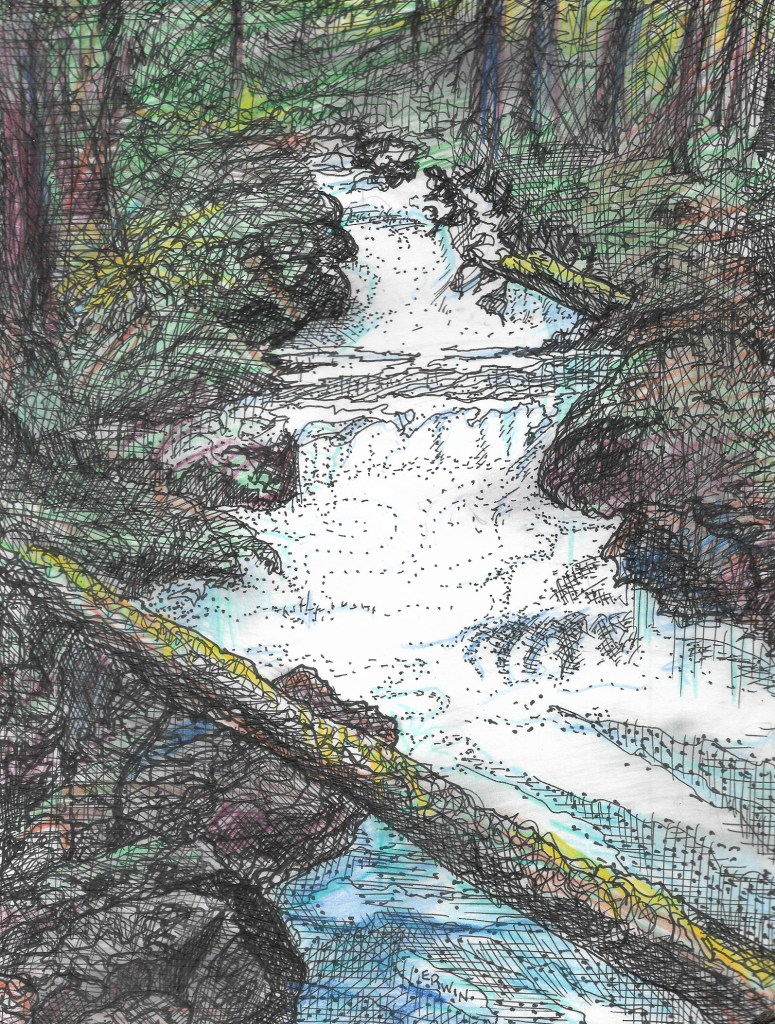
…as we tend to do, turning the channel to avoid any unpleasantness from Ukraine or Uvalde, we look for, yes, pleasantness, peace, quiet beauty. The previous piece, available with a simple scroll-down, was a lightened-up alternative to a harsher, much harsher one. Yes, it is in my files. Ready.
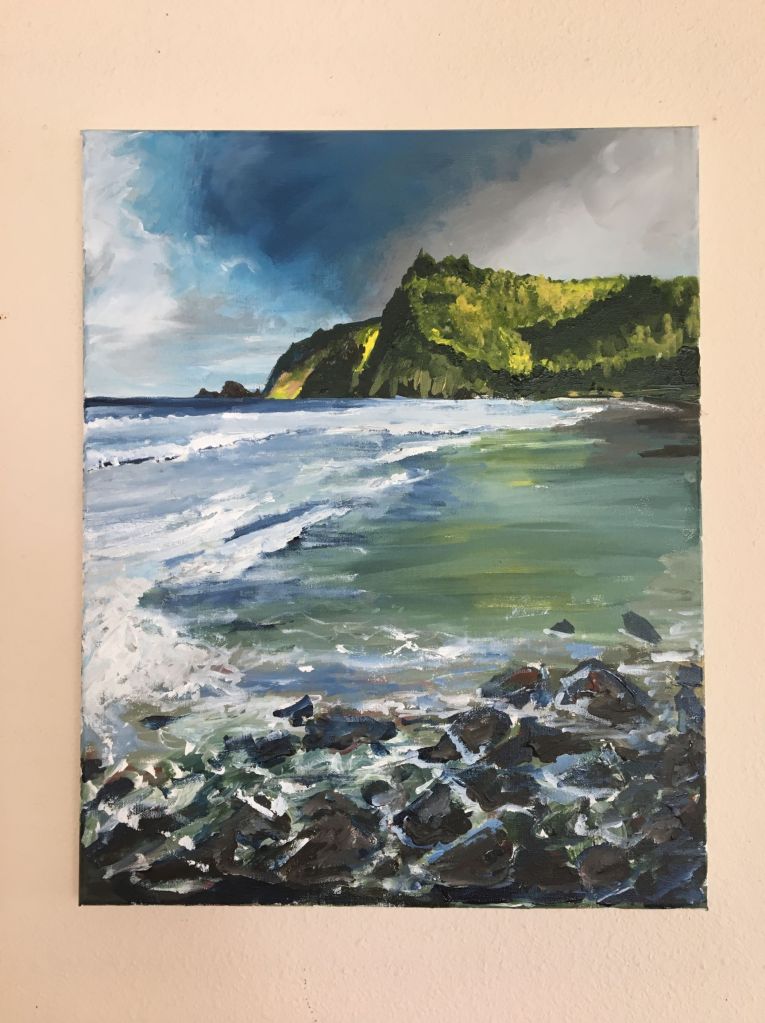
But now, here is the latest work from my friend, Stephen R. Davis.
Northwest Fantasy Point Break, somewhere between Oz and Neverland
There is a certain distance from Steve’s paintings at which abstraction becomes rendering.
Inside, outside
I am considering the places in our minds in which we look at the crazy, fucked up world at the proper distance. Considering. I’ll get back to you on that. Meanwhile… peace.
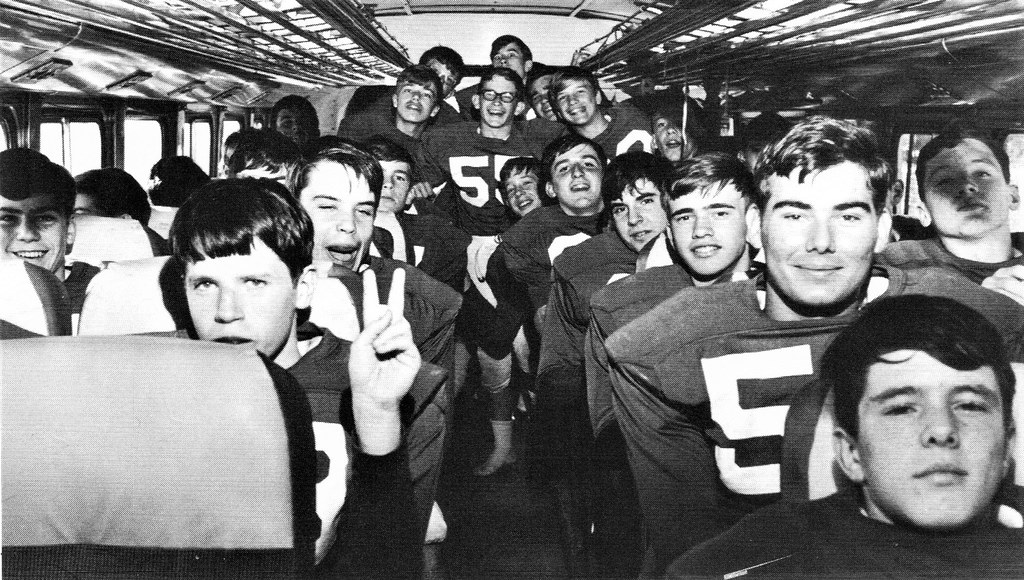
I’m pretty sure these kids got up and kept playing.
I was born in a narrow sliver of time between a war ending, another conflict escalating, and a constantly reinforced fear that the Commies and other bad guys were out to get us. 1950s. America.
A simpler time? Sure. I was a child.
When I was a kid, most of us boys, and sometimes, girls, played Cops and Robbers and Cowboys and Indians all the time. Neighbors had bomb shelters installed. Civil defense drills were held at school to prepare us for nuclear bombs from afar. Duck and Cover. I lived close enough that I was taught to walk home to die. Kids who rode busses were to stay at school. Even survival didn’t seen pleasant. I lived close enough to a military base that our house would be flattened in the initial blast. Mutually assured destruction doesn’t mean much to those at ground zero. Our parents were children of the Great Depression. My father and most of the fathers of my contemporaries were uniformed veterans of World War II and/or Korea. My mother worked in D.C. in the department charged with gas rationing. Other mothers worked and learned to drive and had already learned the self-sufficiency forced upon each generation of wives and mothers. We played Army in the fields and groves and driveways with actual American and German uniforms, all oversized, loaned to us by Bobby’s father. Bob, Senior had mementos, knives and such, disarmed grenades; and he taught his son a variety of racial slurs as if there was a test. “What sound does shit make when it hits the fan?” Yes, I remember the answer; I’ve just never used it in real life.
Ah, the fifties; romanticized as some perfect, “Ozzie and Harriet,” “Norman Rockwell” time. I did love playing the games. “I shot you.” “No, I ducked.” “You can’t duck a bullet.” “Who says?”
And here we are. I moved twelve hundred miles north since my childhood, and yet, I have never lived far enough from some ground zero to not be someone who would be vaporized. Yet, the bomb shelters are probably now extra storage or wine cellars, people have disguised the racial identifiers, the former fields are houses. Children may or may not be allowed to play in the street. Video screens get larger, games more realistic. Schools no longer run nuclear bomb drills. Active Shooter drills have taken their place.
Duck and cover remains the same.
Getting home from Junior High after a drill (this would be in the sixties, actually), I asked my father what we’d do if ‘they’ (always a ‘they’) dropped a bomb on Camp Pendleton. “Junior, we would die.”
Okay. If I felt some solace in accepting some horrible fate, it wasn’t like I was optimistic. I just sort of thought the odds were in my favor.
We have replaced optimism with a sad acceptance. Really fucking sad.
Steve in a surf Guru pose, throwing a shaka to the shakers and movers and bookers and gram-ers and tubers.
Steve has been using some of his time working on his paintings. This particular one is of the children of a friend of his whose name I probably could recall from a list of names I’ve heard, like, “You know, the guy who lives in LA now,” or “You know, the guy who lives in Chicago but wants to move to… (somewhere- don’t remember where),” or “You know, met him in Baja, back when my money (or something) got stolen, but then we got it back (or didn’t),” or “You know, Stig, lives in Honolulu; you’re thinking of Makena, used to live here, now he’s on the Big Island, wants me to move back there.”
Oh, yeah, Stig. Never met him. Talked to him on the phone once. Background.
“WHO DO YOU KNOW?” is one of my favorite games. It’s really, “Who do we know in common?” Steve and I do have a number of friends and acquaintances and semi-enemies in common, as well as some people who, for example, like Steve, don’t like me. Well. Steve claims some people don’t like him, but I have never met those individuals. Many of those we know in common are from working- carpenters and contractors and such; others are from the surf community.
Because Steve has also worked in the food industry and elsewhere, and because I pretty much only paint, his pool of contacts is larger. Because I pretty much surf only on the Strait, where the pool of surfers; locals, regulars, occasionals, is fairly small (not discounting surf tourists- never do), and Steve has been known to travel, his contact group is… larger.
I have met Cap (Brian, I believe, is his given name). I’ve met Damon (can’t remember his nickname). I’ve sort of met a surprising number of people, in a surprising number of places, who seem to know Steve and seem to number him among their friends. Most recently, one of two cops who came down to a beach because some tourist had reported some old dude on a paddleboard struggling to get to shore. It’s not like they were lifeguards. More like body recovery was my guess. Rope. Grappling hook.
“That was me.” “You’re allright then?” “Sort of. I’m embarrassed and…” “Oh, Steve.” This was one, not both of the cops. “Wow! Haven’t seen you in a while, man; how’s it going?”
Steve, for those who want an update, just underwent his second round of chemo. “Not that bad,” he reported. He recovered from Covid. “Not that bad,” he reported. His eyes, after a violent reaction to a prescribed medicine threatened to melt his corneas, seem to be better. “Way better,” he says.
NOW, the portrait of Steve’s friends’ (assuming he is also friends with the mother) kids is one of many paintings my friend has been working of for a while. The impetus for getting it finished is that Steve’s brother, Paul, is going to Colorado (yes, though he was born in Seattle, I always tell people, “You know, Steve’s from Col-o-rad-o” in my best valley guy voice), and along with two-thirds of their father’s ashes (another brother, John, has the rest), Paul is taking the painting.
Portrait of Stephen R. Davis’s friend Frasier’s children, Nicholas and Cloe (Steve called, I asked)
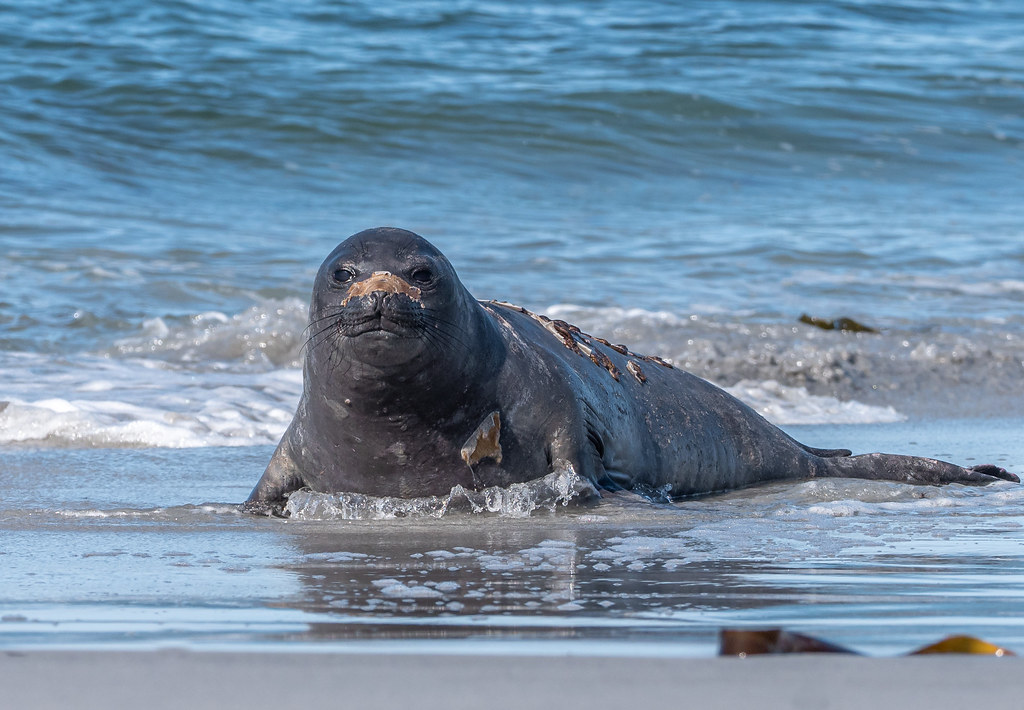
My first thought on surfers getting into trouble in the water is “Probably shouldn’t have gone out.” What I’m trying not to think about is that age might have been a factor. Of course, age is A factor. There are several other contributing factors. I am able to see some humor in the situation, and I will write about this another time; but thanks to Kim for running down to the water when I was crawling ashore like a beached sea lion, pushing my board ahead of me. She didn’t need to carry my board up to the car, but, again, thanks.
Time, or rather, how one spends it, or wastes it, seems to be a zero-sum game, time being the currency. It’s pretty frustrating that painting season is finally here. Yes, the surf prospects for the Juan de Fuca are not the best. So, I could focus on work. I should. Still, I am trying to cut back the manuscript for “Swamis” to a reasonable length, and, in spare moments, I do long to forget that I have to get a bill in the mail at the local post office in forty-five minutes, have to finish this job and write proposals for that job, have to go look at several more jobs. Errrrrrr.
The guts of this outtake will be included in my latest (third complete) re-write.
CHAPTER FIVE- TUESDAY, MARCH 4, 1969
There were way too many people at our house, too many vehicles parked on our gravel driveway and our mostly brown, mostly Bermuda grass lawn. I was hanging at the big window, looking West. Our best view. Freddy was outside, running between cars with Detective Lawrence Wendall’s son, twelve years old or so. One or the other would jump up and shoot a finger pistol and the other would duck. Both were laughing.
I first saw the yellow Karmann Ghia convertible, its top up, as it approached up the hill from Via de la Valle and stopped at our driveway. Yellow toward red, but muted by earth tones, rather than toward the green. The Sheriff’s deputy who was assigned parking lot duty as a sort of courtesy, leaned in. The car pulled ahead, made a five-point turn at the spot where the foundation for a separate garage had been poured, two-by-sixes and plywood stacked, and parked facing out. Getaway position.
A woman got out, removed her sunglasses, and set them on the dashboard. She was still wearing regular, prescription glasses. She saw me in the window, reached back into the car, took out a black coat and put it on over her sleeveless black dress, that matching her black hose. She had a string of pearls and a string of hippie beads around her neck. She nodded and pulled out a pair of black shoes – “flats,” a woman would say. She put the sunglasses back on and closed the door.
She walked around to the passenger side of the car, took out a 35-millimeter camera with a fairly long lens, aimed it at me in the big window, and took a photo. I didn’t move. She put the camera back on the seat, pulled one of several notepads from the dashboard and through the open window, and walked toward the house – all the while keeping her eyes on the window I was standing in front of, on me.
I had seen her at the burial ceremony, one of only two people there who those that categorize such things, would call black. She had been hanging back with those attendees who were not provided chairs. Front row to the grave.
“Goddamn reporter,” a whisper from behind me had said.
“Negro ‘Free Press’ Hippie slut.” A male voice I didn’t recognize said.
“You meant to say ‘black,’ and she’s not a hippie.”
“Could still be a slut though, huh?”
“Possible.”
A voice from the row of chairs behind me, one I did recognize, said, “Brazen, though. Asked me if someone forced Gunny off the road or he was just driving too…” He was shushed when my mother was being led back to her chair. “…too fast.”
It may have been one of the few times I looked around at the mourners – the wake attendees. Not that I focused on who the asshole with the slut comment was.
“There’s no shortage of assholes and ignorance, and ignorant assholes,” my father would have said. “You have to tolerate the assholes… you should ignore the ignorant.”
He said it enough times that I would fill in the “If you can,” and we’d both laugh as if that was possible.
B …
“How is it, Detective Dickson…” I heard the reporter ask one of the two detectives almost leaning on the sideboard between the family room and the kitchen “…that an obviously very experienced driver, in broad daylight, would turn almost ninety degrees from a straight section of highway?”
No answer. “Where was he headed?” No answer. “I checked with your dispatch, and…” She stopped. There would be no answer.
Dickson poured a drink from one of several bottles on the sideboard into one of several glasses lined up there. With his hand wrapped around the bottle, he pointed one finger toward the reporter. An invitation. She shook her head and he took a slug from the bottle. He pulled a paper napkin from a holder on the nearby table, set it on the sideboard, set the drink on the napkin, and turned away.
The reporter turned toward the man next to Dickson.
“How is it, Detective Sergeant Wendall, that hitting a patch of scrub brush and construction… equipment, that that would be enough to kill… someone?”
Wendall, older and taller than Dickson, lit up a cigarette, providing him with an excuse to go through the crowded kitchen and out the back door.
She turned back to Dickson.
“So, why is it the Sheriff’s Department is so reluctant to provide more information? Perhaps an autopsy report?”
“How did you get in here?” Dickson asked. “Miss…?”
“Lee Ransom, North County Free Press. I told the guard I’m a friend of Joe Junior’s. Guess he believed me.”
Dickson, then Lee Ransom, looked over at me. I waved. At her, not at him.
No, I didn’t know her. She was super hip and quite attractive. Her complexion was unblemished. Her hair was almost straight. Her features more European than African. She was black in the same way I was Japanese. But that was me categorizing. I could only justify this because I was categorized. Graded on some degree of whiteness on some sort of color chart.
Yes, I did the same. I graded white people on my ‘white trash’ scale; a Judgment based, admittedly, on how they reacted to me. And, because I’m not a total racist, which category I place a person into is subject to reassignment, if warranted. Humor, particularly satire, was a plus. ‘Tolerant’ condescension was a negative.
Ignore the ignorant, tolerate the tolerant… If you can.
Lee Ransom was obviously pushy enough to get into the wake, to move into our kitchen, a room overfilled with women any categorizer would identify as white. Off white, various shades. She didn’t stay long.
Dickson set the bottle down on a bare patch of the sideboard and pointed to the drink Lee Ransom had declined before. Lee Ransom downed it in one shot and handed Dickson the empty glass. Then she turned and walked towards me, her notebook under her arm. She moved the sunglasses up and into her curly but not kinky (another biased description), black-with-reddish highlights hair, like a headband.
She still had the regular glasses on.
“Lee Ransom,” she said.
“Lee Ransom,” I repeated, “I’ve read your, um, stuff. Thought maybe you’d be…”
“Older?”
“No.”
“A man?”
“No.”
“White?”
“Yes. White, for sure.”
“Well,” she said, “I try to write white.”
High marks for the comment.
Lee Ransom and I stifled laughs. We both looked toward the kitchen where too many women were dealing with too many side dishes. There was laughter. Laughter. There were some quick laughs from the little groups in the living room. Shoulder slaps, stories about my father I had heard too many times.
“Tough but fair.”
“Always figured it out,” that followed by the clinking of glass and a “Gonna miss the bastard.”
Lee Ransom bumped against me and whispered, “I was hoping, actually, to speak to your… mother.”
I shook my head.
“You, then?”
Lee Ransom would not be among the women who, one or two at a time, would take a turn entering my parent’s room and closing the door behind them. Two and a half minutes was the average time for condolences, reassurances, and tears, before coming back out and getting a drink or filling a plate at a borrowed table. Joining a conversation already in progress.
C …
Lee Ransom followed me outside. Freddy shot me with his finger pistol and ducked between two cars. When he popped up again, Lee Ransom shot him with two finger guns. He looked at me before he fell back against the next car over.
Lee Ransom and I passed the garage foundation and headed towards the shed; a structure that was complete but unstained and unpainted, plywood with fir battens. I stepped around it, out of sight of the picture windows, and took a pack of Marlboros from the inside pocket of my black suit coat. Handed down from my father, it was, finally, only slightly too big for me.
“My mother called this a barn. She’s since dropped it back down to a stable.”
Lee Ransom lit up a cigarette of her own with a quite feminine lighter, then lit mine.
“Other witnesses have said someone was passing an old bus… the “Jesus Saves” bus… you familiar with it?” I was. I nodded. “So, maybe he, your father, maybe he was… maybe it was… heroic.”
“Heroic?”
“In a way…”
“My father always said,” I told her, “that the scariest thing he had to deal with, professionally, is, say, a wife beater. Someone in a domestic dispute. They don’t care if they live or die. For a while.” When she looked as if this information was off topic, I asked if she had spoken with the people from the ‘Jesus Saves’ bus.
She had.
“The woman, Portia, says she was asleep. The man… Julio, Julio Lopez, said there was a line behind the bus. It wasn’t running right and one car passed them. Surfboard on the top. Then another one, a gray car, possibly a foreign car, tried to pass. Someone… your father, in an unmarked car… It was coming… fast. No siren, but lights. Lopez saw that the car couldn’t make it back in, so he hit the brakes and tried to pull over to the right. But there wasn’t enough time. Your dad tried to pull into that construction site. Gravel. Foreman there told me it was like trying to drive on marbles, and your dad was going… fast. I don’t know why I’m telling you this.”
I gave her an expression I hoped said that I wanted to know more.
“Anyway, the bus, it did go into the ditch on their side. Had to get towed out… later.”
Smoke from our cigarettes combined and was blowing around the shed and toward the house. I lifted the plywood covering a windowless opening and propped it open with the stick on the sill.
“That’s my mom’s horse, Tallulah, in the corral. My mom calls it a paddock. Fancy. Then, she also calls horse shit ‘road apples.’ Or droppings. Also.”
This amused Lee Ransom. That pleased me. We both blew smoke into the empty stall.
“Look, Joseph… I have spoken with your dad. Before. I hung out at the station in Vista, probably way too much. I was always asking him about why the…”
There were pauses. Inhale, speak, blow out smoke; but the reporter talked very quickly.
“No one ever seems to get arrested for the, um… the marijuana in the orchards. The backyard industry. The cash crop. I mean, shit, it’s out there. I can figure out where to buy it, who to… who to buy it from. So, maybe someone should… have the guts to answer me just why the… swear word… my parents taught me not to fucking swear… why these dicks can’t arrest… someone.”
I wasn’t responding.
Lee blinked and reset her calmer expression. “I do some, some meditation.”
“Probably helps, huh?”
“Not so much. I mean, meditation… do any of us really want to know our innermost thoughts?”
Apparently realizing she was talking too quickly again, she took a breath, blew it out fully, and said, “Cleansing breath.” Then she took a drag on her cigarette, held it for a bit, and blew it out slowly. “I worry I might have a dark side.”
She waited for me to laugh. I did, and then she did. We were both laughing.
“Anyway, your dad… he called you Jody.” Short pause. “Oh, you’re not, not, um, fond of it? I get it. He explained it – Marine Corps cadence.”
“Yeah. Jody. The name has… implications. To a Marine, anyway.”
“Yeah. So, um, Joseph? Could you tell me about… that day? What happened, maybe, before?”
“Before?”
“Well… the tow truck driver said, about the scene, that there were lots of cars: Cop cars, an ambulance… He said he saw a Japanese woman down there, down where your dad’s car ended up. How did, uh, how did your mother happen to… get there? I mean, then?”
“Inexplicable.”
“That’s it?” I nodded. “Inexplicable as in unexplainable, or as in, you won’t explain it?”
“It could be… both.”
That was unnecessarily rude.
“They took a statement, me, my little brother. Detectives from the Highway Patrol; they had to do the investigating because… law. Sheriff’s Office brought in a new guy to handle it on their end. Langdon. You should know this.” Lee Ransom backed away a bit. “Oh, you do know.”
“Case closed… even though no one has located the driver of the…”
“The gray car. No. Not yet.”
I blew out the smoke from a last long drag on my cigarette, exhaled, watched the smoke until it was gone. I rolled and squeezed the filter until the paper came off. I rolled the filter until it was fluff and dropped that into the stall.
“Field dressing, I think they call it? Or maybe it’s field stripping?”
Lee did the same stripping with what remained of her cigarette and tossed that in the stall.
“Droppings,” I said. “Do you want a quote… from me?”
“I kind of fed you one. ‘Heroic, in a way.’ Okay with you?”
“Sure.”
She seemed pleased for a moment.
“Here’s something else – Julio. It’s Chulo. All the surfers call him Chulo. His close friends, from when they were kids, they call him Chulio.”
“Close friends?”
“No, I’m not one of them. He’s older, he’s a local; and I’m an inland cowboy.”
“Cowboy?”
“It’s, um, a term of, another term of derision.”
“Oh.”
Both Lee Ransom and I looked around when Freddy and Wendall’s younger son started having words. Lawrence Wendall, Jr. had joined the game and it was, evidently, the Wendalls against Freddy.
“The way it goes,” I said, looking over enough to cause the older Wendall to back away. “I was never a cowboy in ‘Cowboy and Indians.’”
“My neighborhood… always had one kid trying to be the cowboy. He liked me. I got to be kind of an Annie Oakley,” Lee said, going into a sort of proud, Annie Oakley stance, “Once.”
“I can see it,” I said. “Lee… Annie, Lee Anne Ransom. Pen name. Maybe.”
“Oh,” she said, “If I… yeah, readers would know I’m at least not a white… man.”
We both smiled.
“Surrender, Jap!”
When Lee Ransom and I looked around, Larry Jr. had Freddy pinned against the hood of a car.
“Larry Jr!”
We (Lee Ransom, the three kids, and I) shifted our gaze to the front door. A woman pushed out the screen door, stepped two steps down from the deck and onto a concrete pad, a casserole dish in her hands.
“Wendall’s wife,” I said. “Theresa. Separated… I heard.”
Theresa Wendall’s high heels didn’t make the transition from concrete to the Bermuda grass. She started to fall forward. Her hands were moving forward, the casserole dish was moving forward. She dropped to one, then both knees. She had to let go. The dish skittered across the weak version of a suburban lawn.
Lee Ransom moved quickly, dropping to one knee. “Corning Ware,” she said, retrieving the glass lid, placing it back into position. “My mom has one just like it.”
Detective Wendall was, very quickly, out the door and standing beside his wife as several other wake attendees gathered on the porch. Theresa was almost crawling to the dish.
“It’s not my fault,” Theresa Wendall kept saying; “not my fault.”
Wendall crouched next to his wife; one hand on her shoulder. He looked at Lee Ransom. Not unkindly, maybe appreciatively. Lee stood up, backed toward me.
“It’s not broken, mom,” Larry Jr. said, he and Freddy and the younger Wendall kid scooping what looked like lasagna from the grass with their hands, seriously considering putting it back in the Corning Ware dish.
“You can leave it,” I said. “We have some chickens. They’d…” I shouldn’t have looked at Mrs. Wendall. She wanted to scream as well as cry but had to smile. “They’d love it. I had some myself. Good.”
Wendall looked at the reporter and me as he helped Theresa to her feet. His expression was less appreciative, more like embarrassed. I stuck both hands out, palms down, fingers spread, in what I hoped was a ‘not a thing’ gesture. It might have more resembled the ‘safe’ gesture from a baseball umpire.
Lee Ransom was looking at the detective, shaking her head. I took the combination of the movement and the expression to mean, ‘this is off the record.’ She then looked at me with an expression I took as ‘is this a story?’
“No, Terry, it’s not your fault,” Wendall said as Theresa removed her high heels. She handed them to her ex-husband and put one hand on their son as he presented the covered dish. Theresa then let the last of these tears fall, let out a quick laugh, and turned toward the people now gathered at the door. “My special lasagna… with Bermuda grass.”
I did notice at the time, and will note here, my mother was not among the people gathered just outside and at the door. This was a story, but a side story.
Wendall escorted his estranged wife and their two boys to where Mrs. Wendall’s station wagon was parked. They got inside but Wendall didn’t. Freddy went to the window of the back seat. Neither of the Wendall boys looked at him.
Freddy turned, looked at me, laughed, shot both Lee Ransom and me with his finger guns, both hands this time. We both reacted properly to being fake wounded. Or fake killed. Freddy laughed, put his hands in his pocket holsters, and went back to the front porch.
“In Cops and Robbers, Lee Annie Oakley Ransom, I always played Cop.”
Heading down the driveway, Mrs. Wendall waved at Lee Ransom and me, then at the Deputy who had been directing traffic as she passed him. Off duty. He joined Wendall, who had just finished another cigarette, just tossing the butt into the patchy Bermuda grass. Both cops looked at the cigarette, both looked at me. Both headed back toward the back door of my father’s house.
“Where I grew up,” Lee Ransom said, “when I got just a little older, we played Cops and Robbers with real cops.”
I didn’t ask, but she added, “Kid who liked me… want to know?” I did. “He’s fine; up in Sacramento working for some state representative.”
“Sure.”
“Sure.” The reporter shook her head, dropped her sunglasses back over her regular glasses. “Yeah. Sure.”
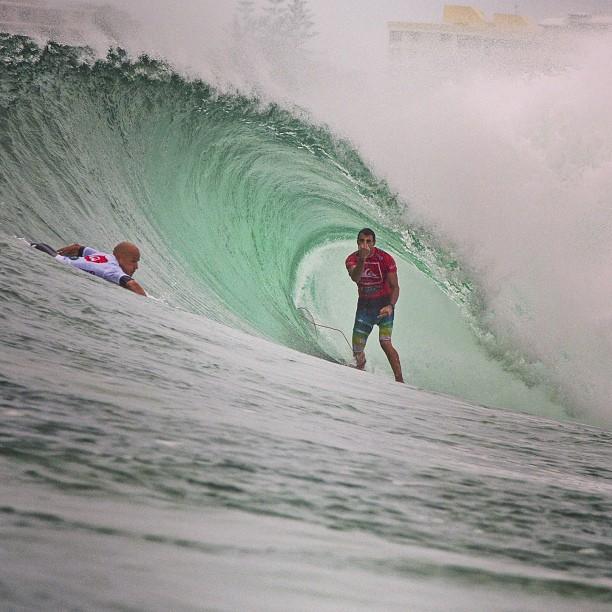
Another lovely day at Swamis. Oh, and there are waves, also? What?
LATE ADDITION: I was working on a door on a second story deck when someone started yelling at me from the street. I ignored it for a moment, then turned, stood up. It was Shortboard Aaron, stopped on the street. So, of course, I yelled back. Shortly after he drove on, the client ran out and asked if I was all right. “Yes.” I told Stephen Davis about it a bit later. “O,” he said, “A drive by shouting.”
Indeed.
Adam “Wipeout” was heading to Legoland. Carlsbad, California. He was pretty frothed-up at the surf forecast for Southern California and San Diego’s North County when he called me a few days before he and his family were to board the big airliner. “It looks… si-iiii-ckkkkkk!” is pretty much an exact quote. Yeah, Adam is frequently frothing when discussing surfing. Yeah, so am I.
“Where do you think I should go?” Um. “Have you heard of Grandview?” Yeah, that was my spot. “I thought Swamis was your spot.” It was. They were all my spots.
I felt compelled to give Adam a list: TAMARACK was my spot, where I started board surfing; then GRANDVIEW because that’s where, when I was a freshman at Fallbrook High, the older surfers went; then OCEANSIDE (pier, harbor jetties, any peak that was working) because I worked in Oceanside; then PACIFIC BEACH (and the adjacent beaches- Mission Beach, Tourmaline, Windansea, Sunset Cliffs) because I lived in PB; then LA JOLLA SHORES (and adjacent beaches) because I lived in University City, just across I-5; then any spots in the ENCINITAS area because I lived in Encinitas (albeit east of I-5); but TRESTLES because I worked just up the hill from, and with a killer view of LOWERS for ten months, and was able (not actually authorized) to park on the beach; then OCEAN BEACH because we moved to Mission Hills, just up from Old Town San Diego and OB was the closest beach, and it was a pain in the ass to go anywhere farther.
I must add that I did a lot of surfing at SAN ONOFRE when I was in High School. Never after. The go-to spot, with my inland surfer friends, was probably the beach breaks between Swamis and Pipes, not capitalized because I don’t want to blow up the spot. I did surf, on return trips to San Diego, some Swamis, most notably two times on New Year’s day, dawn patrol, not too crowded, some Sunset Cliffs while working for the Navy on the other side of Point Loma, and a few sessions at Pipes and Grandview, with my old friend Ray Hicks. Oh, and one session at La Jolla Shores with my nephew, Trisha’s brother’s son, Dylan Scott.
All of that is past tense. Long past. For the last forty-plus years I’ve been way west of I-5, trekking to a variety of spots, most of them kind of known, all of them extremely fickle, and none of them spots I would like to see become more crowded.
There are some places I have surfed that I will almost certainly never visit again. Lupe’s Left Loopers in Mazatlan, a super rare inside-the-harbor spot down by where my father once lived (with Adam Wipeout on that one). I still might cruise down to Short Sands or Seaside, stay at my brother’s (once my father’s), piss off a few regulars.
Swamis? I would love to. SO, when Adam got down to San Diego and the waves were uncrowded and chopped up by the old south wind, and he asked me where he might surf…
Because everything that happens is part of some bigger story, because I try to capture bits of that story as they fly by, because, objectively, it is kind of an interesting if not unique tale, I did write about my work van breaking down in Gig Harbor. I will check out the version I wrote for the Quilcene Community Center Newsletter, then, more than likely, make some… changes.
Another Chapter in the Serial
I was driving my van home from the repair shop, and I was… anxious. Very anxious. There was a noise like a nearly worn-out fan coming from the front of the van. I had checked. It wasn’t, thankfully, the blades hitting the radiator. There was another sound, like sheet metal vibrating and clanging. And then there was the occasional clunk.
Clunk, like the engine was taking a breath, like the automatic transmission couldn’t decide which gear to go into. Clunk.
My hands were gripping the steering wheel. The rain was coming down at a just-under monsoon volume. The wipers were not quite keeping up. My breathing was overwhelming the defroster. The traffic was at the race-stop-slow-race-repeat phase of the afternoon retreat from the major cities, Tacoma in this case, that starts sometime before four pm and ends sometime before midnight… depending.
I called everyone I have on my contact/speed dial list on my supposed-to-be-stealth flip phone. None of my contacts, almost exclusively family and other surfers, picked up.
Trish, who had driven me to Gig Harbor, was ahead of me, somewhere, headed for our daughter Dru’s house in Port Gamble. Dru had picked me up a couple of weeks before, on another rainy night, when my van just stopped running. I would have turned on the radio for the distraction if I wasn’t so concerned, wasn’t listening so intently for some sounds that might suggest the van might make it the sixty-some miles from Gig Harbor to… home.
Clunk.
What I know about vehicles making that dead air hiccup is that one only gets so many clunks. I know this because my father, a mechanic, supplied me with a stream of almost-dead vehicles from the time I got my license; rigs that would break down for a variety of reasons: Overheating, lack of oil, abundance of speed; and after a variety of warning signs, the random clunk being one of the most dire. The direst. I learned to be the guy steering the car at the dumb end of the tow chain. First but not the only rule: Don’t hit the lead vehicle.
I continued the habit of buying cars and work rigs, each with a variety of the problems associated with high mileage and advanced age. Cheaper. I have been given several vehicles. Each was almost worth it. Few of my discount vehicles have survived me. In fact, more than a few people have told me I should write a book about my life as a serial vehicle killer.
There are many good stories if good means entertaining for someone other than me. Perhaps you read about my recent black ice experience. The damage was enough that repairing the rig with mega miles and many little quirks and dings, a vehicle I bought for four hundred dollars, (practically a gift) didn’t seem like a reasonable choice, money-wise. Tragic, nonetheless; I never got to take it on a surf trip.
I need a work rig. Replacing even an older vehicle has gotten expensive. When the van broke down with electrical problems that are inarguably associated with high mileage and a lack of a recent tune up, the repair costs didn’t seem too onerous. That is, when I finally found a garage that would work on a vehicle built in the last century (computer thing- diagnosis). When thieves stole the catalytic converter in the garage’s lot, caught on camera, and slammed into my van to evade the local Gig Harbor Police, also caught on camera, doing additional damage, and escaped; and the garage, which had total control of my van, informed me that their insurance wouldn’t cover it; and the Gig Harbor cop who called me (when the garage didn’t) to ask if I wanted to be a victim (“No”), and if I would press charges if the perpetrators were caught (“Hell, yes”), and I asked him if they even got, like, a license number or something from the red truck, with trailer, featured in the above-mentioned video (“It was probably stolen”); well, all that just adds to the intrigue, the excitement of the story. For just a bit of added color, or fun, with a one-hundred-dollar deductible, there was almost three hundred dollars the garage wanted, over what my insurance company would cover.
Oh, and the broken lights and front-end damage, from the thief crashing into my van to (successfully) evade the cop; that could be dealt with, my insurance provider said, on a separate claim. The assumption is that the crooks in the possibly stolen vehicle (with trailer) were most likely uninsured.
Makes sense, I guess.
When I did make it home. I immediately investigated as to whether a replacement catalytic converter needs a break in period. Yes. This, Google and YouTube agreed, is accomplished by getting the engine up to running temperature, then racing the engine at high rpms for about four minutes. This, quite obviously, had not been done. Worst thing, according to Google, is to just drive a vehicle home, ever so slowly.
Clunk.
The repair shop manager had not even told me there would be a needed procedure. He might have if I hadn’t said something sarcastic (a comparison with Les Schwab and vacuuming) when he said the mechanics had not replaced the “Doghouse” (in garage talk), the cover for the portion of the engine that extends into the cab of a van (in regular talk), because they hadn’t taken it off. True, that was Stephen Davis and me, hoping the fix was something simpler (it wasn’t).
I did get an automated text from the chain repair shop’s corporate level just as I was hitting another storm cell at the bottleneck at Gorst (which is right before the bottlenecks at Bremerton, Silverdale, Poulsbo, the Hood Canal Bridge). How would I rate the service I had received?
I’m still thinking about it.
“Vehicles I Have Killed. An Incomplete List.”
Photo borrowed from Bing. Something about therapy for folks with meth addiction issues. Issues. Perhaps I assumed it was tweakers who stole my catalytic converter. Perhaps I’m wrong that they won’t get caught, won’t face charges. Perhaps it is wrong to believe that there might be a downhill spiral associated with some addictions; but shit, man, you fuck with my work vehicle, you’re fucking with my livelihood. I really don’t care how hard you work at stealing shit, it still isn’t a job. Good luck, get help, and, meanwhile, fuck you!
If you’re still with me… it’s like ALL the buoys are down. No, I don’t blame tweakers.
…wasting too much of my time. Shit, I’m not even that stoked on watching really good surfers; but, trying to watch some of the action from contests I missed because I just can’t stay up all night AND go to work, or, honestly, looking for a little surf porn, real surfers ripping on real waves, I have been tricked into watching some punk-ass kooks claiming and celebrating surf school quality rides. Yes, I’ve been severely You-tubed.
Yes, I am a consenting adult, but…
“Another bitchin’ ride… And The Crowd Goes… Wild!!!”
Yes, I should know better; but… really… I mean, if there’s, say, a video selection promising super good waves at a North County point break. “Oh, must be Swamis or Trestles.” Hit. No, it’s some kook cruising Encinitas on his one speed bike, some chatter about how cool he is to be living where he does and doing what he does. I have learned how to put my finger on the red line and fast-forward past some of the probably-sponsored hype. “I always get a pre-surf smoothie here.” Okay, surfing. Yeah, he’s in the inside-ist inside section, awkwardly soft-topping into ankle snappers like he came in number three at the surf school contest.
Scroll down and search. Oh, some other Metuber is rating San Diego County surf spots. Terramar, Tourmaline; must be up to the T’s. His commentary, disappointing. The surf action? Ummm.
Okay, I will watch Nathan Florence videos. He’s personable… and he rips. I might watch, finger on the red line, something by Jamie O’Brien. I did, this morning, watch the top 5 from Margaret River and the condensed version of the men’s and women’s finals.
But I also got partway through a video promising some Northwest surfing. Westport, as it turned out, kook riding the soup, making faces, sticking his tongue out, shooting gang signs (I assume). And then there’s the inevitable ‘subscribe’ dealie.
Nope.
Then again, I don’t have to. The cloud gods know what I’ve been looking at. Next time I hit Youtube, I will, undoubtedly, get, along with some political stuff, some art stuff, more kooks with cameras stuff.
WAIT. YES, I do realize I might seem hypocritical. Yes, it would be great if I could make any kind of money writing about surfing. Yes, I do frequently ride small waves (not soup), and yes, I do pimp the shit out of realsurfers to anyone I talk with for more than two minutes. “Yes, I did find everything… all right. Thank you. Slide or tap? Tap. Okay. You know, speaking of tapping, I have this website and…”
My friend Steve was giving me a hand finishing up the staining of a cabin in the woods. The temporary renter of the cabin was a young woman who works in the wide world of psychoanalyzing and psycho-advising and psycho-counseling. She had just revealed that her partner… surfs. Not around here. “Venice.” Oh. “California.” Oh. I didn’t think Venice is particularly known for surfing. “Well.” Okay, so, he’s a hodad? “What’s a hodad?” Steve explained the term. “So,” she said, “during the pandemic, a lot of people started surfing, or were able to surf more.” Oh, yeah; for sure. “So…”
It still didn’t answer the question about hodad-ness.
So, then I told her what the pandemic did for folks out here on the fringe. For folks who only need a signal from the cosmic cloud to work remotely, remoteness was, and still is, up for grabs. Or for sale. “So?” So, more surfers. “And does that, in some way, annoy you?”
Yes. You see, I said, I seem to differentiate between surfing, and surfers who have a certain… connection… and those who do it for the… social aspects. Surfing is cool and I, um… uh… I don’t really go for cool by association.
Somewhere in here the woman made, I believe, a psycho-judgment that I was, not a sociopath and narcissist that I claimed to be, and possibly took some pride in being, but a grumpy old surfer unable to realize and/or accept that surfing is really just another excuse for healthy social interaction in a beachside setting.
Man, I hope someone else shows up who appreciates my bitchin’ trailer and my state-of-the-art board. San Onofre, 1950.
Wait. I am just another grumpy old surfer unable to appreciate the reality or share the joy? Oh, the guilt I feel. I was being accused of being self-aware and in denial of being self-aware; no, not true.
Well, maybe. I don’t know. Allow me to self-examine. I have developed some appreciation of the cultural circus aspects of surfing. Some. You know, like going to Westport mid-summer, once every other year. Festive.
When I started, just after junior high, none of my contemporaries surfed. Surfing was cool, even then. If you lived twenty miles from the nearest breaking waves, but surfed, you had an automatic plus in the cool category. Many tried it, some stuck with it. No one dropped the surfer checkmark next to his name (not sexist, didn’t seem to have any female surfers at Fallbrook High- would have been fine with it, probably). I was part of some sort of informal crew, one that broke up almost immediately after high school.
Then I wasn’t. I was a lone surfer. Sounds cooler than it is. I worked in Oceanside, then moved to Pacific Beach, University City, Encinitas, Mission Hills. I occasionally went surfing with someone I worked with or for. I recognized surfers at spots I frequented, but surfing was something one did before or after (or during- Trestles period) school, or work; forty minutes or so in the water, on average. This is where and when I developed my ‘ghetto mentality.’ Keep your head down, don’t look other surfers in the eye. These are not your friends; these are your competition. This is my often-used excuse for poor wave etiquette. I should apologize. Probably. I may have changed. Possibly.
Wait, they had, like, cool surf rigs back in 1963? Wow! San Onofre is a happening! And scaffolding. Brilliant!
San Diego, Ocean Beach, 1978: We were moving to the Northwest. I was unaware of any surf possibilities on the Olympic Peninsula. I checked out from my job before lunch. Trish was still working. It was fall, but the day was hot, and the water was still warm. I was walking out toward the pier. There was a crowd sort of hanging on the wall and in the parking lot. I don’t really remember if the surf was good or not. What I remember is the gallery, hanging out, sharing and utterly convinced of their individual and group coolness. Believing I was giving up surfing, my thought was, “Yeah; I’m too old for this shit.”
It might actually be that the older surfers are always being pushed out of the way, accused of not getting it by another next generation of surfsters, if not hipsters. It might also be true that it is difficult to maintain a certain level of involvement in a place where the waves are fickle. I have difficulty imagining what it might be like in a place where the waves are more consistent, and, undoubtedly, more consistently crowded. When I sneak away and go to some possible surf location, I do, almost always, know someone, or many someones who are also there, looking for a few waves.
There are multiple identifiable-if-unofficial groups of surfers in the spread-out neighborhood of the Strait/Islands/Northwest Coast, each with revolving memberships, that one could, loosely, describe as ‘crews.’ Or, maybe, ‘pods.’ Some surfers are actually accepted in multiple informal groupings. Some surfers are not accepted in any. Sad.
True of everywhere, no doubt.
I am actually very happy that I do have friends who surf. I’m actually fine with chatting it up on the beach. For a while. Party? Party wave?
Hmmm. Best things I can say about my therapy session is that it confirms what the self aware me already realizes, and that didn’t have to pay for it.
…and another “SWAMIS” cutback. FIRST, here on the Olympic Peninsula, buoys, designed to help ships not sink or crash, somewhat helpful for surfers trying to determine if some portion of some swell might find its way into the Strait, have been ripped from their anchors, set adrift, lost, found, or, we don’t really know, put out of service. Putin? One theory. None of the downed or drowned bouys have been put back into service.
SO, surfers in, say, Seattle, have been relying on surf forecast sites before making a decision as to whether to invest the increasing amount of gas money, wait in line at ferries, face traffic slowdowns if ‘driving around.’ NOW, it must be mentioned that there are always waves of some sort or shape or size on the actual PACIFIC COAST. Almost always. AND the most characteristic condition on the Strait is flat. Flat with east wind, flat with north wind, flat with south wind, flat and somehow blown out with west wind.
STILL, surfers get desperate. So, trying my best to glean something positive from whatever sources I could, I went up Surf Route 101, looking. I wasn’t alone. More to not get skunked than to satisfy my surf lust, I ventured into calf-high curlers, my fin popping across rocks. PERHAPS BECAUSE I had paddled out, three more adventurers joined me. PERHAPS BECAUSE they had believed some forecast site, I passed many surf rigs on my way back down Surf Route 101. NOT ONLY THAT, but a friend of mine texted me, asking if I had scored bombs. AFTER ALL, Magic Seaweed was saying…
NOW, maybe it got awesome. Somewhere, for some brief period. MAYBE. YES, I did look at various forecasts. Not looking good for the Strait. Depressing. I must now upgrade my most recent session to “Pretty good. Didn’t break a fin.” Again, there are always waves on the actual ocean.
The rocks at Swamis, someone dropping in on someone. Taken from some hotel brochure.
MEANWHILE, I am trying to find some time to continue cutting my manuscript for “Swamis” down to a reasonable and, hopefully, saleable length. Tightening it up. I am up to the days after Chulo is beaten and set alight next to the wall of the SRF compound. This is a (copyrighted) version from the second completed draft. I might mention that, if you have any experience surfing on the west coast, you know (a snippet of a quote from Miki Dora about Malibu) “The south wind blows no good.”
CHAPTER 14- SATURDAY, MARCH 22, 1969
Three full days after Chulo’s murder, the burn-scarred section of the wall was back to white, visibly white even in the minimal pre-dawn light. I wasn’t sure if I had actually slept. I got out of bed at four, got to Swamis early enough to park the Falcon in the choicest location; front row, ten spots from the stairs; the optimal view of the lineup.
The Falcon was the same car in which my dad had taught my mom to drive, the station wagon, three-speed manual transmission. This was the car she used to drive her two boys to swimming lessons, and church, and to my appointments with a string of different doctors; and to the beach; surf mats and Styrofoam surfies and whining Freddy, maybe an annoying friend of his. The factory installed (optional upgrade) roof racks were now pretty much rusted in place.
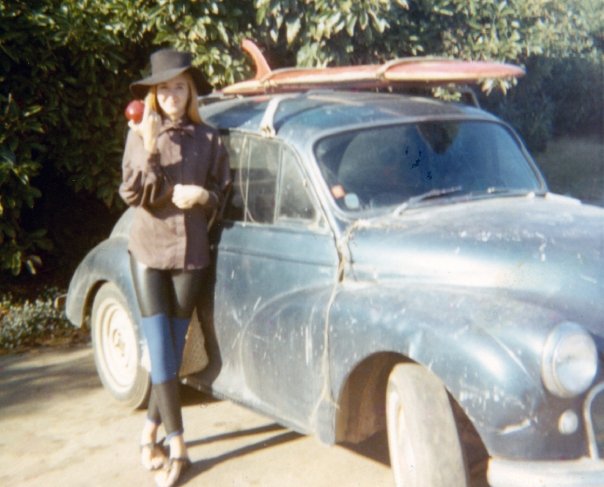
The difference was the Falcon was now my car. A surfer’s surf wagon. Hawaiian print curtains hung on wires, a “Surfer Magazine” decal on the back driver’s side window, a persistent smell of mildew. Beach smell. With my boards now shorter, I usually kept them inside, non-hodad-like, but, for several of the reasons a hodad would do it, I kept the nine-six pintail on the roof for a while longer. “Just in case the waves are really small,” might have been one excuse.
A predicted swell, this gleaned from other surfers and pressure charts in the Marine Weather section of the newspaper, hadn’t materialized, and a south wind was blowing. Cars with surfboards were passing each other up and down 101. Surfers were hanging out in parking lots and on bluffs and beaches, talking surf, watching the few surfers out at any spot bobbing in the side chop. Maybe it would clean up, maybe it would actually get bigger. And better.
I would wait. Waiting is as important a part of surfing as trying to be the first one out or paddling out before the best conditions hit. Just before. My shift at my weekend-only, for-now, job didn’t start until ten-thirty; about the time the onshores typically get going. Different with a south wind. Sometimes it would clean up as some weak front moved inland or simply fizzled. Sometimes.
If I went out at nine, I could get a good forty-five minutes of surfing; maybe ten waves or more. I had my notebook, college-ruled; I had the four and eight track tape player under the passenger’s side of the seat; a collection of bargain tapes purchased at the Fallbrook Buy and Save; and I could do what I always did, study. My father’s billy clubs sized flashlight, four new d batteries, provided the lighting.
Read, recite, memorize, reread. That was my system. Less important details fall off with each attempt to memorize. The facts and details best remembered, by my logic, would most likely be the ones on the tests. Any quirky anecdotes, something that amused me; yes, I remembered those, too. I had another system for multiple choice tests and standardized tests. Two of the four choices were obviously incorrect, fifty-fifty chance on the others. Best guest. The system worked surprisingly well, well enough that California’s supposed Ivy League university accepted me.
My father hadn’t understood why I couldn’t go there.
I was a faker, kid with a system; it never would have worked; not in that bigger pond, every student top of some class somewhere.
No studying on this morning. I had to sneak over to the crime scene, the wall that surrounds the Self-Realization Fellowship compound. There was (and is) a wrought-iron gate in the higher, arched (former) entrance, around the corner, facing 101. As with the other breakpoints in the wall, that section is topped with the huge gold sculptures, each one representing a blooming flower. Lotus blossom. They could as easily represent a flame, not dissimilar to the one on the statue of liberty, not dissimilar to the burn marks on the wall my friends had described.
The SRF compound is a place where people, on their own, go seeking enlightenment, a realization of the true self. Seekers, seeking.
At about seven-fifteen I did walk over. Had to. I expected more. I expected some instant and obvious explanation. There was a man by the wall, wheel-barrowing soil from a pile near the highway to the wall, raking it in. I had seen him before. Dark skinned. East Indian, I presumed. He was dressed in a long-sleeved shirt, white, with faded blue workman’s pants, rubber boots, and heavy leather gloves. Most of his face (and I knew he had a beard) was covered in what appeared to be an overlarge (plain cloth) bandana, a standard bandana (red) around his nose and mouth, and a tropical straw hat (quite different from the cowboy style Mexican farmers and landscape workers preferred). He dropped the new soil around newly planted but full-sized plants.
There was no evidence that something horrific had occurred. The new paint blended perfectly. The plants looked… it all looked exactly the same as it always had; as it did even in the late 1950s, before I surfed, when my father took us there just so my mother could see the gardens.
If I blinked, I thought, it might be like taking a picture. I might remember details. I might remember better. Image. Catalog. File.
My novel, “Swamis,” would be complete and possibly readable by now if I wasn’t so (I have to say) involved in the backstory for each of the main characters (and, I guess, if there weren’t so damn many of them). I wouldn’t have been so involved in the details if it wasn’t so important to me to know and show how distinctive each character is. And realistic, authentic.
It hasn’t aided my task that character development and the crashing of characters against each other is so much fun for me. Writer fun, not like reader fun.
A reader wants FOCUS. I am trying. My third page one rewrite has narrowed the timeline, tightened the storyline, dropped out a few characters.
Here is an exchange that won’t be in the novel. I have already eliminated this scene at the San Diego Sheriff’s Office Vista Substation:
We’d been in the office too long. We were all a bit more… relaxed.
Dickson closed the door with a kick of the knee when he reentered the office with two more cups of coffee. He handed one to Jumper, said he put a little coffee in with the sugar. Wendall took the other cup, said Frederick Thompson had not been drunk or under the influence of drugs as far as the medical examiners could tell. “Just crazy.”
“Helicopter pilot,” Jumper said, as if this explained something. It seemed to. Maybe not enough. “He flew evac in Korea, got out, surfed, went back in for Vietnam. Gunships. Different thing. Fucked him up.” Jumper paused. “So, yeah; crazy.”
Wendall lit up another cigarette. “And… all of this… craziness, Langdon is claiming, and he has the ear of the politicians, is because of the Sheriff’s Office laissez-faire” (he pronounced it la-zy-fair) “policy toward pot growers and dealers in our county.”
“Miss Ransom and the ‘Free Press’ assholes got that part right,” Dickson said. “La-zy-fair for sure.”
Wendall leaned over the desk as far as he could. “It wasn’t your father, Jody; Gunny thought he had it under control. It’s just… grown… too fast, too many new, um, participants. We knew about Chulo; that he was collecting money from the hippie dealers. Chulo and…?”
Jumper and I both said “Portia” at the same time.
Oceanside 1974. The proximity to Camp Pendleton and a steady stream of vulnerable Marines had made the downtown a pretty tough place in the Vietnam era. I worked at Buddy’s Sign Service in this area June, 1969 to September, 1971. Yeah, too much exposition.
“Oh yeah,” Wendall said, “Portia. She’s actually Patricia Sue Langley. Patty Langley, runaway from, um, Many Wives, Utah; busted for petty theft…ha ha… back in ’65. No, um, end of ’64. She was a minor, so… So… and… oh, then she got… sexual. Oceanside. Marines, mostly; easy pickin’s.”
Dickson interjected. “Not our, as you know, jurisdiction.”
“Oh, but then Patty got herself down to Leucadia…” Wendall said, “across 101 and down from where you live now, Jody; one of those motels.”
Dickson pointed toward Jumper. “Second one past your place.”
“When I was a kid,” Jumper said, “Chulo and I’d go around, pick up coke bottles at the Log Cabin Inn, other motels; turn them in for the, the deposit. Good money for a kid.”
I felt compelled to join in. I spoke quickly to make up for the obvious lack of interest by the others. “A neighbor kid, Roger; he and I went to this ball game down by Live Oak Park. Fallbrook. Roger’s brother was playing. We picked up bottles; took them to the guy at the little… the stand. The guy said they were his bottles, wouldn’t give us the deposit money.”
“You tell him who your dad was?”
“No.” I looked at Wendall, Dickson, Jumper. They were waiting. “Roger did.”
Wendall cleared his throat. Loudly. “So. Jody’s dad… Gunny… Joe; he always liked to point out how most all the motels were on the south-bound side; like that showed nobody’s coming up from San Diego looking for a place; it’s all from the north. L.A.”
“Anyway,” Dickson said, “guess she… Patty, um, slash Portia, got tired of… servicing… Jarheads; fresh-outa-boot-camp Ji-rines; they’d probably want to go two or three times.” He did a subtle hip thrust motion, adding, “First time ought to be free. Ha! Probably wouldn’t even make it out of his skivvies.”
Wendall took over. “It was my call. Disturbance. The proprietor actually called it in; but Gunny and…” Wendall pointed over his shoulder. “Gunny and Big Imagination here show up. I’m standing outside a room with some fat business type from Covina… West Covina. So… fat. He claimed he hadn’t gotten his money’s worth.”
It was a brief pause, but Dickson took the story. “So, Joe goes, ‘money’s worth of what?’ The guy… hey; it’s your story, Wendall. Did you take a bribe on that one?”
“Well.” Wendall looked around to make sure everyone was watching. “Sort of. Gunny, he goes up to the guy, looks down at his…you know, package. The guy was in… he’d put on his business jacket. Seersucker; some sort of sales guy green. Sears or Pennys; one of those. No shirt, and, you know, tidy whities; size, um, enormous. For his butt. No big bulge; not that I would notice. Black socks, the kind you hold up with garters. Garters. This Chipper, Mortenson, shows up and the… West Covina guy is acting like we’re supposed to be… like we’re on his side. Mortenson, you remember him, huh; tough bastard, loved to pull over kids.”
“And beaners,” Dickson said, looking directly at Jumper before giving Wendall a sweeping ‘take-it-away’ gesture.
Wendall was leaning forward, both elbows on my dad’s old desk. “So, Gunny, he’s got Mr. West Covina’s wallet in his hand and, I guess, repeats, ‘Money’s worth of what, Mr. um, Redwick?’ Red… wick.”
We all may have chuckled. Wendall continued.
“So, Patty’s standing there, wrapped up in a blanket. Not because it’s cold… and the motel owner, older woman who thought she’d be renting places for artists; like, you know, like Leucadia’s Newport Beach or something; she’s got an arm around Patty, and Patty’s got a bottle of orange soda up against one eye, and Gunny’s just waiting for Humpty Redwick to answer. And I say, ‘Maybe he was getting some, um, advice on, um, clothing choices.’ Morty… Mortenson, this cracks him up. But Gunny’s all business; serious. I mean, Morty’s seen some shit. He’s a vet, too. Korea, at least. Army. Chosin Reservoir. Bad shit. And he’d been cruising up and down 101, ‘Slaughter Alley’ for years. He was still, those days, still on a motorcycle. So, yeah; blood… tough guy, and he’s just… laughing.”
Wendall put a cigarette in his mouth, pulled out his Sheriff’s Office Zippo from his shirt pocket, snapped the lighter open with a jerk of the wrist, hit the wheel with a snap of the finger. More theatrics. “So, now Morty sees your dad’s serious. I mean, Morty was big, but Gunny was looking… you know how he could… that look; fierce, fierce-like; and Gunny he… he opens up Redwick’s wallet, then holds every photo of the guy’s wife and kids up to his face; whole, you know, string of them; and then shows them to me. And the owner. And Patty. Gunny takes out all the cash. He asks the proprietor if the motel fee has been paid. She says, ‘Diner’s Club,’ and Gunny holds a twenty and a couple of singles up in Redwick’s face, puts that cash back in the wallet, sticks the rest out toward Patty, sticks the wallet back into Humpty’s inside coat pocket.
“Gunny’s still holding, probably, two hundred bucks. She, Patty, she shakes her head. And I say, ‘Oh, the advice,’ and she, no one would take her for dumb; Patty says, ‘Maybe Mr. Redwick should switch to some, um, boxers… maybe some, uh, dark color; that might be a choice.’ She takes the money. Now Gunny’s smiling. We’re, all of us, laughing. Not Redwick. He does look a little relieved, maybe.”
Wendall stopped, inhaled, blew the smoke out kind of forcefully. We all watched the cloud get sucked into the fan, some of it actually going out the window.
“Wait. Wait. So, Morty gets a call; three car pile-up by the Carlsbad Slough. He gets on his bike, starts it up, peels out. Lights and sirens.”
Jumper filled in with, “Not your jurisdiction.”
“Right. Then, two doors down, this other guy tries slipping out of a room. Gunny’s watching Patty. She must of looked over. The motel owner, she seems, um, concerned. Gunny gives me a look. The other guy, he tries to duck back into the room. I run down… yeah; I can run… I push open the door, grab this guy. He must have thought it was all over when Morty left.”
Wendall did a sort of relaxed pose, casually inhaled, slowly blew out smoke.
“And?” Jumper and I both asked.
“And…” Wendall looked pleased. “And there’s another, definitely underaged girl inside; not beat up, but… I mean, it was obvious. So, short story long, it all went official. Other than the money.”
Any excerpts from “Swamis” are protected under copyright laws, Erwin A. Dence, Junior, author.