Surf Movies, Hoover High

I just cut another mini-chapter in what I’m calling the ‘massive edit’ of “Swamis.” I’ve passed page 200 of what was 300, and I am, for better or more better, adding words in some places while I cut in others.

As such, I added a couple hundred words to a part on the real life swell of December, 1969. There should be surfing in a surf novel, and, although it’s not a ‘Big Wednesday’ climax, it’s not just background, either.

First, here’s a pencil and pen drawing:
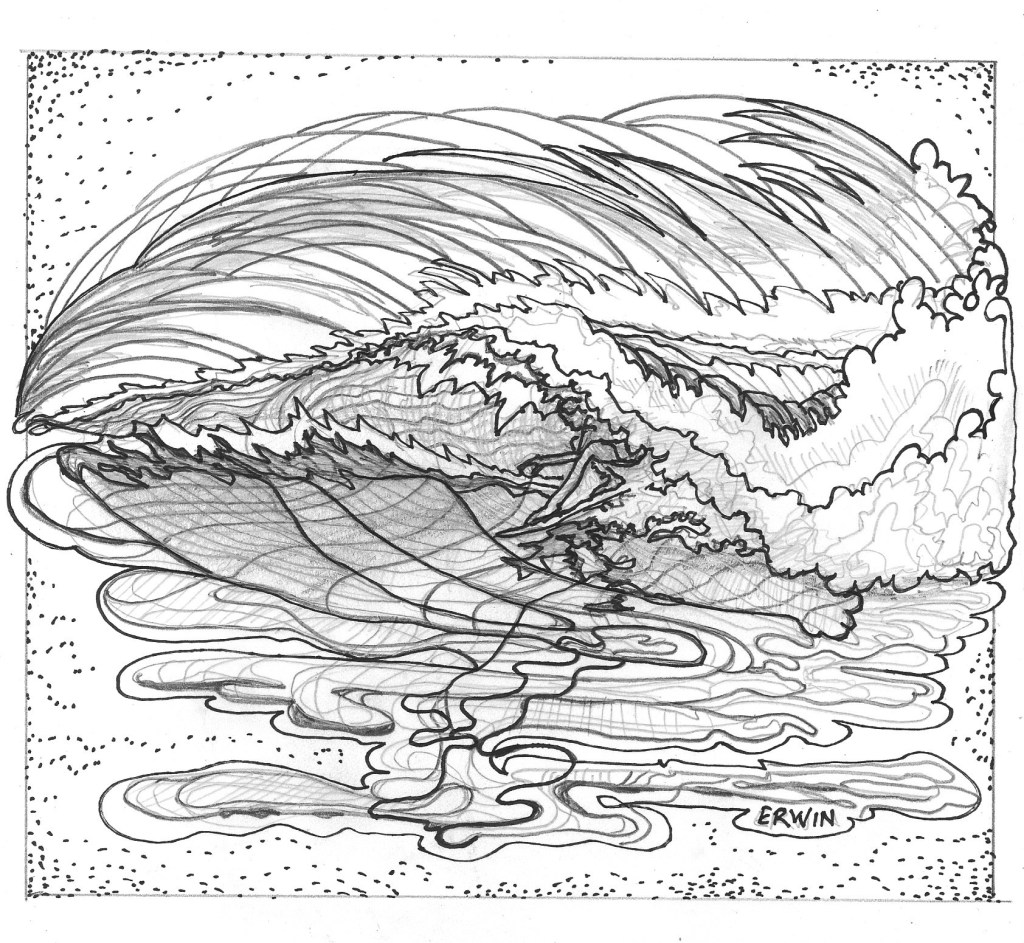
I am trying to capture a certain feel- working on it

Before I get to the outtake, I could explain where it came from. I never attended a surf movie alone (or any movie at any theater or high school gym, or went to any sit-down restaurant), but I also never went with my surfing friends. I first saw “Endless Summer” with my mom and sister. I went to a movie at Hoover High with Emily, my chemistry lab partner. I was supposed to drive down in my Morris Minor, but it was, as it frequently was, broken down, so Emily and I got to get dropped off by my parents, on a date of their own. Dropped off. Embarrassing.

I went with Trish, but, for some reason (probably the broken car, again) we got to ride with my sister and her boyfriend, Alan, who might have passed for a surfer if he hadn’t, the very day, shaved off his mustache. Trish looked good, might have acted as if she enjoyed the movie. The embarrassment increased when we, as was the custom, stopped at the Carnation ice cream place. It was some time in 1969, I was a senior at Fallbrook High, and had competed for a second time in the KGB/Windansea high school surf contest. Thor Svenson, president of the Windansea Surf Club, and some members, came into the restaurant and, maybe it was my startled expression rather than Mr. Svenson actually recognizing me, but he nodded, and I nodded, me sitting in a booth with more-chic-than-necessary Trish, my sister, Suellen, and her farmboy-looking date.

I survived, and did push Trish into a couple more outings, one at Mira-Costa Junior College, closer to home; and at least one at the local Junior High in Pacific Beach, after we got married and moved there.

But, to explain where this outtake came from, a girl whose Navy doctor father had just been transferred from Virginia came to Fallbrook, mid-term, 1968, and took a seat across from me in English class. We talked surfing, I said I’d show her around, and we went, that very day, after school. I discovered, after we went to the Surfboards by Heck (it’s still mentioned in “Swamis”), that she wasn’t really interested in actually surfing. Because I was her first date in Fallbrook, probably, and because I… because I was me; Phil or Ray, or Phil and Ray called me up to see how it went. “Hey,” my father said, walking past; “A man doesn’t talk about what happens on a date.” “Nothing happened,” my mom said; “I’m sure nothing, nothing happened.” She was right, of course; other than, as mentioned, the girl figuring out I might be a real surfer, but I wasn’t even or even close enough to her on the social status scale. Fine. Different scales.

Here’s the piece:

SURF MOVIE- HOOVER HIGH- SATURDAY, SEPTEMBER 21, 1968

This was all kind of normal at surf movies, sixteen-millimeter productions shown at high schools and rented theaters, even after “Endless Summer” had made the leap to the big screen.  I had attended a few, Hoover High in San Diego; fifty miles from Fallbrook and at least fifteen miles from the ocean.

This time I was with, rather than one or two of my friends, a date; a girl from my History class, who’d just moved to Fallbrook from Hawaii, said she surfed and would love to go to a surf movie.  I discovered she wasn’t really a surfer by the time I showed her the third or fourth surf spot (Grandview or Beacons, both looking pretty good) on the way down.  She discerned I probably wasn’t in with the rich or popular kids before we got to Windansea.  I drove back on 395.  Closer.  “Fun,” she said.  “Yeah,” I said.  “See you.”  It wasn’t long before she started dating a rich popular kid and I became her “I was new in town” story.

Still, I had enjoyed the movie.  I always enjoyed the scene; surfers hooting, laughing, making that sort of whooshing sound for a slow-motion ride; or being reverently silent; all in unison, all at the appropriate times.  And, even if she wasn’t an actual girlfriend, it was a date; she was pretty cute. She did look like a surfer.

Surf when you can, stay safe, see you around.

“Oceanside and Imperial Beach” Outtakes from “Swamis”

Mostly because I don’t want to ask people to be my friend, don’t want to be turned down, I don’t follow Facebook. I do have a page; would have to look up my password. Stuff from realsurfers does go there, but if you sent me a friend request, it’s not rudeness or anything personal; I just haven’t checked.

Trish, however, does have a big Facebook life. Wait, does that sound, um, like something that might be (mis)construed as a putdown? I don’t mean it that way, partially Trish monitors and assists in administering the site our daughter, Dru, set up, “I’ve heard of Quilcene.”

Shit gets out of hand on a pretty regular basis on a site meant to do things like report bear and/or cougar sightings (no, they aren’t usually cruising surf route 101 and the Olympic foothills together), lost and found dogs, such things; but, with a population of somewhere around 500, the site has many many more members, and some of them can’t help but get personal. Or political. Or both.

Trish will, if I’m around while she’s checking out Facebook, give me the ‘you have to see this,’ or, more frequently, she’ll just start laughing and I’ll have to switch out my glasses and check it out.

This is the first time I’ve saved something, and, don’t misconstrue the reason I think it’s so hilarious. It’s mean. I figure it’s just the way folks down south go to the beach.

yeah, it’s mean.

Sorry. Couldn’t help it. Here’s another outtake from “Swamis.” I’ve become increasingly ruthless as I’ve gone through the massive edit. I do have a plan for what I’m collecting/saving under the title “Sideslipping.” Later.

This is fiction. Here’s where some of it came from: I worked in Oceanside, Buddy’s Sign Service, immediately after graduating from high school, 1969. The shop was one block from the in-city segment of 101, two blocks from the Greyhound Bus Depot (two blocks and railroad tracks from the water, two blocks to the pier). Rough neighborhood.

When I went to work painting for the Navy, Civil Service, I ran into Cliff Bridge, nicknamed “The Preacher.” When other WWII vets tried to give him a hard time after his admission that his battle station was a locker, he said, “I was on a landing craft on D-Day.” Shut them up.

As far as the Imperial Beach story; I did get a chance (which I enjoyed) to paint a sixty-five foot angle iron construction tower when one of the two guys sent out dropped two pails of paint on the first day, called in sick the second. No one died, but I did see the Tijuana Sloughs going off with perfect offshore wind conditions. No, didn’t go out. Working. Scared? Maybe. The guy who later killed himself is taken from what I heard about a guy who bullied me when I was in high school.

Fiction; me taking something, rolling it in batter and deep-frying it. Kind of like a corndog.

OCEANSIDE AND IMPERIAL BEACH  

Oceanside was labeled a ‘Marine Corps town,’ a pretty rough place in the 1960s; all the rougher as the Vietnam War ramped up.  A succession of Camp Pendleton Commanders had threatened to not allow Marines to go to Oceanside on leave, particularly downtown.  Downtown was pretty much the section where 101 (with differing names up and down the coast) intersected with Mission Boulevard, the route east.  Follow it for twenty miles, you’d be in Fallbrook.

The Downtown section featured record stores and tattoo parlors and the cheap-credit-for-cheap- jewelry jewelry stores (‘a little sparkle for your girl back home,’), the pier, the beach, the stations for the railway and Greyhound Bus. It also featured the hawkers and the greasy spoon restaurants and the places lonely guys with very short hair, their faces and heads and necks (Leathernecks was a nickname from World War II) sunburned below where their hats (‘lids’ in Marine Corps-speak) had covered them during boot camp; teenagers who weren’t old enough to vote or go to bars, could hang out, try to act like civilians, and fail, before being shipped out.

And, evidently, Oceanside had reasonably priced hookers.

Oceanside.  Along with Imperial Beach, on the border with Tijuana, those two areas had the lowest-priced beach front real estate on the Southern California coast.  Both places had piers, both had consistent waves.  The Tijuana Sloughs were exotic, dangerous, legendary, with stories of lost boards ending up in Mexico, for rips and fog and for big waves.  A four-foot day at I.B. Pier turns into eight foot a mile to the south, on the border; with sneaker sets appearing on the horizon.  The only thing, I was told by a guy who surfed the Sloughs, scarier than getting caught inside by a set, was being outside, drifting south and out to sea.

A SPARKLE

I never surfed Imperial Beach; did see it while on a case that took me to the Navy’s Ream Field, a helicopter base that was constantly threatened with being phased out and shut down.  Ream Field was near the water, on very flat land.  Known as much for wind and fog as waves, in February of 1976 a Santana was working, and, from the hanger where some Civil Service worker had fallen, or was murdered, while painting a lighting tower; I could see the tops of waves, backblown spray, even from the ground.

After climbing the sixty-five-foot tower, however, I could see from the pier to, maybe, Ensenada.  The cleanness of the scene hid the riptides and put a sparkle on the polluted water. 

“Yeah, I hated the fucker,” the surviving painter said, “he just didn’t get his safety belt hooked-in… missed it.  Nothing I could do.”

Since I’ve already gone too far here, I might as well add that the accused painter had been involved in the D-Day invasion.  An eighteen-year-old Seaman Apprentice, originally from Oklahoma, “but on the Kansas border,” he was issued a forty-five and assigned to a landing craft.  “And, if anyone refused to get out; I was to shoot them.  Those were my orders.”

An embittered, divorced, alcoholic chain-smoker, he wasn’t a particularly sympathetic character.  The D-Day story was quite helpful.  “I never had to kill nobody,” he said; “They all just… went.” 

“He never killed anyone,” I said.  The dead painter’s family decided not to pursue him but continued their suit against the Navy Public Works Center.  They may have received some sort of compensation.  That was no longer my case.  The surviving painter, a few years later, in some trailer out in East County, Descanso, I think, shot himself.

SLAUGHTER ALLEY was the nickname for Highway 101 between San Clemente and Oceanside, the eighteen- mile portion that went across Camp Pendleton.  There were only guardrails between the north and southbound lanes, but bloody accidents were quite common.  My mother kept track, said, if I was going to San Onofre, even if riding with someone else, I’d better go across the base.  I usually did.  I-5 was connected by 1969, and the name faded.