FIRST LIE: “I just want to get in the water,” or any variation on this (purposefully not talking about the folks cruising SURF ROUTE 101 and, I guess, everywhere, with Walmart plastic kayaks, canoes, wavestorms) by someone who actually surfs. Okay, shouldn’t have excluded Wavestormer Troopers, BUT…
…here’s the (a) story: So, three sessions ago, fighting a radically outgoing tide and small, choppy waves, I had one of those go-outs in which I, objectively, SUCKED. Two sessions ago, on a borrowed SUP, same spot, even smaller waves, I, subjectively, did OKAY. Or, at least, better… BUT, tasked with packing a board heavier than my Hobie on a long trek back, and unable to just drag someone else’s board across the soft sand and the scrub, I allowed, for the first time in my career, someone else to pack my board part way. It was his board. I was… grateful.
So, next session I packed in my MANTA board. I had finally coated over the paint with resin, and figured, if the waves were the usual, minimal, I could, at least, jump into a few. The waves lived up to my expectations; minimal. AND, NO, even if I said I just wanted to get in the water, which I didn’t, I would be lying. I wanted o RIP. I always want to rip. I didn’t. I let frothed-out ripper KEITH ride the board. He did rip. I watched. I caught ONE WAVE, belly ride, totally tubed, with enough juice to propel me down the line and into the gravel shelf. YAY!
MANTA and slightly lost Hobbit.
OH, and Keith put a ding in the Manta. That’s one of the costs in surfing. Occasionally getting h orumbled is another. STILL, next time I get wet…
SECOND LIE: “I’m not political.” Add to this, “I am willing to talk.” That part is true. I am working on a project proposal for a guy who is running for the state senate as a republican. So, in discussing the job, politics did come up. I said that, probably, 70 percent of people agree on 75% of things, that where the radical 30%, 15 in each direction, left and right, come together is distrust of the government. The potential client agreed. THEN, because he is also part of the nebulous percentage of people who consider themselves religious (there is a scale on this), I added that we are all raised with certain morals, and, if we go against these, we, in our own minds, sin. So, because we want to consider ourselves ‘good people,’ we try to live up to our own sense of morality.
HE AGREED. What I actually (or also) meant, or meant to imply was, that if a person is raised by a parent who used every device and trick to fuck over people in order to enrich himself, that person’s moral backstop, compass, guidebook, whatever, is… different.
BECAUSE I couldn’t help myself, and, actually, I MIGHT DO MORE, I drew a couple of, possibly, kind of political illustrations. I found out a few things: A LOT of women do not want to see even a negative image of Fred Trump’s son, a NASTY piece of work. I don’t know. Maybe I’m wrong: there might be, like, 15% who think… SHIT, I can’t imagine why they’d have anything other than disgust, AND, if they defend him on some false and thin pretense, I might believe they have an incredibly strong resistance to the gag reflex, and/or are lying.
Again, I am willing to talk.
“SWAMIS.” Since I am serializing the novel, I should recap: 1. Joey is at the court-appointed psychologist’s office; the conversation coming around to whether he has moved from being bullied to being a bully. 2. Joey’s first meeting with Julie at Pipes.
CHAPTER THREE- SUNDAY, SEPTEMBER 15, 1968
My nine-six Surfboards Hawaii pintail was on the Falcon’s rust and chrome factory racks. I was headed along Neptune, from Grandview to Moonlight Beach. The bluff side of Neptune was either garage or gate and fence, or hedge, tight to the road. There were few views of the water. I was, no doubt, smiling, remembering something from that morning’s session.
There had been six surfers at the outside lineup, the preferred takeoff spot. They all knew each other. If one of them hadn’t known about me, the asshole detective’s son, others had clued him in. There was no way the local crew and acceptable friends would allow me to catch a set wave. No; maybe a wave all of them missed or none of them wanted. Or one would act as if he was going to take off any wave I wanted, just to keep me off it.
As the first one in the water, I had surfed the peak, had selected the wave I thought might be the best of a set. Three other surfers came out. Okay. Three more surfers came out. Sid was one of them. I knew who Sid was. By reputation. A set wave came in. I had been waiting. I was in position. It was my wave. I took off. Sid took off in front of me, ten yards over. I said something like, “Hey!”
Rather than speed down the line or pull out, Sid stalled. It was either hit him or bail. I bailed. Sid said, “Hey!” Louder. He looked at me, cranked a turn at the last moment. He made the wave. I swam.
“I didn’t do anything wrong,” I said, back at the lineup. The four other surfers there were laughing with Sid.
“Wrong, Junior; you broke the locals rule.” Sid pointed to the lefts, the waves perceived as not being as good, on the other side of a real or imagined channel. “Local’s rule. Get it?” Trying to ignore the taunts of the others, I caught an insider and moved over.
After three lefts, surfed, I believed, with a certain urgency and a definite aggression, I prone-paddled back to the rights, tacking back and forth. A wave was approaching, a decently sized set wave. I wanted it.
“Outside!” I yelled, loud enough that four surfers, including Sid, started paddling for the horizon. I paddled at an angle, lined up the wave at the peak. Though the takeoff was late, I made the drop, rode the wave into the closeout section, pulling off the highest roller coaster I had ever even attempted.
There had been no outside set. I kept my back turned to the water as I exited, not daring to look up at the surfers on the bluff, hooting and pointing. I did look up for a moment as I grabbed my towel, my keys and wallet and cigarettes rolled up in it, tromped up the washout to Neptune Avenue, trying not to smile.
Driving, almost to Moonlight Beach, a late fifties model Volkswagen bus, two-tone, white over gray, was blocking the southbound lane. Smoke was coming out of the open engine compartment. Black smoke. Three teenagers were standing behind the bus: Two young men, Duncan Burgess and Rincon Ronny, on the right side, one young woman, Monica, on the left.
There was more room on the northbound side. I pulled over, squeezed out between the door and someone’s bougainvillea hedge, and walked into the middle of the street, fifteen feet behind the van. “Can I help?”
Duncan, Ronny, and Monica were dressed as if they had surfed but were going to check somewhere else: Nylon windbreakers, towels around their waists. Duncan’s and Monica’s jackets were different, but both were red with white, horizontal stripes that differed in number and thickness. Ronny was wearing a dark blue windbreaker with a white, vertical strip, a “Yater” patch sewn on. Each of the three looked at me, and looked back at each other, then at the smoking engine. The movement of their heads said, “No.”
Someone stepped out of an opening in the hedge on the bluff side of the road, pretty much even with me. I was startled. I took three sideways steps before I regained my balance.
Julia Cole. Perfectly balanced. She was wearing an oversized V-neck sweater that almost covered boys’ nylon trunks. Her legs were bare, tan, her feet undersized for the huarache sandals she was wearing. She looked upset, but more angry than sad. But then… she almost laughed. I managed a smile.
“It’s you,” she said. It was. Me. “Are you a mechanic?” I shook my head, took another step toward the middle of the road, away from her. “An Angel?” Another head shake, another step. She took two more steps toward me. We were close. She seemed to be studying me, moving her head and eyes as if she might learn more from an only slightly different angle.
I couldn’t continue to study Julia Cole. I looked past her. Her friends looked at her, then looked at each other, then looked, again, at the subsiding smoke and the growing pool of oil on the pavement. “We saw what you did,” she said. I turned toward her. “From the bluff.” Her voice was a whisper when she added, “Outside,” the fingers of her right hand out, but twisting, pulling into her palm, little finger first, as her hand itself twisted. “Outside,” she said again, slightly louder.
“Oh,” I said. “It… worked.”
“Once. Maybe Sid… appreciated it.” She shook her head. “No.”
I shook my head. “Once.” I couldn’t help focusing on Julia Cole’s eyes. “I had to do it.”
“Of course.” By the time I shifted my focus from Julia Cole’s face to her right hand, it had become a fist, soft rather than tight. “Challenge the… hierarchy.”
I had no response. Julia Cole moved her arm slowly across her body, stopping for a moment just under the parts of her sweater dampened by her bathing suit top. Breasts. I looked back into her eyes for the next moment. Green. Translucent. She moved her right hand, just away from her body, up. She cupped her chin, thumb on one cheek, fingers lifting, pointer finger first, drumming, pinkie finger first. Three times. She pulled her hand away from her face, reaching toward me. Her hand stopped. She was about to say something.
“Julie!” It was Duncan. Julie, Julia Cole didn’t look around. She lowered her hand and took another step closer to me. In a ridiculous overreaction, I jerked away from her.
“I was going to say, Junior…” Julia was smiling. I may have grinned. Another uncontrolled reaction. “I could… probably… if you were an… attorney.”
“I’m not… Not… yet.”
Julia Cole loosened the tie holding her hair. Sun-bleached at the ends, dirty blonde at the roots. She used the fingers of both hands to straighten it.
“I can… give you a ride… Julia… Cole.”
“Look, Fallbrook…” It was Duncan. Again. He walked toward us, Julia Cole and me. “We’re fine.” He extended a hand toward Julia. She did a half-turn, sidestep. Fluid. Duncan kept looking at me. Not in a friendly way. He put his right hand on Julia Cole’s left shoulder.
Julia Cole allowed it. She was still smiling, still studying me when I asked, “Phone booth? There’s one at… I’m heading for Swamis.”
A car come up behind me. I wasn’t aware. Rincon Ronny and Monica watched it. Duncan backed toward the shoulder. Julia and I looked at each other for another moment. “You really should get out of the street… Junior.”
“Joey,” I said. “Joey.”
She could have said, “Julie.” Or “Julia.” She said neither. She could have said, “Joey.”
No one got a ride. I checked out Beacons and Stone Steps and Swamis. I didn’t surf. The VW bus was gone when I drove back by. Dirt from under someone’s hedge was scattered over the oil, some of it seeping through.
OBLIGATORY COPYRIGHT STUFF: I reserve the rights to any and all of my original works. Please respect this. Erwin A. Dence, Jr. Thanks.
HAPPY LABOR DAY! I do hope you’re getting WET and BARRELED! The next time (and any time) I get in the water, remember, “I’M HERE TO SURF.”
I probably should have split this into two parts. Thank you in advance for reading. You aren’t required to do it in one sitting. I apologize for annoying ads; it’s because, since I haven’t made any money on this (vanity?) project, realsurfers, I pay the minimum to Word Press. Hence, ads. I inserted a photo of, basically, the view from where Julia Cole’s mother’s house would be, to break up the chapter.
Though the manuscript (not a secret) lacks focus, mostly due to a stubborn desire to make side characters seem real, I have been trying to narrow in on the relationship between Joey and Julia. There’s more of that after the sunset photo.
SIDEBAR, with apology- The professor in a watercolor class I took at Palomar Junior College had a habit of grabbing my work before I was finished. “Done,” he would say. Of one painting I was ready to overwork and ruin, he asked if I loved the woman I was trying to render, his argument being that I should concentrate on shading and form, the pieces, or, since I lacked the skills for truly rendering an image, I could go for something impressionistic.
I don’t believe I’ve over-described Julia Cole, and since the narrator cannot know what she is thinking, we (presumptuously including you) have to rely on how she behaves. Yeah, like the way it should be. Maybe. Do I love Julia/Julie? YES, and if any character has to be real, complicated, vulnerable, tough, for me to consider her properly rendered, it is she. Or is it ‘it is her?’
CHAPTER THIRTEEN- SUNDAY, MARCH 30, 1969
I didn’t get up early enough to surf. Rather, I didn’t leave early enough. I got onto I-5 from 76, got off at the Tamarack exit. Eight surfers out at the main peak in front of the bathrooms. Too small for Swamis, too crowded at the main peak at Pipes. I passed by the turn that would lead me to the grocery store, drove through the parking lot at Cardiff Reef. There were waves, but they were cut up by the shifting sandbars, chopped up by water flowing out of the lagoon on a big tide shift. Outgoing. Still, surfers were taking off on peaks, bogging down on flat sections the shorter boards couldn’t float over. I never got out of the Falcon, but I did stop, between cars, when a larger set hit the outside peak. The five surfers in the water were caught inside. Even that wave flattened out, split into two weaker peaks, and got wobbly in the outflow from the lagoon.
Eleven minutes early, I parked the Falcon in the spot closest to the southwest corner, visible from the double door entrance. I grabbed three loose carts, pushed them together, and aimed for the entrance.
Weekends. Easter vacation. Excuses to go to the beach. A higher percentage of the customers at the San Elijo Grocery, Mrs. Tony’s to locals, seemed to be tourists, down or over from somewhere else. The state park across the tracks and the highway, extending along the bluff at Pipes to the lower, flatter area at Cardiff Reef, contributed customers. Suntan lotion and creams for sunburn, floaties and cheap shovel/pail/rake kits contributed to the independent grocery store’s bottom line.
Almost all the west, ocean-facing wall was glass. The view was of the road, the railroad tracks, the highway, the four-year old shrubbery that was just beginning to provide privacy for campers at the state park. The windows started at four feet from the floor, allowing for bags of dog food and fertilizer and compost, cheap beach chairs and portable barbecues, and extended twelve feet, four short of the sixteen-foot ceiling. The rolldown shades that only partially mitigated the afternoon glare were up.
The middle of three registers was empty. Mr. Tony was at the first register, his voice and laugh echoing off the exposed trusses and half-painted plywood ceilings, bouncing off the windows. He was just finishing up a story I had heard enough times to whisper the punchline as my boss revealed it to an obvious camper. “Can’t get that at no Piggly Wiggly!” Someone from the southeast was my guess.
Mr. Tony dropped the smile when he saw me. I dropped my arms to my sides, slightly out from my hips, palms out, to show I was wearing the appropriate clothing: Chinos, sensible shoes, long-sleeved shirt with a collar, no hippie beads. My hair, over my ears for the first time in my life, was slicked back. I would wet it in the customer’s men’s room occasionally.
I stepped toward the counter, ready to bag groceries. Mr. Tony handed the customer his change, watched me place the items in a bag, then nodded toward the back of the store.
Halfway down the center aisle, I couldn’t miss hearing Mr. Tony with his next customer. “All these hippies. Kid’s thinking he’s foolin’ me with the hair; figures I’m okay with the duck’s ass, greaser look. Pretty soon the kid’s gonna look like a pachuco. Huh, Guillermo?”
Mr. Tony and Guillermo both laughed. “Pachuco.”
The grocery store’s office was behind the wall that held assorted beach and camping gear, tents and sleeping bags, lanterns. A string of Christmas lights, always on, framed the entrance to the storage area. A set of smaller lights framed a hand painted sign hung on the area’s most prominent post. “No public bathrooms.” There was always incoming freight in with the stacks of boxes and partial boxes of non-perishables the Tony’s had gotten a special deal on. Frisbees, hula hoops, tiki torches, garden hoses. Seasonal decorations were also stored there: Plywood Santas, American flags. There was a table for painting the paper signs for bargains and produce prices, bottles of red and green and blue and yellow paint, worn brushes stuffed in dirty water in an oversized pickle bottle.
The door to the inner office was unpainted and unmarked other than a fading message in grease pencil. “Not a bathroom.” The door was almost always open because Mrs. Tony was almost always there.
Mrs. Tony was sitting on the far side of her ping pong table desk, straight back from the door. Clear view. She had yelled “Jody” before I entered the storage area. She began moving aside stacks of invoices and customer account cards, each no less than a six inches high, to maintain her view. She looked up at the clock above the door, pulled out my card from the smaller of three stacks to her right, made a note with the pencil she kept in her hair, stabbed between the rollers and bobby pins and a scarf. Mostly red on this day, with white flowers.
“Jody,” she said again, standing up, “Did you see your apron?”
“Oh. I… get my own apron?” She looked at me as if I had said something rather rude or really stupid. “I mean, thank you, Mrs. Tony.”
“Yeah. Go help Doris.” She pointed through the doorway. “Good?” I nodded. I could see my Pee-Chee notebook under a stack of other papers immediately in front of here. She shook her head, waved her pointer finger. “I haven’t gotten a chance yet, Jody.” She glanced at the clock again. I checked it on the way out. 10:03.
…
Doris, late forties, about the same age as Mr. and Mrs. Tony, was ringing a woman up at the middle register. I walked up, trying to re-tie the cloth string on my new green apron. “Mr. Tony’s at the ‘so glad to see you’ register,” she said as I moved into bagboy position.
I looked over. Tony was talking to and laughing with a man, a bit older, dressed in a gray suit, fedora to match. There were no groceries on the counter.
Doris’ hair was also in curlers and covered with a scarf, hers in several shades of light green. Her customer was wearing a dark dress, with pearls, and what I had heard referred to as a ‘Sunday-go-to-meetin’ hat.’ The woman asked, “Saving your good hair for your man, Doris?” Doris smiled and kept ringing up the groceries. Quickly, most of the prices memorized.
The woman nodded toward the man with Mr. Tony, both now at the front windows, each with a foot up on a pile of bags of dog food. She looked at the prepared pie on the counter. “We’re skipping the sermon, Doris, but we’re definitely going to the social.” She looked at me. “That’s where you hear all the good shit.” I did a sideways nod, tried to appear both impressed and mildly shocked.
“Right about that, Connie,” Doris said. She and Connie laughed. I nodded. I smiled. “Careful with Connie’s pie there… Jody.”
Connie looked at the name, hand sewn, in white, onto my green apron. “Jody? JODY. I’ve got a niece in Arizona named Jodie. JODIE.” I pinched a spot on the apron below the name. I pulled it forward. I looked down at it, looked back at customer Connie as if I might have grabbed the wrong apron.
Connie looked at Doris, looked at the total on the register, looked toward a tall, thin, metal shelving unit just to the right of the cash register, equidistant between the middle and south register, and attached with two strands of metal rope to a metal I beam post. Three wide, five high, each of the shelves contained an approximately even number of tan colored cards. The shelving unit itself was set on top of three wooden milk crates. With a metal gridwork inside to hold and separate glass containers, the crates were built to interlock when stacked, “Story’s Dairy” and “Fallbrook” was stenciled on the sides of each of the crates.
Doris stepped toward the shelf. “Pie’s got to pass for homemade… JODY,” Connie said. ”I have a nice serving dish, out in the car. Should work well enough with the hypocrites and sinners.” I looked at the pie, looked at the shelf Doris pulled the card from. Four down, middle. L-M-N. The pie wouldn’t pass. I nodded at Connie and smiled. She may have missed it. She was adding here initials to the card. “I meant the other hypocrites and sinners, of course, Doris.”
…
Mid-day rush. I was rushing between Doris’s counter and Mr. Tony’s; bagging, smiling at the customers; smiling bigger when Tony said something that might not have been deservingly amusing or clever; smiles Tony had to know were fake, smiles few customers bothered to analyze. I nodded at customer comments, most of which didn’t concern the weather, did concern the damn hippies or the damn tourists or the damn surfers. “At least you’re not one of those,” at least one of the customers told me. Smile.
For the third time on this day, Mr. Tony used someone questioning my name as an excuse to break into his version of the Jody Cadence. “Jody’s bagging groceries, bringing carts back, too…”
Mr. Tony stopped, laid his left hand out and open, and toward me, and waited. This was my cue to join in the joke, add another line. This time it was, “At the San Elijo Grocery, the surf’s always in view.”
We did the “One, two, one two” together. Mr. Tony laughed. I tried not to look embarrassed. Part of the job. So glad to see you.
At two o’clock, Mrs. Tony came to the front to relieve Doris. She made sure I saw her shove my Pee-Chee folder into the shelf under the counter. She pulled an oversized watch with half of the wristband from one of the big pockets on her apron, didn’t really look at it. She made sure I got the message. Keep working.
There was a lull around four. I was at Mr. Tony’s register. “Joe DeFreines’s kid,” he was telling this customer, a regular, probably thirty years older than Mr. Tony. “Jo-dy. Joke. Marine Corps cadence, from… Korea.”
The man shook his head. “Army.” Mr. Tony stepped back. “World War Two, Tony, the durn leathernecks stole it. It’s… fact.” The man laughed, took both of his bags from the counter before I could move them to the cart, and held them against his chest. He took two steps, purposefully bumped into me with a shoulder. Friendly bump. “Good man, Joe DeFreines.” He took two steps more steps, and said, without looking around. “Tony’s okay, too, for a fucking Gi-rine.”
“Jo-dy,” Mrs. Tony, at the middle register, said, loudly, sharply, almost like someone calling cattle. Pigs, more like it, emphasis on the second syllable. She was holding my Pee-Chee notebook out and toward me, six customer account cards on top of it. She slid it, several times, toward the credit shelf as I approached. “Lots of regulars on a Sunday,” she said, “putting it on their tabs.” I took the folder. “You might want to learn some of their names.”
“I’m… working on it, Ma’am.”
Mr. Tony stepped toward us. Mrs. Tony gave her husband a message, eyes-only. Back off. He did. I set the Pee-Chee on the counter, spread the tab cards on top of it. Mrs. Tony said, “Ask your mother,” and turned away.
I reshuffled the cards, rearranged them, alphabetically, and put them away as quickly as I could. “It’s a lot of money, Mr. Tony,” I said, tapping the edge of the folder on the slight guardrail at the edge of the counter. “Lost Arroyo Investments. Are you… familiar?”
Mr. Tony looked at the folder rather than at me. He exhaled, popping his lips, slightly. “It’s not dirty. I guarantee you that.” He turned toward his next customer, one aisle away. “You ready, Honey?” She wasn’t. Not quite. Without looking at me, he asked, “You afraid to ask your mom?” Turning toward me, he read my expression correctly.
“Almost four-twenty, Jody,” Doris said as she returned to the middle register. “Your break. Take it or lose it.”
I acted as if I hadn’t noticed that Doris had removed the scarf and curlers and had brushed out her hair. Doris looked as if she wanted a comment. I was bagging, concentrating. Produce, one bag; ice cream, white, insulated bag; several cans of soup, bottom of double bag; one loaf of bread from a local baker, on the top; quart bottle of milk, TV Guide, straight into the cart. I gestured my willingness to push the cart. The older woman at the counter shook her head. Another church goer, I guessed, another dark dress with white pearls.
“Headed that way anyway, Ma’am. Mrs. …?”
“Not Mrs. anything anymore.” I stepped behind the cart. “Jackie, just Jackie.”
“Just Jackie, did you notice Doris’s hair?” Just Jackie turned and said something to Doris I didn’t hear; something Doris, self-consciously primping, pushing up the curls on one side of her face, seemed to appreciate. Doris gave me a different look when Jackie stepped next to me and set her purse into the cart. Embarrassed but appreciative, perhaps.
The shades across the front windows were a third of the way down, the sun just at the bottom line, the light half glaring, half insufficiently muted. Jackie kept one hand on the side of the cart as she and I walked. I was one set of windows from the main doors, even with Tony’s register, when I saw Julia Cole enter.
It would be an over-romanticization if I said that, at just that moment, the sun, full force, dropped below the shade and Julia Cole was bathed in that light. Amber. That is how I saw it; pausing, stopping myself and the cart, and because I stopped, Jackie stopped.
“I can manage from here… Jody,” Just Jackie said, looking at Julia Cole, looking at me, looking at Mr. Tony at the first register, looking back at me. I blinked, looked at Jackie. She was smiling as if she knew something about sunlight and amber and magic.
Julia Cole, walking toward me, had her eyes on me. I was only slightly aware of Jackie pushing the cart toward her. Julia’s expression changed when she turned toward Jackie. Surprised, perhaps, at the woman’s expression. Still, Julia appeared to be no more than polite.
Julia Cole moved to her right, out of the glare. She stopped. She did not intend to walk any closer to me. If it was a dare, I wasn’t taking it. I was replaying the previous seconds.
Julia Cole was very close. She said something, not quite a whisper. I saw her lips move.
“Ju-lie!” It was Mr. Tony’s loudest voice. “Surf up or something?” Julia Cole turned toward the voice. “Jody can take off and go if he wants.”
“No. No, Mr. Tony, it’s not… that.”
With Mr. Tony and Julia Cole in my periphery, right and left, I saw the silhouette in the alcove at the main doors. Only a hand and arm came out of the shadow. The hand was pointed at me. It twisted and flattened. Fingers out, the hand was pulled back. A summons. Duncan Burgess at the corner of the entrance alcove, just in the light, standing next to Julia Cole’s big gray bag.
Julia Cole asked me a question. Before I could process, she repeated it. “Can you come outside? I mean, please.”
I looked at my watch. 4:23. Break time. Ten minutes. I didn’t look around. I did hear Mr. Tony’s voice, mid-range volume-wise. “And how’s Christina and her little one?”
“Margarita. She’s… fine, Mr. Tony. Christine’s…” Julia’s laugh was surprisingly sharp. “Well, you know Christine.”
“Most popular bag girl we ever had.” Julia must have waited for the punchline. “And the worst.” Mr. Tony’s and Julia Cole’s laughs were several octaves apart; but perfectly synced, timing wise.
Julia gave me a look I read as meaning I was to go see Duncan without her.
Reaching under my apron and into my shirt pocket for the pack of Marlboros and the Zippo lighter, I headed for the alcove. I struck the wheel on the lighter at the point where the windows stopped. It flared up. Duncan noticed. I lit up as if this was normal. Duncan picked up Julia Cole’s bag, backed through the right-hand glass door and held it in the open position, allowing me just enough room to pass. I exhaled at precisely that moment.
Dick move.
Duncan Burgess took a roll of photo paper out of the top of Julia Cole’s bag. He removed the rubber band, put it around his left wrist, unrolled and handed the stack to me. He watched me as I went through the first three pages.
“Contact prints,” he said. “Julie gets them… Palomar. College credits.” I nodded. Duncan looked at the cigarette in my right hand. He stuck out two fingers on his right hand. I allowed him to take the cigarette. I took the stack of photos. “Teacher likes her. Probably a pervert. Photographers. They all are. But… free developing.” Duncan took a drag, blew the smoke just to my left. “Julie takes… a lot of photos.”
Unlike the first three pages, 35-millimeter black and white images from sections of exposed negatives, the fourth, fifth, and sixth pages were almost full-page images of Chulo, in his rough and dirty evangelizing robe, and another man, taller, in a robe, barefoot, his left arm in a sling, leaning to his right on a single crutch. Jumper. The mid-section of the Jesus Saves Bus was behind Chulo and Jumper. The image of Jesus was between them.
I looked at the second three pages, shuffled the first three in behind them, and studied each of the larger images. “Chulo is smoking,” Duncan said, moving to my right side. I looked at my cigarette between the fingers of Duncan’s left hand. He took another drag. “Next photo…”
In the next photo, Jumper’s crutch was falling away as his right hand was knocking the cigarette out of Chulo’s mouth. “Julie said they’d been arguing. Like, quietly. Check out the third enlargement. See? She zoomed in. Jumper is pulling something from a pocket of his robe, handing it to Chulo.” Duncan put his index finger on the photo. “There. See?”
Duncan took my cigarette out of his mouth and offered to put it in mine. I declined, possibly backing away too quickly. Duncan blew smoke between me and the photo. Dick move. Payback.
“You can’t see it.” It was Julia Cole. She had come out the entrance door and was looking over Duncan’s shoulder and directly at me. I looked away from the photo and looked directly at her. “They weren’t arguing,” she said. “Not exactly. Chulo was… he was crying.” I blinked. Julia Cole blinked.
Chulo, in the last photo, was smiling. And crying. Jumper was smiling. I let go of the papers with my right hand, allowing them to roll up against my thumb.
“Actually, Julia Cole, I think they both were… crying.”
Julia Cole smiled. I lost focus on Duncan Burgess, directly in front of me, and everything else. “I do think so,” she said. “You’re… right.”
I would like to believe, and still do believe, that Julia and I froze for the same number of seconds. Her eyes were alive, studying mine, and mine, hers.
“Hey, Junior…” Duncan came back into focus. “You gonna help or not?”
“Not.”
I stepped back, handed the roll of photos to Julia. Duncan stuffed the cigarette butt in among many others in the waist-high concrete pipe ashtray at the side of the entrance door. I tapped my watch. “There’s nothing I can do, and… and my break’s over.”
Julia and Duncan exchanged looks. If Duncan looked angry or frustrated, Julia looked disappointed. She held the roll of photos upright, spun it in little circles, looking past it. At me. Disappointed, angry, resolved; then neutral, then a ‘Fuck you, then,’ Julia Cold look.
Duncan moved between Julia and me. He removed the rubber band from his wrist and double wrapped it around the roll of photos, giving Julia Cole a ‘told you so’ look. He turned toward me; moving his face closer, too close, to mine. I didn’t step back. I was trained not to. Duncan made a growling sound as he pushed past me and though the exit door.
Mr. Tony met Duncan ten steps in. Tony gave him the same side hug he had undoubtedly given Julia. “How’s your dad, Yo Yo?”
“No one calls me that, anymore, Mr. Tony, but… he’s, um, better.”
“You’re excited for prom and graduation and all that, I expect.”
“Can’t wait.” Disingenuous.
Mr. Tony slapped Duncan on the back. “Oh, come on, Duncan!”
Julia Cole stepped closer to me to allow a couple, tourists, possibly newlyweds, with matching sunburns, to keep holding hands as they entered the store. She looked past them and at Mr. Tony and Duncan and the couple. The door closed.
“So, Miss Cole, you’re… angry?”
“I had no… expectations. It was Duncan.”
“Oh? But… why does… Duncan… care so much?”
“He has his reasons.”
“You don’t ask.”
Julia Cole turned toward me. Her expression said, “I don’t need to” before she did.
I wanted to keep Julia Cole talking. I wanted her that close to me, close enough that the only thing in my field of vision was her. I was more aware than usual of my pauses, the lapses, the seconds I spent replaying previous seconds, trying to remember, trying to catalog exactly what she said, and how she looked, exactly, when she said it.
“I had one,” I said. “Yo-yo. Duncan.” Pause. “Sparkly.”
“We all did. Phase.” Short pause. “Sparkly? Yours?”
“Mine? Yeah. Sparkly.” Pause. “Walk… walk the dog.”
“Basic.” Pause. “Good trick. Easy.”
“Yes. The, um, trick… the one I liked… most, was…” I moved my hand up and down a few times, palm down, then flipped it over, pantomimed throwing the yo-yo over my fingers, then flipping my hand back over. “It’s like… switching stance.”
Julia Cole was staring. I was a fool. Ridiculous. She smiled. Politely. “It… is.” She held the smile longer than I could comfortably handle. She was studying me. I looked away, politely, allowing her time to drop the smile and continue the studying. “What do… you think?”
I pointed at the roll of photos. “Chulo smokes. I believe Jumper… maybe he doesn’t. Or… he quit.” I pulled out my father’s lighter. “Zippo. That’s… a guess.”
“Zippo?”
“Marine Corps logo. Maybe, if you enlarge it, the image, more…”
“I will.” Julia looked appreciative in the moment before she looked past me and into the store. I took the opportunity to look at her. When she seemed to sense this, I looked where she was looking.
Duncan and Mr. Tony had moved just beyond the first counter. Duncan pulled folded bills from an inside pocket of his windbreaker. “On account,” he said. Mr. Tony took the cash, pulled out several account cards from the rack, top left box, A-B. He shuffled through them, set one aside, took his pen out of his shirt pocket, wrote something on the card and showed the card to Duncan. He looked past Duncan at Julia Cole and me. I looked away. None of my business. She looked away and toward my car at the far end of the lot, then back at me.
That may have been that lapse, the pause that caused Julia Cole to speak. “I have… other photos. Negatives. I could… How late do you work?”
I refocused on Julia. “Today?”
She didn’t wait through the guaranteed pause. “We saw all the red lights, Swamis, from my, my mom’s house. Cops. Fire engines. We went down. It was… you don’t get it, do you, Junior? That… night. After…”
I didn’t get it. Julia Cole looked frustrated, even irritated.
“We saw it. Saw… it. It. Chulo. Portia. Gingerbread Fred was still there. Everything. It was… I just thought… maybe… you… might…”
I wasn’t keeping up. There was something in my mental image file, the view from Swamis and up the hill. It was a photo in an old Surfer magazine. In color. Maybe it was a cover photo. “From my mom’s house” she had said. It would have to be…
“What is… wrong with you?”
Julia Cole moved a hand over her mouth the second after she asked that question. All I could see was the back of her hand and her eyes. All I could hear were the words. “What is… wrong with you? What… is… wrong… with you?”
Three seconds, ten, I have no idea how long I was staring at Julia Cole. She was backing away and into the parking lot. I backed into the edge of the exit door. I took my eyes off Julia Cole, spun around, and pulled it open. Duncan and Mr. Tony both looked in my direction. In twenty-one steps I was even with the counter, with them. I stopped, pivoted, ninety degrees right. “Duncan Burgess, do you know Jesus?”
I pivoted back. I walked to Doris’s counter, everything slightly out of focus, unaware she was speaking. I grabbed a bundle of San Elijo Grocery paper bags, ripped off the paper ribbon that held them together, stuffed as many as I could into a shelf at Doris’s knee.
Doris put a hand, flat, on my chest. “So, Joey, I figured, I don’t have a man at home… currently; why not let my hair… down?”
I looked at Doris, tried to smile. I looked to my right. Duncan was gone. Mrs. Tony was at her husband’s register. Mr. Tony slid the account card and Duncan’s cash toward her. “Two-fifty-five on Burgess.” Mrs. Tony opened the register, took the bills from her husband, and began counting them. Mr. Tony looked at me. Mrs. Tony looked at him. Both looked at me before I could turn back toward Doris. What was wrong with me?
Doris looked at Mr. and Mrs. Tony. Her expression was hopeful. That’s what Julia’s expression was. Had been. Hopeful. Optimistic. Temporarily.
“What is wrong with me,” I whispered.
“Doris; you look… gorgeous.” Mr. Tony’s body language, the raising of his shoulders, suggested he was suddenly aware the compliment had been in his loud voice. He didn’t turn toward his wife for her reaction. He walked toward the front windows.
Mrs. Tony, walking toward Doris and me with the draw from the other register stuffed in one of the pockets of her faded green apron, stopped and looked at her cashier. She looked over at her husband, a shadow in the glare, as he used the pulley to lower the first of the window shades all the way down. Mrs. Tony touched her own hair, let out an only slightly exaggerated sigh, and pointed at me. “Julie. Beautiful girl, huh Jody.” I couldn’t respond. “The money; ask your mother. Huh?”
It was nearly sunset when I walked across the parking lot. 6:32. Daylight savings time had kicked in and the sun would set, officially, at 7:13. The tourists and inlanders and visitors and customers were all headed elsewhere. The wind was, if anything, slightly offshore. There was time to catch a few waves if I made a quick decision and went somewhere close.
Something was stuck, face up under the driver’s side window wiper. It was a flyer for an Australian surf movie. “Evolution.” There was one on the bulletin board on the wall between the entrance alcove and the window wall. Or there had been one. Friday, April 4, Hoover High School, seven pm. Saturday, April 5, San Dieguito High.
There was something under the flyer. More pages. Seven. Photo paper. Stiff. Slight curl. Slightly damp. I looked at the images as if they were flash cards, moving each to the back of the deck, going through them again and again. The photos were so dark that the artificial light of camera flash and flashlights and headlights burned out any details: Firefighters and cops, Dickson and Wendall; a woman in a robe holding back Portia. One photo showed the unmistakable anguish on Portia’s face. Another was of someone’s body, burned, against the wall. In another, the body was being covered with something more like a tarp than a sheet. In the last photo, Gingerbread Fred was on his knees, looking up. Up.
“Tear in the shroud, “I said.
I couldn’t look at any of these images for more than the time it took to move to the next photo. I couldn’t allow any of these images into my memory, a file too easily pulled. Too late. It was imprinted, permanently. I could describe each of the photos now in more detail than the actual photographs showed.
That was what Julia Cole had seen, witnessed, photographed. I tried to look again at each of the enlargements. It didn’t work. All I wanted to see, or imagine, were Julia’s expressions when she was trying to tell me about that night; how sincere, raw, honest she looked; how beautiful. All I wanted to do was collapse.
I didn’t. I went through my ring of keys, separated the one for the Falcon, I rolled up the pages. There was a note on the back of the flyer: “Portia said you are your father’s son, and you might help. I have more…” Out of room, the words went sideways. “…waiting… for you.”
I looked around the lot. Julia Cole wasn’t there. Of course, she wasn’t.
…
Vulcan Avenue runs parallel to Highway 101 and the railroad tracks, and in front of the San Elijo Grocery. There were several cross streets. I took one, went up two blocks, turned left. I looked at the houses, looked toward the water. I went up another block, headed south again. I stopped at the middle of three empty lots, the place where the best view would be. Optimal view. Surfer magazine view. Swamis Point.
Two houses farther south, on the uphill side of the street, a VW mini-bus, grey-green, white top, was parked in front of a house. “Julia’s mom’s house,” I said. Partially hidden by the VW and some shrubs, the back of the Jesus Saves bus was parked in the driveway. “Portia said you are your father’s son, and you might help.” I repeated the phrase. “Waiting… for you.” Me.
A light went on inside the house, behind the sheer curtains. I drove on. I pulled a u turn at the end of the block, coasted by again before I dropped back down to Vulcan and turned right. When I got to D street, I turned left. The Surfboards Hawaii shop was on my right. There were no cars on the block, either side. Several storefront businesses were on my left. David Cole C.P.A. was one of them. No lights. I got to 101 and turned right.
At Tamarack, parked on the bluff, lights to the south to lit the underside of the clouds. There were black lines on a dark ocean in front, breaking from a peak, gray soup to a gray beach. The rights looked better than the lefts. Still, I was replaying phrases. “You are your father’s son.” Portia. “What’s wrong with you?” Julia. “Waiting for you.” I reread the note that had been on the windshield by the light of my father’s flashlight. I straightened the photos, without looking at them, and placed them in a yellow notebook and slid that into a PeeChee.
I stayed on 101 until it curved away from the beach. Carlsbad Liquor was on my right, still open. Baadal Singh’s truck was parked nearby. “Gauloises bleus,” I said, out loud. “Picasso smokes these.” I considered stopping in, possibly buying a pack. I didn’t.
“Swamis” and all revisions are copyright protected, all rights reserved by the author, Erwin A. Dence, Jr, Thanks for respecting this, and for reading,
A reminder- “Swamis” is fiction. I will be attempting to put the chapters on another page, and will continue to post on Wednesdays with other content on Sundays.
CHAPTER FOUR- THURSDAY, FEBRUARY 27, 1969
Our house in the hills between Fallbrook and Bonsall was a split level, stucco house, aluminum sash windows, composite roof. Someone else had started building from some plans purchased from a developer. My parents could save money, they were told, by finishing the lower level and the garage. They could replace the plywood shed at the edge of a corral with a small barn, room for a horse, a side area for hay and tack. New fencing. More trees. A garden. A covered patio off the kitchen, or, perhaps, a bay window.
My father promised the patio, and then the bay window. He was working on it, but he was working. Working. There was, outside the sliding door, a concrete slab, with paving stones leading around the corner and down to the driveway. The two-story portion of the house featured a plate glass window, four foot high and eight feet wide, in total, with crank out, aluminum sash windows on either side. This window offered a view to the west, over scrubby trees and deep arroyos, of the hills, some rounded, others more jagged, with ancient boulders visible on all of them. Mission Avenue was hidden below and between. Mission, the road that linked Fallbrook with Bonsall, Vista, Oceanside, everywhere west, everywhere worth going to.
Looking out this window, I felt almost level with the hills, a yellow light descending from the ridgeline. Morning. There were, I knew, waves of hills in irregular lines between my hills and the unseen ocean. I had spent time, looking away from my studies, imagining the hills in timelapse, the sun setting at one place in winter, another in summer, lines off clouds held back at the ridgeline, breaking over the top, torn, scattering. I had imagined the block as transparent, the ocean visible, late afternoon sunlight reflected off the water and into the empty skies.
…
I was at the dinette table in the kitchen, head down, a bowl of oatmeal, a tab of butter on top of it, in front of me. There was a glass pitcher of milk between my setting and the other two. There were four lunch sacks on the counter. Two were a light blue, one was a shade more orange than pink, the fourth was the standard lunch sack brown. My mother, already dressed and ready for work, took a carton of Lucky Strikes from a cupboard, put a pack into the brown lunch sack.
She looked out the window over the sink. She sniffled.
My father, in one of his everyday detective suits; coat unbuttoned, tie untied; leaned over from the head of the table. “Go get it, Jody.” The ‘now’ part of the command was unspoken. His voice was calm. Almost always. I didn’t move. I didn’t look up from my oatmeal. “You didn’t think they’d send a copy to the school? Jody?”
I stood up, lifting my chair up high enough that the metal legs, even though they had plastic shoes at the bottom, wouldn’t scrape the oak flooring. I looked at my father. He was looking at my mother. She sniffled, again, but didn’t turn around.
My bedroom was at the end of the hallway, past my parent’s and my father’s den on the right, the guest bathroom, Freddy’s room, then mine on the left. There were pictures taken from surfing magazines on several walls, a cluttered desk between the closet and a bunk bed, the bottom bunk converted into a space for books and toys and cardboard boxes taped and marked, stuff from our house in Fallbrook, the middle-class starter home. The Magarian Tract.
Though we had been at the ranchette for more than four years, and because I really didn’t need the stuff, and because the garage had never become water and weather tight, most of the boxes in my room remained stacked and taped and marked. Grease pencil. Yellow, mostly. Some black. I lifted one marked “Cowboy stuff” and took out the legal sized envelope.
As I walked up the hallway, I heard my father ask, “You thought I’d just sign this, Ruth?”
“You always have.”
My parents almost never raised their voices. My father didn’t have to, my mother just… wouldn’t. I’ve been asked about my parent’s relationship many times. Japanese war bride, ex-Marine. My answer will always be, “They had a certain dynamic.” The answer could as easily be, “It wasn’t what you think.” Whatever they thought.
My parents were standing at the counter to the right of the double sink. I placed the envelope on the tablecloth, next to my father’s plate. Sausage and eggs. Uneaten. Cup of coffee. Half full. I sat down. I looked over. My father signed at the bottom of two pages. My mother refolded them into thirds and put them into an envelope. She set the envelope on the left side of the sink and said, “thank you.”
My father was looking at several other pages. Legal size. He looked toward his wife. Her back was to the sink, both hands behind her on the edge of the counter. She looked at my father’s hands as he folded those papers in half. He took in a breath, took two steps toward her, let out the breath slowly. He handed her the papers with his right hand. She took them with her left, picked up and handed him the brown lunch sack with her right.
“Not mine, Ruth. Never was. You could… this could give you… freedom. Ikura desuka?”
My father almost never spoke Japanese. My mother froze. My father’s expression was one of instant regret.
“Freedom, Joe?”
I replayed the words. “E’-kew-rah des-kah.” Again. “E’-kew-rah des-kah.”
…
My mother and the envelope and the papers were gone. My father set the brown lunch sack onto the counter, took two more packs from the carton of Lucky Strikes from the cupboard, unfolded the two folds on the lunch sack, put them in, refolded the sack. Not as neatly. He took two steps toward the sliding glass door, looked at his feet. “Socks,” he said. “Jody, you won’t be surfing… or working at Mrs. Tony’s; none of that shit.” He paused, looked at the envelope on the dinette table. “Stanford.” He threw his left hand out and down, ends of his fingers touching the Stanford logo. “You… you earned this. You’re going.”
“Going?”
My father looked toward the hallway, looked at me. “It’ll be… she’ll be fine. I have to…”
“Go. Yes.”
Freddy came into the kitchen. “Daddy?” Our father responded with a weak sideways nod. Freddy followed him through the living room, into the foyer, out onto the front porch. The front door slammed.
When Freddy returned, our mother was back in the kitchen. My brother, not even trying not to cry, looked at her, and then me, as if whatever was happening was our fault.
“Freedom,” I whispered, my left hand, in a fist, over my mouth.
The house phone was on a table just outside the formal dining room. Our mother picked up the receiver and dieled a number on the phone’s base. “No, I am well,” she said. “Annual leave. ‘Use it or lose it.’ I have accumulated…” She chuckled. Fake. “No. They’re both fine. I will be in tomorrow.” She looked at me. “Thank you.” She put the phone back on the base. “Joey, I will need the station wagon. You and Freddy… better hurry; you will have to take the bus.”
Freddy looked at me. “What did you do this time, Jody?”
…
Gary and Roger were my closest surf friends. Roger started board surfing the summer I did, 1965. Roger started the next summer. Though Roger lived closer to me, Gary offered to give me a ride home. I was riding shotgun. Gary’s sister, squeezed tightly against the passenger door, backseat of their mom’s Corvair, said, in an unnecessarily whiny voice, “I’m glad it’s all cool with you, Gary.”
“It is, Princess; cool with me.” Gary glanced over at me. “The Princess has a license, but our mom won’t let her drive without… supervision.”
“Well, thanks again for the ride, Gary; and for going by Potter for… Freddy. Oh, and thank you…”
“Princess,” Gary said.
The Princess blew air out of the side of her mouth. I looked around and over the seat. The Princess shook the wrist of her left hand, gave me a look I took as that the raspberry was meant for her brother rather than me. Freddy was not quite as tight against the door on the driver’s side. Neither tried to talk to, or even look at the other.
“So, Joey,” Gary asked, “what do you think of Roger’s latest girlfriend?”
“She’s a sophomore, you know,” the Princess said. “Sophomore.”
“Thanks for the info, Princess. Now, Joey, maybe, after school… days are getting longer. We could do Oceanside pier. Tamarack, if I drive.”
“Four gallons of gas, two quarts of oil; that sound about right, Gary?”
“Or Joey; we could go in Roger’s stepdad’s Mustang.”
The Princess mumbled a quiet, “Fuck you, Gary,” as her brother downshifted, unnecessarily, at the first of several uphill curves. Freddy’s laugh and repetition of the words were louder and clearer.
“Or Princess and some of her friends… Juniors, no sophomores, could go with us,” Gary offered. The Princess let out a high-pitched, “Ha!” and a low-pitched sort of extended grunt sound. Freddy giggled. “Or, if we can’t go surfing after school, maybe me and you and Roger could ditch and go all day.”
Gary looked at me and winked. I shook my head, but I did smile. “Or maybe next week… or so, if we have all our stuff ready, boards loaded, we could make it to Grandview. Swamis. Somewhere… good.”
“Possible. Timewise.”
“Cool.”
The princess’s head suddenly appeared between Gary and me. “Most of you Fallbrook surfers aren’t even partway cool,” she said. “And besides, my friends won’t even cruise town in this crappy car; and besides that, it would be creepy.” The Princess looked at me and seemed to realize her face and mine were way too close. Still, she didn’t move away.
“Creepy,” I said.
“And they might find out Gary’s surfing just isn’t all that… cool,” the Princess said, almost smiling before she fell back into the seat and against the door.
We arrived at our driveway. The Falcon station wagon was still there, my nine-six pintail on the rack. The Falcon was backed up to the curved gravel pathway that went up the slight grade to the front door. Bender board and stakes had been installed for a while, ready for concrete.
“Board on the roof. Obvious Hodad move, Joey.”
I looked up at Gary’s Hansen surfboard hanging over the hood of the Corvair. “Obvious.”
Gary used the area between the unfinished garage and the temporary shed at the corner of the corral to turn around. The Corvair had barely stopped when Freddy jumped out and ran for the house. The Princess jumped out and ran around to the front passenger door. I took a few seconds to get my books and folders out of the seat. She leaned on the open door and checked out the ranchette. Disapprovingly.
Gary popped the clutch on the Corvair halfway down the driveway. There was a second cloud of black smoke as Gary, unnecessarily double-clutched, attempting, unsuccessfully, to get scratch in second gear. There were a few drops of oil soaking into and staining the insufficient gravel on the decomposed granite driveway.
My mom was standing at the front driver’s side door of the Falcon, Freddy pressed against her and between her and the seat. She was looking at me. “You know I’ll be back,” she said, for both Freddy and me. She looked over at the old horse casually eating grain on the near side of what she called a paddock. “I can’t trust you boys to properly take care of Tallulah.”
The outside ringer for the telephone went off. We all looked toward the house. Freddy ran. I set my books down on the grass, walked around the front of the Falcon.
“Joey. I left some money… on the counter. Take the Volvo. You and Freddy can go to that Smorgasbord place he likes. You know how to find the Rollins Place; right?” I nodded. “No eating in the Volvo. Right?” I shook my head.
“Mom,” Freddy yelled, “It’s Daddy.”
“A couple of days. That’s all. You know I can’t really leave… my boys.”
“Or Tallulah.”
“Or Tallulah.” My mother got into the Falcon. She chuckled. “Stick shift. Hope I haven’t forgotten how.”
“Daddy! He wants to talk with mom. Joey!”
“Three on the tree, Mom.” I closed the door for her. “You’ll be fine.”
My mom started the Falcon. “I called the station. Your father was out. I talked to Larry.”
“Larry? Wendall.” She nodded. “What did you tell… Wendall?”
“Nothing. I just… no, nothing. I said everything was… fine. Like always.”
My mother had that determined look on her face; determined to be strong, to not cry; even if the strength wouldn’t last, even if the tears would flow as soon as she went down the driveway. She popped the clutch. Accidentally. The back tires threw some gravel and the Falcon stalled. She hit the steering wheel, restarted the engine, eased the clutch out, moved down the driveway and left, down La Canada.
I looked toward the west. The sun was high enough. There was enough time for a few waves between school and dark if I went to the pier. I wasn’t crying. Freddy, clearly, was.
“Jody. He wants to talk to you. Jody!”
The doors to the Volvo were locked. Of course. I ran up the path to the door. Freddy was on the porch. The phone’s base was on the floor, three feet from the table. The cord to the receiver was stretched to its maximum length. Freddy tried to press the phone to my chest as I tried to pass him. The keys to the Volvo were hanging, along with other rings of keys and a rabbit’s foot, on a crudely shaped horse’s head Freddy had made at summer camp.
I grabbed the keys. Freddy pushed me. I pushed him down, the phone still in his hand. I took it from him. “Freddy, stop the blubbering. Dad?” I wasn’t really listening. I tried to direct Freddy toward the kitchen, rubbing my fingers together in the ‘money’ symbol. He was too busy blubbering. I leaned down toward my brother. “No, Dad; I couldn’t stop her.” Pause. “I am sorry about whatever Margaret, and Wendall, and everyone at the substation… thinks.” Pause. “Insolent? No.” Pause. “Dad, the clues were all there; you were just… busy.” Pause. “Hello. Hello.” Dial tone. “Dad?”
I looped the long cord as I headed toward the kitchen, put the receiver onto the base, the base back on the table. Freddy stayed on the floor, his back against the frame of the opening between the foyer and the living room. “You could have stopped her, Jody.” I didn’t respond. Freddy screamed, “Everyone’s right; you’re a god-damned retard. Retard!”
“Let’s go then, Freddy.” My voice was as even as I could manage. I grabbed the cash from the dinette, walked back, stood over him. “Come on.”
Freddy laid out flat. He shook his head. “I’ll wait for Daddy. Dad.”
“There’s pizza in the refrigerator. You can heat it up in the oven or, I don’t know, god-damned retard like me, you can… goddamn eat it cold.”
The phone rang. Freddy rolled to his stomach, jumped up, and got to the phone on the second ring. “Uncle Larry.” Pause. “No, I don’t know where. Jody?” I shook my head. “Joey!” Out the door and down the path, Freddy still calling my name, all I heard was, “Retard.”
“Swamis” copyright 2020, Erwin A. Dence, Jr. All rights reserved
I am still working on the novel; when I can. I’m busy; working. It’s painting season, and I haven’t had the luxury of a few hours early in the morning when my brain is best suited to writing; or, more likely, the energy to take those hours and then do a days work an hour each way from home. Now, I must admit, I have taken some time to attempt to find and ride waves. Don’t tell my clients. Not that much time.
And I’ve been thinking about the novel; where it is, how to resolve it; who killed Chulo; who killed Jody’s father; and, once worried that a novel is supposed to be over 60,000 words, I’m now at somewhere over 55,000 and needing thirty or… I need more words.
So, here I am home relatively early, took a much needed nap, interrupted after half an hour by Trish, just wanting to know if I’m home (yes, and no, I can’t go back to sleep), and I have some time before Trish gets home, so, rather than write new stuff, I thought I could post something from what I have written.
Part of my wanting to do this is that, discussing the painting of a rental with one of my clients, retired attorney Rick Shaneyfelt, I started telling him about the novel. I can’t say listening to a painting contractor talk about plot and character development was particularly fun for Rick, but, like talking surf with a friend, it did get me inspired to do something (something) on the novel.
Because I wanted to back up the version on my computer, I have a zip/stick/whatever drive, and I’ve been writing on that. The version on the computer is somewhat behind and, because I edit what I’ve written more often than adding new chapters, it’s different. I was going to copy and paste a chapter that actually had surfing in it, but, scrolling down, I got to this part.
AND, of course, I made changes. I can straighten that out later. MEANWHILE, please check out this part, probably about a third of the way in to what I’ve written so far on “SWAMIS.”
JUMPER AND THE WOMAN FROM THE JESUS BUS… WEDNESDAY, SEPTEMBER 24, 1969
“I was surfing at Pipes,” Jumper told me, both of us walking across the Palomar campus from the upper parking lot, “last spring; kind of junky, and… Swamis wasn’t working. It was pretty early. Overcast. I see this woman coming down the stairs. Kind of a flowing… I don’t know, robe or something, behind her.”
“From Pipes? You saw her from Pipes?”
“Yeah; good vision. And she runs around the corner…”
“Boneyards?”
“Yeah. And… the waves weren’t too good, anyway; so I decide to go for a run.”
“Yeah, so, you, um, run. Sure. You dropped your board and…?”
“Yeah. I stuck it against the rocks by the ramp, jogged on down.” Jumper did a bit of a comic jogging move, legs flying to the sides. “Ran. I mean, the beach was empty; I stayed on the hard sand… (whistles the Marine Corp anthem a bit) and I get to Swamis, go around the corner, around the point, and…”
“And?”
“And there she was; full lotus position.” Jumper held out both hands, palms up thumb to first two fingers. I nodded, gave him a hand motion that meant ‘and?’ “So, she’s sitting on whatever it was she had been wearing, and she’s…”
“Naked?”
“No. No. But, she’s…” Jumper moved his free hand from one side of his chest to the other a couple of times. “…topless.”
“Oh. And, full lotus?”
“Full lotus; eyes closed. I guess her dress was kind of… (he acted as if he was pulling up a skirt, unevenly, one leg, then the other) there was a lot of, a lot of leg showing. Thigh. I’m, I, um, run past. Then, then I figure; like, if she’s in a trance… so, I kind of jog- okay, jog; back… around… couple of times.”
Jumper did a sort of over-awkward, vaudevillian version of his beach moves, eyes on one place (in this case, on me).
I duplicated Jumper’s jogging routine, adding some arm flapping, some out-of-sync hand motions.
PORSCHE/PORTIA AND SHAKESPEARE…
We were both laughing. Jumper’s voice got lower as we approached the first classrooms, little groups of students, a few more men than women, waiting for the 7pm classes to begin. There was only one I recognized (Jeanie, had dated John in high school- he had moved away- his dad was transferred- didn’t want to ask if they were still together- assumed they weren’t- she was standing quite close to a guy I didn’t know). Jeanie and I exchanged those ‘wave in lieu of conversation’ waves.
Jumper exchanged nods with several guys, waved at a young woman. She stepped forward. He stopped, allowed her to give him a hug. There were words, “Welcome back,” “Yeah, yeah.” “You… good?” “Good; yeah; good.”
Jeanie didn’t step forward to explain… anything. The people Jumper knew all looked a bit suspiciously at me. Or I imagined they did. He didn’t introduce me. He nodded in the direction we were going, and we moved on.
“It was; it was the woman from the ‘Jesus Saves’ bus. Portia.”
“Oh. Oh? Yeah. Her.” I had heard her name. I knew her name. Portia. She was somewhere over twenty, under thirty; long black hair, very tall, always in a long skirt, kind of a Hippie/Prairie/Churchy. Now I was imagining her topless, full lotus. “Portia?”
“Maybe. Yeah. Yes. Porsche, like the sportscar; and, it’s, like, maybe the third time I circled, she opens her eyes and…”
“Shit!”
“Shit; yeah; and she says, ‘I’m not Buddhist or Hindu or nothing,’ and I just…”
“Fuck. Busted!” I was giggling.
Jumper got a bit more serious; gave me a look. Sideways. I had fallen a bit behind him. I knew better. I pulled even with him. “She says, ‘Jumper, Jumper Hayes.’ Not like it was a question.”
“What?” I stopped. I stopped giggling.
“Yeah. Yeah, and I say, trying to not look at her tits, which, by the way, she made no move to cover. Just, uh, out there. Eye level. Tan. They’d been out before. For sure. But, they were…” Jumper put both hands out, as if cupping breasts. I probably was trying to determine something more specific about size and shape; probably something about whether they were high and… yeah; I was wondering.
The notebook under my left arm almost fell out as I tried to duplicate Jumper’s hands. Yes, he had twisted, rotated his wrists a bit. Size and shape.
“Really?”
“Really.”
Jumper dropped his hands, started walking again. “Wait. Wait! And you said?”
“What?”
“You were about to say what you said when she said, ‘You’re Jumper Hayes.’ And it’s not Porsche like the car, it’s Portia, like, like a character from Shakespeare.”
“Shakespeare?” Jumper asked. We both nodded, neither of us sure.
“I think,” I said.
“Well, then. Shakespeare.”
ATH-A-LETES…
We were approaching the correct block of classrooms. “We’ve missed some classes, you know.”
“You know I don’t care, Jumper; didn’t want to take this class.”
“Well; you’re a brain, supposedly; you can make it up.”
“Probably just basic stuff; getting free food, beating confessions out of the innocent, rousting Mexicans, harassing Hippies; probably inherited most of it.”
Jumper looked to see if I was serious. Joke. We rounded the last corner. There was a group of about seven or eight large guys in the middle of the block.
“Ath-a-letes,” Jumper said. “It’s kind of a joke. You tell someone you’re taking Police Science, they ask if there’s a lot of athletes in the program. Easy A, as I said.”
Several of the ath-a-letes nodded at Jumper, one at me (Fallbrook jock- lineman, shotputter, heavy weight wrestler), as we approached. Jumper stuck both hands in the air, flipping the bird with each. The athletes gave way. We walked past them.
Most of them. The biggest one stepped in front of Jumper. Jumper stopped. I stopped. The guy was wearing a San Dieguito letterman’s jacket that may have fit when he was smaller, younger; fourteen or fifteen. He was somewhere over twenty. Jumper’s age, probably. “Jumper fucking Hayes,” he said.
“Tiny fucking Tod,” he said.
Tiny Tod picked Jumper up, said, “We was so worried about you, man.” Yeah, somewhere around Jumper’s age.
Jumper didn’t resist. Not that he could. Larger force. He was being shaken like a ragdoll. And then he was set back on his feet. “Thanks, Tiny.” Jumper rearranged his shirt a bit. “I’m good. You taking this class?”
“Uh; yeah; coach said we have to.”
“But, uh… coach?”
“I’m a freshman, Jumper. Navy, man; four years. Saw the world.”
“Okay.”
“Mostly San Di-fucking-a-go. NTC. Cook. You? Heard you and Chulo did some time in the Gray Bar Hotel. Fuckin’ shame ‘bout Chulo.”
“Yeah. Um… no; they gave me, me more than Chulo; gave me a choice.” Jumper snapped to attention. “Semper fi, Swabbie.”
“Wait. No.” Tiny Tod pointed to a ‘USN’ tattoo, with anchor, on his upper arm, grabbed Jumper’s arm. Jumper gave him a look (we all watched the exchange, saw the look); Tiny dropped the arm. “Sorry.”
Jumper looked around at the other students, rolled up the left sleeve on his t shirt to reveal the rest of his scar, just to the inside of the middle of his bicep. He laughed. One syllable only, sticking his finger into the former wound, pushing it in past the first knuckle. “No muscle there; huh?” He laughed a bit more, pulled down his sleeve. “All right.” He looked around at the other students, back at Tiny, pointed at me. “If any of you need to, cheat off’a this guy. He doesn’t just look smart. Um, smart-er; anyway.”
All the athletes looked at me. Tiny stepped aside. They all stepped aside. I followed Jumper. He looked around, jerked his head as a signal. I came up even.
He kicked out with his right leg, caught me mid calf. “Sidekick,” he said.
“No way,” I said. I stopped just long enough to kick out my left leg. Missed. He laughed.
Five or six men, older men; men, were standing at the other end of the building in another group; smoking, laughing. A couple of them looked our way. Jumper stopped between the two groups. I stopped; even with him.
“Okay, Jody,” he said, in a lower voice, “So I say, ‘Yes, I am. Do I know you?’ And she says, ‘I knew Chulo Lopez. You were a friend of his.’ I say, ’Chulo? Yes; good friends; known him… knew him… all my life.”
“Chulo?”
“Yeah, and then she unfolds her legs, straightens them, stands up. Gracefully.” Pause. Even lower, “She was wearing underwear. I looked. Yeah. I did. Black. Lacy. Her skirt kind of, um, falls down. She must have had a belt to… She was a little, um, uphill of me; and she walks closer. Her tits are still, just, out there. I’m looking in her eyes. Trying to. So dark. And she’s looking me up and down. And she says, or, maybe, she asks, ‘Do you know Jesus?’ And I kind of… I kind of want to laugh. I say, ‘Yeah. Jesus; half man, half God; I know a lot about Jesus.’ And she goes, ‘Do you think Chulo has found redemption?’”
“Wait,” I said, “Redemption?” Now we’re both serious. I pulled a pack of Marlboros out of my jacket pocket. Maybe it was because all the guys at the other end were smoking. Jumper shook his head. I put the cigarettes back.
“Yeah, redemption. And I say… a couple of other runners, joggers; they were- I’d call them joggers; outfits and all; were headed our way… from the Moonlight beach direction; and she, Portia… Por-ti-a; she pulled up her dress; slowly covered her tits, watching me all the time, and, and, I guess it was the shawl thing around her waist. She…”
“Jumper; man; what did you say?”
“I said that whoever killed my friend Chulo had better look hard for redemption; because I’m looking for him, and I must apologize to God and to Jesus for this, revenge.”
“Revenge. Shit. What did she, Portia, what did she say?”
“She…” Jumper looked from side to side, back at me. “She just sort of…” He smiled. “Smiled.”
I had, of course, more questions; but it must have been close enough to seven. A man came out of the classroom, herded the crew inside, most cigarette butts left in the number 10 can at the door; some butted and tossed into the juniper bushes. The athletes walked past, pretty much around us. When the teacher caught a glimpse of Jumper and me, he pushed the next to the last student, Tiny Tod, inside, turned, both hands waving us off. He started walking, quickly toward us.
“Dickson,” I said. “Detective Dickson.”
“That,” Jumper said, “I would call that jogging.”
VISTA SUBSTATION- THURSDAY MORNING, SEPTEMBER 25
“I’ve been here before,” Jumper said. “You?”
“’Course. Yeah. Sure; my dad worked out of here.” I pointed to a separate office, big window, closed door. “That was his.” Jumper nodded. We were standing in the larger, open area, with several empty desks and rows of file cabinets for dividers; a couple of uniformed deputies leaning over a woman clerk at a typewriter in a far corner. Jumper was holding a paper cup of coffee.
“Different circumstances, probably,” Jumper said.
The door to what had been my father’s office opened. A man dressed in a nicer suit (higher rank, better suit) walked out… dot dot dot…
I tried to not make changes once this got onto the WordPress page; couldn’t help myself. Again, thanks for checking it out. Trish should be home any minute, with groceries to bring in and take out to eat. Maybe, in the morning…
CLUES are the key in writing “Swamis,” the novel. It really seems that, as I continue with the process, the story is telling itself to me. It is a mystery novel, after all, but, though I know where I want it to go; I’m constantly surprised by clues that suddenly appear.
That is, though I’m trying to break the story into little pieces, keep it off a simply-linear path, dole out the clues, flesh out the characters, keep the plot plausible; I am attacked by some new thought.
Let me admit now that I haven’t decided who killed Chulo Lopez, Gingerbread Fred, and Jody’s father.
Here are a couple of ways it could go: Jesus Freaks, Pot Growers, Pot Traffickers, Sheriff’s Officers. I’m about 13,000 words into the story, and I just looked up the average length of a novel- 60 to 90,000. I don’t want to pad the story*.
*This is amusing to me because I keep getting sidetracked; I’m writing about people who are my age, from a certain era; I’m including real people, and (variations on real) experiences, and personal knowledge from that era, 1969; all to make the story real.
Real-er.
Although the characters are all fictional, composites, they are becoming more real to me; from sketch to renderings; and I’m increasingly aware I can’t totally control them.
SO, I’m excited to see where they go.
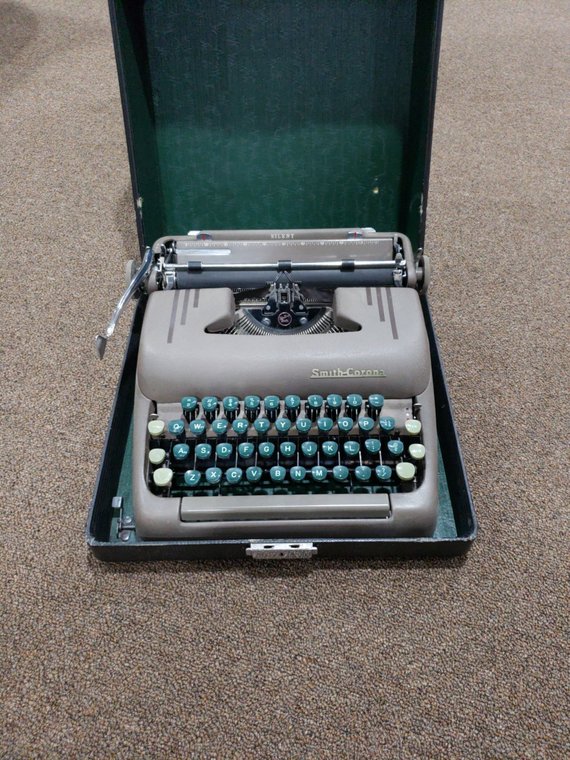
THE LATEST clue/plot device/whatever that came to me is the typewriter. At first it was a typewriter that Jody is using to type up a paper for Jumper; but then I remembered a typewriter, belonging to my parents (Mom mostly) I was allowed to use. A portable Smith-Corona in a case.
NOW I’m imagining Jody, typewriter on the hood of his old station wagon, parked at Swamis… oh, and I’d better look up 60s era Falcon station wagons; see how the tailgate worked, if the windows were electric or had a crank; don’t want to misrepresent.



 Real Surfers