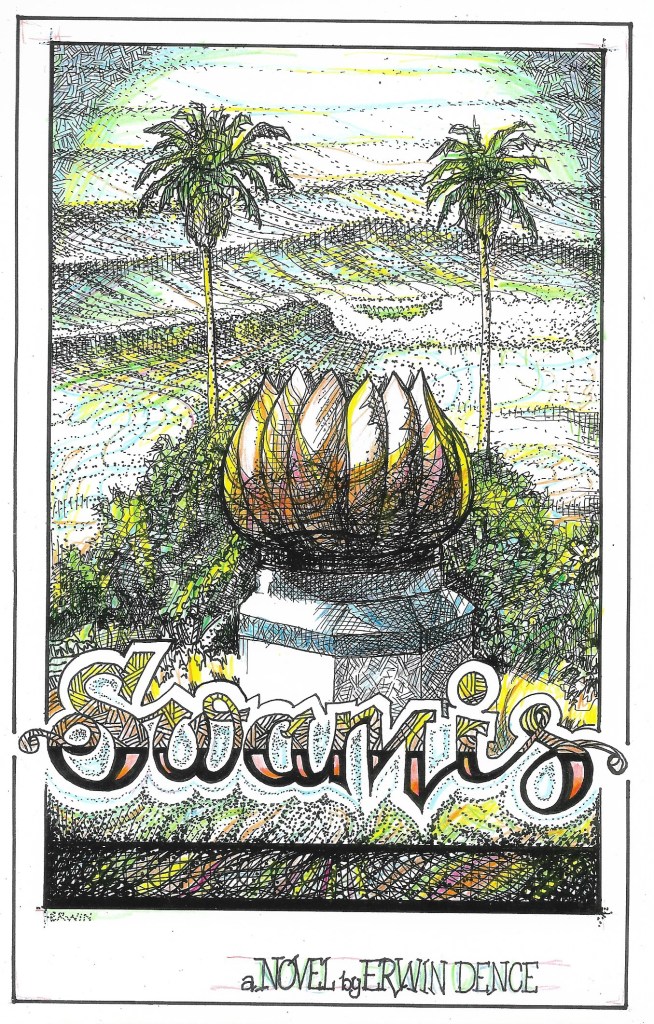
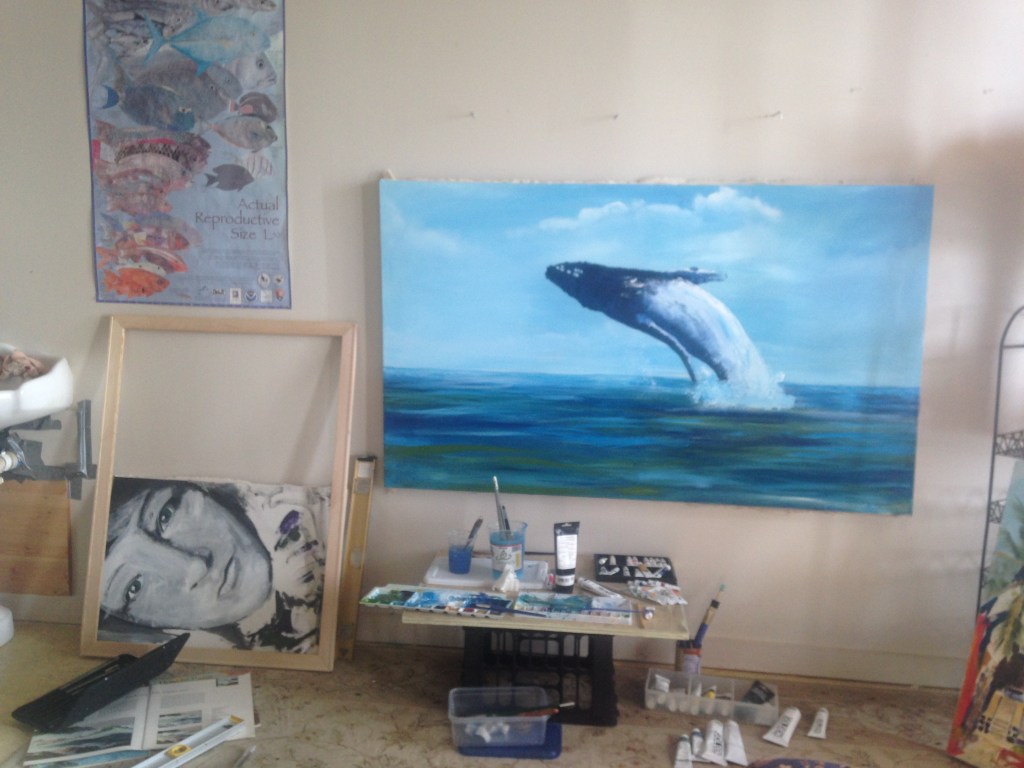
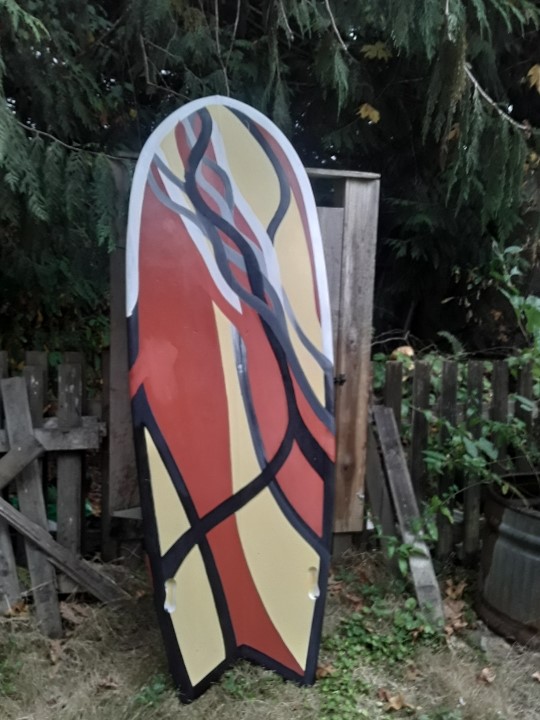
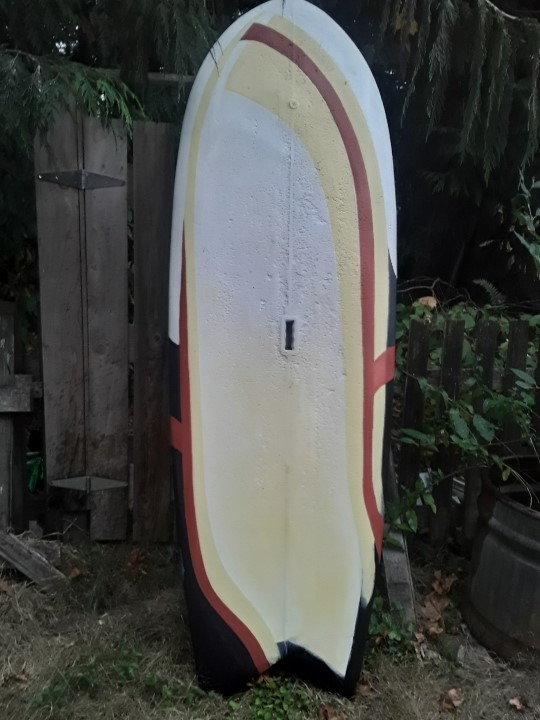
I am writing this on my tablet. Dru loaned me a computer so Trish can keep the one we share while she is spending time at Dru’s house. The borrowed laptop is a Mac rather than Mic (read Mike). Mostly the mac is for continuing “Swamis.” I haven’t yet connected it to the internet. So, hunting and pecking on my tablet. Mic and Mac and now, Tab.
IS writing a novel set in my youth a way to relive what has been lost in the fifty-plus years since? Yes. And no.
NO, much of the time covered was great. Far from all. It’s over. That wave is gone. I’m having new setbacks and adventures, dramas and traumas and the occasional great ride.
YES, I get to remember the obvious people and events. In remembering, things I have not put in the easily accessed files are brought back. This is… enjoyable, even as I realize an ever higher percentage of what I write will be cut (but probably saved, elsewhere).
AND, I get to shape characters from the amazing real people I have come into contact with. Even those characters originally based on friends have become… different. This is, again, part of the fun. Each character becomes more complex, the added fictions making him or her more… realistic. Hopefully this is also true for the reader.
THE STORY I believed I knew has demanded to be something else. More and, somehow, less. I am tightening the timeline. YET, when I finish whatever counts as a writing session, I cannot help but consider where and how it could be different, hopefully better.
We can’t change the past. We can’t go back and edit out the awkward falls and crappy conditions, can’t add a few more awesome rides to past surf sessions.
It’s another outtake from my manuscript for “Swamis,” re-edited, because I just can’t help it, and posted here because I just can’t leave it in some bound-to-get-lost file. I like the story. It is based, mostly, on two incidents: My running into a classmate on the night of the homecoming game, five years or so out of high school, and my being declined for purchasing cigarettes when I was seventeen. Gordy was with another classmate, a girl who was my chemistry lab partner, and with whom I had gone on one date, just before I met Trish. Gordy had gone full-on hippie, did put the emphasis on the ‘ing’ part of the word ‘fuck-ing.’ All a bit anachronistic.
This was the first image in a search. I wasn’t lazy, it just works the best.
SO FUCK-ING COOL… MAN
Gordy claimed to be a surfer, though I never saw him actually in the water. On the beach a few times, talking surfing as if he had just been in, somewhere else, somewhere better, or just about to get in. Later, if it got better. He was two years ahead of me in high school and regaled the other non-surfing jocks at school. Gordy was not one of the older students Gary and I bugged and begged for rides to the beach. Once, maybe.
I was in a liquor store in Vista. Gordy was sporting a full-if-sparse beard and long hair (Fallbrook High had a dress code), parted in the middle (of course), and clothing, Hippie-garb I called it, that denied his quite-upper class upbringing.
“Still fuck-ing’ surfing, Jody?”
I took the usual few seconds to replay his sentence. He had separated the syllables, put the emphasis on the second one. “Ing!’”
“Of course.”
“So fuck-ing’ cool, man. We just don’t fuck-ing’ see each other, man; like, like we used to.”
Gordy was, obviously, stoned. He had his left arm over the shoulder of an even more-stoned girl, younger, possibly still in high school. She was wearing a headband, her boutique-chic top hanging precariously on her breasts. She was nodding, giggling, her eyes unable to focus or even adjust to the light from the coolers we were standing next to.
The girl looked at me, squinting, then nodding, a finger pointed way too close to my eyes. Big smile. “My brother Larry,” she said, “he says you’re a fuck-ing’ stuck-up asshole; oh and…” She lost her thought.
Emphasis on the ‘ing.’
“Larry?”
“Larry,” the girl said. “Larry Walker.”
“Oh. Larry Walker? Yeah.”
“Yeah. Larry. You did punch him out, Jordy.” Gordy didn’t wait for my response. “Freshman football. Practice. I was J.V., just before I went varsity.”
I replayed the incident in my mind. Larry was the ball carrier. I had tackled him. Open field. He and I were both on the ground. The play was over. He gave me an elbow shot to the groin. Someone pulled him up. He pulled his helmet up and back, smiling at me with his plastic mouth guard smile. “Gettin’ tackled by a beaner’s bad enough. Some fuckin’ half-Jap…”
Straight shot. No broken teeth. Mouth guard.
“Yeah.” Gordy and Larry’s little sister had walked away. I walked toward the counter. The guy behind it looked at me for a second, continued leering at the girl as she and Gordy came up behind me. “Larry’s little sister,” I said. The Counter Guy nodded. Appreciatively (by which I mean creepily).
“She’s probably going to be, like…” I turned, looked at her (questioningly, not, I hope, creepily). “…a Junior?”
Larry’s sister nodded, her nod a bit uncontrolled. “Uh huh.”
“Class of, uh, a second…”
“Seventy-one! Yea!” She made a bit of a cheerleader pompom gesture, one hand, a jump motion without actually getting off the ground. Junior Varsity.
I looked back at the Counter Guy. He looked at Gordy. A little judgey, not that Gordy noticed.
Gordy took his left hand off Larry’s sister’s shoulder and put it on mine. I looked at his hand. He took it away. I put two one-dollar bills, my package of Hostess donettes and a quart of chocolate milk on the counter, pointed to a pack of Marlboros (hard pack) on the back wall, turned back to Gordy and Larry’s sister. Gordy sort gave me a specific look. Disappointment.
“I know, man… Gordie; you probably don’t fuck-ing’ smoke… cigarettes.” He and the girl both giggled.
The Counter Guy set the cigarettes on the counter, rang up the carton of milk and the donettes.
“Pack of matches, too; please.”
Counter Guy put two packs of matches on top of the Marlboros. “You’re seventeen, huh?”
I didn’t think. “Yeah, I am.”
“Well,” he said, “You got to be eighteen.”
Gordy laughed. The girl laughed a moment later.
The Counter Guy slid the cigarettes away from me, slid a fifty-cent piece and two dimes and two pennies back to me.
“Oh,” I said. “I’m eighteen, too. I meant…”
Counter Guy looked past me, to Gordy. “And you, sir?”
“I left my license in my other pants,” I said. Counter Guy ignored me, smiled (still creepily) at Larry’s sister. I looked at her. She seemed to take the leering as flirting. Gordy handed his date a bag of potato chips and returned a six pack to the cooler.
Gordy returned, surprisingly quickly. He put one hand on the cigarettes, the other on my change. “I’m eighteen,” he said, “and I can fucking’ prove it.”
“Twenty-six cents more then, for the chips.”
“Didn’t mean to be so… fucking’ uncool, Gordy,” I said, as he and I stepped outside, Larry’s sister a few steps behind us.
“Nah; it’s cool,” Gordy said. He flipped me the cigarettes, one pack of matches, making sure I realized he was keeping the other one. He pulled Larry’s sister closer to him, slung his left hand over her shoulder and perilously close to her breasts, extended his right hand as two (obviously) off-duty Marines approached (obviously Marines, obviously off duty), both looking more at her than at him. “Either of you two gentlemen twenty-one?” he asked, pulling out several ten-dollar bills.
Neither of them was, but the next guy approaching, not a Marine, definitely was. The citizen looked at the two Marines, at Gordy, at Larry’s sister. He put his hand out, said, “it’ll cost you.”
“Peace, man,” I said, walking away, waving my free hand in a peace sign. Gordy, his hands off Larry’s sister, left hand holding his wallet, flipped me the peace sign with his right hand, but quickly, and not where the Marines could see the gesture. Not that they or the Citizen taking money from Gordy were looking past Larry’s sister. She gave each of them a very quick, weak smile, and, in a moment of self-awareness, pulled her top up a little higher on her breasts.
Flipping the peace sign was, for anyone under thirty or so, pretty much over by this time, the winter of 1969. On special occasions, perhaps; the act was shared with friends as a sort of code, an action we would only later” refer to or try to explain as having been done “ironically.”
IF YOU’RE STILL WITH ME, thanks. I should add that the football punch part is actually derived from an incident in which classmate Bill Birt, in practice, sophomore year, pulled off a teammate’s helmet and slugged him in the face. Kicked off the J.V. team, the coach, allegedly, said, “Now, Bill, if you only played that way in a game…” The result of blending in all the real stuff is fiction.
All original writing contained in realsurfers.net and anything taken from manuscripts for “Swamis” is protected under copywrite and is the property of Erwin A. Dence, Jr.
GOOD LUCK SURFING. And I don’t mean that sarcastically or ironically.
An early 60s Falcon, factory racks, custom tires (pretty sure)
This is another outtake from “Swamis.” If writing is trying to put the puzzle pieces together, this was written to support something later in the manuscript and taken out because I figured out another way to get the information on the page.
I will reveal where the idea that a small, independent grocery store would have tabs for customers. It is based on The Village Store in Quilcene, Washington, known at the time when Trish and I moved here, late fall, 1978, as “Mary’s” Village Store. Mary and her husband, nicknamed Pard, offered credit based on a quick conversation. “We’ll set you up with a tab.” Nearly everyone in town had a tab. Mary also offered a sort of ‘payday loan,’ with, like ten percent interest, as in, if you borrow a hundred bucks on Tuesday, you pay a hundred and ten on Friday. Good money.
Because you had a tab, you had some obligation to buy locally, as in not going to a supermarket in Port Townsend or elsewhere for groceries. And Mary kept tabs, so to speak, on those who had tabs. Her standard greeting was, “What do you know?” She was persistent and serious in this. She wanted to know.
We, of course, had a tab. Trish worked at the store for (I’d have to ask her) some amount of time. I painted the store to pay off the tab. I wasn’t happy with having one.
Still, it worked well for Mary and Pard. They had stacks of thin pieces of cardboard, tabs, in order, alphabetically. If Mary was at the counter, she would survey the card. Her expression would reveal whether or not you should put this purchase on the tab or give some explanation on when you might pay the amount owed down.
When Mary and Pard attempted to sell the Village Store, local gossip/legend has it, they had to eat a lot of the debt accumulated over the years. There have been several owners since. I have no idea whether the current owners take this kind of casual credit. My guess is… no. I haven’t asked.
Okay, here’s the outtake:
SIDESLIPPING- OUTTAKES FROM “SWAMIS”
I loved the Falcon. My first car.
No, it wasn’t a gift. I was making payments, money withheld from paychecks at the job my father set me up with. “Responsibility has to be learned,” my father said each time he picked up his half, straight from the middle register at the San Elijo Grocery. It was a sort of ritual, every other Saturday night, my father taking cash from the hands of his old Marine Corps buddy. “We all have to learn how to work hard. Huh, Tony?”
Tony, Mr. Tony to me, would look at the cash, look at me, and smile. “Right, Gunny.”
With my first payday, December 28, 1968, Tony gave me my half, which, at a dollar fifty an hour, for sixteen hours on weekends, plus a few more days during Christmas vacation, paid for the gas to get to Cardiff from Fallbrook, and not much more. He winked and said, “It’s Kind of like…” Mr. Tony nodded and smiled, the nod with a certain and meaningful rhythm, a bit of a jaw thrust included in the motion. There was a bit of a twist of the lips in Tony’s smile. Suggestive.
My father gave Tony a look I was very familiar with. Disapproving. Disappointed.
“Sorry, Gunny.”
“It’s all right.” Tony seemed relieved when my father laughed and pushed me away. “Real world, huh?” Tony nodded. “The boy keeping his tab clear?”
“Chocolate milk and those little donuts are all he’d put on a tab, Gunny.” My father looked at Tony with another expression I was familiar with, the just-try-lying-to-me look. “No tab for Jody, Gunner, no little loan ‘til payday with exorbitant interest.”
“Usury, it’s called, Tony.”
“Yeah. Jesus doesn’t like it.”
“But you do.”
“Brings in customers. Kind of makes up for the folks who skip out.”
“And you and Mrs. Tony love having people… owe you.”
“We do.”
…
I loved my job; bagging, stocking shelves, sweeping up; I described myself as a nub at a family grocery store with a view of Cardiff Reef.
I already said this, but I loved the Falcon. This was the family wagon in which my mother, and then I learned to drive. Three on the tree. Pop the clutch. Stall. Try again. My father, frustrated enough teaching my mother, gave her the task of teaching me when I was fifteen and a half. Exactly. She was so much calmer than he had been. I knew, even as my father turned the Falcon over to me, that I would be expected to teach my brother, Freddy. I didn’t plan on being calm. I didn’t plan on being around. I had other plans.
As always, thanks for reading. All “Swamis” outtakes are protected under copyright, as is all original writing and original illustrations contained in realsurfers. Almost all the photos are borrowed.
In my attempt to cut and whittle and refine my manuscript, “Swamis,” into something, one, readable, and two, sellable (could have said marketable), I am eliminating this portion. Changes: Virginia (Ginny) Cole is now Julia (Julia), Erwin as a character (put in because some readers might believe Joey (aka Jody) is me, is gone. Out. I should (will) add that Trish did go to junior high in Oceanside with Barbi Barron and was a temporary member of Barbi’s unofficial Oceanside girls’ surf club before Trisha’s dad got transferred to the East Coast. I did see Barbi frequently at the Oceanside jetties and the pier when I was working at Buddy’s Sign Shop in (let’s call it) O’side. I did have a night class, public speaking, with Cheer Critchlow, Palomar Junior (now Community) College. He did, and I reminded him of this, at a high school contest at Moonlight Beach in 1968, in which he was a judge, eliminate real people Scott Sutton and Jeff Officer and me in our first (and only) heats. I never met Margo, did hear and read about her.
With those notes, the story is sort of (kind of) true (if fiction is sliced from real life).
CHAPTER 14- WEDNESDAY, FEBRUARY 19, 1969
For reference, this was a week and a day before my father’s death, four weeks before Chulo’s.
Ginny Cole was, to my seventeen-year-old self, perfect. There is no way my memory, in the fifty-plus years since, could have further enhanced that image, that belief. Perfect.
Some of the girls I had gone all through school with were great, and I could easily supply a list of those I’d had crushes on, but, yes, I’d gone all through school with most of them. There were, always, new girls; daughters of Marines stationed at Camp Pendleton, temporary duty, three years and gone. They came from or went to Twenty-nine Palms, Camp LeJeune, Barstow; occasionally one would come from Hawaii, Philadelphia, even overseas.
Fallbrook is on the east side of the triangle that is Camp Pendleton- Fallbrook, Oceanside, San Clemente. From kindergarten on there were sons and daughters of Civil Service workers, pharmacists and ranchers and irrigation contractors and teachers and real estate agents and builders. There were those whose fathers lived, during the week, in apartments in the vast smoggy sinfulness of Los Angeles.
If we were isolated, purposefully, there were always newcomers with stories of different places. Exotic, mysterious, sophisticated, up to date.
Ginny Cole was, in my mind, miles away from dusty Fallbrook. Mysterious, exotic, distant; and she surfed. Ginny would know what it means that someone surfed, and she would know the allure, more fiction, even fantasy, than reality, of surfing itself. There’s what surfing is, and what surfing suggests, what being a surfer says about a person- the aura around the reality. Perfect.
Ginny Cole was like the best photos from surfing magazines, like memories of my best rides. I could bring her image into my mind at will, or without willing it; images from the few times I’d been on the beach or in a parking area or in the water with her. Not with her; around her, near her. It wasn’t like she knew me; another teenage surfer, awkward out of the water, not yet skilled enough to be noticed in the water; but working on it; hoping to be a surfer who, when I took off on a wave, people would watch.
Teenager fantasy, of course, in the same way, playing pickup football, my friends would self-narrate: “Roger Staubach drops back… and the crowd goes wild!” There were always witnesses in my mind when I would skateboard; carving bottom turns and cutbacks, pulling up and into the curl, crouching, hands out, locked in, eighteen miles, straight, from the nearest saltwater.
Competing. Improving.
It was more than that Ginny was a girl in the lineup. She could surf, ride a wave with graceful, dancer-like moves, always close to the power. She would always be noticed.
I cannot honestly swear that it wasn’t that I wanted a surfer girl girlfriend the way a girl might want a football quarterback, a lead guitarist in a garage band; the way a guy might want a cheerleader or that girl who’s always just so nice. And so pretty.
Ginny wasn’t phony nice or made up pretty. She was just-out-of-the-water pretty; she was real; she was perfect. I saw it. I assumed everyone did.
If I did see Ginny as perfect, I did think winning her over would be difficult, challenging. There would be other suitors. I knew I was ridiculous, naïve; definitely, but I was competitive. I didn’t know her, couldn’t see more than my romanticized image of her. I did hope that if she shared that obsession with and addiction to surfing, she might understand me.
Still, also, and always, I knew I was ridiculous.
…
Virginia Cole wasn’t the only girl surfer in the North County; there were a few others: Barbie Barron, Margo Godfrey. I frequently saw Barbie in the water and in the parking lot at Oceanside’s shorter jetty, or over by the pier. Southside.
I once saw Margo with Cheer Critchlow at Swamis on a still-winter afternoon; uncrowded, big and blownout. Pretty scary. Yet they were just casually walking out, chatting, wading out on the fingers of rock, pushing through to the outside peak. Scott and Jeff and Erwin and I, our portable crowd; four inland cowboys, shoulder-hopped, choosing only the smaller waves on the inside, watching any time either Cheer or Margo would take off.
Coolness, casualness, some sort of self-confidence, some sense of comfort in one’s own skin. Things I lacked, things I appreciated, qualities I believed Virginia Cole had. Yes, I do realize how this makes me sound; exactly like a seventeen-year-old on the cusp, the very cusp of… everything.
MORE NOTES: I am also tightening the timeline for the story. I have to. One thing all the over-writing has given me, besides so many back-stories for characters I have to eliminate or cut back on, is the knowledge that there is at least one main and worthwhile story in “Swamis.” I will keep cutting back and hacking and going down the line until… yeah, until.
ALSO: I have changed some other names, partially because I have written words the real people didn’t say, put them in situations that are totally and completely fictional. My best surfing friends Ray and Phillip- sorry, you’re now Gary and Roger (names from childhood neighbors), Wally Blodgett, who drove kids around for dawn patrol, is now Petey (kept the Blodgett part). Sid (whose name I borrowed from a real surfer who was in a Surfboards Hawaii ad in mid-sixties, can’t remember his last name) is, so far, still Sid. I will let you know who else changed as the manuscript changes.
ALSO: Pretty shitty spring for waves on the Strait AND pretty shitty weather for painting houses. YES, it would seem that would give me more time for writing and drawing. So, maybe it’s not THAT shitty.
Good luck to all the real people and real surfers. Remember, this stuff is copywrite protected.
…and another “SWAMIS” cutback. FIRST, here on the Olympic Peninsula, buoys, designed to help ships not sink or crash, somewhat helpful for surfers trying to determine if some portion of some swell might find its way into the Strait, have been ripped from their anchors, set adrift, lost, found, or, we don’t really know, put out of service. Putin? One theory. None of the downed or drowned bouys have been put back into service.
SO, surfers in, say, Seattle, have been relying on surf forecast sites before making a decision as to whether to invest the increasing amount of gas money, wait in line at ferries, face traffic slowdowns if ‘driving around.’ NOW, it must be mentioned that there are always waves of some sort or shape or size on the actual PACIFIC COAST. Almost always. AND the most characteristic condition on the Strait is flat. Flat with east wind, flat with north wind, flat with south wind, flat and somehow blown out with west wind.
STILL, surfers get desperate. So, trying my best to glean something positive from whatever sources I could, I went up Surf Route 101, looking. I wasn’t alone. More to not get skunked than to satisfy my surf lust, I ventured into calf-high curlers, my fin popping across rocks. PERHAPS BECAUSE I had paddled out, three more adventurers joined me. PERHAPS BECAUSE they had believed some forecast site, I passed many surf rigs on my way back down Surf Route 101. NOT ONLY THAT, but a friend of mine texted me, asking if I had scored bombs. AFTER ALL, Magic Seaweed was saying…
NOW, maybe it got awesome. Somewhere, for some brief period. MAYBE. YES, I did look at various forecasts. Not looking good for the Strait. Depressing. I must now upgrade my most recent session to “Pretty good. Didn’t break a fin.” Again, there are always waves on the actual ocean.
The rocks at Swamis, someone dropping in on someone. Taken from some hotel brochure.
MEANWHILE, I am trying to find some time to continue cutting my manuscript for “Swamis” down to a reasonable and, hopefully, saleable length. Tightening it up. I am up to the days after Chulo is beaten and set alight next to the wall of the SRF compound. This is a (copyrighted) version from the second completed draft. I might mention that, if you have any experience surfing on the west coast, you know (a snippet of a quote from Miki Dora about Malibu) “The south wind blows no good.”
CHAPTER 14- SATURDAY, MARCH 22, 1969
Three full days after Chulo’s murder, the burn-scarred section of the wall was back to white, visibly white even in the minimal pre-dawn light. I wasn’t sure if I had actually slept. I got out of bed at four, got to Swamis early enough to park the Falcon in the choicest location; front row, ten spots from the stairs; the optimal view of the lineup.
The Falcon was the same car in which my dad had taught my mom to drive, the station wagon, three-speed manual transmission. This was the car she used to drive her two boys to swimming lessons, and church, and to my appointments with a string of different doctors; and to the beach; surf mats and Styrofoam surfies and whining Freddy, maybe an annoying friend of his. The factory installed (optional upgrade) roof racks were now pretty much rusted in place.
The difference was the Falcon was now my car. A surfer’s surf wagon. Hawaiian print curtains hung on wires, a “Surfer Magazine” decal on the back driver’s side window, a persistent smell of mildew. Beach smell. With my boards now shorter, I usually kept them inside, non-hodad-like, but, for several of the reasons a hodad would do it, I kept the nine-six pintail on the roof for a while longer. “Just in case the waves are really small,” might have been one excuse.
A predicted swell, this gleaned from other surfers and pressure charts in the Marine Weather section of the newspaper, hadn’t materialized, and a south wind was blowing. Cars with surfboards were passing each other up and down 101. Surfers were hanging out in parking lots and on bluffs and beaches, talking surf, watching the few surfers out at any spot bobbing in the side chop. Maybe it would clean up, maybe it would actually get bigger. And better.
I would wait. Waiting is as important a part of surfing as trying to be the first one out or paddling out before the best conditions hit. Just before. My shift at my weekend-only, for-now, job didn’t start until ten-thirty; about the time the onshores typically get going. Different with a south wind. Sometimes it would clean up as some weak front moved inland or simply fizzled. Sometimes.
If I went out at nine, I could get a good forty-five minutes of surfing; maybe ten waves or more. I had my notebook, college-ruled; I had the four and eight track tape player under the passenger’s side of the seat; a collection of bargain tapes purchased at the Fallbrook Buy and Save; and I could do what I always did, study. My father’s billy clubs sized flashlight, four new d batteries, provided the lighting.
Read, recite, memorize, reread. That was my system. Less important details fall off with each attempt to memorize. The facts and details best remembered, by my logic, would most likely be the ones on the tests. Any quirky anecdotes, something that amused me; yes, I remembered those, too. I had another system for multiple choice tests and standardized tests. Two of the four choices were obviously incorrect, fifty-fifty chance on the others. Best guest. The system worked surprisingly well, well enough that California’s supposed Ivy League university accepted me.
My father hadn’t understood why I couldn’t go there.
I was a faker, kid with a system; it never would have worked; not in that bigger pond, every student top of some class somewhere.
No studying on this morning. I had to sneak over to the crime scene, the wall that surrounds the Self-Realization Fellowship compound. There was (and is) a wrought-iron gate in the higher, arched (former) entrance, around the corner, facing 101. As with the other breakpoints in the wall, that section is topped with the huge gold sculptures, each one representing a blooming flower. Lotus blossom. They could as easily represent a flame, not dissimilar to the one on the statue of liberty, not dissimilar to the burn marks on the wall my friends had described.
The SRF compound is a place where people, on their own, go seeking enlightenment, a realization of the true self. Seekers, seeking.
At about seven-fifteen I did walk over. Had to. I expected more. I expected some instant and obvious explanation. There was a man by the wall, wheel-barrowing soil from a pile near the highway to the wall, raking it in. I had seen him before. Dark skinned. East Indian, I presumed. He was dressed in a long-sleeved shirt, white, with faded blue workman’s pants, rubber boots, and heavy leather gloves. Most of his face (and I knew he had a beard) was covered in what appeared to be an overlarge (plain cloth) bandana, a standard bandana (red) around his nose and mouth, and a tropical straw hat (quite different from the cowboy style Mexican farmers and landscape workers preferred). He dropped the new soil around newly planted but full-sized plants.
There was no evidence that something horrific had occurred. The new paint blended perfectly. The plants looked… it all looked exactly the same as it always had; as it did even in the late 1950s, before I surfed, when my father took us there just so my mother could see the gardens.
If I blinked, I thought, it might be like taking a picture. I might remember details. I might remember better. Image. Catalog. File.
My novel, “Swamis,” would be complete and possibly readable by now if I wasn’t so (I have to say) involved in the backstory for each of the main characters (and, I guess, if there weren’t so damn many of them). I wouldn’t have been so involved in the details if it wasn’t so important to me to know and show how distinctive each character is. And realistic, authentic.
It hasn’t aided my task that character development and the crashing of characters against each other is so much fun for me. Writer fun, not like reader fun.
A reader wants FOCUS. I am trying. My third page one rewrite has narrowed the timeline, tightened the storyline, dropped out a few characters.
Here is an exchange that won’t be in the novel. I have already eliminated this scene at the San Diego Sheriff’s Office Vista Substation:
We’d been in the office too long. We were all a bit more… relaxed.
Dickson closed the door with a kick of the knee when he reentered the office with two more cups of coffee. He handed one to Jumper, said he put a little coffee in with the sugar. Wendall took the other cup, said Frederick Thompson had not been drunk or under the influence of drugs as far as the medical examiners could tell. “Just crazy.”
“Helicopter pilot,” Jumper said, as if this explained something. It seemed to. Maybe not enough. “He flew evac in Korea, got out, surfed, went back in for Vietnam. Gunships. Different thing. Fucked him up.” Jumper paused. “So, yeah; crazy.”
Wendall lit up another cigarette. “And… all of this… craziness, Langdon is claiming, and he has the ear of the politicians, is because of the Sheriff’s Office laissez-faire” (he pronounced it la-zy-fair) “policy toward pot growers and dealers in our county.”
“Miss Ransom and the ‘Free Press’ assholes got that part right,” Dickson said. “La-zy-fair for sure.”
Wendall leaned over the desk as far as he could. “It wasn’t your father, Jody; Gunny thought he had it under control. It’s just… grown… too fast, too many new, um, participants. We knew about Chulo; that he was collecting money from the hippie dealers. Chulo and…?”
Jumper and I both said “Portia” at the same time.
Oceanside 1974. The proximity to Camp Pendleton and a steady stream of vulnerable Marines had made the downtown a pretty tough place in the Vietnam era. I worked at Buddy’s Sign Service in this area June, 1969 to September, 1971. Yeah, too much exposition.
“Oh yeah,” Wendall said, “Portia. She’s actually Patricia Sue Langley. Patty Langley, runaway from, um, Many Wives, Utah; busted for petty theft…ha ha… back in ’65. No, um, end of ’64. She was a minor, so… So… and… oh, then she got… sexual. Oceanside. Marines, mostly; easy pickin’s.”
Dickson interjected. “Not our, as you know, jurisdiction.”
“Oh, but then Patty got herself down to Leucadia…” Wendall said, “across 101 and down from where you live now, Jody; one of those motels.”
Dickson pointed toward Jumper. “Second one past your place.”
“When I was a kid,” Jumper said, “Chulo and I’d go around, pick up coke bottles at the Log Cabin Inn, other motels; turn them in for the, the deposit. Good money for a kid.”
I felt compelled to join in. I spoke quickly to make up for the obvious lack of interest by the others. “A neighbor kid, Roger; he and I went to this ball game down by Live Oak Park. Fallbrook. Roger’s brother was playing. We picked up bottles; took them to the guy at the little… the stand. The guy said they were his bottles, wouldn’t give us the deposit money.”
“You tell him who your dad was?”
“No.” I looked at Wendall, Dickson, Jumper. They were waiting. “Roger did.”
Wendall cleared his throat. Loudly. “So. Jody’s dad… Gunny… Joe; he always liked to point out how most all the motels were on the south-bound side; like that showed nobody’s coming up from San Diego looking for a place; it’s all from the north. L.A.”
“Anyway,” Dickson said, “guess she… Patty, um, slash Portia, got tired of… servicing… Jarheads; fresh-outa-boot-camp Ji-rines; they’d probably want to go two or three times.” He did a subtle hip thrust motion, adding, “First time ought to be free. Ha! Probably wouldn’t even make it out of his skivvies.”
Wendall took over. “It was my call. Disturbance. The proprietor actually called it in; but Gunny and…” Wendall pointed over his shoulder. “Gunny and Big Imagination here show up. I’m standing outside a room with some fat business type from Covina… West Covina. So… fat. He claimed he hadn’t gotten his money’s worth.”
It was a brief pause, but Dickson took the story. “So, Joe goes, ‘money’s worth of what?’ The guy… hey; it’s your story, Wendall. Did you take a bribe on that one?”
“Well.” Wendall looked around to make sure everyone was watching. “Sort of. Gunny, he goes up to the guy, looks down at his…you know, package. The guy was in… he’d put on his business jacket. Seersucker; some sort of sales guy green. Sears or Pennys; one of those. No shirt, and, you know, tidy whities; size, um, enormous. For his butt. No big bulge; not that I would notice. Black socks, the kind you hold up with garters. Garters. This Chipper, Mortenson, shows up and the… West Covina guy is acting like we’re supposed to be… like we’re on his side. Mortenson, you remember him, huh; tough bastard, loved to pull over kids.”
“And beaners,” Dickson said, looking directly at Jumper before giving Wendall a sweeping ‘take-it-away’ gesture.
Wendall was leaning forward, both elbows on my dad’s old desk. “So, Gunny, he’s got Mr. West Covina’s wallet in his hand and, I guess, repeats, ‘Money’s worth of what, Mr. um, Redwick?’ Red… wick.”
We all may have chuckled. Wendall continued.
“So, Patty’s standing there, wrapped up in a blanket. Not because it’s cold… and the motel owner, older woman who thought she’d be renting places for artists; like, you know, like Leucadia’s Newport Beach or something; she’s got an arm around Patty, and Patty’s got a bottle of orange soda up against one eye, and Gunny’s just waiting for Humpty Redwick to answer. And I say, ‘Maybe he was getting some, um, advice on, um, clothing choices.’ Morty… Mortenson, this cracks him up. But Gunny’s all business; serious. I mean, Morty’s seen some shit. He’s a vet, too. Korea, at least. Army. Chosin Reservoir. Bad shit. And he’d been cruising up and down 101, ‘Slaughter Alley’ for years. He was still, those days, still on a motorcycle. So, yeah; blood… tough guy, and he’s just… laughing.”
Wendall put a cigarette in his mouth, pulled out his Sheriff’s Office Zippo from his shirt pocket, snapped the lighter open with a jerk of the wrist, hit the wheel with a snap of the finger. More theatrics. “So, now Morty sees your dad’s serious. I mean, Morty was big, but Gunny was looking… you know how he could… that look; fierce, fierce-like; and Gunny he… he opens up Redwick’s wallet, then holds every photo of the guy’s wife and kids up to his face; whole, you know, string of them; and then shows them to me. And the owner. And Patty. Gunny takes out all the cash. He asks the proprietor if the motel fee has been paid. She says, ‘Diner’s Club,’ and Gunny holds a twenty and a couple of singles up in Redwick’s face, puts that cash back in the wallet, sticks the rest out toward Patty, sticks the wallet back into Humpty’s inside coat pocket.
“Gunny’s still holding, probably, two hundred bucks. She, Patty, she shakes her head. And I say, ‘Oh, the advice,’ and she, no one would take her for dumb; Patty says, ‘Maybe Mr. Redwick should switch to some, um, boxers… maybe some, uh, dark color; that might be a choice.’ She takes the money. Now Gunny’s smiling. We’re, all of us, laughing. Not Redwick. He does look a little relieved, maybe.”
Wendall stopped, inhaled, blew the smoke out kind of forcefully. We all watched the cloud get sucked into the fan, some of it actually going out the window.
“Wait. Wait. So, Morty gets a call; three car pile-up by the Carlsbad Slough. He gets on his bike, starts it up, peels out. Lights and sirens.”
Jumper filled in with, “Not your jurisdiction.”
“Right. Then, two doors down, this other guy tries slipping out of a room. Gunny’s watching Patty. She must of looked over. The motel owner, she seems, um, concerned. Gunny gives me a look. The other guy, he tries to duck back into the room. I run down… yeah; I can run… I push open the door, grab this guy. He must have thought it was all over when Morty left.”
Wendall did a sort of relaxed pose, casually inhaled, slowly blew out smoke.
“And?” Jumper and I both asked.
“And…” Wendall looked pleased. “And there’s another, definitely underaged girl inside; not beat up, but… I mean, it was obvious. So, short story long, it all went official. Other than the money.”
Any excerpts from “Swamis” are protected under copyright laws, Erwin A. Dence, Junior, author.
I have written some lyrics for songs over the years. It is surprising to me how many years ago some of them were developed as I drove from here to there or wherever. Or back home from wherever. Songs, not poetry. Not that I have that much disdain for poetry; it just seems a bit more pretentious than… okay, I have purposefully written a few poems.
Since I have been playing harmonica (harp to hipsters and such folks) long enough (since 1969 or so when Buddy, of Buddy’s Sign Service, gave me a Hohner full-sized slide chromonica- current replacement cost- $224.88 at Guitar Center) that I have enough Blues Bands and Special 20s, as well as the cheapie versions by Hohner and other manufacturers, with blown reeds to, someday, get them all together (or as many as I can find) with some resin and create some sort of assemblage. So Artsy. In my mind, it would be the kind of thing where any observer would have to ask, “Do you know what harmonicas cost nowadays?” More than they did when you bought one, just to try it out.
It is not accidental that many of my lyrics fit into a blues format. My older son, James, is a musician, mostly a guitar player. James started out with Heavy Metal, studied Classical Guitar at the Lionel Hampton School of Music, did some sessions at Port Townsend’s Centrum Blues Festival (not that he attended classes. He claimed that going to the week-long retreat, paid for by his grandfather, gave him access to “The Bad-asses,” he and some of them jamming on the porches of the old buildings at Fort Warden), moved on to blues-jazz fusion with his own bands, while playing lead guitar with The Fabulous Kingpins, a long-time cover tune band.
I’m sure I’ve mentioned James before. Sorry; I got started, kept going.
SO… blues, harmonicas, lyrics; the harmonica is an instrument one can play while driving. Legally, I believe, if one isn’t distracted. One hand. While I can play a range of songs… note of caution- wailing out the last verse of “All Along the Watchtower” will blow out the reeds with notes you only meant to bend- I do use my alone/driving time to write/play/sing loud enough to almost overcome the noise from the blown-out muffler on my surf rig.
I do have a working radio on my work van, with pre-sets to one NPR station, one hip Seattle station, one cool station from Everett, and one local one from Port Townsend. But… when the news is redundant and or horrific, when the folks are begging for funding, when the music is shitty or the talking heads are discussing topics I don’t actually care about, I can hit an alternate list. Classical FM, an AM station I’ve never bothered to tune out. Or I can play harmonica and sing a variety of songs I know some or all of the words to. “In the Early Morning Rain,” “Brother Can You Spare a Dime” are two examples.
It might not be surprising that a collection of songs I put together and got a copywrite for (I would have to look for the actual date- it has been a while) is entitled, “Love Songs for Cynics.” Not that I’m all that cynical. I do have some, you know, like, love songs in the mix. Here are a couple of the titles: “Ain’t Got No Problems with Lolita,” “Honey Days,” “I Just Wanna go Surfin’,” “And So am I,” “You Made me what I Am.” Oh, that one is a bit cynical.
The NEWS. A problem with watching dire weather forecasts, looking at confusing and not-necessarily-epic surf forecasts, reports from Seattle about homeless camps and people stealing catalytic converters and drilling holes in gas tanks to steal ever-more-costly fuel, network news about Ukraine and Putin and tanks and shelling and evacuations and refugees is… it is just too much.
I WAS THINKING, specifically, about this song. I tried to remember all the lyrics. No, it’s not about peace; it’s really kind of whining, poet-like. However, with a little tweaking…
“Give me some good news, please, no more bad; You know I’m crazy, but I’m not mad; Guess disappointed’s the word I’d choose; Come on, can’t you give me some good news? Something that might shake away these blues.
Something that might shake away, something that might take away, you know we can break away from these blues; If only you could give me… some… good… news.”
There is also, along with the other two verses I can’t totally remember at the moment (on a thumb drive somewhere, a printed copy somewhere else), an outro with this:
“…You know and I know and we know and they know, the world has blown a fuse; And God ain’t grantin’ no more interviews; so, come on, can’t you give me… some… good (big finish here) NEWS.”
James and me a few years back, bending notes, breaking strings, blowing out reeds.
OKAY, I’m going to check that surf forecast again. Not to dissuade anyone, but it looks a little… sketchy.
“SWAMIS” UPDATE: I’m four chapters in on the total rewrite and I’m condensing and tightening what I wrote in the outline I wrote to condense and tighten the over-expansive two earlier versions. It’s actually going pretty well. I just did more on Portia and Baadal Singh, set up Chulo and Gingerbread Fred for the chapter after the next one, and I’m thinking… can I just eliminate that one, move on to Chulo’s murder?
Thinking. It’s what I do when I’m not playing harmonica.
Wait. Is he sticking his tongue out? Is that a Saint Christopher medal? What kind of material is that top, or is it a wetsuit, made of? Is he just jumping up, or is he grabbing the rail for no apparent reason? GoPro shot courtesy of, I think, Cap, second-handed to me by Stephen R. Davis.
INTRO-
Trish and I, a little later today, are meeting up with our daughter, Dru, and heading down Surf Route 101 to see Dru’s younger brother, and Trisha’s and my youngest child, Sean.
EXPOSITION- Optional
Sean has an older brother/oldest child, James, over on the borderland between Washington and, yes, Idaho. James lives in the red state, works in the red, East of the Mountains part of Wa, and, yes, a bit of the blueness may have faded in the years since James headed that direction, signed up for classes at the U of I because of the Lionel Hampton School of Music, continued his practice of having his own band, continued improving on guitar playing, got into a popular Moscow-based cover tune band, the Kingpins, as lead guitar player (he can crank out any riff you’ve ever heard), dropped out of school, continued spelling his name Jaymz, got married to a woman with a young son, had a son, got divorced, got remarried. His stepson had the first of several (3 now) kids, his son had a kid and joined the Navy, pretty much in that order.
Brief history, without the histrionics.
So, back to Sean, down in Olympia. But first, yes, since our youngest child is turning forty, I must be something other than young. I am not writing about that today. Maybe a little.
MORE EXPOSITION- Also optional (suggesting all other reading is mandatory)
Sean attended the Evergreen State College, graduated, got a master’s degree in Public Administration. Any day now we expect him to use the degree and his experience in working jobs in which an advanced degree is not required and get something better, white collar, perhaps. Sean does have the capacity to retain and pass on incredible amounts of knowledge on subjects he has a passion for: Movies, action figures. Action movies. So far, this passion hasn’t turned into a clear career path. We have hope.
All Sean needs is focus.
FOCUS and “SWAMIS” What I really wanted to talk about-
After writing two complete versions of my novel, I decided an outline might be a tool to cut down on the extraneous and peripheral stuff. Plot, not backstory. Not exposition. No fancy descriptions, just basic setting, dialogue, action. Because of the time I have invested, I have to rationalize. I know my characters. Helpful.
The PLOT, the STORYLINE(S) have always been the same. Everything else is in support of the story.
DIALOGUE is very important to me- getting the rhythm and the use of language right. I used an ‘if it is important, I will remember it’ technique, trying not to constantly check with the second unexpurgated manuscript.
I wanted to use STORIES told by various characters to establish the character of several of the… characters. FOR EXAMPLE: JODY/JOEY is meant to be someone with a history of violence, of striking out when he felt threatened. I wrote several stories to back that up. JUMPER was severely wounded in Vietnam and almost certainly has Post Traumatic Stress Disorder. I wrote a whole lot on that, probably won’t use any of it. JOSEPH DEFREINES was a decorated war veteran. I didn’t write much about that, but because my father also served in World War II and Korea, I know something about how Joey’s father would suppress his own trauma.
What I attempted to do is cut out some of the stories, shift some of the stories around, have them told, in a shorter form, or merely alluded to, by other characters. STILL, I love some of the stories.
THE ACTUAL MANUSCRIPT- I told myself it would be so easy converting the outline into a novel. NO, none of this is actually easy. I do, however, love it all. I have to rationalize the time I spend writing and thinking about what little changes I just need to make; I tell myself that all writing helps one become a better writer. SURFER ANALOGY- Wave count; it’s all about the wave count.
The outline ended up being 14 ‘Episodes,’ If that sounds like it’s more screenplay than outline… yeah.
Adding the descriptions of the settings has not been as quick and easy as I had imagined. I have made more changes and will, undoubtedly, continue to do so. Tighter. That is the goal.
I currently have the Forward, the first big chapter and a good start on chapter two at a state I’m pretty happy with. I printed the nineteen pages up. THE PLAN IS, when I have Drucilla, who loves to listen to podcasts and books on tape, as a captive audience in the car with Trish driving (after my last crash, Trish will no longer allow me to drive if she is in the vehicle- I’m fine with it), I will read the manuscript to her.
FOCUS- I was talking to a client the other day about painting the trim on her Port Townsend Victorian house, and, as I do, I was off on numerous tangents. “We have to focus on the painting here,” she said. “Oh. Okay.” I said I wasn’t insulted, then said, “Yeah, I am kind of insulted. It’s okay.” I walked toward my van. “You know, the main character in the novel I mentioned… He gets so involved in all the stuff that is going on that… I think, for a detective, that kind of perceptiveness might not be a bad thing.” She nodded. “I have every confidence,” she said, “based on your reputation, that you have the ability to focus totally on what you’re painting.”
“Well,” I said, climbing into my big boy van, “I do.”
I wanted to add “When I have to.” I wanted to add a lot more. No time, had to get to working. Focusing on the task at hand.
DRUCILLA BACKSTORY- Optional but possibly interesting-
Dru went to Loyola University in Chicago, graduated, got a good job with an advertising firm, didn’t complete her master’s degree (Trish hopes she still might), worked for “The Onion,” moved back to the northwest a couple of year ago. She lives in Port Gamble, works in a shop there and does off site work for another advertising outfit in Chicago, works for the Olympic Music Festival. Dru actually did some recording of ‘concerts in the barn,’ the barn being in Quilcene, when she was in high school. Dru’s best friend from high school, Molly, lives in one of those old houses just down the street from her.
I really want my only daughter to help edit and package and sell “Swamis.” The threat is, if she doesn’t, and someone else does, and some money is eventually made, she would have to wait until Trish and I die to reap the real benefits. Trish plans on living to one hundred, I’m not planning on going anytime soon and… and… We’ll see how it goes today with the forced listening.
Hopefully the Luau slash surf/slumber/beach/birthday/whatever party went well.
I have a list of reasons for not attending parties. Yes, I am a known competitive talker, a talk-over specialist, and, since I have a voice louder than, most likely, yours, well- if parties are, as I have come to believe after interrogating numerous self-identified partyers for numerous years on what exactly ‘to party’ means; to hang out and talk in various states of consciousness; maybe I actually do party. Informally, as in, without background music.
Perhaps there is, rather than a list, only one item that has me turning down invitations to end-of-the-job, let’s-have-the-workers-over parties, just to mention one category of parties I have declined to RSPV. Ridiculousness. Sub-set would be lack of control of what I say. As in: Either I let it all go, unfiltered, direct from ear to mouth; then re-run all my gaffs and insults (intentional or accidental); or have someone inform me of them; or I go all wallflower and watch others be silly and/or mean and/or pouty and/or approach that delicate place where repartee descends into actual fisticuffs.
Repar-tee!
No, it’s not a real party unless someone runs off crying, someone melts down in a state of over-intoxication (this usually means being fucked up enough to speak his or her truth), more than one person throws up, a fight or near-fight occurs, someone falls into or is pushed into the bonfire, or, this would be a highlight, police intervene.
In the wallflower scenario, I have been told, I might appear standoffish, condescending, or worse, uppity and/or judgmental. “Who? Me?” There is really no greater social sin than uppity-ness.
Yes, of course there are, but uppity-ness is, you know, bad. “Who invited that stuck up (fill in your own word here)?” Uppity folks might not make the invite list.
Okay. Yes, after I heard there was an upcoming party at a beach almost at the end of what is, essentially, a dead-end road, and did see there was some remote possibility of actual swell, I did text a critical member of the party planners to wrangle an invitation.
Which I declined. Of course. Not because I’m, like, too good to hang out with folks I’ve probably been in the water with, many of whom I have chatted it up with on the beach. “When are the waves getting here?” “Well; glad you asked. According to the data…” Please refer to my list. Above.
Now I can’t help thinking back to beach parties I did attend: SIXTH GRADE GRADUATION (unofficial)- Oceanside Pier, southside. I was the only guy in a speedo (my dad, champion swimmer, wore speedos). I was embarrassed. No, not for that reason. Some people, girls too, mature… earlier. I will have to write about bulges and awkwardness some other time. The mom chaperones seemed to appreciate a speedo. HIGH SCHOOL GRADUATION (unofficial)- Tamarack. No speedos. Despite having learned to surf at Tamarack, I showed up in street clothes, without a board. I was tackled by a girl from my class as I approached the campfire- pretty much the highlight. It was, at least, what I remember. Oh, just remembered her name- Barbie. Really. Some other surf wannabes from Fallbrook High may have brought boards. No, after four years of teenage angst, of trying to make myself into some imagined version of cool, there was no way I was going to surf in front of these some-time beach goers.
“See? I told you he couldn’t be all that good.” Uppity? Scared? Worried? I’m fine with uppity.
Now I’m thinking about other, non-beach parties I attended. I won’t bore you with the details. Maybe some other time. My motto has long been, “I’m here to surf.” Yeah, but, “When do you think the waves will get here?” “Glad you asked.”
STEPHEN R. DAVIS UPDATE- Steve seems mostly recovered from the super severe, full-body (including eyeballs) reaction to drugs. He just had his second chemo session, and has a port installed. Pretty scary, invasive stuff. When I asked if he’s experiencing all the well-known side effects of chemo, he says he isn’t; he feels great; looking forward to getting back in the water.
“SWAMIS” UPDATE- I just dropped off a thumb drive with what started out to be an outline. This was an attempt, after two bloated versions of a manuscript, to cut the story down to a manageable length and scope. BUT… I love the dialogue. The thing reads more like a script. Hmmm. I have started rewriting the actual novel, trying to stick to the outline. Plot. Plot. Plot. The plot I do have. It’s just that I am so easily distracted.
Happy… whatever you’re celebrating.
Okay. I have written this. I am going to post what I have written. Then, later, I will self-analyze. Harshly. Feel free to participate. I use the ridiculousness scale; try to keep it under eighty-six.
Errant was the word I thought I heard the woman say. Errant Angels. It was intriguing and amusing, equally. Clever. I had to know why she used the word. Errant.
I had misheard. I was painting a small house (it would qualify as a cottage) in Port Townsend that had previously belonged to Keith Darrock and his wife. Keith, a pivotal member of the local PT surf crew, had substantially remodeled the cottage a few years ago before selling it to the current owner, Michelle.
Michelle wanted her cottage painted. It needed it. A year or two older than me, Michelle told me about her days at Height-Asbury, in 1967 or so, before the San Francisco Hippie scene was discovered and publicized and sanitized and splattered on weekly magazines.
“Have you heard about the ‘Diggers?’” I had, but I got that wrong, also. No, Michelle said, they weren’t fools who worked so others could hang out, take existential trips, find themselves; in exchange for food and lodging, the Diggers found odd jobs; sweeping, cleaning, pulling weeds; work for a teenage runaway like Michelle from Modesto.
What Michelle had said, what I had misheard, was that; having found herself, a few years later, in the mid- 1970s, in Port Townsend; before it was discovered by yet another wave of speculators, by pensioned retirees and trust babies and refugees from the supposed ‘casual California lifestyle;’ with a child and without a regular job, she started a little service company that did, yes, odd jobs. “Errand Angels.”
I like Errant Angels better.
It creates a different image, probably based on the only other time I recall hearing the word. Errant. Errant Knights, out looking for adventures. Don Quixote. Sure. I can imagine it: On their own Angels performing little miracles here and there, perhaps looking up, wondering if the Boss would approve.
This is a work by my late sister, Melissa. While she claimed I, her oldest brother, was part of the reason she chose to pursue the lofty goal of actually creating art, Melissa, my youngest sister became my inspiration the first time I watched her sit down, sketch Trisha’s Uncle Fred with a number 2 pencil, and capture him… perfectly. Melissa Joanna Maria Marlena Dence (nickname given Melissa Jo by our mother, who never met Melissa’s husband, Jerome Lynch) started out drawing horses, I started out drawing waves and surfers. Always striving for perfection, brutally and unnecessarily hard on herself (generous with my work, apologetically honest) I never really understood Melissa’s leaning toward images such as this one. Dark. Frightening. She was way braver than I am. I do think of her when I’m trying to be… better.
These portions of a work are the closest thing Melissa and I had to a collaboration. The pen and ink wave is mine. The little girl on the beach under it is from a photograph of Melissa when she was a little girl. I sort of believe the work was never quite completed, not to her satisfaction.
Angels, ghosts, images; I have pretty much completed a way-too-detailed ‘outline’ of “Swamis.” I cut the shit out of the second unexpurgated version, purposefully not even trying to write the flowery setting/descriptive stuff. I was striving to make every move clear. I did include all the dialogue that I feel is needed. Love the dialogue. So, it’s probably dry, definitely cut, possibly not cut quite cruelly enough.
Illustration copyright Melissa Lynch. Erwin Dence asserts all rights and protections under copyright laws for original content on realsurfers.net (I was informed I should add this).