Too-Epic “Swamis”

My novel, “Swamis,” keeps growing, keeps reaching past ‘novel’ to ‘epic novel’ length. I keep editing it, deleting stuff, then, tightening and polishing and making sure all the little moves are clear; it just keeps rolling past the 120k word zone, that fictional border that keeps a fictional story at a readable length.

Yeah, and as much as it hurts me to cut chapters, with where I am, so close to an ending that keeps evading me in the rewriting and editing, I definitely need to cut a couple of thousand words. SO, I keep moving them to the backup, shadow story, labeled “Sideslipping” on my laptop. I have published some of these on realsurfers, and, if I can swing the computer moves, I will stick some ‘edits,’ don’t want to call them ‘deleted scenes,’ here. MAYBE ‘deleted scenes’ is acceptable.

See the source image
John Witzig photo, Australia, sixties; but it sure looks like Swamis

The following is actually two big outtakes. Remember, though there is a lot of actual people and real events included in “Swamis,” this is fiction. I transplanted my best surfing friends Phillip and Ray into situations that never happened, stuck myself in there, too, mostly so readers don’t think I am Jody. I am not. And, yeah, it’s a lot of words to delete; still not enough:

                                SIDESLIPPING- OUTTAKES FROM “SWAMIS”

Here we go:

Someone I met much later, a former member of the La Jolla/Windansea group, ten years or so older than me; old enough to have dived for abalone and lobster; old enough to have ridden a new balsa wood board, said, of surfing in his era, “We just sort of plowed.”

When I switched from surf mats to boards, in 1965, diving for and selling abalone and ‘bugs’ (lobster) for cash was already over; being a ‘true waterman’ was no longer a priority.  This only added to the mystique.  There was a certain reverence, respect, held by surfers of the “Everybody goes surfing, surfing U.S.A.” era for the members of that post-war generation; beatnik/hotrod/rock n’ roll/pre-Gidget/rebellious/outsider/loner surfers plowing empty waves. 

That is, for those (of us) who actually gave a shit.

Tamarack was obvious; one peak in front of the bathrooms on the bluff, a bit of a channel; a parking lot at beach level.  Good place to learn; sit on the shoulder; wait, watch, study; move toward the peak; a bit closer with each session.  Get yelled at; get threatened; learn.

Eventually, if you wanted to improve, you would have to challenge yourself to ride bigger waves, beachbreaks with no channel, tough paddle outs.  You would have to learn to hold tightly to the board’s rails, your arms loose enough to move with the violence of a breaking wave.  If you wanted to surf the best waves, the set waves, even at Tamarack, you would eventually have to challenge a better-than-you surfer for a wave.

Chapter Eight- Thursday, March 20, 1969

Phillip and Ray lead the discussion about the murder and the excitement.  There was a bigger than usual crowd at the big concrete planter boxes, designed with seating all around, trees and bark inside them. The break was called ‘nutrition,’ between second and third periods, and there were two trailers set up where nutritious snacks like orange-sickles and twinkies could be purchased.  

Mostly Ray was talking, with Phillip adding key points, and Erwin looking out for any nearby teachers.  Mark and Dipshit Dave and three of the Billys were there. I was in my usual spot, standing in the planter, observing, listening.  Some of the local toughs and the cooler non-surfers were, unusually, part of this day’s group; listening; more friends of friends of Ray and Phil. 

Two of the Rich Kids came over from the Senior Area.  Mike, who had been my best friend up until third grade, jumped up next to me on the planter.  “Missed the excitement, huh Joey?”

“Guess so, Mikey.”

I had already heard the story.  My mind was somewhere else.  

“Um, hey; Joey; you know…”  I knew what Mike wanted to say.  “We’re still; you know, friends.”  He tapped me on the chest, tapped his own.  “It’s just… your dad.  Sorry.”

I tapped Mike on his chest, three times, held up a flat palm between us, went back to being somewhere else.   

…

In our freshman year, the most crowd-centric of several big concrete planters became the pre-school, break, and lunchtime hangout for the entire crew of Freshmen surfers (as far as we knew); Erwin and Phillip and me. With the administrative building behind it, the gymnasium/cafeteria downhill, most of the classrooms to the west, and a bit of shade provided by the trees, it was a good place for observing while still laying low, avoiding… avoiding the other students; the older students in particular; but also any awkward interactions with girls and rich kids and new kids who had gone to other Junior high schools, Pauma Valley (East, toward Palomar Mountain) and Camp Pendleton (West) and Bonsall (Southwest) and Rainbow and Temecula (Northeast).

Temecula. In my senior year, 1969, there were four or five kids from there; three were siblings; two Hanks sisters, one brother. These days, if people don’t know where Fallbrook is, they have heard of Temecula. Big city. “Yeah, sure, Temecula; out on The 15.”

Putting “The” in front of the name of highways came later, along with traffic helicopters and rush hour destination forecasts. Later.

I-15 was Highway 395 then, and Temecula was, often, twisted into Tim-meh-cu’-la; not for any good reason except, perhaps, it was more inland, farther East than Fallbrook, Fallbrook, a town that self-identified (with signage) as “The Friendly Village;” but was nicknamed, in a self-deprecating way, Frog-butt.

Again, the planter was a good place to observe the daily run of mostly manufactured dramas, crushes and romances and slights and breakups, from.  High ground.  The planter offered a good view of the slatted, backless wooden benches where the sociable girls, this clique and that one, sat (one or two sitting, two or three standing), in groupings established through some mysterious sort of class/status jockeying, some girls able to move from one group to another; some not.

The planter was adjacent to the Senior Area, a sort of skewed rectangle of grass and concrete with covered picnic tables.  This chunk of real estate was off limits and jealously guarded, mostly by guys in red Warriors letterman jackets, against intruders; though any senior who made any effort to appear cool (particularly when talking with underclass girls) would feel obligated to say the exclusivity of the senior area was no big deal to him. 

Girls.  Yeah, the planter was a good place to observe girls, some I’d known since kindergarten. Changing.  So quickly.  Heartbeat by heartbeat.  Girls.  So mysterious. 

It’s not that I didn’t try to understand how a (comparatively) poor girl with a great personality could be in with three rich girls, at least one of whom was totally bitchy (I mean ‘slightly difficult, quite mean, and unreasonably demanding,’ but I would have meant and said bitchy back then).  I figured it was because they knew each other before we figured out whose parents had more money than whose (ours).

…  

Phillip was new when we were freshmen.   He had come from Orange County; but he had done some surfing and his older sister was going out with a guy who was definitely one of Fallbrook High’s four or five real surfers.  Phillip and I shared a couple of classes.  I’d known Erwin since kindergarten.  He was a Seventh Day Adventist, which was, he explained, “Kind of like Christians following Jewish traditions.”  “Oh, so that’s why you’re not supposed to surf on Saturdays?”  “It’s the Sabbath.  Holy.  Sundown Friday until sundown Saturday.”  “Too bad.”  “Well; we have gone to, um, Doheny; somewhere we wouldn’t run into anyone from, you know, here.”  “Oh?”  “Yeah; hypocrisy and guilt. If surfing isn’t, you know, actually sinful…”  “Oh, but you know it is.”  “Sure is.”

Erwin was one of the only Adventists at our school, and he started board surfing right after junior high; about the same time I did; when his sister, Suellen, beguiled by “Gidget” movies and an episode of “Dr. Kildare,” probably (no doubt, actually); got herself a used surfboard and let her brother borrow it. 

Sinful, yes; addictive, undoubtedly.  I once, early September, just after school started, saw Erwin sitting on his sister’s board, toward the channel of the lineup.  Sunday.  Tamarack.  It wasn’t big, really, maybe a little bigger than had been average over the summer. 

“You’re in the channel, Erwin.”  “So?”  Closer to the peak meant closer to the crowd.  We challenged each other, had to go.  We both paddled, over and out; and sat, anxiously, outside of where the waves were breaking, watching other surfers, from the back, take all the waves.  When a set wave showed up, we were (accidently) in position.  We both; heads down, paddled for it; Erwin prone, me on my knees.  We both caught the wave.  I pearled, straight down, my board popping back up dangerously close to other surfers scrambling out. Erwin rode the wave. Probably quite ungracefully, but, if only between him and I, he had bragging rights.

Bragging rights, but only between Erwin and me.  Being ignored for a mediocre ride was far better than being noticed, called-out as a kook, told by three surfers, only one of them older than I was, to go surf somewhere else, go practice my knee-paddling in the nearby Carlsbad Slough.

I never did.  I persisted.  I got better.  I had significant surf bumps by the time I started riding boards that took knee-paddling out of the equation.

Sometimes I, or Phillip and I, would go (on a Sunday) with Erwin’s mom and his many siblings; sometimes Phillip (on a Saturday) or both of them (on a Sunday, after school, or on a holiday)  would go with Freddy and me and my mom.  Always to Tamarack.  Lower parking lot.  Freddy never surfed a board.  Surf mat; the real kind, hard, nipple-ripping canvas.  Sometimes Freddy and I would get dropped-off, try to fit into the crowd, ease close to someone else’s fire when our mom’s shopping took longer than the time we could manage to stay in the water.

…

Ray and some of the other guys our age didn’t start surfing until the summer before our sophomore year, so Phillip and Erwin and I were ahead of them, better than them.  Many of our contemporaries at least tried it.  Anyone newer to surfing than you were was a kook and/or gremmie.  Surfing had its own dress code and, more importantly, a fairly strict behavioral standard.  A code I thought, at the time.  It was fine to get all jazzed up among other surfers, going to or from the beach, but not cool to kook out among non-surfers. 

Even in the proper surf gear, Phillip and Ray, both blondes, looked more like what TV and movies said surfers should look like (unless you were foolish enough to believe Annette Funicello and Frankie Avalon were anything even close to real- real surfers knew the extras, the background guys, Miki Dora especially, and Mickey Munoz, were the real surfers).  Erwin and I, dark haired; even when dressed in the requisite surf garb of the time, weren’t immediately recognized as surfers, weren’t immediately given whatever prestige we thought surfers received.

Or we were, and the prestige wasn’t what we thought it might be. 

By the time we were seniors, most of the other Fallbrook surfers our age had dropped off; surfing was less important than whatever they were doing; though they still looked like surfers and always asked when I’d gone last; always said we’d have to go, together, some time.

Some time.  We still rarely hung out in the Senior Area.  The planters.  

We all seemed to have cars; hand-me-downs from parents or older siblings off somewhere new.  We could go surfing alone.  Phillip and Ray had girlfriends, on and off.  Even Erwin had a girlfriend, Trish; not an Adventist.  Separate lives.  Separate adventures.  Romances.  Drama.  Sometimes we’d still surf together; usually not.

The stories of those adventures connected us. Loosely, probably.

I studied, I surfed. But, at nutrition and at lunch, pretending not to notice the swirl of so many stories around me, this concrete planter box was my social scene.

Surf Addiction- The First Thrill is Free

The obvious reason that there are so many people who think of ourselves as surfers, real or otherwise (and I will write about the obvious advantages of being a HODAD, later), is that, kook to pro, riding a wave is (or should be, definitely can be) THRILLING.

Get that thrill of tapping into nature’s energy, dropping in, dancing across the wave face, one with the… yeah, yeah, next time you’ll do even better. Maybe. Not to sound cynical here, but sixty-some years after I had to be, allegedly, rescued from the waves at SURF CITY, North Carolina, I’m still chasing, and occasionally fully realizing the THRILL.

It comes with the lessons, dudes, but no way is it, like, mandatory

WAIT. So, we moved to California when I was four, so this incident in which I toddled from my dad’s oceanfront (bought it cheap, sold it cheap, all washed away in hurricane) house to glory in the surf. It must have been blissful before an Aunt had to save (?) me.

Sixty-six years, and, while I’m explaining stuff, some of the least fun I’ve had were sessions where, considering myself pretty durn good at surfing, back when I was 19, 20; which, objectively, was the height of my ability (if I don’t add the increasing number of asterisks that go with age – wave knowledge does increase as knees and ankles deteriorate), when I was more pissed than blessed because performance did not live up to my expectations.

EXPECTATIONS; this is another issue. In retrospect, I should have just realized that waves are a gift, and the ride in which everything goes perfectly is rare. If a surfer can get one memorable wave in a session, he or she should be satisfied. IF NOT, there’s always the possibility of a NEXT TIME; next time, yeah, less of a crowd, more of a wave, that next time.

MEANWHILE, do consider avoiding the disappointments and frustrations; switch to being a REALHODAD. There are so many benefits. “Yeah, I surfed, Baja; bitchin’ surf camp, dudes; stood up the first day. Really. Kinda cool.”

NEXT TIME I will go into how I’ll never get past the first step in curing SURF ADDICTION, with a story of how I got mediocre waves shared with five high-fiving SUPers, obviously ripper wannabes who honed their skills riding ferry wakes off of Alki Beach, and then got to hear, again, via texts, about how other surfers I know found proper peelers, and then, because I’m so extremely childish/kookish (and I did get a few fun rides), I got all snarky/grinchy on the return texts… and then I said, okay, I was wrong; I’m not going to even look at the buoy readings the next day, and then, close to a fickle surf spot, even more fickle than most, and without a board or wetsuit (because I wasn’t going to think about surfing), I checked the buoys. FUCK! Had to be breaking. And it was, sort of, with too many surfers for the spot and more in the closest parking area. SO, YEAH; I hodad-ed it up; handed out my excuses (two of which are mention above). NO, I would rather have been surfing. My name is Erwin, and I’m an addict.

SO, I GUESS, next time I’ll write about how foolish it is, if you can’t make an actual living at surfing, to give up too much in search of the THRILL.

COMMENTS- WordPress makes it kind of a pain to write comments anyway, but it seems, right now, and I have tried to correct this, if you hit ‘comment,’ it just goes kind of nowhere. I’m getting close to finishing “SWAMIS,” the novel, and I will put in a web address to which one can send feedback; honest if not flattering. Next time.

Another Outtake from “Swamis” With Surfing

Swear to God I’m getting close to finishing the manuscript, keep saying, as I tighten up the writing on chapters, putting in little details I just can’t help adding (mostly things I think are sarcastically amusing), with the word count back up over 122,000, with over 65,000 words worth already moved to another spot (“Sideslipping”) that I will soon find large chunks I can eliminate.

Not happening. SO, here’s a chapter that doesn’t actually occur within the boundaries of the story. Yes, I set those edges. Anyway, here it is, pretty much a true story; that is, for me. No, Jody is not a fictional version of me; I just let him have some of my, um, experiences. Like this one:

MONDAY, DECEMBER 1, 1969  

I had planned on ending “Swamis” on December first, 1969.  That was the day of the first lottery draft, critical to the rest of my life, and the first day of the still famous swell that hit Hawaii and the west coast; waves big enough that almost everywhere was closed out. 

LEGENDARY

In the San Diego County area, Cardiff Reef, Windansea, and Sunset Cliffs were, maybe, possible; with Boomer and The Cove at La Jolla turning from the usually washy nothing to a giant left-hand point break; the legendary Ricky Grigg among the few takers.  Lots of watchers. 

To make it all more spectacular, a Santana was blowing, straight offshore in the early morning, and hard enough that the waves were holding up several seconds longer.  The typically more-straight-than-hollow walls were legitimate barrels, spitting from within, spraying back high into the air. 

It is deceptively easy to get out at Swamis.  Surfers who shouldn’t be out are out.  There’s challenging oneself and there’s just being stupid.  There’s the crowd to deal with, but the waves make the final judgement; and the ocean is always ready to humble… humble anyone.

I was out there, trying, along with too many others, to catch one from the shoulder; paddling into the sting of the spray, not catching the wave.  Or, almost ready to drop in, at that moment of commitment, looking down at height of the wave, at the hollowness between me and the trough, looking back into the pit; some crazy surfer on it from fifty yards back, crazy speed, screaming past me as I backed-off.

“Cheer Critchlow,” someone in the pack yelled.  “He’s been to Hawaii.” 

The bluff was lined, shoulder to shoulder, with onlookers, two deep at the optimum spot.  I caught five waves.  On the second, a smaller one (for the day) that I caught by paddling for it, frantically, toward the point, while the rest of the pack was paddling desperately toward the channel or for the horizon as another set approached.  It was catch the wave or take the pounding. 

The wave was probably eight feet (California scale), and I made the drop, pulled an extended bottom turn and sped, full speed through the first section.  I shifted my balance, mid face, moved  higher on the wall.  So high.  Where there’d normally be a slow spot, there was another section, the wave heaving yards ahead of me, dropping out below me.   Only my forward speed allowed me to almost control the board, sideslipping into full trim.  I was, no doubt, screaming.  I was locked in, tubed, crouched as tight as I could be.  There was nowhere else to be.  Maximum speed.  “Fuuuuu-uuuck!”

Fuck.  Almost to daylight, the foam shot me even faster.  The lip hit me.  I went sideways, flipping, hitting the flat.  Rolled with the power; body surfing move.  Not hurt.  Done.  

“That’s it,” I told myself.  “Done.”

It wasn’t over.  I sucked in foam when I hit what I thought was the surface.  Foam is not air.  I was coughing, trying to stay calm, trying to get enough air in before dropping under the next wave. 

I was all right.  I could swim in, get my board, hang on the beach long enough to settle down, then join all the others, watching.  No shame.  I had gone for it.   I swam toward the point, away from the riptide; a succession of waves pushing me closer.

No board.  I looked around before I looked up; sun behind the row of gawkers.  I still claim I could hear a chorus of “It’s in the rip!”  I definitely saw the hands, shadows, up in the glare, pointing out.  In the rip.

“Fuck.” My board was in the channel, in the rip, halfway out to the lineup.  No.  To leave the board would be shameful.  It wasn’t just that.  I wanted another wave.  One more; and this time I’d make that section.  I rock-danced over toward the rip, swam out.  

I skipped most of school and work for most of the week, managing to surf every day as the swell dropped to normal.  Normal.  Jumper and Ginny missed the first morning.  Only.

“Swamis” Too Big

Stuck inside because the winds that blew smoke from fires in California and Oregon out to sea has shifted. The smoke has moved up and come in full strength (thickness might be a better word) with the onshore flow, that push not enough to offer any real surf. There is enough stagnant air, probably about a pack and a half a day’s worth (not sure how to quantify this for vapers, those who inhale vapors, on purpose), that makes even the non-running-type work of painting seems hazardous.

Or maybe it’s an excuse to stay inside and write.

I worked on tightening several chapters of “Swamis,” and then wrote the following. This will most likely not make it to the completed manuscript, but, partially (mostly) because feedback pushed me toward more fully covering the death of Joseph DeFreines, Senior; which I have, mostly gotten out of the way, I have been forced to consider that “Swamis” is just too fucking much for one book.

The characters have been established, the storyline set in motion. In the original, unexpurgated version, there were more references to how the events from 1969 affect the future lives of Jody and Ginny and Baadal and Jumper and Portia, and others. If I cut the story off somewhere before the mystery of who killed Chulo is resolved, possibly, that could be the second part of a trilogy, a book centering on the (fully) adult characters could provide a wraparound that would… yeah, I could do this.

Meanwhile, I’ll keep writing. And, not to be too political, I feel compelled to add that… okay, I have a story, true life, featuring gun-toting, non-mask-wearing non-surfers and their interaction with a heavily-tattooed surfer outside a Port Angeles Safeway. OH, and, still, no surf on the Strait, no place to surf if there were waves. Not political. Here’s the excerpt:

CHAPTER FORTY-FIVE- SATURDAY, SEPTEMBER 12, 2020

I am currently 198 (pages out of 291) through a full manuscript rewrite, this triggered by the feedback from bloated, confusing unexpurgated draft containing somewhere in excess of 123,000 words.  With a hundred pages left to go, having deleted somewhere around 64,000 words, “Swamis,” right now, is back up to 121,725 words, and, with as much as I plan to cut out some of what remains in the story, I am increasingly aware that I can’t (partially as in, I am not willing to) eliminate enough.

The manuscript in which I actually got to ‘the end’ was saved, one copy printed, several copies sent out, somewhere before the pandemic, before the shutdowns and the election meddling and the rest, before the smoke from the way-worse-than-usual fires. 

“Swamis,” the story, it too big.  Trilogy?  Maybe.  I’m looking for a place to cut it off, a place to pull out.   All I can give you is words, and as Ginny Cole said about a black and white photo of a sunset, a person’s mind fills in the colors.

How Stephen Davis Saved the Zoom…

…LONG DISTANCE.

IF YOU WANT TO KNOW PRETTY MUCH EVERYTHING THAT’S WRONG with something you have written, read it out loud.  I figured I would start with that, only part of what happened at the “Art and Writings of Erwin Dence” Zoom event on the most recent Thursday night.

Keith Darrock, Port Townsend Librarian (he has a fancier title I can’t remember- just think librarian only more so, add in that he rips on any board in an ever-increasing quiver) and I got into the Zoom virtual space early, me on standby in my living room, he moving his laptop to an appropriate location in his home, books in the background.

Trish and our daughter, Dru, who had spent a lot of time making a slideshow from the illustrations (available for viewing on the previous post, non-slideshow) were joining-in from Dru’s place in Port Gamble.

I had spent part of the day preparing for what I hoped and imagined would happen at the Zoom event, having been way too distracted to get any significant work done the previous day because I was contacting and inviting (texting, mostly) folks I thought might be willing to participate.

WHEN I DID speak to someone, it turned into… well, I do like to talk.  I should particularly mention that I spent some time on the cell phone with a local Port Townsend (professional- as in no other ‘real’ job) writer who was gracious/foolish enough to read the entire unexpergated version of “Swamis” and give me a lot of guidance.  He said he’d probably be watching the last night of the Democratic National Convention, but, again, he was gracious/foolish enough to discuss what changes I had made to the manuscript since his review, and he did reveal why he had dedicated himself to writing.  “I just couldn’t see myself doing anything else for a living.”  “Road construction, retail sales?”  “Good luck.”

BECAUSE I had never actually written a succinct description of “Swamis,” as in 25 words or less, and I wanted to sound more author-like if pressed, I endeavored to do so.  Okay, it’s 376 words or so.  AND, because, in my mind, the audience/Zoomers might include the folks who have attended library events in the past, I went through the manuscript and picked out three pages that I thought might appeal to that educated group of hip and literate PT word lovers.  The subchapter is one of the more (I thought) semi-romantic parts of the story.

SO, 7pm Pacific Daylight Savings Time is 3pm on the Big Island of Hawaii where Stephen R. Davis, freshly freed from quarantine, is hanging out (and, yeah, I guess, working).  He was one of the first to ZOOM in, from his phone, from a vehicle, riding with former PT resident, and, by all accounts, surf ripper, McKinna (probably didn’t get the name right- I’ve heard of him but may never have met him- son of a well-known surfer, actually learned to surf in Wa. state), heading out looking for surf.

“So crowded,” Steve said, “Lots of wahines in bikinis.  Very little material.  I can’t tell you how little material there is in these bikinis.”

Okay, pretty appropriate.  By the time some other folks had joined, Steve and McKinna were going out at a surf spot with (we got to see this) some great looking waves.  Other folks had joined in, a couple of library types, as in solid citizens, but mostly local surfers I could easily name; and, if I get them to sign some simple non-disclosure agreements, I might.  Joke.  Sort of.  Permission.

If I had to summarize the evening, it was like what one would hear from a group of surfers in any beachside parking area, probably anywhere:  Who snaked who, what happened after that one session at that one spot, where did all the hipsters and hodads come from, and what about that time when…

SOMEWHERE IN THERE, about the time when I had to cut my video because of limited bandwidth from my overstretched DSL line (not that I minded this, the slideshow was designed, mostly, so that folks didn’t have to look at me) I did read my description of “Swamis,” and, most-embarrassingly, I did read the three pages I had (erroneously) selected, trying to vary the voices for the four characters.

THERE ARE sections of the novel with actual surfing, brilliantly described, with less dialogue from fewer voices.

THIS WAS WHEN STEPHEN R. DAVIS returned, chased, he said, out of the water by a “pack of rippers.  Kids.  They’re everywhere over here.  So many rippers.”  SO, we (and we, by this time, included, among others, Dru’s friend, professional DJ, Trenton, and Trisha’s nephew, and, I guess, my nephew-in-law, or, maybe, just nephew, Dylan, La Jolla surfer and recent graduate from UCLA Law School) were treated to another virtual tour of the Big Island, commentary by Steve, with continuing banter from what constitutes most of the unofficial PT Surf crew, special dispensation for ADAM WIPEOUT and, sort of, me, both of us from the SURF ROUTE 101 division.  Unofficial.

NEXT DAY REVIEW:  Fun; some good stories shared.  Trish told Dru I was nothing like Joey in my novel, told me I definitely need help in writing anything even close to romantic fiction.  Steve added significantly to if  he did not entirely save the event.  Dylan, probably used to surfing in the crowded California city surf with it’s ghetto mentality, thought it was great that surfers actually could enjoy each other’s company, even virtually.  Steve and McKinna scored some empty rights at sunset, Hawaii time.

Here’s my description of “Swamis:”

Joseph DeFreines, Jr. tells stories centered around the legendary Southern California surf spot, Swamis, focusing on 1969.  It’s a world of hippies and burnouts and Jesus Freaks and protesters, a time when words like love and peace and war and revolution might all be used in a single sentence.

Joseph’s father, a detective with the San Diego County Sheriff’s Office, has just died in, of course, mysterious circumstances; Joe has just graduated from an inland high school and moved to the coast; he’s turning eighteen and facing the draft; and he’s falling in love with a surfer girl whose father definitely has a connection with the North County’s cash crop, the area’s open secret, marijuana.

The growing and processing and selling of marijuana is progressing, getting more sophisticated, more profitable, and more dangerous.  The formerly cottage industry is evolving from the homegrown, with plants hidden in the avocado orchards and kids selling dime bags.  There is money to be laundered, good citizens getting involved.  There is, or could be, a wholesale market.

The unofficial line with the Sheriff’s Office, in a quote from Joseph, Senior, is “The world works on an acceptable level of corruption.”

When a man is burned to death just outside of the white walls of the religious compound that gives Swamis its name, that level has been breached.

While surfing has its too-obvious allure; too much freedom in too little clothing, its aura of rebellion and undeniable coolness, it also has, at least in Joseph’s mind, a certain set of high standards, a code of conduct.  He’s wrong.  He’s naïve. It’s a different world, existing con-currently with the world of commuters, the world of law enforcement, the world of pot… so many concurrent realities.

The characters in “Swamis” are complex: A detective’s son with possible epilepsy and a history of violent outbursts; a wounded returning Vietnam Vet; an ex-teen runaway-turned-evangelist; a Japanese war bride; a hired thug who becomes a respected detective; a black photojournalist; an East Indian who wanted to be a revolutionary and was banished from London; Mexican middlemen under immense pressure.  If Swamis are seekers more than prophets, they are all Swamis.  Still, none are perfect.

Maybe Virginia Cole.  To Joey.

Maybe, among the chaos, there’s the occasional perfect moment, the perfect ride on a perfect wave.

385 words.


The Big Zoom Show… it’s, like… tomorrow? What?

Thursday, August 20, 7pm Pacific Daylight Savings Time. So, to Zoom in, and, frankly, I’m a bit worried about this, particularly since I can’t seem to figure out how to highlight stuff so it’s easy for you, but, okay, https://zoom.us/j/91279664230

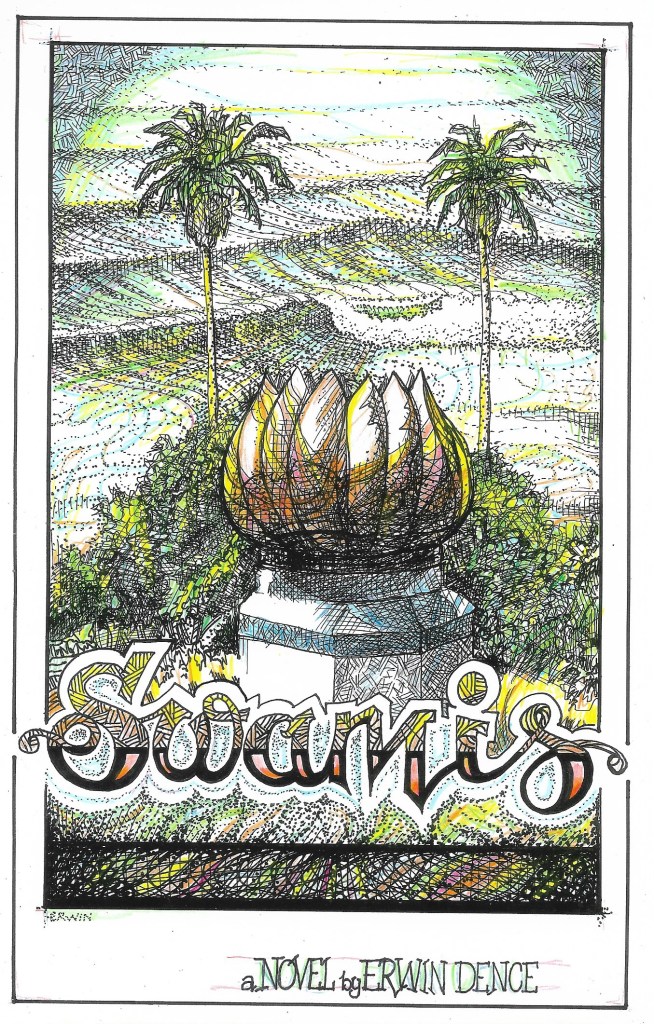
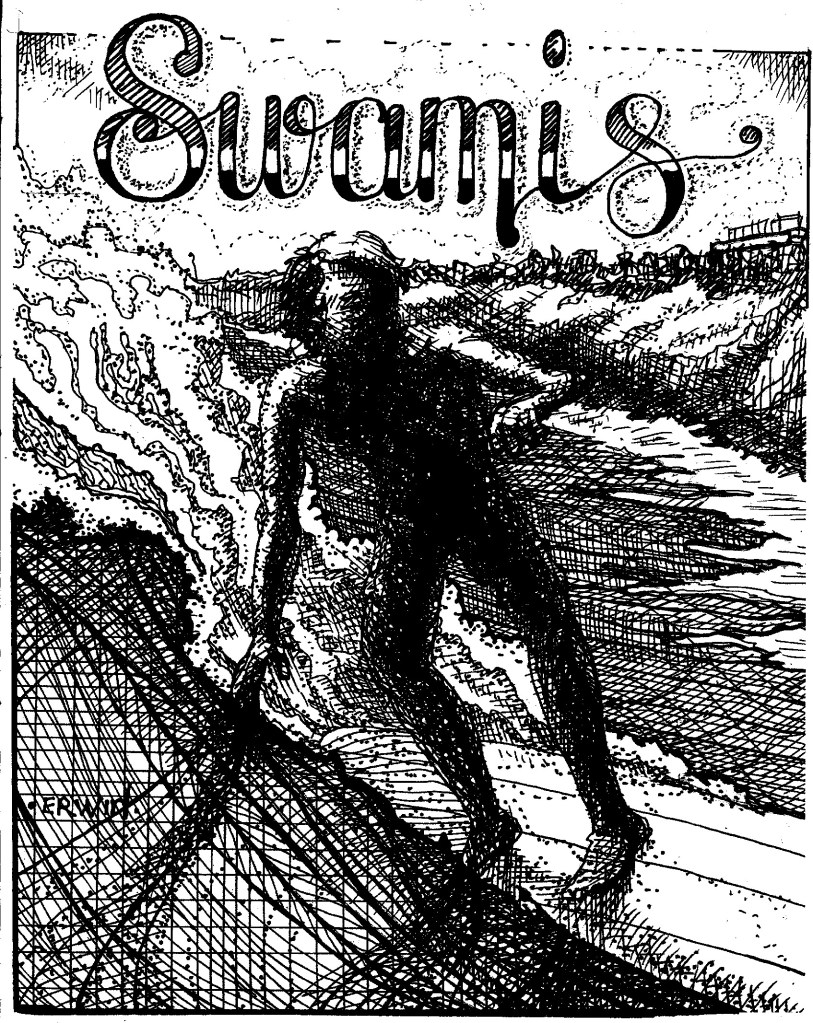
Allright. No, not really, but, when the event starts, moderator/curator/librarian/ripper Keith Darrock is planning to show some of my illustrations. This is partially so Zoomers don’t have to see my face, and it was totally my idea. Yeah, Keith agreed. It seems like the easiest way to do this was to put a bunch on my site, let Keith scroll down. As such, I have attempted to move some from a thumb drive. We’ll see how that works. Stand by.

image-3

“Overrun” With a Bit of Help

Things went wrong when I tried to post this yesterday. I had three or four paragraphs written, then did the cut-and-paste thing. OOPS! I had two copies of the text, taken from my manuscript for “Swamis,” and, when I tried several ways to speed up the deletion of the unwanted second version; errrrrrr, I eliminated the other stuff.

Anyway, this particular chapter is, in my work of fiction, written by 22 year old Jumper Hayes, freshly back from and severely wounded as a Marine in Vietnam. It’s 1969, and he asks the fictional Jody, just turning 18 and a fellow student in a Creative Writing class at Palomar Junior College, to type up what he had written.

What is very important to me is that anyone reading “Swamis” be certain that the writer was there; that it is accurate and has the feel of the place at the time. Since I wasn’t in Vietnam, I asked Trisha’s brother, my brother-in-law, James L. Scott, who was an officer in the Marines in Vietnam, to provide some feedback.

And he did. He said it read like it was written by someone who wasn’t there. He particularly pointed out the lack of swearing.

SO, here’s my solution. Jim said it was ‘better.’ I’m thinking he’s giving it a C+, maybe more like, hopefully, a B-. Check it out.

Wait, here’s what I was doing while Jim was in Vietnam. That’s a board, the “Sunshine Super Seed” with me, a board Scott Sutton made, sold to Trish. Her mother thought Scott ripped Trish off, so I bought it. Very thick. I could, at the time, knee paddle it.

CHAPTER TWENTY-ONE- WEDNESDAY SEPTEMBER 17, 1969

This is the piece Jumper submitted in Creative Writing class:

“OVERRUN”  

There weren’t enough claymores; or someone had set them off too soon; or there were just too many of them.  VC.  Local irregulars.  Them.

It wasn’t a firefight.  We were doing most of the shooting.  Our position wouldn’t hold.  We would be overrun.  Too many of them, running, charging, pushing others forward; leaping over branches and bodies.  Almost all of them were yelling, screaming; their screams mixed with ours, with the screams and moaning of pain, the constant-but-irregular beat of gunfire.

We couldn’t kill enough of them fast enough.

“Fall back!” the LT yelled, just before he fell back, dead; two soldiers over from me.  A couple Marines ran.  Others backed away, automatic weapons fanning the clearing.

I stood up, firing blindly; left to right, right to left.  Screaming.

I felt the first bullet.  Heat, then numbness, my left arm suddenly useless.  I saw the expressions on the faces; fear and anger and determination, then surprise, as I dropped two of the three charlies coming at me.  Closer.  So close.

The second one fell forward.  His momentum versus a bullet.  My rifle was jammed against his chest.  I kept firing.  As I was falling backwards, the third soldier struck me in the side of my head; and kept running.

Overrun.

This is battle.  Fear and anger and determination and confusion.  Falling back and falling down.

I was never unconscious.  Time had become nothing; time was blood in my eyes.

I was lying next to Sammy, PFC, smartass fucker from Houston; dead, wet, and cold; cold by Vietnam standards.  Vietnam, that steaming, sweating, triple-canopy jungle, rice fields that smelled like shit, scared yet smiling villagers; Viet-fucking-by-god-Nam.   

The two gooks; kids, really, more like conscripted villagers, rice farmers with guns; the two I had just shot, were on top of me, all of us in an awkward pile; their blood mixing with mine.  Pressure on my other wound.  The bad one.  I was behind a tree blown down by one of the previous air strikes.  I was squirming under the bodies and as close to the trunk as I could get.  More than a dozen feet stepped on us; running, charging, now chasing rather than attacking.

There is a tradition, as old as man, as old as war:  Once a position is secured, others make sure each one of the enemy fighters; the vanquished, the defeated, the overrun; is dead.  Weapons and clothes and some measure of revenge are the spoils; souvenirs; guns, clothes, ears.

Savage salvage.

Almost instantly, flies and crawling insects attacked.  They know death.  They know the difference, they don’t fucking care.  The flying and buzzing and crawling.

At the Little Bighorn, I thought, and I’m not sure why; I was trying so hard just to be quiet; women from the tribe smashed the heads of each one of the dead enemy soldiers; with the exception of, it’s said, General Custer.  Out of respect.  Respect?

That was more legend than history.  The history of man is the history of war.  You don’t have to know history to know the truth of this.

I was just trying not to move, to be still, quiet, alive; when I felt movement, heard moaning.  Low, close.  It was the kid, on top of me; not dead, getting louder.  I couldn’t allow this.

Maybe his moaning had been a prayer.  So sorry.

The noise, the gunfire and the yelling, which had been getting farther away, maybe an hour or so after the initial attack, was now coming back toward me.  Marines, motherfuckers; don’t like losing.  Reinforcements.  And we had the firepower.  An airstrike might be called in; cannons or mortars or planes or helicopter gunships, fifty caliber machine guns; followed by fresh troops.

At least, if I was in the targeted grid, it would be quick.

Some of the same shoes, jungle tennies, that ran over me before; ran over me again.  Retreating.   I clung to consciousness.  Eventually I heard calmer voices, mopping up.  “Here’s one,” a voice said.  “You alive, pal?”

“I think so,” I said.

The next thing I remember was the sound of a helicopter.  V-woop, woop, woop.

“We killed the fuck out of them slopes, Gunny,” the Marine at the landing site, said.  “Good to hear,” I said.  He said, “You’re walking.  You’ll have to wait for the next one.”

I wasn’t walking.  I was standing.  The next evacuation would be mostly bodies.  “Don’t think so, Corporal,” I said, lifting my empty rifle with the arm that still worked.

Overrun.

CHAPTER TWENTY-TWO- SUNDAY, SEPTEMBER 14, 1969

I’m dropping back a few days.  Jumper Hayes and I were in the formal dining room at his parents house, his chair moved to one of the corners of the table, mine at what I guessed was his father’s spot, my typewriter case open in front of me.

SEMI-COLONS

“Overrun” was Jumper’s story.  Surprisingly shocked by his original, hand-written version; I was equally surprised when he asked me to type it for him; and more surprised when he seemed so casual, even detached, as I read my third draft out loud, then handed it to him as if it was done.  Complete.  Ready to hand in.

“Sounds good.  Mostly.  Different than I’d of thought.”

“It’s your words.  Mostly.”

“Semi-colons,” he asked, “they’re, um, useful?”

“They’re like, um; somewhere between comas and periods,” I said.

“Sure.”

“It’s, it’s like, when someone reads it, out loud; it’s the rhythm.”

“Rhythm.  Yeah; I heard that, like a, um, cadence.  Semi-colons.”

“It’s like surfing; smooth flow…” There were hand gestures here.  “Take off, drop, turn, set up, swoop… flow.  Didn’t you ever think surfing is like…”

Jumper pointed to my free hand.  “A little jerky on your set up there, Jody.”

I dropped both hands.  “I’m not changing anything; maybe just, uh, rearranging.”

“I only asked you to type it up, man.”

“Yeah; well; editing; it’s a, uh, collaborative… process.  Some stuff has to be… cut.”

“Oh?  Collaborative… editing process?  Well, Jody, seems like you cut out a lot of fucking, cocksucking, motherfucking, shit-stomping, goddamn swearing, there; makes it sound like it was written by some draft-dodging, tit-sucking, flag-burning, mom’s boy, queer-bait, pussy, shit-bird, asshole, cocksucker who wasn’t fuckin’ there.”  When I seemed adequately shocked, he added, in a bit of a whisper, with a bit of a smile, “I was… there.”

“Okay, Jumper,” I said, pointing to the second page, “I did leave in the ‘motherfuckers’ in the, um, ‘Marines, motherfuckers, don’t like losing’ sentence.”

Jumper laughed. “So, uh, no; Jody; you have to own the words.  If you read it right, like you’ve ever fuckin’ sworn before; maybe, in your life, it’d be, like…”  He rose from his chair.   “‘Marines, mo-ther-fuck’-ers…’ like… hey; here’s something, Jody:  Our LT… his name was… it wasn’t his name; we called him Berkeley; it’s where he was from.  Or, at least, he went there.  Anyway… fucking Berkeley.  He was a gung ho motherfucker.” Jumper looked at me when he said ‘motherfucker;’ we both nodded- good flow.   “He was ‘God Bless America! Fuck everyone else!’  Yeah.  Really.  A couple of months in country, though; he changed.  Hey; I was the second whitest guy in the platoon.  Want to know how he died?”

“Who?  Berkeley?  Not really.”

“Okay.”  Jumper sat back down, looked at my corrections and editing on his story, looked at the portable Smith-Corona typewriter, sitting in its open case, and taking up one-eighth of the available space on the oversized, family table, almost more like a picnic table with a shine and doilies.  Most of the surface was covered in stacks, neat stacks of newspapers, invoices, order forms, bills and correspondence.  Again, neatly stacked, properly dusted.

Jumper looked at the new piece of paper spooling around on my typewriter.  “I should have taken a typing class, Jody.   Valuable.”

“Yeah.  A whole year.  Eighth grade.”  Jumper sat back down.  “Glad I did.” I sat down in front of the typewriter.  “Would you feel better if you told me?”

“What?”

“Double space is appropriate,” I said, nodding at the page.  “I mean, about Berkeley. Would talking about him, what happened, would it make you feel… better?”

“Probably not.”

“Okay.”  I started typing, looking at the page on the table.  “Maybe another time.”  I pulled a piece of twice-used masking tape from the inside of the case, hung the previous typed draft onto the leading edge of the open case.  Rather like a curtain.  “Or never.  I’m putting some fucking, ass-licking… um, just tell me where to put in the swearing.  Where it’s… appropriate.”

I heard a door open and close.  I heard voices. “Use your best fucking judgment,” Jumper whispered, his eyes going between the hanging pages and my face; “oh, and I wasn’t calling you a… an asshole.  Didn’t mean you.”

“Sure.”  I set my fingers on the proper keys, eyes on the last draft, and started typing, whispering, “draft-dodging, tit-sucking, flag-burning, mom’s boy, queer-bait, pussy, shit-bird, asshole, cocksucker.”  By the time I got to “who wasn’t fuckin’ there” it was less than a whisper.

“My parents,” Jumper said; “Sunday.  Mass, shopping, baseball.  Or football, depending.”

“Yeah.  Typing.”    

In time I converted the Jumper swear to “Draft-dodging, flag-burning cocksucker; tit-sucking, mom’s boy, queer-bait, pussy asshole.”  Better flow, I thought.  I cut out ‘shit-bird,’ I owned the words.

…

This is the version of Jumper’s piece I kept; “Overrun,” written by a twenty-two-year old, edited by an eighteen-year old.  Just turned eighteen-year old.  His submission included more swearing and was, again, shockingly well received by the students, highly praised by the professor.  My own first submission to the Creative Writing class is long gone, long and purposefully forgotten.  No, not completely.  “Rivulets, streams in the sand, saline flows, returning to Mother…”

Cringe.

…

Fixating on “Swamis”

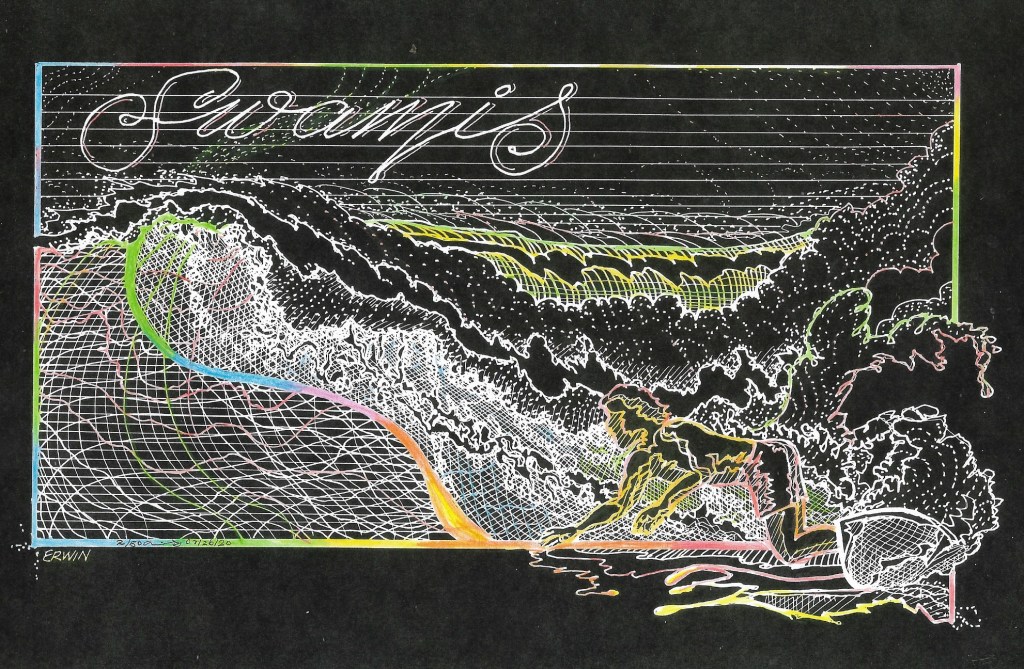
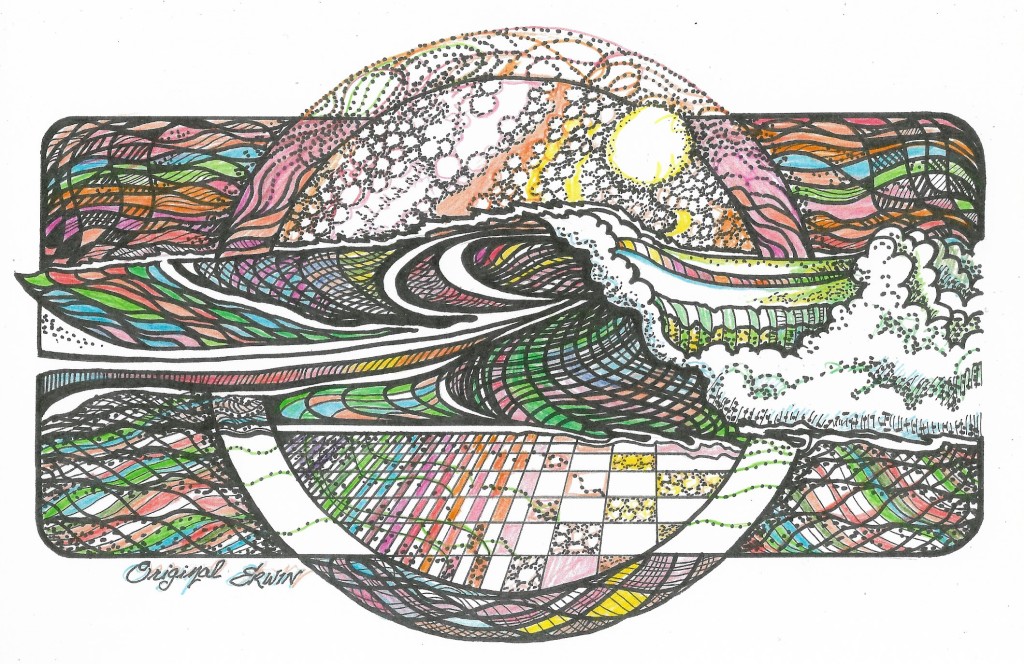
While simplifying my manuscript for “Swamis” has actually become more complicated, I have also spent some time complicating illustrations; adding more color than necessary, going full psychedelic. Maybe that’s all right and even acceptable; the story does take place in Southern California, 1969.

You’re most likely too young to have any memories, or, if you were there, it may be more flashback than memory. A former cliché that may, through disuse, may have reached the statute of limitations on repeating is this: “If you can remember anything about the 60s, you really weren’t there.”

Okay, I googled it. The quote has been attributed to: Paul Kantner, Robin Williams, Paul Krassner, Pete Townshend, Grace Slick, Timothy Leary, and others. If you know who all of those people are… whoa! Look at you!

So, here are my latest workings:

overdone positive, line bending negative.

ANYWAY, I’m still getting my stuff together for the ZOOM event with the Port Townsend Library, Thursday, August 20, 7pm. There’s supposed to be a slide show of some of my stuff so people who tune in don’t have to look at me. Here’s a link: https://ptpubliclibrary.org/library/page/art-and-writing-erwin-dence OKAY, so how do I make that all blue so you don’t have to type it all out.

Oh, some of these and others are available at Tyler Meeks’ DISCO BAY OUTDOOR EXCHANGE. Stop in when you’re cruising out to the Peninsula, Thur-Sunday, 10am to 6pm.

More Swamis, More Coming

I am discovering more about the art and science of printing, particularly about how yellow seems to overwhelm other colors. Here is a version of my latest “Swamis” illustration:

inspired by 1960s Ron Stoner photograph

SO, I wanted to wait to see how the scanned drawing, now pixels on a screen, compares to the illustration I stuck in the scanner. Ummm, pretty close if I tilt the screen until it shows maximum color. This is taken from the color image, reduced to fit on eight and a half by eleven, which, because the yellow was too pervasive and some of the other colors were washed out, I attacked the drawing with colored pencils.

Okay, yeah; now if I could only get the drawings straight. They are, I swear, properly placed in the scanner. ANYWAY, I’m dropping a couple of framed pieces off at TYLER MEEKS’ DISCO BAY OUTDOOR EXCHANGE this afternoon, very limited edition prints with color added. Yeah, like on the actual drawings. I know there is no surf, but drop in on your way by. He’s open Thursday-Sunday, 10am to 6pm.

MEANWHILE, I am trying to get farther along on my latest edit (possibly not the last- but maybe the last full manuscript/big change version) of “Swamis” the novel. MORE INFORMATION is forthcoming on the upcoming ZOOM discussion/reading, with, if I can get it together, a slide show of my artsy works. Keith Darrock is setting it up with the PORT TOWNSEND PUBLIC LIBRARY. Thursday, August 20, and, yes, I will be putting more information out there. Here. Out here.

Stay safe, wear your fucking mask when appropriate; see if you can convince your friends and acquaintances who are obviously obstinate if not completely stupid refusers and deniers. to, at least, put on the fucking mask when they can’t fucking stay the fuck away. Yes, I am using profanity; not that that is unusual; but seeing people who think they’re making a statement by pushing into a store without a mask, expression saying, ‘yeah, say something,’ and I’m trying to buy a newspaper and a quart of chocolate milk; not risking getting whatever you’re spreading.

And wait, for all else I think I am; I make my living painting houses; and I do want to give a little praise to the other blue collar working folks who take a step back, grab their masks, and put them on when being able to socially distance isn’t possible. AND, YES, I know I do surf tiny waves on the Strait of Juan de Fuca, but, really, two feet isn’t six feet, not even here.

All real surfers have experienced those moments when we think we’re at the surface, suck in some air, only to find it’s foam; unbreathable. There are few things scarier than the inability to catch one’s breath. That’s what this virus brings; along with searing headaches, high fevers, delirium. It’s real, it’s around, and it’s more luck than any sort of inner strength or goodness that has kept us from getting it so far. So far. Through preaching.

I have a version of this headed for Disco Bay; hand colored

Stoner Photo made Fictional

It was almost coincidental that I found a photo from Ron Stoner of Swamis in about 1966, a year or so after I started surfing. Here it is:

Okay, the one on the right. The left photo is of the Malibu Invitational, in, I believe, 1965. My dad took my sister, Suellen; I declined to go. Too far away. Note the pre-drone angle.

So, here’s my version:

I believe I showed more than my usual amount of discipline.

Usually I can’t keep well enough alone. I did several modifications to another possible illustration for “Swamis,” the novel I’m now over halfway through my latest rewrite/edit (definitely making the manuscript easier to follow if less, um, colorful- Still too wordy, too much dialogue). This drawing is based on another Stoner Swamis photo. Before and after, with another after in the neverland file.

SO, I have several copies of the newer drawing and will attempt to show some discipline and restraint in coloring them. Results forthcoming.

MEANWHILE, I am getting some drawings together in preparation for the zoom event with the PORT TOWNSEND PUBLIC LIBRARY. I was actually volunteered by PT ripper Keith Darrock; and, since I don’t really need folks being forced to watch me talking all about my writing methods and such stuff, the plan is to get a selection of my art works together and have a slide show. It’s all supposed to happen August 20, but I will certainly post reminders as the date approaches.

AS ALWAYS, stay safe, surf when you can. OH, oh, yeah; Stephen R. Davis is in Hawaii, flight delayed by a hurricane; not sure about his current status, quarantine-wise. Checking the Big Island forecast fourteen days out… hmmm.