
IT’S FINALS DAY at the WESTPORT LONGBOARD CLASSIC and realsurfers has a correspondent embedded in the event. Longtime explorer on the coast and the Strait, TOM BURNS, is a *judge, and has agreed to send a few photos and some commentary my way.
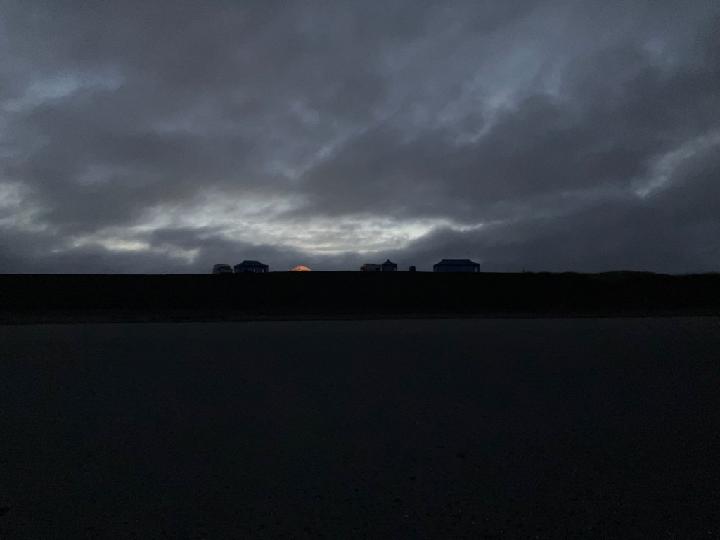
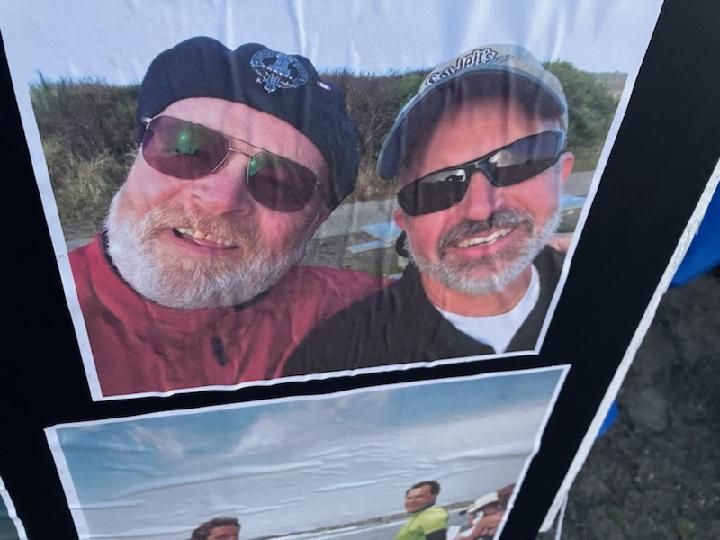
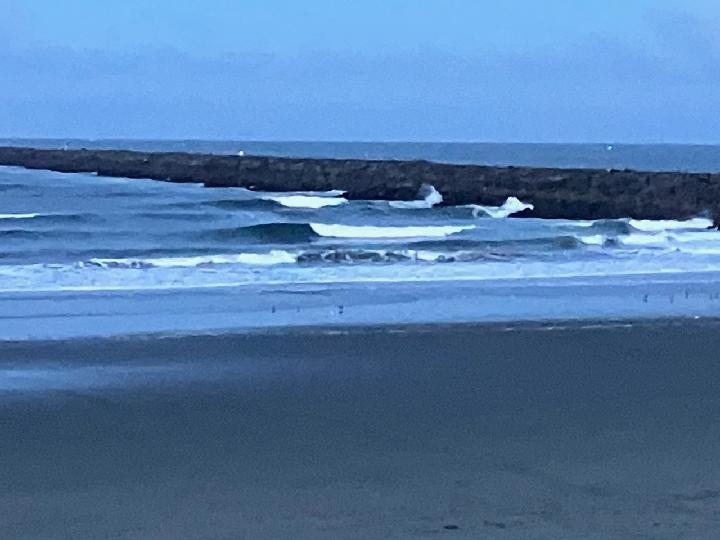
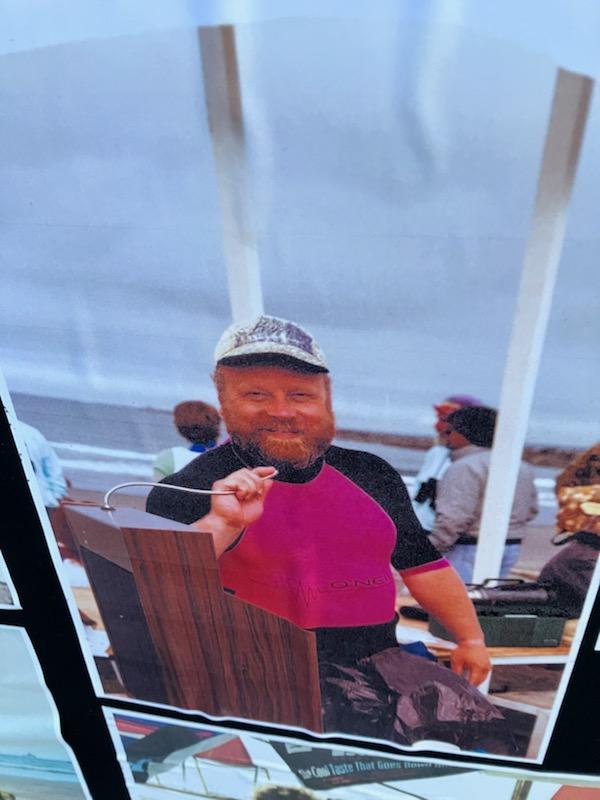

PHOTOS- Logo; O’Dark Thirty a Westport; Photo from the ‘memorial wall’ of TOM LE COMPE (RIP), one the ‘harbor boys,’ and one of the first to surf the jetty in the sixties, and Tom Burns; a shot of ‘The Corner” early this morning; Someone Tom didn’t give me a name for; and BARRY ESTES (RIP) with Tom from a RICKY YOUNG contest back in the late 1980s and 90s.
I competed in several of those contests, pushed to do so by my friend from my shipyard days, RAPHAEL REDA. I didn’t meet Tom there. I met him on the Strait of Juan de Fuca. Tom, a month or so older than me, was years ahead of me in knowledge of where and when to find waves, but still has a fairly high ratio on the skunk-to-score chart. Tom is, among surfers I know, the preeminent name dropper, with a long history, great memory, and a willingness to talk story. We quickly discovered we have some friends in common, Drew Kampion and Pathfinder Darrell Wood to name drop two, AND Tom was perfectly willing to adopt some of the colorful folks I’ve run into: Tugboat Bill, Big Dave, Concrete Pete, folks without nicknames.
*I helped out at the precursor to the Longboard Classic, the CLEANWATER CLASSIC, a couple of years. Not surfing, I was volunteering and sort of representing SURFRIDER. Not satisfied to stand on the beach with a flag, I pushed my way into being a spotter for the judges, Tom being one of them. I refused to leave. Partially because I do bring the fun, and I do watch a lot of WSL contests on the computer, Tom convinced the head judge to allow me to be a judge the next year. I brought the fun. Too much fun for the head judge. I got in trouble for not matching the other judges’ assessment of rides. “6.5? No, I gave it a 4.6. I mean… really? 6.5?” I wasn’t asked back. Tom wasn’t either. Somehow I was his fault.
EVIDENTLY TOM has served his time in judge purgatory.
OF COURSE, being as tribal as anyone, I’m rooting for surfers from the Olympic Peninsula. We’ll see.
I am up to Chapter 9 on the re-re-re-reedit and tightening of “SWAMIS.” Remember, this material is copyright protected, all rights reserved. Thanks for honoring this, and thanks for reading.
CHAPTER FIVE- THURSDAY, FEBRUARY 27, 1969
Our house in the hills between Fallbrook and Bonsall was a split level, stucco house, aluminum sash windows, composite roof. Someone else had started building from some plans purchased from a catalog. My parents could save money, they were told, by finishing the lower level and the garage. They could replace the plywood shed at the edge of a corral with a small barn that would provide room for a horse, a side area for hay and tack. New fencing. More trees. A garden. A covered patio off the kitchen, or, perhaps, a bay window.
My father promised the patio, and then the bay window. He was working on it, but he was working. Working. There was, outside the sliding door, a concrete slab, with paving stones leading around the corner and down to the driveway. The two-story portion of the house featured a plate glass window, four foot high and eight feet wide, in total, with crank out, aluminum sash windows on either side. This window offered a view to the west, over scrubby trees and deep arroyos, of the hills, some rounded, others more jagged, with ancient boulders visible on all of them. Mission Avenue was hidden below and between. Mission, the road that linked Fallbrook with Bonsall, Vista, Oceanside, everywhere west, everywhere worth going to.
Looking out this window, I felt almost level with those hills. Morning light, descending, brought out the details of the ribs and rocks. Afternoon shadows crept from it until the hills once again became a blank shape. There were waves of hills in irregular lines between my hills and the unseen ocean. I had spent time looking away from my studies, imagining the hills in timelapse, the sun setting at one place in winter, another in summer, lines off clouds held back at the ridgeline, breaking over the top; torn, scattering. I had imagined the block as transparent, the ocean visible, late afternoon sunlight reflected off the water and into the empty skies.
…
The light outside was still neutral when I moved to the dinette table in the kitchen, a bowl of oatmeal, a tab of butter on top of it, in front of me. There was a glass pitcher of milk between my setting and the other two. There were four lunch sacks on the counter. Two were a light blue, one was a shade more orange than pink, the fourth was the standard lunch sack brown. My mother, already dressed and ready for work, took a carton of Lucky Strikes from a cupboard and put a pack into the brown lunch sack.
She looked out the window over the sink. She sniffled.
My father, in one of his everyday detective suits; coat unbuttoned, tie untied; leaned over from the head of the table. “Go get it, Jody.” The ‘now’ part of the command was unspoken. His voice was calm. Almost always. I didn’t move. I didn’t look up from my oatmeal. “Stanford, Jody; you didn’t think they’d send a copy to the school?”
My father’s questions demanded an answer or a response.
I stood up, lifting my chair up high enough that its metal legs, with plastic shoes at the bottom, wouldn’t scrape the oak flooring. I looked at my father. He was looking at my mother. She sniffled several times but didn’t turn around.
My bedroom was at the end of the hallway, past my parent’s and my father’s den on the right, the guest bathroom, Freddy’s room, then mine on the left. There were pictures taken from surfing magazines on several walls, a cluttered desk between the closet and a bunk bed, the bottom bunk converted into a space for books and toys and cardboard boxes taped and marked, stuff from our previous house.
Though we had been at the ranchette for more than four years, because the garage had never become water and weather tight, most of the boxes in my room remained stacked and taped and marked. Grease pencil. Yellow, mostly. Some black. I opened an untaped box marked “Cowboy stuff” and took out the legal sized envelope.
As I walked up the hallway, I heard my father ask, “Is this who we are now, Ruth?”
“Not we, Joe. Me. You… didn’t want to be…”
“Involved? No!” I heard a thump, hand to a solid surface. Less than a slam. “Fool that I am, I am… and have been involved this whole time.”
My parents almost never raised their voices. My father didn’t have to, my mother just… wouldn’t. I’ve been asked about my parent’s relationship many times. Japanese war bride, ex-Marine. My answer will always be, “They had a certain dynamic.” The answer could as easily be, “It wasn’t what you might think.” Whatever they thought.
My parents were standing at the counter to the right of the double sink. I placed the envelope on the tablecloth, next to my father’s plate. Sausage and eggs. Uneaten. Cup of coffee. Half full. I sat down. I looked over. My father signed at the bottom of two pages. My mother refolded them into thirds and put them into an envelope. She set the envelope on the left side of the sink, on top of several other loose papers. Legal size. Eight and a half by fourteen inches.
“I’ll fix it, Joe. Today.”
My father grunted, stepped around my mother. He was looking at the pages, shaking his head. He looked toward his wife. Her back was to the sink, both hands behind her on the edge of the counter. She looked at my father’s hands as he folded those papers in half. He took in a breath, turned toward her, let out the breath slowly. He handed her the papers with his right hand. She took them with her left hand, handed him the brown lunch sack with her right.
“Ruth. You could… This could give you… freedom. Ikura desuka?”
My mother only rarely spoke Japanese, my father almost never. My mother froze. “Freedom, Joe?” My father’s expression was one of instant regret.
I replayed the words. “E’-kew-rah des-kah.” Again. “E’-kew-rah des-kah.” There was something in the flow, the rhythm of my mother’s native language I had given up trying to capture. “E’-kew-rah des-kah?”
…
My mother and the envelope and the papers were gone. My father set the brown lunch sack onto the counter, took two more packs from the carton of Lucky Strikes from the cupboard, unfolded the two folds on the lunch sack, put them in, refolded the sack. Not as neatly. He took two steps toward the sliding glass door, looked at his feet. “Socks,” he said. “Jody, you won’t be surfing… or working at Mrs. Tony’s; none of that shit.” He looked at the envelope on the dinette table. “Stanford.” He threw his left hand out and down, ends of his fingers touching the Stanford logo. “You… you earned this, Jody. You’re going.”
“Going.”
My father looked toward the hallway, looked at me. “It’ll be… she’ll be fine. I have to…”
“Go. Yes.”
Freddy came into the kitchen. “Daddy?” Our father responded with a weak sideways nod. Freddy followed him through the living room, into the foyer, out onto the front porch. The front door slammed.
When Freddy returned, our mother was back in the kitchen. My brother, not even trying not to cry, looked at her, and then me, as if whatever was happening was our fault.
“Freedom,” I whispered, my left hand, in a fist, over my mouth. “Ikara desuka.”
The house phone was on a table just outside the formal dining room. Our mother picked up the receiver and dialed a number on the phone’s base. “No, I am well,” she said. “Annual leave. ‘Use it or lose it.’ I have accumulated…” She chuckled. Fake. “No. They’re both fine. I will be in tomorrow.” She looked at me. “Thank you.” She put the phone back on the base. “Joey, I will need the station wagon. You and Freddy… Better hurry; you will have to take the bus.”
Freddy asked, “What about taking your car, Mommy?” Our mother looked at me and shook her head. I shook mine. Freddy looked at me. “What did you do this time, Jody?”
…
Gary and Roger were my closest surf friends. Roger started board surfing the summer I did, 1965. Gary started the next summer. By the time we were seniors, many others had tried surfing. Most didn’t stick with it for long. Though Roger lived closer to me, Gary offered to give me a ride home.
I was riding shotgun. Gary’s sister, squeezed tightly against the backseat passenger door of their mom’s Corvair, said, in an unnecessarily whiny voice, “Glad it’s all cool with you, Gary.”
“It is, yeah; it’s cool with me.” Gary glanced over at me. “The Princess has a license, but our mom won’t let her drive without… supervision.”
“Well, thanks again for the ride, Gary; and for going by Potter for… Freddy. Oh, and thank you…”
“Princess,” Gary said.
The Princess blew air out of the side of her mouth. I looked around and over the seat. The Princess shook the wrist of her left hand and gave me a look I took as suggesting the raspberry was meant for her brother rather than me. Freddy was not quite as tight against the door on the driver’s side. Neither tried to talk to, or even look at the other.
“So, Joey,” Gary asked, “what do you think of Roger’s latest girlfriend?”
“She’s a sophomore, you know,” the Princess said, looking at me. “Sophomore.” I gave her the expression she was looking for. The relationship was wrong. And creepy.
“Roger’s business, Princess. Now, Joey, maybe, after school… days are getting longer. We could do Oceanside pier. Tamarack, if I drive.”
“Four gallons of gas, two quarts of oil; that sound about right, Gary?”
“Or Joey; we could go in Roger’s stepdad’s Mustang.”
The Princess mumbled a quiet, “Fuck you, Gary,” as her brother downshifted, unnecessarily, at the first of several uphill curves. Freddy’s laugh and repetition of the words were louder and clearer.
“Or Princess and some of her friends… Juniors… no sophomores, could go with us,” Gary offered. The Princess let out a high-pitched, “Ha!” and a low-pitched sort of extended grunt sound. Freddy giggled. “Or, if we can’t go surfing after school, maybe me and you and Roger could ditch and go all day.”
Gary looked at me and winked. I shook my head, but I did smile. “Or maybe next week… or so, if we have all our stuff ready, boards loaded, we could make it to Grandview. Swamis. Somewhere… good.”
“Possible. Timewise.”
“Cool.”
The princess’s head suddenly appeared between Gary and me. “Most of you Fallbrook surfers aren’t even partway cool,” she said. “And besides, my friends won’t even cruise town in this crappy car; and besides that, it would be creepy.” The Princess looked at me and seemed to realize her face and mine were way too close. Still, she didn’t move away.
“Creepy,” I said.
“And they might find out Gary’s surfing just isn’t all that… cool,” the Princess said, almost smiling before she fell back into the seat and against the door.
We arrived at our driveway. The Falcon station wagon was still there, my nine-six pintail on the rack. The Falcon was backed up to the curved gravel pathway that went up the slight grade to the front door. Bender board and stakes had been installed for a while, ready for concrete.
“Board on the roof. Obvious Hodad move, Joey.”
I looked up at Gary’s Hansen surfboard hanging over the hood of the Corvair. “Obvious.”
Gary used the area between the unfinished garage and the temporary shed at the corner of the corral to turn around. The Corvair had barely stopped when Freddy jumped out and ran for the house. The Princess jumped out and ran around to the front passenger door. I took a few seconds to get my books and folders out of the seat. She leaned on the open door and checked out the ranchette. Disapprovingly.
Gary popped the clutch on the Corvair halfway down the driveway. There was a second cloud of black smoke as Gary, unnecessarily double-clutched, attempting, unsuccessfully, to get scratch in second gear. There were a few drops of oil soaking into and staining the insufficient gravel on the decomposed granite driveway.
My mom was standing at the front driver’s side door of the Falcon, Freddy pressed against her and between her and the seat. She was looking at me. “You know I’ll be back,” she said, for both Freddy and me. She looked over at the old horse casually eating grain on the near side of what she called a paddock. “I can’t trust you boys to properly take care of Tallulah.”
A bell on the two-story part of the house rang. “Telephone,” Freddy said, dropping books as he ran. I set my school stuff on the grass and walked to the front of the Falcon.
“There’s some money… on the counter. Take the Volvo. Later. Six-thirty or so. You and Freddy can go to that Smorgasbord place he likes. Or Sambo’s.”
“Sambo’s… closed, Mom.”
“Oh. Yes. You know how to find the Rollins Place; right?” I nodded. “No eating in the Volvo. Right?” I shook my head.
“Mom,” Freddy yelled, “It’s Daddy.”
“Tell Freddy your father knows where to find me.” Our mother got into the Falcon. She chuckled. “Stick shift. Hope I haven’t forgotten how.”
“Daddy! He wants to talk with mom. He wants her to wait… for him. Jody!”
“Waiting,” our mother said, shaking her head. “Not waiting.”
“Three on the tree, Mom.” I closed the door for her. “You’ll be fine.”
“Fine.” My mom smiled, turned away, started the Falcon. “I called the station. Your father was out. I talked to Larry.”
“Larry? Oh. Sure. What did you tell… Wendall?”
“Nothing. I just… no, nothing. I told him to tell your father… I was going to… straighten everything out, that it would be… fine. I will.”
“If it’s about… college… I will, of course, go.”
“Of course. It isn’t… I have to go.”
My mother had her determined look on her face; determined to be strong, to not cry; even if the strength wouldn’t last, even if the tears would flow as soon as she went down the driveway. She popped the clutch. Accidentally. The back tires threw some gravel and the Falcon stalled. She hit the steering wheel, restarted the engine, eased the clutch out, moved the car over to the fence for the corral, reaching her left hand out, calling for her horse.
“Tallulah.” The horse turned around for a moment.
I looked toward the west. There would have been enough time for a few waves between school and dark if I had gone to the pier. I wasn’t crying. Freddy, clearly, was.
“Jody. He wants to talk to you. Jody!”
The doors to the Volvo were locked. Of course. I ran up the path to the porch. Freddy was just inside the door. The phone’s base was on the floor, three feet from the table. The cord to the receiver was stretched to its maximum length. Freddy tried to press the phone to my chest as I tried to pass him. The keys to the Volvo were hanging, along with other rings of keys and a rabbit’s foot, on a crudely shaped horse’s head Freddy had made at summer camp.
I grabbed the keys. Freddy pushed me. I pushed him down and took the phone from him. “Freddy, stop the blubbering. Dad?” I wasn’t really listening. I tried to direct Freddy toward the kitchen, rubbing my fingers together in the gesture for ‘money.’ I leaned down toward my brother. “Yes, Dad; still here.” Pause. “I am sorry about whatever Betty Boop and Wendall, and everyone at the station… thinks.” Pause. “Insolent? No.” Pause. “I don’t know. Freddy and I are going to…” Pause. “David Cole?” Pause. “Too late. Hello.” Dial tone. “Too late.”
I looped the long cord as I headed toward the kitchen, put the receiver onto the base, the base back on the table. Freddy stayed on the floor, his back against the frame of the opening between the foyer and the living room. “Stop her, Jody.” I didn’t respond. Freddy screamed, “Everyone’s right; you’re a god-damned retard. Retard!”
“Let’s go then, Freddy; you fucking baby.” My voice was as even as I could manage. I grabbed the cash from the dinette, walked back, stood over him. “Come on.”
Freddy laid out flat. He shook his head. “I’ll wait for Daddy. Dad.”
“He’s not… Freddy, there’s pizza in the refrigerator. You can heat it up in the oven, or, I don’t know, God-damned retard like me, you can… goddamn eat it cold.”
The phone rang. Freddy rolled to his stomach, jumped up, and got to the phone on the second ring. “Daddy?” Pause. “Uncle Larry.” Pause. “No, I don’t know where. Jody?” I shook my head. “Joey!” Out the door and down the path, all I heard was, “Retard.”
I’M NOT POLITICAL, BUT… I couldn’t help but notice, this week, with citizen don refusing to acknowledge that he got trashed and thrashed in the debate, that he also went back to his greatest wiffs and denied the sexual assault issue he also, very expensively, lost, saying the woman he assaulted was not his type, not ‘the chosen one.’ ALSO, this week, asked if he had any apologies to make about, like, anything, the elderly douche said he had nothing to apologize for.
Speaking of which, I couldn’t help but wonder if JESUS ever apologized for telling the truth. “Oh,” you say, “but Jesus paid a terrible price.” So, who pays the price for someone who only tells lies?
Again, not political. Get some waves.
 Real Surfers