Erwin,
 Here’s 3 photo’s that my brother-in-law scanned. The one with him and the bellyboard with Ed Shumpert’s mermaid I don’t ever remember seeing before. That board is from the time that we were surfing Grandview back in the late 60’s. My Dad gave that board to the Belly Up Tavern and the last time I was there is was still up in the rafters. They had a party there for my Dad after he died. Ed Shumpert later did the sculpture of Duke Kahanamoku in Huntington Beach. He also shaped for Ocean Pacific Surfboards before it became the surf clothing company using the logo designed by Ed. The picture of the three guys on the board must from way before I was born.
Buzz
Glass Art by Buzz Blodgett

This will soon be a follow up on a piece on Wally Blodgett, and, in many ways, illustrates the father’s legacy and it’s eventual evolution at the hands of the son.
To see more of his exquisite craftsmanship, always with an eye on the water, check out blodgettglass.com
wally-portrait-from Buzz Blodgett’s-college-photo-class
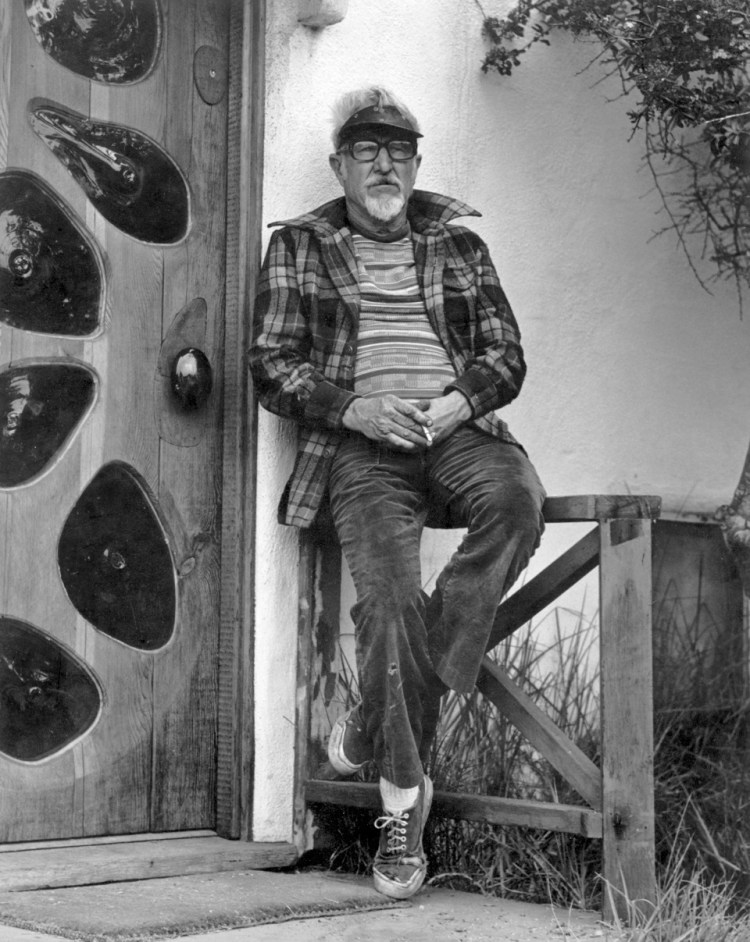
All right, this shows my lack of computer skills. This is Buzz Blodgett’s photo of his father, Wally.
Buzz is my age, and back when I was cruising the surf spots along the bluffs between Leucadia and Cardiff, Wally was packing his car with boards and kids. The difference between Buzz’s father and mine, and probably yours, is Wally got in the water.
The first irony here is, though I spoke to Wally, I never really spoke to my peers.
I have a story about Wally. This isn’t it.
My story isn’t polished enough. Not yet.
It’s a tale of glass and art and, really, that sort of taking a minute for kindness.
Meanwhile, Buzz sent me this and another great photo. I finally figured out how to get this one from my e-mail to my site. So, here it is.
The second irony is: I was taking a photography class at Palomar Junior College at the same time as Buzz, but, unable to get into the beginners class, I tried to sneak into the advanced group.
Though I was instantly revealed to be a kook in the darkroom, I was allowed to stay. I remember almost wetting myself, refusing and unable to leave as the first images of my first self-developed roll came to life
If you can wait a bit longer, I have to make sure the finished piece is worthy.
alternate arch

I wasn’t totally pleased with the illustration for the story on the classic Hawaiian Arch. So, here’s another attempt. I’ll wait until my sister, Melissa Lynch, an awesome artist, gives me some imput.
I should mention she’s my younger sister, but, artwise, I’m intimidated by her. And, I have a story that is waiting for her illustration. It’ll be great. No pressure, Melissa.
Whether I use this drawing or the other, or another, I’ll delete the others.
Yeah, my scanner seems to produce those ‘burn marks.’
Not in black and white.
Classic Arch Pose in 1972 Blackball Session
 CLASSIC ARCH POSE IN 1972 BLACKBALL SESSION
It would have to be categorized as summer ‘fun surf;’ early afternoon, pre-glassoff texture, the lines broken up enough to offer some peaks with workable shoulders; nothing scary, nothing great, just, fun.
The surfing area in Pacific Beach gets pushed, each summer, well north of the Crystal Pier, the black ball flags and lifeguards making sure the swimmers have a chance at rolling and tumbling. It was one of those days where the crew of painters I was working with, having finished our day’s assignment, headed for this bar or that strip club. Trish still at work, I headed for the beach.
The whole purpose of telling this story is to justify the classic Hawaiian arch. Pose? Maybe. Fun? Oh, yes. A tradition worthy of passing on? Indeed.
I would argue that the move, leaning back, reaching your hands heavenward to thank God, the Universe, or whatever Deity you recognize for allowing you to be racing across some wave face is a surfer’s praise position, a moving Hallelujah.
And it’s a natural reaction to the joy of a particularly enjoyable moment, like rotating your stance just slightly to place your hand into the curl or wall of a breaking wave, maybe out of some sense of respect, maybe just to feel the rush of water.
But, there is the ‘look at me’ argument. It is a pose. Hang five. Hold it. Backpeddle.
I don’t know where my ride fits in. I was wailing across a wave, sneaking my left foot forward on my roundy-nosed six foot board… arching, possibly even letting out a ‘eeeooowww!’ as if I were surfing with just a few friends. I wasn’t. The other surfers out were a couple of school kids, strangers, both of them wading out, witnessing.
They shared a laugh between themselves. Some grownups. Geez.
Yet, on the next ride, one of the kids, still laughing his ass off, kind of timidly slid his front foot forward, kind of awkwardly leaned back. “Eeeeeooowwww!”
Another tradition passed on. Another moment held, held a little longer… and backpedal, drop down, pull back up and onward, rotating just slightly…
Hallelujah!
Cheater Five

Since I check out magic seaweed.com just about… no, every day, I was struck by this image. Tagged as “Crouching and elegant,” the photo was taken at Cote des Basques, France, by McSnowHammer.
The image is striking in it’s balance between black and white. It’s a well-surfed little tube; might be equally pretty in color, softer.
There are some differences between the drawing, free-handed on scratchboard, and the photo.
Actually, the more I look at the photo the more I wish my drawing could reveal a little more detail. It is, after all, merely scratches on a smooth-but-blank surface.
Yet, we all seek to capture or recapture a moment; a little unexpected inside power pocket.
I may go back, do some more scratching. For now, Thank you McSnowHammer, thank you Miss “Crouching and elegant.”
My wave… Mine, mine, mine!
FRIENDS, SNAKINGS, FADES, AND WARREN BOLSTER
It is my firm belief that no one takes off in front of someone he has respect for.
A firm belief, with some exceptions. Kooks, heads down, reciting some mantra like, “Paddle like you mean it!” are not disrespectful, merely kooks. One recent kook-drop, wave-sharer had my wave partner, at the end of the ride, turn to me and say, “Epic!”
It was a small wave, but did go on a ways.
“Really?” I said, rather than, “Oh, and I was even closer to the curl. Wow! Double Epic”
I forgave him because I was once exactly that guy. Let me apologize now for all the rides I ruined at Swamis and Tamarack, my head down, paddling, paddling.
Then, of course; there are waves shared with friends. I’m thinking of my old friend, Ray Hicks, at Pipes, and my nephew, Dylan, at La Jolla Shores; each evidently thinking I was acting as a blocker for them, clearing a wave of other surfers. If so, I forgive them, too. Maybe they thought wave-sharing brought us closer. “Um, uh, sure.”
And then there are the accidental snakings. Perhaps Jeff Parrish’s friend, also named Jeff, who, to avoid confusion, and because he has a bald head, I called “Wienerhead” (he claimed not to mind- but, evidently, did): just didn’t see me at Westport, didn’t believe I could have surfed that far across the wave, coming up behind him, yelling “Waikiki!”
Try it; it’s better than whistling or yelling, “Mine, mine, all mine!”
I may have actually said this out loud. I’ve always thought it.
The truth is I’ve been snaked on a very small percentage of the waves I’ve ridden. This is perhaps because I’m a large person. I have tried hard to (mostly) ride waves I’ve earned by being in the right place, closer to the peak, a bit farther out.
Closer to the truth, I generally prowl the inside, catch waves others have missed, or mis-timed, or wiped out on, or can’t actually make.
Sometimes I’m wrong about whether the PRIORITY SURFER could make the section, but nothing is more wasteful than giving-way, seeing the surfer fall or get eaten by the section and ‘your’ wave peel off perfectly empty.
Yes, I’m a recidivist, a shoulder-hopping repeat offender, willing to get caught inside a few times, somewhat casually (usually) avoiding surfers on waves. During one fairly recent session at a fairly crowded reef break I caught eight waves (no snaking) before I actually made it all the way out to the lineup.
When one wave snuck past the bobbers outside, a woman named Trina, freshly back from Australia, looked at the wave, looked at me, said, “If no one else wants it, I’ll take it.”
I wanted it, but gave her the nod.
When I came in, Tugboat Bill said, “I see what you’re doing, how you get so many waves.” Busted.
THE LINEUP: The waves line up, the surfers wait in some semblance of a line. I guess in some perfect scenario, surfers take turns, rotate in. I sort of understand the system. Still, as my crowd-savvy friend Ray says, “The best surfer out always gets the best waves.”
Aggression plays some role. It’s only in my older incarnation that I probably wouldn’t brazenly paddle to the best lineup spot (lineup as in wave, not surfers in line), maybe even sit just inside of somebody waiting for the perfect set wave.
“How’s it going?”
I do tend to keep, in some specific mind folder, a record of most of the waves on which someone felt it necessary to take off in front of me. There was this guy at Lower Trestles who seemed to think I had chosen the best waves. I was working up the hill, parking on the beach, and usually extended my half hour lunch to an hour and a half, work to work. I cruised back down a couple of hours later for a look-see at coffee break time (it was a government job and the statute of limitations has long ago expired) and this guy was still out, going full bore, surfing like he’d be shipping out to some war zone the next day. That may well be true. Still, he was also still shoulder-hopping others. And not just snaking, but fading.
FADING: This is the more anti-social form of shoulder-hopping; forcing the actual Priority Surfer far enough into the peak or up the wall to guarantee he won’t make it; the trick being timing the act so you, the Fader, still makes the wave.
The fade, rather than the more usual tactic of wailing down the line, hoping the surfer behind you falls naturally or doesn’t make the section. Then you can do a big cutback or something on your wave.
The fade is always on purpose. The act itself saying, “Mine, mine, mine!”
So, WARREN BOLSTER, Swamis: The famous photographer seemed to feel totally justified as we both paddled hard for the same wave. I didn’t give way. I was closer to the peak, he forced me closer. We took off at the same time dropped, turned, moved up into trim. He did a little stall… the lip hit me, and he rode on.
At the time I thought he’d probably built up a bit of frustration (or inspiration) taking photos of others and wanted to maximize his surfing time.
Understandable. I mean, I get that; not that it’s justification.
When I read, years later, that the photographer whose skateboarding photos had helped push the rebirth of that sport had taken his own life, I wondered about whether there was some karmic buildup of the negative aggression. I have no way of really knowing, but, if some surfers somewhere recall with some nostalgia how they were pushed off a wave by Miki Dora, I was, at least, faded (brilliantly) by Mr. Bolster, may he rest in peace.
CRYSTAL PIER, 1973: It would be nice to think I was just blissfully unaware of what a wave hog I used to be. I was, I swear, until I was enlightened. Partway through an afternoon session, sitting on the outside in a pack, always scanning left and right, checking my position, a kneeboarder looked over at me and actually spoke.
With the city surf spot ghetto mentality (“Don’t look them in the eyes”) in full force, this was kind of unusual. “Why don’t you let someone else have a wave?”
I had, honestly, never considered it.
“Sure.” I meant the waves between mine.
Another afternoon session at CRYSTAL PIER: The waves were all pretty unmakeable. The extreme angle of the swell tended to make them rights, but not makeable rights. Pretty much any place you took off gave you a chance to haul ass down the line until the wave closed out.
So, I took off in front of some guy who, though he couldn’t make the wave, thought he could. So, leashless, he shot his board ahead in the curl. The nose of the board banged against my ankles. I grabbed it as the whole thing collapsed.
“Next time,” he said, bobbing fifteen yards away, me holding his board, “It’s your head.”
Still, he nodded, somewhat gratefully, as I pushed his board toward him.
Being twenty-two years old, I didn’t weaken when he and his several friends looked over at me as if I might just give in and go in. Nope. A bit later, the sun setting and the crowd thinning, I was paddling for a wave with the same guy who had threatened me. He was on the peak side. I paddled him even closer, waited until the last second, jumped up, turned. He went over the falls.
This time his board washed all the way in. We looked at each other. He smiled. When he paddled back out, he said, “Look, I’m a goofyfoot. If you want all the rights, fine; I’ll take the lefts.”
“Deal.” Still, he left the water after one more wave, gave me a little wave in passing.
Forty years later, I’m still prowling. I won’t take off in front of you… unless I have to.
No, I don’t have to.
Inside BREAK

(lyrical excerpt from longer song. Add your own rhythm… and classic Hawaiian soul arch)
I just wanna go surfin’, now tell me, is that such a sin?
I just wanna go surfin’, now tell me, is that such a sin?
When you know damn well, it’s been a mighty long time since I went…
I’m gonna take off late, free fall drop,
Carve off the bottom and fly off the top;
Locked in so tight the wave spits me out;
Hit the shoulder and turn one-eighty about;
Moving down that line like a water snake,
Saving my best moves for the inside break.
Hit the inside section… arching, hanging five…
That’s when I know that I’m still alive.
I just wanna go surfin’, but I don’t have any time;
I just wanna go surfin’, but I don’t have any time;
Now, if YOU get to go surfin’, and you need a good board…
Borrow Mine.
Joe Roper Surfed Crystal Pier Like it was Pipeline
JOE ROPER SURFED CRYSTAL PIER LIKE PIPELINE
Joe Roper was the standout surfer among a group of kids who hung around and mostly surfed the Pacific Beach (PB) side of Crystal Pier. By kids, I mean younger than I was when Trish and I got married in November of 1971, moved to a one bedroom apartment within easy walking distance. I was twenty, Trish barely nineteen. Two months later we moved to a two bedroom up Mission Boulevard, easy biking or skateboarding distance.
The stretch of beach from PB Point and Tourmaline Canyon to the pier was my new locale, I was a local; sometimes venturing to the reefs of Sunset Cliffs, sometimes the breaks of La Jolla.
A Local. It didn’t mean a lot to Trish; meant a whole lot to me.
Joe and his cronies were in the early years of high school. Rather small in stature, driving across or tucking into the lefts off the pier, Joe made it look like getting barreled at the Bonsai Pipeline. And Joe got consistently barreled.
My two years plus tenure in PB seemed to line up with the “Dogtown” resurgence of skateboarding, and, while I was lettering new prices on the menu board for the little sandwich shop that shared space with the P.B. Surf Shop, close to the pier, trading some graphics for a wetsuit vest, trying to sell some original surf art at the Select Surf Shop on Mission, Joe and his buddies were doing low Larry Bertlemann spins on skateboards on the street, one gloved hand centering the turn, scraping across the pavement.
Just to further time stamp this tale, “Maggie Mae” and “American Pie” were hits on the radio, and surf leashes were still called kook straps.
I had yet to purchase one.
To someone who learned to fall on his board if he fell, how to swim in if he couldn’t, it was quite annoying when some grom dropped in, and, when it got hairy, simply bailed.
ROPER STORY ONE:
One afternoon, sitting just a little farther outside, I witnessed Joe, on a left, ride it into the shorebreak. He could have avoided contact with the equally-young surfer approaching on the right. Nope. Rather than kick out, he kicked into a full board-to-body board slam, followed not with an apology but a version of the classic, “Get fucked and go back to the valley.”
I actually asked Joe why he had behaved so violently. It seems the recipient of the slam was guilty of being from Clairemont, just on the other side of I-5, the real setting for fictional “Ridgemont High,” as in “Fast Times At…”
What this meant is the territorially-attacked inland cowboy lived within five miles, ten max, of the beach being so vigorously defended.
ROPER TWO:
I started surfing in Western Surfing Association (Ray Allen, to drop another name, was local head at the time) sanctioned contests, beginning with the first one held early in the 1972 season. Because I did well enough in that contest, I was seeded into the second round of the next event. This, and the contests to follow, featured more contestants, but, being seeded, I could avoid the first round.
Though I never won an event, somehow my surfing was adequate to maintain a somewhere-between-seventh-and-third-place performance level. Oh, yes, I was moving up. 2A, amassing points toward 3A.
Each contest provided another lesson in hurrying-up-and-waiting. On a particular Saturday, the contest was to be held at Crystal Pier. My heat was scheduled for about 10:30, which meant sometime later, I cruised down in Trisha’s VW bug to check it out.
There was Joe Roper, signed up to compete, and two or three of his buddies, standing around, and no contest. “It’s been moved to La Jolla Shores,” one of the kids said. A few minutes later, their boards on the rack, mine secured with my surf leash (yeah, I’d joined the kook strap set), it holding my almost new, custom painted (by me) surfboard.
This particular board was shaped and glassed by the local surf shop, the design pirated/copied/stolen from a photo accompanying an ad in “Surfer” announcing the Tom Morey-designed, Gordon & Smith-built model, the “Waterskate.” Just like the original, mine featured a concave deck that rose up, side to side, from the stringer, to some thick downrails. It was probably about six-two..
So, going down that last swooping hill from La Jolla proper to La Jolla Shores, the part of the leash holding the nose of my board popped off, the board sliding down the passenger side, the rail of the nose bouncing on the pavement, once- slow down- twice, three times- “Somebody grab it!”- steady scraping- pull over- Stop. Wince. Re-tie.
“Sorry, man,” Joe said in the parking lot, running off to join his friends.

EXTRA ROPER:
After moving into a condo in University City (north of Clairemont and East of I-5- inland cowboy territory) the south end of my surfing grounds was probably Windansea. It was probably sometime after we moved to Encinitas in 1975 that I picked up a copy of “Surfer,” saw a photo of Joe Roper in a Gordon and Smith ad, tucked into a wailing wave at Pipeline that could have been, a bit smaller, one of those lefts off Crystal Pier.
Joe is and has been the owner of a surfboard repair shop in, I think, Mission Beach (other side of the pier). No, he didn’t repair the ripped up rail on my ripped-off/fake Waterskate, but… well, maybe there’s no ironic connection here.
However, in the karma-will-get-you department, the first or second time I waxed the board, climbing over the rocks to go out at Tourmaline, Skip Frye, test rider and surfboard designer and shaper at Gordon & Smith, was heading the other way.
Skip Frye was already a legend who could find a wave between waves in a crowd, who quietly ruled the range between PB Point and Crystal Pier; I was just another after-work-and-weekends surfer, but, this time, I was the weekend warrior with a pirate’s board, trying to hold it so Mr. Frye didn’t see the top. Unsuccessfully, though he didn’t say anything.
Once the board developed dangerous cracks along the spines on the deck, I ripped the glass off (my painting was mostly on the bottom), shaped it down to a saner, flatter shape, reglassed. Along with a board I got back in my Oceanside days, one that had a sort of bad-surgery-technique removal of the mid-section popular in the rush to move into the short board revolution, it was one of my favorite boards of all time.
As, maybe, more irony than karma, and not because I was tying it down with a surf leash, the former fake-waterskate blew off on I-5, nowhere to be found by the time I got back to the area.
It was between the onramp from Grand/Garnett in PB and the first exit to Mission Bay- 1973ish- just in case, maybe…
JOE ROPER SIDEBAR
There’s a guy who I’ve seen many times at my favorite break on the Straits. Big guy, rides, without a paddle, the same SUP model I own. We’ve spoken several times in the water. On this occasion, he was out at my, and his, backup spot.
Just about to get out, the break suddenly crowded (northwest version- 7 or 8 others) with also-skunked-elsewhere-surfers, I must have said something about San Diego. “Where?”
“Different parts,”
It turns out Dave (that’s all the name I’ve gotten so far) was part of that Pacific Beach brat pack. Dave’s father was a chef at Maynard’s, a restaurant near the pier, and, while I was just over 20, Dave, in 1972, was in middle school.
Yes, he knew Joe Roper. Yes, Joe was the best of his contemporaries. No, they didn’t like anyone from east of I-5. Dave filled me in on a few P.B. details. He said Phil (Italian last name- Dave knows it), the owner of the Select Surf Shop, had died.
“Oh. I tried to sell some art work there. You punks didn’t buy any, just pawed through them.”
“We didn’t have money for artwork,” Dave said.
“That’s what Phil told me. Oh, and he tried to pick up on my wife.”
“Well.” Dave smiled and nodded. “Great place to be raised.”
I smiled and nodded. “Great place to be twenty years old.”
Bob Townsend- Same World, Different Era
BOB TOWNSEND- SAME WORLD, DIFFERENT ERA
It isn’t really even ironic, now that I’m so deeply involved in my ‘real surfers’ project, wherever it’s leading, that I should unexpectedly run into real surfers in odd places. There was the mailman delivering to a paint store Bremerton who, seeing the surf decals on my work/surf van, had to tell me about his surfing days. There have been several others approaching me with surf stories at several different gas stations.
Each ex surfer would get a sudden mad glint in his eye when giving some brief career resume, with an emphasis on some high spot; some session on some magical waves.
There was a homeowner, several years ago, in Port Ludlow, sort of the La Jolla of Jefferson County, Washington state, who told me, back in his Southern California days, he briefly had an employee who founded some sort of surfboarding magazine.
“John Severson?”
“Yeah; that was him. Nice kid.”
I probably- okay, definitely- do bring surfing into most conversations. So, checking out a possible painting job in the same Port Ludlow, a house on a beautifully landscaped bluff falling away and down to a lovely lagoon, some twisty finger of the ocean, it shouldn’t be surprising that, when the homeowner said he wanted to go back to San Diego, after I asked “Why? It’s summer;” after he said he has a house in Rancho Santa Fe, after I said, “If you ask people in La Jolla where the rich people live, they’ll say Rancho Santa Fe;” after he said, “Well, that’s not us;” and after I asked, sort of off the cuff, “Do any surfing down there?” he turned and said… “Used to.”
Okay, so Bob Townsend graduated from San Diego High in 1050, a year before I was born. He started surfing on a paddleboard in the late 1940s, “With a cork on the front so you could let the water out once in a while.” He went to college in Santa Cruz, but, other than that, never surfed north of San Onofre, never wore a wetsuit. His last board, ridden somewhere around 1959, was a redwood/balsa combo.
Whoa! I was impressed.
Asked where he surfed, he listed Sunset Cliffs, Blacks, Windansea, Swamis, and San Onofre. He knew where Pipes is located, but never, apparently, bothered with Tamarack, any of the North County beachbreaks; and didn’t even consider heading north to, say, Malibu.
“Why would I?”
“Well,” I’m thinking, “Because you could.”
What I did say was, “When I was a kid, going down 101, through the little towns; it was magical. You could still see the ocean past the houses. When we’d go through Del Mar, my father or mother would always say, “Desi Arnaz lives here.”
“Nice guy,” Mr. Townsend said, chuckling a bit; “I sold him a car once.”
Hanging around for over an hour to give a five minute estimate, I had to ask Bob if he remembered there having once been a pier at Cardiff Reef, across from Don Hansen’s original surf shop.
“Yeah, and there was another one in Del Mar.” “Really? Where?” “Over by that restaurant.” “Like, 15th street?” “Guess so.”
I’m not sure if the former car dealership owner (Townsend Lincoln/Mercury, Mission Valley- he sold in in 2006) was just tired of our northwest winters or missed his family enough to miss out on our northwest summers. We agreed San Diego is so much more crowded than back when I was a kid and he was surfing point breaks and deep reefs.
“I remember hearing, late 50s, I guess,” I said, using an example I often use, “that there were 100,000 people in San Diego proper, another 100,000 in the rest of the county. If I thought it was crowded back in the late sixties…”
“This all brings back great memories,” Bob said. “You know, it was a life style. We used to head out, camp on the beach. Great.”
Later, when I absolutely had to get to another project, Bob told his wife that the painter is from San Diego, actually lived in Mission Hills, Fort Stockton Drive, same street they’d once lived on. She was busy preparing for their drive south, their house over the lagoon on the market. “And he surfs. Up here.”
Last question: “Do you think there’s kind of a code of, I don’t know, honor, in being a real surfer?”
“Definitely.”
“Yeah. Me, too. I’ve tried to, anyway. I mean, real surfers don’t…”
I didn’t have to fill in any details. We both nodded. I wrote up a quick quote, said his real estate agent could check out my work, let him know if he should send a check.
“Just call me,” he said, handing me two business cards. “Use this number.”
Still trying to visualize someone riding a heavy board at Sunset Cliffs, I had to ask; “Maybe it was New Break.”
He hadn’t recognized that name. “Over by the college. It’s supposedly super localized.” “The college wasn’t there then.”
No, I guess not. But there were those magical.waves on mystical reefs; waves that only get bigger, glassier, more forgiving with time.
UPDATE: Bob Townsend called me on the cell phone the other day; introduced himself as “Your old surfin’ buddy.” No, I hadn’t primed and painted the section of railing. It had been raining, a heat spell on the way. He and his wife had made it to San Diego. Yes, I’ll get it; if not the next day, the day after that. Yes, I had mentioned my brother-in-law, Jim Scott, is the real estate broker with the longest business presence in the Mission Hills area. Did he need a real estate agent? He did.
I had a couple of new questions to ask Bob, partially because I’d been talking to Keith Durrock about his father. Keith’s dad is somewhere in age between me and Bob. He surfed, had been a lifeguard in the Pacific Beach area, and, according to Keith; “It was a whole life style thing. Besides surfing, he and his friends dived for lobster and abalone…it was a different era.”
So, “Did you do any of that?”
“We all had crowbars with us at all times.”
“Crowbars?”
“For prying the abalone off the rocks.”
So, in my constantly evolving creating and storing mind pictures, I’m adding wetsuitless divers in the kelp, crowbar at the ready.
And the water’s so…your picture might be a bit different.
Blink, back to now.


