Birthdays, Quickies, and “SWAMIS,” Chapter 7

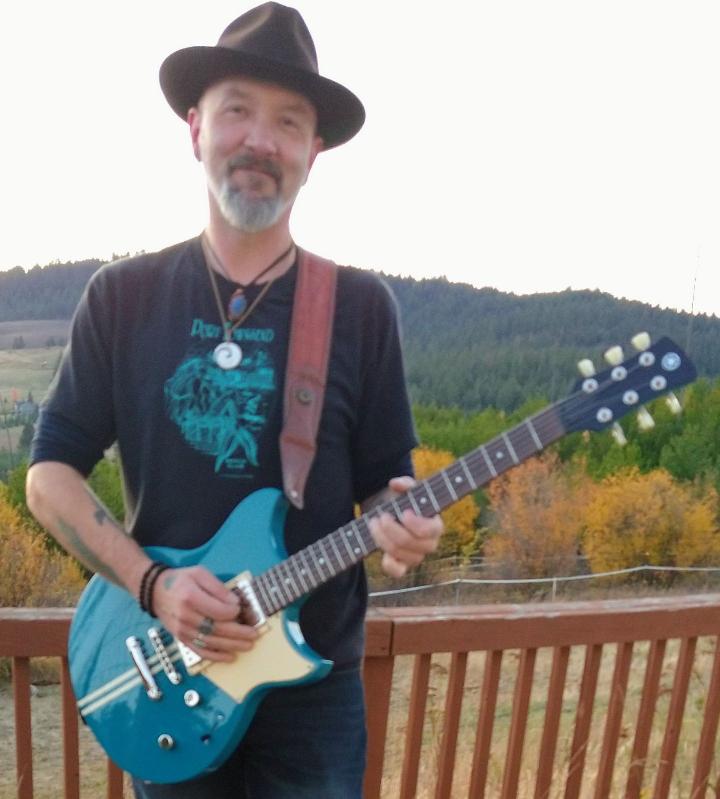
TRISHA’S and my older son, older. JAMES JOSEPH MICHAEL DENCE had a birthday yesterday. His caption, texted with the photo, is “Forty-eight never looked so good.” J.J. when he was young, JAYMZ as a stage name, he has been in Moscow, Idaho since college, working and playing guitar with the FABULOUS KINGPINS, all the while leading his own bands, the current version being SOLID GHOST.

SIDENOTE- I just received (yesterday) a reasonably priced front zip wetsuit, replacing the one I’ve thrashed and patched, the one famously (locally) for having the hole in a most inopportune place for someone knee paddling in a crowded lineup. The suit is from NRS, which, I discovered, stands for NORTHWEST RIVER SUPPLY, and, surprise, they are located in MOSCOW, IDAHO. James said he almost went to work for them, a small outfit then, but now worldwide, but “They still pay Idaho wages.” Yeah, well… in this case, I appreciate it.

ADAM ‘WIPEOUT’ JAMES, obvious animal lover, worldwide local, and HAMA HAMA OYSTERS ambassador, is having a birthday TODAY. 47, and choosing which locals are ready to welcome into which lineup. Adam put the ‘local’ in ‘local or lucky,’ (I do take credit for the phrase) seeming to arrive at locations on days that turn out to be EPIC. Example- Cape Kiwanda, the pullback capitol of the world, with the point actually acting like a point break. Almost guaranteed today will be awesome and barrelling. At least, using a phrase often used by Adam, there’ll be a few butt barrels.

SEQUIM VORTEX STORIES-

I’m checking out at Costco. The checkout guy, possibly trying to impress the young woman assisting, says, “Pop a wheelie. On, like, a BMX bike. You’re too young for that one. This guy probably gets it.” “Yeah, I am, but, you know, there’s never a mention of mama wheelie.” “Oh. Is that a thing?” “Probably not.”

I’m headed from Home Depot (for stain) to Walmart (for bird food, mostly, assuming I need a decent excuse for going to either big box, right-wing owned store), and I see this guy at the light with a sign that says, “Looking for human kindness.” I change lanes to avoid eye contact (because I’m a hypocritical liberal who already voted, solid blue, but one who is still working at 73), and because I run a constant stream of ‘what if’ scenarios through my mind, I wonder what reaction I would get from the man if I came back and gave him the gallon of milk from Costco. It might be, “Yeah, that’s exactly what I meant.” Or not.

I’ll skip the in-depth ‘Previously’ for “Swamis” again, but this chapter mostly takes place at GRANDVIEW, JOEY and a guy from Fallbrook High racing over after school. If you’re figuring out that the story is almost more about the relationship between Joey and JULIE COLE… yeah.

CHAPTER SEVEN- FRIDAY, MARCH 14, 1969

Fallbrook Union High School was letting out. Gary and Roger and I were standing in the big dirt parking lot behind the band room. Johnny Dale, in his daddy’s restored 1957 Chevy Nomad station wagon, two girls in the front seat with him, slowed down, then popped the clutch, and spun out directly in front of us. Gary, then Roger, flipped Johnny off, both called him an asshole. Both looked at me when I didn’t participate.

“Witnesses,” I said.

“You?” Gary asked. “No,” they both said. The next two cars that passed got three sets of double eagles, my gesture only waist high, almost happily returned by the car’s occupants.

“Friday, March 14,” I said, writing the date into a page about a third of the way through a red notebook sitting on the hood of a yellow 1968 Super Beetle with two surfboards, side by side on the Aloha racks; my bruised and patched nine-six pintail and a brand-new Hansen ten-two. “Finally enough light after school for going. Gary and Roger bailed.”

Roger said, “We’re not bailing, Joey; we have dates.”

Gary mouthed, “Dates” while running his hand along the rail of the board on the driver’s side, adding, “With girls. And it’s fuckin’ Friday! And, anyway, Joey, where’s your date, Doublewide Doug?”

“Doug-L-ass has… art seventh period,” Roger said. I nodded, looked at my watch, wrote a sentence in the notebook without saying it out loud.

“Why is it,” Gary asked, “That Dingleberry Doug has a new fucking car and a new fucking surfboard?”

“Why is it, Gary, that Joey is such a whore that he’ll ride with Dipshit Doug?”

“Why is it, Joey, that everyone’s getting shorter boards, but your buddy, Dipsy doodle Doug, is going full-on aircraft carrier?”

I looked around the lot. “Because, gentlemen, Doug’s… working; one, and his father’s running irrigation for all the new… ranchettes; two, and three, I’m a whore for the surf, and three, again… gas money.” I stepped back from my friends. Both were wearing Levis, Ked’s boat shoes, J.C. Penny’s white t shirts, and nylon windbreakers. As was I. “Why is it that we all don’t have… matching windbreakers like we’re on the Dork Neck Dreever Surf Team?” Both gave me ‘fuck you’ looks. “You guys, with the blonde hair and all. Uninformed people might believe you surf better than I do.”

“Fine with me, Joey. Gary? You?”

“Yeah. Fine, but… Hey, Joey; here comes your date now!”

Doug, varsity offensive lineman, was on the sidewalk, still a distance away, slow running toward us. He had a cardboard art portfolio under his right arm, his left arm out and ready to straight arm anyone in his path.

“Joey DeFreines, surf slut,” Gary said, kissing his right hand, then using a big arm movement to simulate throwing the kiss toward Doug. Roger ran out, putting both hands out as if he might catch this pass.

Doug only saw the last part before Roger bumped into him and bounced away. Doug dropped Roger with his left arm. “Incomplete,” he said, leaning over to help Roger back up.  

Gary’s mom’s Corvair pulled in beside Gary and me, trailed by its usual puffs of black smoke. The Princess was driving. There was another girl in the front seat, two more in the back. Sophomore girls. Giggling. The Princess peeled out just as Gary went around the back of the car.

“Better remember to put some oil in it, Princess,” Gary said, pointing to the hood. “One quart ought to do it.”

 The Princess popped the clutch, honked as she cut another car off, and pulled out and onto the side road in a cloud of black smoke.

Doug touched his car and leaned against it, breathing heavily. “Made it!” He opened his portfolio, pulled out a piece of drawing paper and laid it on the hood. “Check this shit out!” It was a drawing, pastels, of cartoonish people and cars on the side of a road. A red light was glowing from beyond and below the cars and people. “Pulled over” was written in the same red as a sort of caption.  

“It’s from… last week’s Free Press,” I said.

“Where’d you get it, Doublewide Dave?”

” Well… Roger, someone in my art class wanted me to scotch tape it on…” He pointed toward me. “Jody’s locker.”

“Grant Murdoch.”

“Grant fucking Murdoch.”

“Bingo! I told him to fuck himself, Jody, you and I are surfin’ buddies.”

“Surfin’ buddies, Doug-l-as,” Gary said, extending the ‘ass’ part, “Don’t wear that fucking letterman jacket to the beach. Joey wants all the hodads to think he’s from somewhere else.”

“Laguna… specifically,” I said as I rolled up the drawing, using the scotch tape at the corners to secure the roll. “Or San Clemente. Santa Cruz. Just… not… Fallbrook.”

Douglas took a folded piece of paper out of a pocket, the Warrior’s jacket off and tossed it, inside-out, onto the hood of his car.

“Oh, and fuck Grant Murdoch,” Gary said as he and Roger turned and headed toward an almost new Ford Mustang, two girls standing beside it.

Doug looked that way as he unlocked the driver’s door. “Roger’s stepfather’s car, Doug.”

“Yeah, I know, but, Jody, that one girl; I think she’s, maybe, a… sophomore.”

I stepped in front of Doug, blocking his view. “Maybe.” I shaded my eyes and looked toward the sun.

“Maybe she flunked third grade or something. We… You ready?”

I half-danced around the front of the car, grabbing my books and notebooks. “Maybe.”

When I got in the super beetle, Doug slid the paper across the dashboard. “Murdoch. Wanted me to give it to you…” I didn’t unfold it. “Personally. I didn’t look at it.”

I placed the unopened paper into the side pocket of my PeeChee folder. “We going?”

Doug was driving. I had a book open, its paper bag cover with unreadably psychedelic pencil lettering. “Civics” and “Grandview” and “JOEY DeFreines.”

“Shit, Jody, I could just cheat off of you.”

“Or… you could… study. I’ll just give you the… shit I think’ll be on the test.” 

“Close your eyes, Jody.” Doug pushed the book back toward my face.

I knew exactly where we were; three big corners west of the village of Bonsall, on the last straightaway before the sharp left and the narrow bridge across the wide valley that held the thin line of the San Luis Rey River. I looked over the book and Doug just in time to see the construction site, an elongated building framed up, level with and parallel to the highway on an artificial peninsula of fill.

“Building it quick, Jody.”

“Yes. Quickly.’

“Um, uh, Jody; you know, my sister… she taught me how to drive. She said, if there’s a truck or something coming… on the bridge… she just closes her eyes.”

“Uh, Doug… no. Eyes open. Please.”

We made it across, no vehicles coming our way. A choice had to be made. It was a soft right-hand turn or a steep hill.

“Oceanside’s probably faster,” Doug said. “Cut over at El Camino Real.”

“Faster then, Doug.”

Doug downshifted, made the soft right-hand turn. Thirty seconds later Doug said, “Um, you know; Gary and Roger call you Joey.” I didn’t look over the Civics book. “I’ll call you that if you call me…”

“Dangerous Doug? Or… your choice. Sure.”

“And you can tell Gary and Roger that I’m, you know, really good, surfing-wise. Joey.”

I lifted the book back up to my face. “Or… I can give you a dollar for gas… Doug-ie.”

“Oh. No. That’s all right… Jo-ey.”

Doug cut off an oncoming pickup truck as he made the thirty-five-degree turn onto the El Camino Real cutoff, southwest, up and out of the valley, We hit highway 78 on the other side, merged onto I-5, got off at Tamarack Avenue. High tide. Shorebreak. We didn’t even drop into the lower parking lot. Doug missed the turn for Grandview. So, Beacons. Doug pulled in next to a green-gray VW bus with a white roof.

“Last chance, Doug. Sun’s down in… forty minutes.”

 The tide was dropping. There were five surfers out, two of them girls. Young women. One of the young women was Julia Cole. There were four guys in street clothes on the beach. Two were watching the young women, one was looking at the flotsam along the tide line, one was doing some sort of surf pantomime, a beer bottle in each hand. He was the one who looked up the bluff at Doug and me.

“Jerks,” I said.

“Fucking Hodads,” Doug said as he opened the trunk on the front of his super beetle. That one in the blazer and wingtips, guaranteed not from around here.”

I moved to the bluff, wrapping Doug’s extra towel around me. A set was coming in and Julia Cole was on the second wave. I turned my shortjohn wetsuit back to outside out, peeled off my Levis and boxers, pulled the wetsuit up partway, wrapped the clothes in the towel, pulled the sleeveless suit up the rest of the way. Right arm through, I connected the stainless-steel turnbuckle at the left shoulder.

“My first wetsuit, Doug, December of 1965, made by a sailmaker at Oceanside Harbor, cost fifteen dollars. Christmas present. This one… seventeen-fifty, plus tax. But they were custom, two weeks from measuring to pick up.”

“Val’s,” Doug said as he unstrapped the boards, “my dad… up in LA.”

“Val’s is… valley, as in… valley cowboy.”

“Not trying to hide it.”

“Good. Noble. I am.” I pulled a cigarette out of the pack, showed it to Doug. He shook his head. I lit the Marlboro with three paper matches. Throwing my clothes into the trunk, I stashed my wallet, cigarettes, and matches in one shoe, stuffed the other shoe inside that one, slid the shoes under my clothes.

“Yes, Jo… Joey; I will lock the car.”

Halfway down the first section of the path, I saw that Julia Cole and her friend were out of the water. The three other Jerks followed the pantomimer toward them. “Monica,” the pantomimer, the Head Jerk, said. Loudly. His crew laughed. He repeated the word, stretching it to, “Mon-ee-ca. We have some be-er, San-ta Mon-e’-ca.” 

            Monica, her head down, made it to the bottom of the trail. The Head Jerk, walking backwards toward the bluff in front of Julia Cole, blocked the trail access. Julia Cole stopped; her face was very close to the Head Jerk’s. She said something. He put his free hand over his crotch, hopped backwards, throwing his hands out and up, beer sloshing onto his madras shirt.

Julia Cole was ten steps up the trail when he said, “Juuu-li-a. Juuuu-lee-ya; you are so cold. Soooo coooold. Ju’-li-a cold.”

Doug and I, boards under our arms, made the turn at the trail’s upper switchback.

The Head Jerk took several steps up the trail, turned back to his crew. “Come on up, you pussies!” Raising the volume, he added, “Surf broads. You jagoffs liking Monica’a ass better… or Juuu-lie’s?”

If any of the Jagoffs responded, it was more like growling or laughing than discernible words. “Brrrrrrrr,” the Head Jagoff said, Julie fifty feet up the trail, “Is the water cold, Juu-lie? And… I’m wondering if you’ve got anything on under that wetsuit. I saw… skin.” 

More laughter. One of the members of the Jagoff Crew said, “Come on, dude; cool it.”

Head Jerk moved both beer bottles to his left hand and shot his right hand out. Pleased that the subordinate flinched, Head Jagoff said, “And don’t fuckin’ call me dude… dude.” He started up the trail. His cohorts hung back, possibly because they saw me, looking quite displeased, and the much bigger Doug, behind me, also displeased.

 Monica and I met at the lower switchback. I stopped. Doug stopped. I stood my board up, holding it with my left hand, and moved to the uphill side.  Doug did the same. Monica nodded, quickly, but looked down as she passed. Julia Cole had an expression as much determined as pissed-off. Defiant. Looking at me, she didn’t seem to adjust her expression one way or the other. I did notice the chrome turnbuckle on one side of her wetsuit was undone and her bare shoulder was exposed. Skin. She noticed I noticed. Another asshole. Another jerk. Her lower lip seemed to pull in, her upper lip seemed to curl. Disappointment. Or anger. Julia blinked. I didn’t. I couldn’t.

Julia Cole passed me and then Doug. “Joey’ll get ‘em,” Doug said.

“No,” she said. “Not… no.”  

I may have been replaying Julia Cole’s expression for the third or fourth time when Head Jagoff approached the tight angle at the switchback. I may have missed the first few words he kind of spit at me.

I replayed his words. “What’s the deal, asshole? Huh? You some sort of fuckin’ retard?”

“Possibly, Dude,” I said. “I do believe, Dude, you owe Julia Cole and Monica… don’t know her last name… a sincere apology.”

“You do,” Doug said. “And… don’t know where you’re from, Jagoff; somewhere east coast; but we don’t fuckin’ call our chicks ‘broads’ around here.” Doug looked at me.

“I believe,” I said, “The Jerk prefers being called Dude… over Jagoff.”

“No, Jagoff seems apropos. That, Jagoff, means ‘appropriate.’ It’s French. Jagoff, which, I might be wrong, has something to do with… you know, whacking the… willy.”

Jagoff looked at Dangerous Doug in his new Val wetsuit, his un-dinged Hansen leaning against his left shoulder, his spotless white towel over his right shoulder. Jagoff looked back down the trail. His cohorts hadn’t moved. “Come on up. We have us a fuckin’ farm boy and some sort of retard Gook.”

“Oh, no. Jody; Willy Whacker called you a Gook.”

“Common mistake.”

“Step aside, fuckers!” Neither Doug nor I moved. “Jody,” Jagoff said, leaning in way too close to my face. “Girl’s name. Well. Fuck Monica! Fuck Julie fuckin’ Cole. And… fuck you, Jo-dee… And your fat-ass friend.”

Doug turned toward me. “I meant… Joey, but. Joey, I don’t think an apology is, you know, forthcoming.”

I let go of my board and extended my right hand, palm up, toward Jagoff. My board fell against the bank. He looked at my hand. He made a sound as if he was hawking up a loogie. I kept my hand out. He spit near but not on my hand.

Doug laid his board, carefully, uphill, against the scrub and ice plant on the bluff. He wrapped his towel around his neck and pointed at each member of the Jagoff Crew, now partway up the lower portion of the trail. “Hey, assholes, come on up and help out your friend. But, warning, Joey’s a, for real, fucking, by-God, Devil Dog!”

Jagoff shook his head. “Devil Dog?” It didn’t register. He looked up toward the parking lot, sneering. He put one of the beer bottles in his other hand. Holding the bottles by the necks, he smashed them against each other. The open one shattered, the remaining beer running down his arm. He held the raw edges against the palm of my right hand. He was smiling. “Fuck you, Gook!”

I closed my eyes. I imagined an eleven-year-old kid. My opponent. He had padded fabric head gear and a heavy pad on his body, a padded pugil stick in his hands. He was sneering. Other voices were cheering. I could hear myself crying. Big sobs, inhaling between each one. My father’s voice said, “Eyes open, Jody! Open!” The kid in the head gear, still sneering, was about to hit me again, this time with the right-hand end of the stick. I could also see the Jagoff, his beer bottle weapon pulled back. My father’s voice screamed, “Get in there! Jody!” I did. I saw my pugil stick connect, saw the opponent fall back. His sneer gone.

 As was Jagoff’s.

Both beer bottles were on the path, both now broken. It would be a moment before Jerk/Dude/Jagoff reached for his nose; before the blood started flowing from there and his upper lip. It would be another few moments before the three Jagoffs, frozen near the top of the bluff, continued scrambling for the top.

“Devil Dog,” Dangerous Doug said.

“Devil Pup,” I said, keeping my eyes on my opponent. “Marines, Dude… may I call you Dude? There were tears in Dude’s eyes, blood seeping between his fingers. “Or… your name? No? Well, Dude, Devil pups; it’s kind of like… summer camp… on the Marine base, with hand-to-hand combat.”

Doug pulled his towel from his shoulders and handed it to Dude. “Apology, then, Dude?”

Fluffy towel to his face, Dude nodded. “Not to us,” I said. He nodded again. “Promise?” Third nod. “Okay. And, if you would… pick up the glass. It dangerous. Huh, Doug?”

“Dangerous,” Doug said. “Keep the towel, Dude. Souvenir.”

Looking from Doug to me, Dude pulled the towel away, blood seeping through it. “You don’t know Julia Cole. What she’s really like. You defending her, it’s like…”

“You’re right. I don’t know her.”

“’Cause we’re from Newport, Dude. Huh, Joey?”

Dude was staring at me. His eyes narrowed, then widened. Whether or not this meant he recognized me, I smiled. “Newport… yeah.”

Doug blinked and mouthed, “Laguna.”

When Doug and I got to the beach, Dude was still at the same spot, placing pieces of broken glass into Doug’s towel. His friends were in the parking lot, three vehicles over from the VW camper bus. There was a flash of light off glass. Julia Cole was behind the passenger side door. I couldn’t see her expression. I could remember it from earlier.

“Sorry, Doug. You know I’m trying to be all ‘peace and love,’ and not…”

“You shittin’ me, Joey? You’re a fuckin’, by-God Devil Dog!”

When we were knee deep in the water, Doug jumping onto his board early, too far back, too much of his board’s nose out of the water, I said, “Maybe we can keep this little incident to ourselves.”

Doug laughed. “How good am I doing, Joey?”

I jumped over a line of soup and onto my board. “You’re fuckin’ ripping, Dangerous Doug!”

            I left my wetsuit and my shoes on the porch, stacked my books on the dinette table, and looked back into the living room, all the lights except a lamp by the console off. My mother was on the couch. A World War II era record was playing, a woman singing wistfully about lost love. Seventy-eight rpm. The wedding photo was leaning against the console. The song ended and another record, 33 and 1/3 rpm, dropped onto the turn table. “South Pacific,” original Broadway cast.

            My mother got up, adjusted the record speed, and walked into the kitchen. I followed.

            “The surfing?”

            “Good. Doug is just learning, and…”

            “Doug. Who are Doug’s… people?” She turned off the oven and pulled out a foil covered plate, set it on the cast iron trivet on the kitchen table. “Would you like milk?”

            “I’ll get it. Doug’s father has the irrigation company. Football player. That Doug.”

            “Irrigation. Football. Doug. You and he are… friends… now?”

            “Now? I guess so. Surf friends, Mom; it’s… different.”

“Still, it is nice that you have… friends.”

            “It’s just… it’s not… Surfing’s cool. I surf. It doesn’t make me cool.” My mother gave me a look I had to answer with, “Yes, mother; friends are… nice to have.” She nodded and walked through the formal dining room and into the living room.

            I pulled the paper Doug had given me out of the PeeChee and unfolded it. “It was a drawing of me, from this week’s Free Press. Me in the window, looking out. The pen and ink drawing wasn’t quite a rendering, not quite a cartoon, with un-erased pencil lines. “Grant,” a signature at the bottom, was not finished in ink.

I tried to figure what Grant’s motives were. Intentions. I allowed water trapped in my sinuses to drain from my nose, not wiping at them with a paper napkin for a moment, then blowing as much water as I could into the napkin.

Freddy ran into the kitchen from the hallway, half pushed me against the counter. “She called,” he said. “The reporter. Asked for you… after I told her mom wasn’t here. Are you crying?”

            “No. No.” I refolded the drawing. “Who? Lee Ransom?”

            “Yeah. Her. Mom was here. Outside, grooming Tallulah.”

             “Okay.”

            “I told her…” Freddy switched to a whisper. “I told her what you told me to say.” I nodded, tried to push past my brother. He put a hand to my chest. “She asked what kind of car mom drives.” I did one of those ‘and?’ kind of shrugs. “She said she asked one of the detectives, and he pointed to a different car than the one someone else pointed to… not the Volvo.”

            “Which one?”

            “Which car?”

            “Which detective?”

            “Boys!” I looked around Freddy. Our mother was in the dining room. I couldn’t tell from her expression how much she had heard. I had to assume too much. 

“SWAMIS’ is copyrighted material, all rights reserved by the author, Erwin A. Dence, Jr.

And, in the RELUCTANTLY POLITICAL catagory, please vote the reasoned choice; BLUE. There is no other America to save America from going the way of many another country. There is no reasonable reason to vote for a disgusting example of a human being and wannabe dictator. If you claim some sort of Christian stance, ‘he is redeemable’ kind of bullshit argument, you must not believe Jesus when he said about those who speak the way the orange candidate does, that “the truth is not in them.” Or, perhaps, you put little value in the last book of the BIBLE. Cons con. Liars lie. Grifters grift.

New material on Sunday.

‘STWAITING.’ Sometimes Getting Skunked is Preferable

‘STWAITING” (add a lisp to get the word right), the fine art of waiting around on the STRAIT OF JUAN DE FUCA for the swell to rotate, or the tide to drop, or rise, or the waves to just get a little bit bigger, a bit more consistent; and then, finally, going out just as the 13th squall blows it all out AND, catching four waves total, you are forced into doing The paddle of shame.

STILL, THERE’S ALWAYS A STORY- But first…

Trisha’s brother’s son, our nephew, DYLAN SCOTT. I sent him an ORIGINAL ERWIN shirt for his birthday and as a house warming present. He sent me a video from SURFLINE REWIND of him at one of his local ENCINITAS spots, D Street. Since I have the non-premium WordPress package, I can’t display it here, but in the clip Dylan tucks into an offshore-enhanced and throaty barrel, doggy-dooring it at the last possible moment, and doing what appears to be, on my phone, a non-claim claim. I did send the video on to the surfers on my stealth phone.

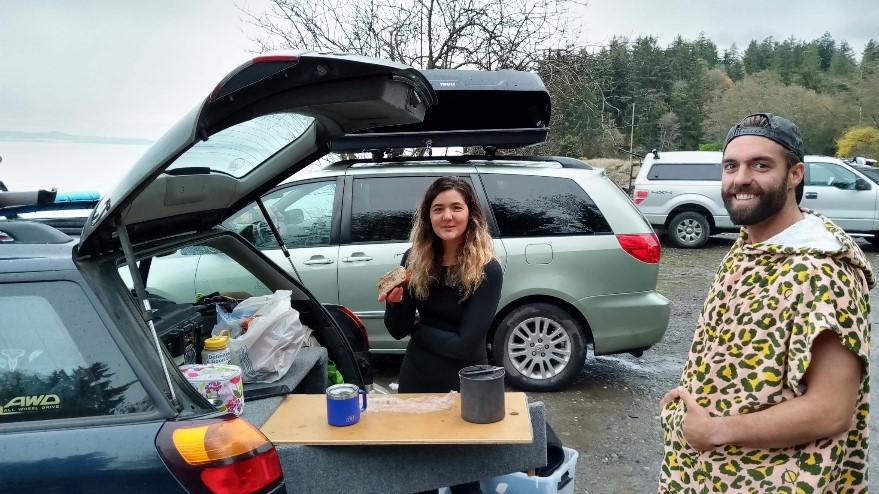
I TOLD this guy that, although it was early, he would, no doubt, be the fashion crusher of the day. It turned out he had a flat tire up the road, and, although he had a jack and a spare, he was waiting for triple A to come from civilization. I guessed he didn’t want to get grease on his poncho.

THE NEXT wanna surf person I saw (should have taken a picture) was suited up and ready to go out. “Really?” “They said it’s supposed to be good,” he said. “Who? Who said?”

TONY AND FIONA are from Vancouver, B.C. where you can get a wavestorm in different, Canada-only colors. Vancouver is kind of like Seattle in that it costs money and takes ferries to get to surf. Evidently it’s cheaper, or as cheap to go to, like, Westport, than it is to go to Tofino. They were camped at LaPush, but left because ‘they’ forecast, like, 16 foot (like, 5 meter) waves, so they left. Quite irritated that my own forecast was proving, possibly, wrong, I gave Tony and Fiona grief, as in, “SO, are you just going to get in everyone’s way when the waves start pumping? How long have you been surfing? Did you go to surf school?” Yes, I sort of apologized, promised to put them on my site with tens of followers in Canada AND throughout the free and unfree world. SO, promise kept. AND, since the waves were so shitty, I have to believe they had a great American time.

THE FADED RAINBOW seems to frame what could be a six foot set at a great distance. It isn’t. It’s a six inch set fairly close. AM I BLOWING UP THE SPOT? My argument is that, if you head out, frothed out by the forecast, expecting epic conditions… well, don’t. As much as I don’t trust forecasts, I think post-casts saying what was rather than what could be, are also dangerous. Since I’m going on years of experience, anecdotal evidence at best, and somewhat relying on actual buoy reports (which are trickier than you might think), and I get skunked… well, there are always waves in WESTPORT.

QUIRKY SCOTT, who does not like his nickname, even when I told him it really means ‘eccentric’, dominated on this day. I am actually a little shocked at how model-like he looks in this photo. NOW, when I say dominated, I mean he caught more tiny waves than any of the other beginning or desperate surfers. I’m in the second category, hopefully.

AT SOME POINT in my paddling for waves that disappeared or disappointed, a woman was staring at me. Wasn’t sure why. It turns out JOSIE (another no photo) heard me talking to Scott, and asked him if I’m that guy who posts stuff on the internet. He said, paraphrasing, “Erwin. Yeah. Tell him you recognize him; it’ll do something for his giant ego.” This wasn’t the first time I’ve been identified, the reaction usually negative. “I like the way you use words,” she said. “Uh, yeah; I know it seems like it’s all stream of consciousness, but, really, I work at, and, yeah, thanks.”

I also, to round out a day of stwaiting, talked to SEAN GOMEZ, Port Angeles teacher and ripper, who got some epic waves recently (I missed it- have friends who didn’t), and to Reggie, who missed out on reportedly epic coast waves in order to make a bunch of money (familiar story for me, newer for Reggie), and saw, on my way home, many more surfers headed to where I had been. “Good luck. They say it’s supposed to be good.”

MAYBE, and this is always the story, it got good after I left.

A photo of a moonset over the unseen Olympics from my front yard. A moment later the full moon was covered by clouds from the latest atmospheric river, a moment later, the moon was back. And then…

NON-POLITICAL STORY: As a decent American, I recycle. I devote what could be a tool shed to saving cardboard and plastic and paper. Enough so that I took half a van load to the QUILCENE transfer station. I’m putting the stuff in the proper bins when this dude comes up to me, looks in my big boy van and says, “Wow, you actually work out of this.” “Yes.” He has spoken to me before, the gist being he’s a painter, ready to work. He actually talks way faster than I do, and had a lot to say about wages and drunk and/or cheap contractors and stoned painters who don’t know shit. “Uh huh,uh huh.”

Somewhere in there he asks me how to register to vote locally. “I, um, got my ballot yesterday. I voted. I… don’t know. You could go to the courthouse, maybe.” “No, man; I don’t want that vote by mail shit. I’m an American. I want to vote in person.” “Well, I think… actually, if you’re voting for Trump, maybe you…” “Damn right I’m voting for Trump.” I tried to dissuade him, but his argument that ‘Kamala isn’t really black’ seemed to be stronger than my ‘Trump is a fucking crook who fucked over every contractor who worked for him’ counter.

He did the violin-playing gesture, usually with ‘cry me a river’ lyrics. I slammed the door to the van, but he, no doubt feeling tough and manly, jumped into his sub compact and drove off. On leaving, I saw MISTER BAKER, former Quilcene Science teacher over by the ‘paper’ bin. “I’m glad to see you survived that encounter,” he said. “Me, too. Yeah. I don’t usually talk politics, but…” “Seems like the last time I saw you, at the Post Office, you were in a heated political… discussion.” “Oh yeah. Mr. Hodgson; he was going on about how he was ‘woke.’ I had to tell him when people like him use ‘woke’ it’s always sarcastically, and if one isn’t smart enough to know being aware of the inequities in society is not a bad thing, one shouldn’t attempt sarcasm. Yeah, and now he’s on the school board and talking about banning books.”

ANYWAY, I didn’t argue with Mr Baker. I do, however, believe he knows where I stand based on the one time I was invited to a cheese and wine (cheese and crackers for me) thingie. And that was before citizen Trump de-evolved into whatever he is now.

IF YOU SEE ME, remind me to take your picture. ANOTHER sub-chapter of “SWAMIS” will be posted on Wednesday, along with whatever fun stuff happens in between. Tensions are only going to get worse between now and election day. Stay cool, surf ’em if you find ’em.

Recap of “Swamis” plus Ch.6,Part One, plus More

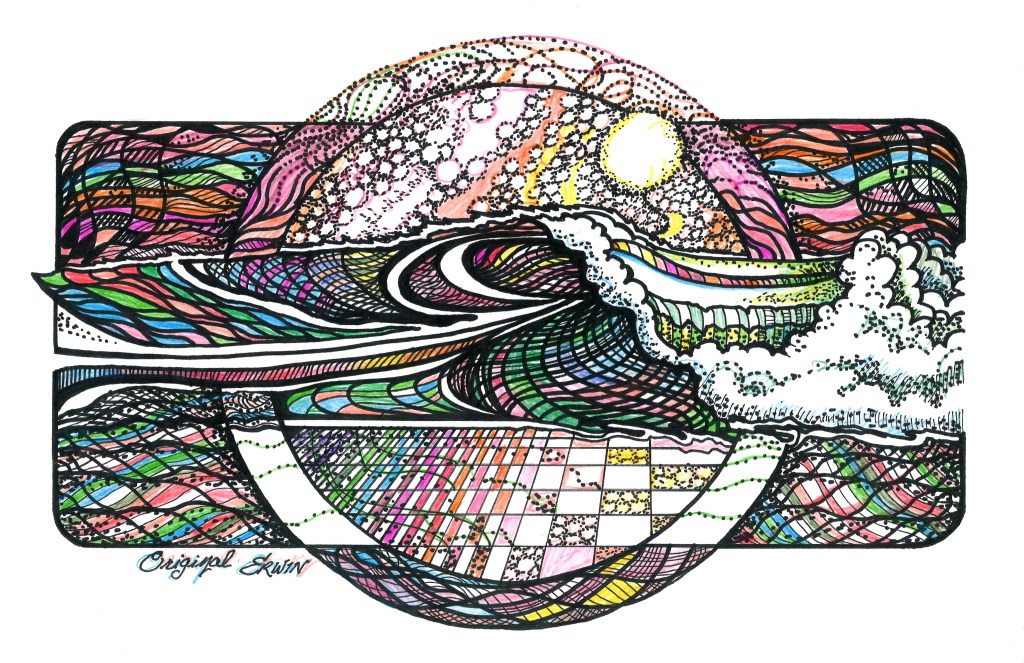
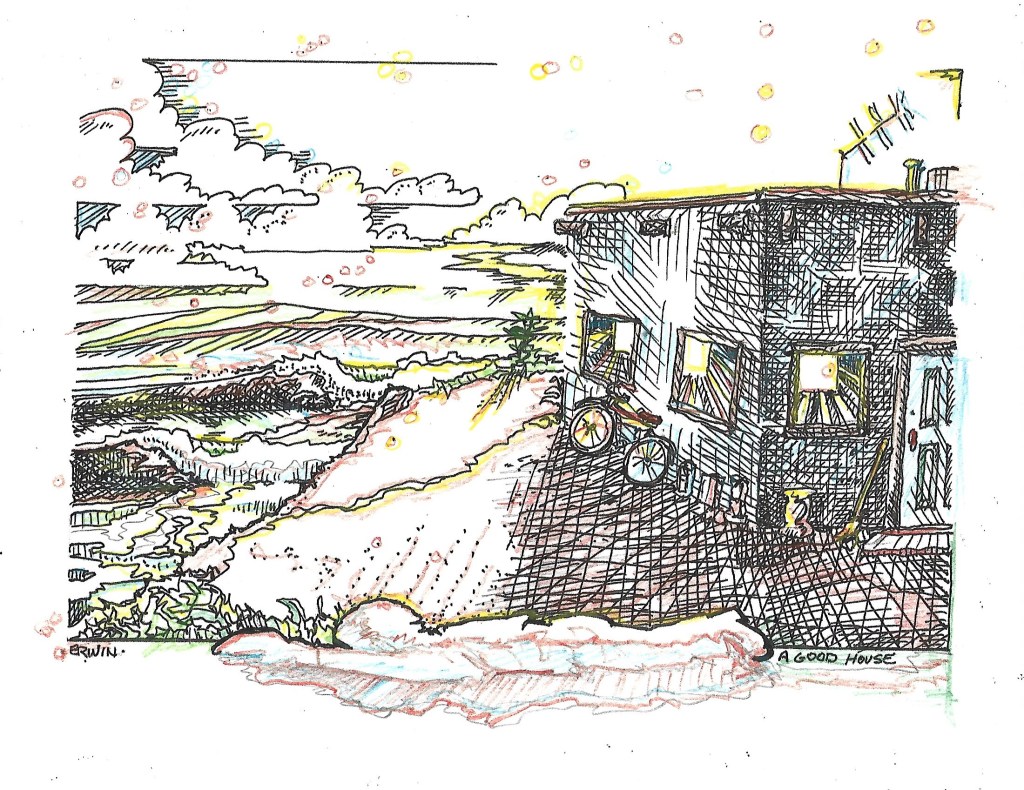
This drawing will, of course, have to be reversed, white-to-black, to go on (future) t-shirts. There are some new hoodies and long-sleeved shirts ready at D&L LOGOS on Monday. I’m pretty excited, as is TRISH. She special ordered one for her, “cost just a little bit more… honey.” “Sure.”

This design, a little larger than the practice ones I had printed. I have to figure out how much they’re costing me, and then… some will be available. I got one xxl, for me, but I may have already sold it.

OKAY, a lot of stuff this week. If your time is limited, SKIP the story. Not classic, all time. Next time… Do read the “Swamis” chapter. Thanks.

IN the ‘every session’s a story’ catagory… I had to go surfing the other day, last chance before my third eye surgery. I was aware, because, despite the rules, news of waves breaking and being ridden spreads, and I missed opportunities because my once-repaired but re-damaged fin box on my beloved but abused HOBIE needed repair, and I was focused on working and trying to buy another board. BUT, the dude with a board within reasonable driving distance wanted too much (as in, it’s listed for $500, out there for 8 weeks, and he won’t take less) for a board that is actually heavier than mine. SO, I purchase resin, hot cure catalyst, and some glass, cut the box loose, fill the hole with glass and resin, slam it back in, half-glass the whole unit in, fin and all. Foolish, knowing how the small waves and big rocks on the STRAIT eat fins.

I did all this on a painting job, the board on the rack of my VOLVO. It dried, I retied it to the rack AND I was ready for the next day’s pre-dawn takeoff. Enroute, I passed an accident on 112, almost to Joyce, a car on its top in the ditch, and it had been there long enough that there were cones and people with signs, and a lit-up display that read, “Accident Ahead.” It turns out three people, none wearing seatbelts, were hurt, two flown out. SO, maybe I should slow down.

AND I DID, but… you know how straps can be noisy? Mine were, increasingly so. It was a while after I arrived at my destinatiion, three people in the water, that I noticed my board was… Ever see people driving down the road with mattresses poorly tied to the roof? YEAH. But I was lucky. And the waves were what we… okay me, what I call FUN. I knew most of the dawn patrollers, met Ian’s wife (forgot her name- sorry; four syllables- don’t want to guess), and KEVIN, a Port Townsend surfer I had heard about. Iron man, stayed out about four hours straight.

SINCE, evidently, surfing is more dangerous after eye surgery than heavy lifting, I can hold on to memories of a decent session until… next time.

BECAUSE IT IS DIFFICULT to go back and pick up the earlier chapters, I am going to provide a recap of “SWAMIS.” Yes, even the ‘catchup’ is a lot of reading.

“Swamis” Recap

CHAPTER ONE -Monday, Nov 13, 1968-

Seventeen-year-old JOEY DeFREINES is talking with his court appointed psychologist, DR. SUSAN PETERS. Joey’s father, San Diego County Sheriff’s Office DETECTIVE LIEUTENANT JOSEPH DE FREINES made the deal following an afterschool incident at Fallbrook Union High School during which Joey put his foot on GRANT MURDOCH’s neck. Dr. Peters asks if, once bullied, Joey has become a bully.

TWO- Saturday, August 14, 1965-

13-year-old Joey tries surfing at PIPES. JULIA COLE is out, already accomplished. She says boy surfers are assholes, surfing is hard, and she stays away from cops and cop’s kids.

THREE- Sunday, September 15, 1968-

Joey tricks SID and other locals in the lineup at GRANDVIEW, gets a set wave. Sid burns Joey and tells him he broke the ‘locals rule,’ that being that locals rule.

Joey, driving his FALCON station wagon, comes upon a VW VAN. Locals DUNCAN, MONICA, AND RINCON RONNY are looking at the smoking engine. They are unresponsive if not hostile to Joey, but Julie (to her friends) asks Joey if he’s a mechanic or an attorney. “Not yet,” he says. There is an attraction between Julie and Joey that seems irritating to, in particular, Duncan.

FOUR- Wednesday, December 23, 1968-

Joey has a front row spot at SWAMIS. He has already surfed and is studying, notebooks on the hood of the Falcon. Arriving out of town surfers want the spot. Joey, hassled by one of them, informs BRIAN that he has a history of striking out violently when threatened, and says he’s on probation. Joey has an episode remembering past encounters, witnessed by the out-of-town surfers and Rincon Ronny, who seems impressed and says those kooks won’t bother Joey in the water. “Someone will,” Joey says, “It’s Swamis.”

FIVE- Thursday, February 27ut-

At breakfast at home in Fallbrook, Joseph DeFreines confronts his son (who he calls JODY) about an acceptance letter from Stanford University Joey hid. Joey’s father is also upset with his wife, RUTH, for some reason, and leaves in a huff, saying he’ll take care of it.

Joey and his younger brother, FREDDY, get a ride home from surf friend, GARY, and Gary’s sister, THE PRINCESS. Ruth is loading the Falcon, says she spoke on the phone with DETECTIVE SERGEANT LARRY WENDALL, and says she will, as always, be back. Freddy blames Joey. Their father calls as their mother pulls away. Joey, looking for the keys to his mother’s VOLVO, speaks briefly, somewhat rudely, with his father. Freddy says he’ll wait for their father. The phone rings. It’s ‘uncle’ Larry. Joey runs toward the Volvo.

SIX- Tuesday, March 4, 1968. PART ONE-

There is a post-funeral wake/memorial/potluck at the DeFreines house. Joey, avoiding the guests, is standing in the big west-facing window. MISTER DEWEY, a teacher at Fallbrook High, says he is surprised that Joey’s ex-Marine, ‘practically a John Bircher,’ father is married to a Japanese woman. “Traditional,” Joey says, “Kill the men, take the women.” Mister Dewey expresses interest in the property Joey’s father never had the time to work on.

A delivery van from ‘Flowers by Hayes’ comes up the driveway, guarded, for the wake, by DEPUTY SCOTT WILSON. The driver of the van is CHULO, a surfer several years older than Joey. Chulo was arrested along with JUMPER HAYES for stealing avocados. Chulo was crippled during the arrest, went to work camp, became a beach evangelist.

Joey has an episode, during which he replays the accident in which, while driving the Volvo, he follows the Falcon and another car around the smoking JESUS SAVES BUS. Joey’s father, in an unmarked car, passes very close to him and pulls off the highway at high speed. JeJ

Chulo was driving the Jesus Saves bus.

Detective Wendall and DETECTIVE SERGEANT DANIEL DICKSON are at a makeshift bar in the living room. ORANGE COUNTY SHERIFF’S OFFICE DETECTIVE LIEUTENANT BRICE LANGDON, dressed in a just out of fashion Nehru jacket and rat-stabber shoes, isn’t popular with the two remaining detectives from the VISTA SUBSTATION, or with the other civilians and deputies from the San Diego Sheriff’s Office.

THERESA WENDALL, putting out food, tries to talk to her husband. He avoids her. Their two boys are running through playing cowboys-and-Indians as Langdon seems to corner Chulo.

CHAPTER SIX- TUESDAY, MARCH 4, 1969  

It was still early afternoon. I was in the living room, ignoring everything behind me, facing but not really seeing anything out the west-facing window. A Santa Ana condition had broken down, and a thousand-foot-high wall of fog had pushed its way up the valleys. The house was situated high enough that the cloud would occasionally clear away, the sun brighter than ever. The heat and humidity, raised by the number of people in our house, caused a fog of condensation on the plate glass.

Below me, cars were parked in a mostly random way in the area between the house and the separate and unfinished garage, and the corral. Continued use had created a de facto circular driveway up the slight rise from the worn and pitted gravel driveway, across the struggling lawn, and up to the concrete pad at the foot of the wooden steps and front porch.

A bright yellow 1964 Cadillac Coupe De Ville convertible, black top up, was parked closest to the door.  Other vehicles were arranged on the clumpy grass that filled in areas of ignored earth. Later arrivals parked on the lower area. The Falcon was parked close to the county road in keeping with my parking obsession; with getting in, getting out, getting away.

I was vaguely aware of the music coming from the turntable built into the Danish modern console in the living room. Stereo. Big speakers in opposite corners of the room, the volume where my father had set it, too low to compete with the conversations among the increasing crowd, the little groups spread around the room. Some were louder than others. Praise and sympathy, laughs cut short out of respect. Decorum.

Someone had put on a record of piano music; Liberace, or someone. My father’s choice would have been from the cowboy side of country/western; high octave voices capable of yodeling, lonesome trails and tumbling tumbleweeds, the occasional polka. My mother preferred show tunes with duets and ballads by men with deep, resonant voices, voices like her husband’s, Joseph Jeremiah DeFreines.

 These would not have been my father’s choice of mourners. “Funerals,” he would say, “Are better than weddings.” He would pause, appropriately, before adding, “You don’t need an invite or a gift.”

Someone behind me repeated that line, mistiming the pause, his voice scratchy and high. I turned around. It was Mister Dewey. A high school social studies teacher, he sold insurance policies out of his rented house on Alvarado. His right hand was out. I didn’t believe shaking hands was expected of me on this day.

“You know my daughter, Penelope,” he said, dropping his hand.

“Penny,” I said. “Yes, since… third grade.” Penny, in a black dress, was beside Mr. Dewey, her awkwardness so much more obvious than that of the other mourners. I did shake her hand. “Penny, thanks for coming.” I did try to smile, politely. Penny tried not to. Braces.

 I looked at Mr. Dewey too closely, for too long, trying to determine if he and I were remembering the same incident I was. His expression said he was.

When I refocused, Mister Dewey and the two people he had been talking with previously, a man and Mrs. Dewey, were several feet over from where they had been. I half-smiled at the woman. She half-smiled and turned away. She wasn’t the first to react this way. If I didn’t know how to look at the mourners, many of them did not know how to look at me, troubled son of the deceased detective.

If I was troubled, I wasn’t trying too hard to hide it. I was trying to maintain control. “Don’t spaz out,” I whispered, to myself. It wasn’t a time to retreat into memory, not at the memorial for my father. The wake.

Too late.

“Bleeding heart liberal, that Mister Dewey,” my father was telling my mother, ten-thirty on a school night, me still studying at the dinette table. “He figures we should teach sex education. I told him that we don’t teach swimming in school, and that, for most people, sex… comes… naturally. That didn’t get much of a laugh at the school board meeting.”

“Teenage pregnancies, Joe.”

“Yes, Ruth.” My father touched his wife on the cheek. “Those… happen.”

“Freddy and I both took swimming lessons at Potter Junior High, Dad. Not part of the curriculum, but…”

“Save it for college debate class, Jody. We grownups… aren’t talking about swimming.”

  Taking a deep breath, my hope was that the mourners might think it was grief rather than some affliction. Out the big window, a San Diego Sheriff’s Office patrol car was parked near where our driveway hit the county road. The uniformed Deputy, still called “New Guy,” assigned to stand there, motioned a car in. He looked around, went to the downhill side of his patrol car. He opened both side doors and, it had to be, took a leak between them. Practical.

The next vehicle, thirty seconds later, was a delivery van painted a brighter yellow than the Hayes’ Cadillac. Deputy New Guy waved it through. I noticed two fat, early sixties popout surfboards on the roof, nine-foot-six or longer, skegs in the outdated ‘d’ style. One was an ugly green, fading, the other, once a bright red, was almost pink. Decorations, obviously, they appeared to be permanently attached to a bolted-on rack. The van was halfway to the house before I got a chance to read the side. “Flowers by Hayes brighten your days.” Leucadia phone number.

Hayes, as in Gustavo and Consuela Hayes. As in Jumper Hayes.

A man got out of the van’s driver’s seat, almost directly below me. Chulo. I knew him from the beach. Surfer. Jumper’s partner in ‘the great avocado robbery’ that sent them both away, Chulo returning, reborn, evangelizing on the beach, with a permanent limp.

Chulo’s long black hair was pulled back and tied; his beard tied with a piece of leather. He was wearing black jeans, sandals, and a day-glow, almost chartreuse t-shirt with “Flowers by Hayes” in white. Chulo looked up at the window, just for a moment, before reaching back into the front seat, pulling out an artist’s style smock in a softer yellow. He pulled it over his head, looked up for another moment before limping toward the back of the van.

The immediate image I pulled from my mental file was of Chulo on the beach, dressed in his Jesus Saves attire: The dirty robe, rope belt, oversized wooden cross around his neck. Same sandals. No socks.

Looking into the glare, I closed my eyes. Though I was in the window with forty-six people behind me, I was gone. Elsewhere.

I was tapping on the steering wheel of my mother’s gray Volvo, two cars behind my Falcon, four cars behind a converted school bus with “Follow me” painted in rough letters on the diesel smoke stained back. The Jesus Saves bus was heading into a setting sun, white smoke coming out of the tailpipes. Our caravan was just east of the Bonsall Bridge, the bus to the right of the lane, moving slowly.

My mother, in the Falcon, followed another car around the bus. Another car followed her, all of them disappearing into the glare. I gunned it.

I was in the glare. There was a red light, pulsating, coming straight at me. There was a sound, a siren, blaring. I was floating. My father’s face was to my left, looking at me. Jesus was to my right, pointing forward.

This wasn’t real. I had to pull out of this. I couldn’t.

The Jesus Saves bus stopped on the side of the road, front tires in the ditch. The Volvo was stopped at a crazy angle in front of the bus. I was frantic, confused. I heard honking. Chulo, ion the Jesus Saves bus. He gave me a signal to go. Go. I backed the Volvo up, spun a turn toward the highway. I looked for my father’s car. I didn’t see it. The traffic was stopped. I was in trouble. My mother, in the Falcon, was still ahead of me. She didn’t know. I pulled into the westbound lane, into the glare, and gunned it.

When I opened my eyes, a loose section of the fog was like a gauze over the sun. I knew where I was. I knew Chulo, the Jesus Saves bus’s driver, delivering flowers for my father’s memorial, knew the truth.

Various accounts of the accident had appeared in both San Diego papers and Oceanside’s Blade Tribune. The Fallbrook Enterprise wouldn’t have its version until the next day, Wednesday, as would the North County Free Press. All the papers had or would have the basic truth of what happened. What was unknown was who was driving the car that Detective Lieutenant Joseph Jeremiah DeFreines avoided. “A gray sedan, possibly European” seemed to be the description the papers used.

”The San Diego Sheriff’s Office and the California Highway Patrol share jurisdiction over this part of the highway. Detective Lieutenant Brice Langdon of the Orange County Sheriff’s Office is acting as a liaison with the Highway Patrol in investigating the fatal incident.”   

Despite the distractions, what I was thinking was that Chulo knew the truth.

Chulo would be depositing the four new bouquets in the foyer, flowers already filling one wall. I looked in that direction, panning across the mourners. The groups in the living room were almost all men. Most were drinking rather than eating. Most of the groups of women were gathered in the kitchen.

A woman wearing a white apron over a black dress brought out a side dish of, my guess, some sort of yam/sweet potato thing. Because I was looking at her, she looked at the dish and looked at me, her combination of expression and gesture inviting me to “try some.” There was, I believed, an “It’s delicious” in there. Orange and dark green things, drowning in a white sauce.

“Looks delicious, Mrs. Wendall.”

Two kids, around ten and twelve, both out of breath, suddenly appeared at the big table, both grabbing cookies, the elder sibling tossing a powdered sugar-covered brownie, whole, into his mouth, the younger brother giving a cross-eyed assessment of his mother’s casserole.  

“Larry Junior,” Mrs. Wendall half-whispered as she shooed her sons out the door. She looked at her husband, leaning against a sideboard serving as a bar. He followed his boys out the door with the drink in his hand, half-smiled at his wife, as if children running through a wake is normal; and was no reason to break from chatting with the other detective at the Vista substation, Daniel Dickson, and one of the ‘College Joe’ detectives from Downtown. War stories, shop talk. Enjoyable. Ties were loosened and coats unbuttoned, the straps for shoulder holsters occasionally visible.

“Just like on TV” my father would have said. “Ridiculous.”

Freddy, out of breath, came out of the kitchen, weaving through the wives and daughters who were busily bussing and washing and making plates and silverware available for new guests. I handed him two cookies before he grabbed them. He grabbed two more.

“They went thataway, Freddy,” Detective Dickson said, pointing to the foyer.

Freddy pushed the screen door open, sidestepped Chulo, and leapt, shoeless, from the porch to what passed for our lawn, Bermuda grass taking a better hold in our decomposed granite than the Kentucky bluegrass and the failing dichondra.

Chulo, holding a metal five-gallon bucket in each hand, walked through the open door and into the foyer. He was greeted by a thin man in a black suit coat worn over a black shirt with a Nehru collar. The man had light brown hair, slicked back, and no facial hair. He was wearing shoes my father would refer to as, “Italian rat-stabbers.” Showy. Pretentious. Expensive fashion investments that needed to be worn to get one’s money’s worth.

Chulo had looked at me, looked at the man, and lowered his head. The man looked at me. I didn’t lower my gaze. I tried to give him the same expression he’d given me. Not acknowledgement. Questioning, perhaps.

Langdon. He must have been at the funeral, but I hadn’t felt obligated to look any of the attendees in the eye. “Langdon,” one of the non-cop people from the Downtown Sheriff’s Office, records clerks and such, whispered. “Brice Langdon. DeFreines called anyone from Orange County ‘Disneycops.’” Chuckles. “They put people in ‘Disney jail’,” another non-deputy said.

“Joint investigation guy,” one of the background voices said. “Joint,” another one added. Three people chuckled. Glasses tinkled.  Someone scraped someone else’s serving spatula over another someone else’s special event side dish. Probably not the yams.

Chulo took the arrangements out of the buckets and rearranged the vases against the wall and those narrowing the opening to the living room. He plucked some dead leaves and flowers, tossed them in one of the buckets, backed out onto the porch, closed the door. I became aware that I had looked in that direction for too long. Self-consciousness or not, people were, indeed, looking at me. Most looked away when I made eye contact.

“If you have to look at people, look them straight in the eye,” my father told me, “Nothing scares people more than that.”

Langdon looked away first, turning toward the two remaining detectives at the Vista substation, Wendall and Dickson, Larry and Dan. They both looked at Langdon, critically assessing the Orange County detective’s fashion choices. I didn’t see Langdon’s reaction.  

My father’s partners had changed out of the dress uniforms they had worn at the funeral and into suits reserved for public speaking events and promotions, dark-but-not-black. Both wore black ties, thinner or wider, a year or two behind whatever the trend was. Both had cop haircuts, sideburns a little longer over time. Both had cop mustaches, cropped at the corners of their mouths, and bellies reflecting their age and their relative status. Both had changed out of the dress uniforms they’d worn at the funeral

 Wendall was, in some slight apology for his height, hunched over a bit, still standing next to the sideboard that usually held my mother’s collection of display items; photos and not-to-be-eaten-off-of dishes. Dickson was acting as official bartender. The hard stuff, some wine, borrowed glasses. The beer was in the back yard.

Langdon had brought his own bottle. Fancy label, obviously expensive wine, cork removed, a third of it gone. Langdon’s thin fingers around the bottle’s neck, he offered it to Dickson. Smiling, politely, Dickson took a slug and reoffered it to Langdon. Langdon declined. Dickson pushed the bottle into a forest of hard liquor and Ernest and Julio’s finest. Langdon shrugged and looked around the room. Dickson displayed the smirk he’d saved, caught by Wendall and me.

Langdon saw my expression and turned back toward Dickson. The smirk had disappeared. Langdon walked toward me. He smiled; so, I smiled.

“I’ve heard about you,” he said. The reaction I had prepared and practiced disappeared. I was pretty much just frozen. “I see you know…” He nodded toward the foyer. “…Julio Lopez.” Langdon didn’t wait for a response. “From the beach?” No response. “Surfers.” No response. “You and I will have to talk… soon.”

I had to respond. “How old are you, Detective Lieutenant Langdon?”

“I’m… twice your age.” I nodded. He nodded. “College. College… Joe.” He smiled.

I may have smiled as I looked around Langdon at Dickson and Wendall; both, like my father, twelve or more years older than Langdon, this assuming he knew I was seventeen. I did, of course consider why he would know this. Wendall gave me a questioning smile. Dickson was mid-drink. 

“I don’t know if you know this… Joseph: Your father was involved an investigation… cross-county thing, involving… me.”  Langdon was, again, looking straight into my eyes. I blinked and nodded, slightly. “Yes. So… if there is any irony in my being… here, it is that Joseph DeFreines was, ultimately…” Langdon was nodding. I was nodding. Stupidly. “…a fair man.”

Langdon did a sort of European head bow, snap down, snap back, and tapped me on the shoulder.  I had half expected to hear the heels on his rat-stabber shoes click.  

COPYRIGHT STUFF- All rights to original content reserved by author/artist, Erwin A. Dence, Jr.

THANKS, AS ALWAYS, for checking out realsurfers.net. Get some waves when you get the chance! And remember, sharing is… caring; that set bomb you let some kook take and blow the takeoff on… well, that was nice. OH, and, just remembered, the controversy on whether it’s justified to drop in on someone who took your wave continues. I saw it, I tried it. Twice. AND I felt… kind of justified. AND, when two guys dropped in on an alleged backpaddler, I was left outside with undisputed priority. GREAT!

All Things being Equinox, “Swamis,” Ch6-Part 1…

…and, perhaps, something, not too deep or crazy, on the chains of morality.

BUT FIRST- I asked for a followup report from TOM BURNS, judge at last weekend’s WESTPORT LONGBOARD CLASSIC. “What I can tell you, Erwin, is that the best surfers won.” OKAY, so, guessing, normal contest deal, competitors butt hurt for underscoring, local bias, etc.

BUT TODAY, the CAPE KIWANDA LONGBOARD CLASSIC, in its 25th year, is Live streaming (got it on my big screen- doesn’t make the waves look better- WAIT!- just saw a rare good one). I did scroll through some yesterday, saw a local surfer from the Olympic Peninsula not advance. No doubt underscored.

EQUINOX STUFF- I tuned into local Port Townsend radio station KPTZ yesterday, expecting to hear something about organic gardening or cold water plunging. Instead, I heard “Summer’s Almost Gone” by the DOORS. What! It was enough to keep me from checking out the news on NPR. Yeah! THE MEMORIES the song brought to me were enough to push me to call my old friend, RAY HICKS. And I would have if September isn’t the craziest time of the year for house painters.

1968. RAY, BILL BUEL, PHILLIP HARPER, and I were headed back to Fallbrook from a surf session at Oceanside or Grandview, smoking cigarettes, listening to our favorite band on a 4 track tape. The song comes on. We’re probably singing along. There’s a fill after each of the verses. “Where will we be… when the summer’s gone?” My adding “We’ll be in school” seemed to fit perfectly, heading toward our Senior year. My cohorts disagreed. Vigorously.

RAY HICKS, 1968

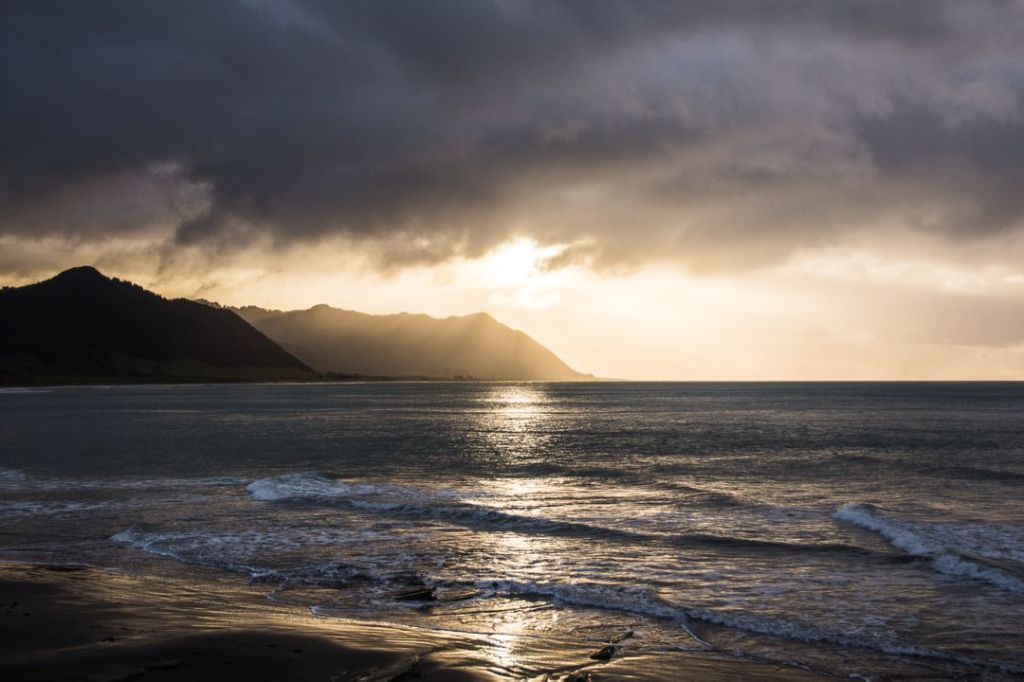
This is not the STRAIT OF JUAN DE FUCA, but it is a similar view. I have always kept track of where the sun sets as each year spins on. The foothills of Camp Pendleton have long been replaced by the eastern slopes of the Olympic Mountains, the sun moving from south to north to south across the ridges. I don’t keep track of the mysterious tracks of the moon; full moon, yes; connected to the tides changes, critical element of surf forecasting/guessing. So, we’re halfway to winter, surfers switching the forecast logic with the hope of swell, the ebbing and flowing hope and, yes, anticipation. Winter’s almost here. Almost here. Where will we be, when the winter’s here… I guess we’ll see.

THE MORALITY THING- We are all taught some guidelines to what constitutes a moral life. Restraints, perhaps. No, definitely. We all want to justify our actions, twisting the boundaries when necessary. No, I’m not making excuses for wave-hogging. It’s sociopathic, possibly, occasionally, doing something one knows is wrong, and then doing it again. STILL, we generally behave within our individually-set boundaries. Almost as if we have to. THE POLITICAL PART- If you are taught from birth to take advantage whenever you can, to screw over others in every interaction, pay attorneys rather than those providing services or products and then ask for my vote, well… no.

CHAPTER SIX- TUESDAY, MARCH 4, 1969  

It was still early afternoon. I was in the living room, ignoring everything behind me, facing but not really seeing anything out the west-facing window. A Santa Ana condition had broken down, and a thousand-foot-high wall of fog had pushed its way up the valleys. The house was situated high enough that the cloud would occasionally clear away, the sun brighter than ever. The heat and humidity, raised by the number of people in our house, caused a fog of condensation on the plate glass.

Below me, cars were parked in a mostly random way in the area between the house and the separate and unfinished garage, and the corral. Continued use had created a de facto circular driveway up the slight rise from the worn and pitted gravel driveway, across the struggling lawn, and up to the concrete pad at the foot of the wooden steps and front porch.

A bright yellow 1964 Cadillac Coupe De Ville convertible, black top up, was parked closest to the door.  Other vehicles were arranged on the clumpy grass that filled in areas of ignored earth. Later arrivals parked on the lower area. The Falcon was parked close to the county road in keeping with my parking obsession; with getting in, getting out, getting away.

I was vaguely aware of the music coming from the turntable built into the Danish modern console in the living room. Stereo. Big speakers in opposite corners of the room, the volume where my father had set it, too low to compete with the conversations among the increasing crowd, the little groups spread around the room. Some were louder than others. Praise and sympathy, laughs cut short out of respect. Decorum.

Someone had put on a record of piano music; Liberace, or someone. My father’s choice would have been from the cowboy side of country/western; high octave voices capable of yodeling, lonesome trails and tumbling tumbleweeds, the occasional polka. My mother preferred show tunes with duets and ballads by men with deep, resonant voices, voices like her husband’s, Joseph Jeremiah DeFreines.

 These would not have been my father’s choice of mourners. “Funerals,” he would say, “Are better than weddings.” He would pause, appropriately, before adding, “You don’t need an invite or a gift.”

Someone behind me repeated that line, mistiming the pause, his voice scratchy and high. I turned around. It was Mister Dewey. A high school social studies teacher, he sold insurance policies out of his rented house on Alvarado. His right hand was out. I didn’t believe shaking hands was expected of me on this day.

“You know my daughter, Penelope,” he said, dropping his hand.

“Penny,” I said. “Yes, since… third grade.” Penny, in a black dress, was beside Mr. Dewey, her awkwardness so much more obvious than that of the other mourners. I did shake her hand. “Penny, thanks for coming.” I did try to smile, politely. Penny tried not to. Braces.

 I looked at Mr. Dewey too closely, for too long, trying to determine if he and I were remembering the same incident I was. His expression said he was.

When I refocused, Mister Dewey and the two people he had been talking with previously, a man and Mrs. Dewey, were several feet over from where they had been. I half-smiled at the woman. She half-smiled and turned away. She wasn’t the first to react this way. If I didn’t know how to look at the mourners, many of them did not know how to look at me, troubled son of the deceased detective.

If I was troubled, I wasn’t trying too hard to hide it. I was trying to maintain control. “Don’t spaz out,” I whispered, to myself. It wasn’t a time to retreat into memory, not at the memorial for my father. The wake.

Too late.

“Bleeding heart liberal, that Mister Dewey,” my father was telling my mother, ten-thirty on a school night, me still studying at the dinette table. “He figures we should teach sex education. I told him that we don’t teach swimming in school, and that, for most people, sex… comes… naturally. That didn’t get much of a laugh at the school board meeting.”

“Teenage pregnancies, Joe.”

“Yes, Ruth.” My father touched his wife on the cheek. “Those… happen.”

“Freddy and I both took swimming lessons at Potter Junior High, Dad. Not part of the curriculum, but…”

“Save it for college debate class, Jody. We grownups… aren’t talking about swimming.”

  Taking a deep breath, my hope was that the mourners might think it was grief rather than some affliction. Out the big window, a San Diego Sheriff’s Office patrol car was parked near where our driveway hit the county road. The uniformed Deputy, still called “New Guy,” assigned to stand there, motioned a car in. He looked around, went to the downhill side of his patrol car. He opened both side doors and, it had to be, took a leak between them. Practical.

The next vehicle, thirty seconds later, was a delivery van painted a brighter yellow than the Hayes’ Cadillac. Deputy New Guy waved it through. I noticed two fat, early sixties popout surfboards on the roof, nine-foot-six or longer, skegs in the outdated ‘d’ style. One was an ugly green, fading, the other, once a bright red, was almost pink. Decorations, obviously, they appeared to be permanently attached to a bolted-on rack. The van was halfway to the house before I got a chance to read the side. “Flowers by Hayes brighten your days.” Leucadia phone number.

Hayes, as in Gustavo and Consuela Hayes. As in Jumper Hayes.

A man got out of the van’s driver’s seat, almost directly below me. Chulo. I knew him from the beach. Surfer. Jumper’s partner in ‘the great avocado robbery’ that sent them both away, Chulo returning, reborn, evangelizing on the beach, with a permanent limp.

Chulo’s long black hair was pulled back and tied; his beard tied with a piece of leather. He was wearing black jeans, sandals, and a day-glow, almost chartreuse t-shirt with “Flowers by Hayes” in white. Chulo looked up at the window, just for a moment, before reaching back into the front seat, pulling out an artist’s style smock in a softer yellow. He pulled it over his head, looked up for another moment before limping toward the back of the van.

The immediate image I pulled from my mental file was of Chulo on the beach, dressed in his Jesus Saves attire: The dirty robe, rope belt, oversized wooden cross around his neck. Same sandals. No socks.

Looking into the glare, I closed my eyes. Though I was in the window with forty-six people behind me, I was gone. Elsewhere.

I was tapping on the steering wheel of my mother’s gray Volvo, two cars behind my Falcon, four cars behind a converted school bus with “Follow me” painted in rough letters on the diesel smoke stained back. The Jesus Saves bus was heading into a setting sun, white smoke coming out of the tailpipes. Our caravan was just east of the Bonsall Bridge, the bus to the right of the lane, moving slowly.

My mother, in the Falcon, followed another car around the bus. Another car followed her, all of them disappearing into the glare. I gunned it.

I was in the glare. There was a red light, pulsating, coming straight at me. There was a sound, a siren, blaring. I was floating. My father’s face was to my left, looking at me. Jesus was to my right, pointing forward.

This wasn’t real. I had to pull out of this. I couldn’t.

The Jesus Saves bus stopped on the side of the road, front tires in the ditch. The Volvo was stopped at a crazy angle in front of the bus. I was frantic, confused. I heard honking. Chulo, ion the Jesus Saves bus. He gave me a signal to go. Go. I backed the Volvo up, spun a turn toward the highway. I looked for my father’s car. I didn’t see it. The traffic was stopped. I was in trouble. My mother, in the Falcon, was still ahead of me. She didn’t know. I pulled into the westbound lane, into the glare, and gunned it.

When I opened my eyes, a loose section of the fog was like a gauze over the sun. I knew where I was. I knew Chulo, the Jesus Saves bus’s driver, delivering flowers for my father’s memorial, knew the truth.

Various accounts of the accident had appeared in both San Diego papers and Oceanside’s Blade Tribune. The Fallbrook Enterprise wouldn’t have its version until the next day, Wednesday, as would the North County Free Press. All the papers had or would have the basic truth of what happened. What was unknown was who was driving the car that Detective Lieutenant Joseph Jeremiah DeFreines avoided. “A gray sedan, possibly European” seemed to be the description the papers used.

” The San Diego Sheriff’s Office and the California Highway Patrol share jurisdiction over this part of the highway. Detective Lieutenant Brice Langdon of the Orange County Sheriff’s Office is acting as a liaison with the Highway Patrol in investigating the fatal incident.”   

Despite the distractions, what I was thinking was that Chulo knew the truth.

Chulo would be depositing the four new bouquets in the foyer, flowers already filling one wall. I looked in that direction, panning across the mourners. The groups in the living room were almost all men. Most were drinking rather than eating. Most of the groups of women were gathered in the kitchen.

A woman wearing a white apron over a black dress brought out a side dish of, my guess, some sort of yam/sweet potato thing. Because I was looking at her, she looked at the dish and looked at me, her combination of expression and gesture inviting me to “try some.” There was, I believed, an “It’s delicious” in there. Orange and dark green things, drowning in a white sauce.

“Looks delicious, Mrs. Wendall.”

Two kids, around ten and twelve, both out of breath, suddenly appeared at the big table, both grabbing cookies, the elder sibling tossing a powdered sugar-covered brownie, whole, into his mouth, the younger brother giving a cross-eyed assessment of his mother’s casserole.  

“Larry Junior,” Mrs. Wendall half-whispered as she shooed her sons out the door. She looked at her husband, leaning against a sideboard serving as a bar. He followed his boys out the door with the drink in his hand, half-smiled at his wife, as if children running through a wake is normal; and was no reason to break from chatting with the other detective at the Vista substation, Daniel Dickson, and one of the ‘College Joe’ detectives from Downtown. War stories, shop talk. Enjoyable. Ties were loosened and coats unbuttoned, the straps for shoulder holsters occasionally visible.

“Just like on TV” my father would have said. “Ridiculous.”

Freddy, out of breath, came out of the kitchen, weaving through the wives and daughters who were busily bussing and washing and making plates and silverware available for new guests. I handed him two cookies before he grabbed them. He grabbed two more.

“They went thataway, Freddy,” Detective Dickson said, pointing to the foyer.

Freddy pushed the screen door open, sidestepped Chulo, and leapt, shoeless, from the porch to what passed for our lawn, Bermuda grass taking a better hold in our decomposed granite than the Kentucky bluegrass and the failing dichondra.

Chulo, holding a metal five-gallon bucket in each hand, walked through the open door and into the foyer. He was greeted by a thin man in a black suit coat worn over a black shirt with a Nehru collar. The man had light brown hair, slicked back, and no facial hair. He was wearing shoes my father would refer to as, “Italian rat-stabbers.” Showy. Pretentious. Expensive fashion investments that needed to be worn to get one’s money’s worth.

Chulo had looked at me, looked at the man, and lowered his head. The man looked at me. I didn’t lower my gaze. I tried to give him the same expression he’d given me. Not acknowledgement. Questioning, perhaps.

Langdon. He must have been at the funeral, but I hadn’t felt obligated to look any of the attendees in the eye. “Langdon,” one of the non-cop people from the Downtown Sheriff’s Office, records clerks and such, whispered. “Brice Langdon. DeFreines called anyone from Orange County ‘Disneycops.’” Chuckles. “They put people in ‘Disney jail’,” another non-deputy said.

“Joint investigation guy,” one of the background voices said. “Joint,” another one added. Three people chuckled. Glasses tinkled. Someone scraped someone else’s serving spatula over another someone else’s special event side dish. Probably not the yams.

Chulo took the arrangements out of the buckets and rearranged the vases against the wall and those narrowing the opening to the living room. He plucked some dead leaves and flowers, tossed them in one of the buckets, backed out onto the porch, closed the door. I became aware that I had looked in that direction for too long. Self-consciousness or not, people were, indeed, looking at me. Most looked away when I made eye contact.

“If you have to look at people, look them straight in the eye,” my father told me, “Nothing scares people more than that.”

Langdon looked away first, turning toward the two remaining detectives at the Vista substation, Wendall and Dickson, Larry and Dan. They both looked at Langdon, critically assessing the Orange County detective’s fashion choices. I didn’t see Langdon’s reaction.  

My father’s partners had changed out of the dress uniforms they had worn at the funeral and into suits reserved for public speaking events and promotions, dark-but-not-black. Both wore black ties, thinner or wider, a year or two behind whatever the trend was. Both had cop haircuts, sideburns a little longer over time. Both had cop mustaches, cropped at the corners of their mouths, and bellies reflecting their age and their relative status. Both had changed out of the dress uniforms they’d worn at the funeral

 Wendall was, in some slight apology for his height, hunched over a bit, still standing next to the sideboard that usually held my mother’s collection of display items; photos and not-to-be-eaten-off-of dishes. Dickson was acting as official bartender. The hard stuff, some wine, borrowed glasses. The beer was in the back yard.

Langdon had brought his own bottle. Fancy label, obviously expensive wine, cork removed, a third of it gone. Langdon’s thin fingers around the bottle’s neck, he offered it to Dickson. Smiling, politely, Dickson took a slug and reoffered it to Langdon. Langdon declined. Dickson pushed the bottle into a forest of hard liquor and Ernest and Julio’s finest. Langdon shrugged and looked around the room. Dickson displayed the smirk he’d saved, caught by Wendall and me.

Langdon saw my expression and turned back toward Dickson. The smirk had disappeared. Langdon walked toward me. He smiled; so, I smiled.

“I’ve heard about you,” he said. The reaction I had prepared and practiced disappeared. I was pretty much just frozen. “I see you know…” He nodded toward the foyer. “…Julio Lopez.” Langdon didn’t wait for a response. “From the beach?” No response. “Surfers.” No response. “You and I will have to talk… soon.”

I had to respond. “How old are you, Detective Lieutenant Langdon?”wh

“I’m… twice your age.” I nodded. He nodded. “College. College… Joe.” He smiled.

I may have smiled as I looked around Langdon at Dickson and Wendall; both, like my father, twelve or more years older than Langdon, this assuming he knew I was seventeen. I did, of course consider why he would know this. Wendall gave me a questioning smile. Dickson was mid-drink. 

“I don’t know if you know this… Joseph: Your father was involved an investigation… cross-county thing, involving… me.”  Langdon was, again, looking straight into my eyes. I blinked and nodded, slightly. “Yes. So… if there is any irony in my being… here, it is that Joseph DeFreines was, ultimately…” Langdon was nodding. I was nodding. Stupidly. “…a fair man.”

Langdon did a sort of European head bow, snap down, snap back, and tapped me on the shoulder.  I had half expected to hear the heels on his rat-stabber shoes click.  

THANKS FOR CHECKING OUT realsurfers.net. Copyright 2020. All rights reserved.

More Doors AND… Panamaniacs

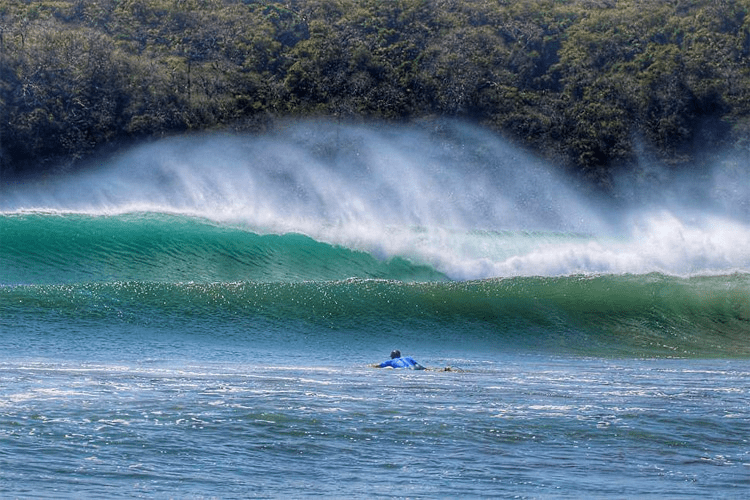
I took this photo from the internet; “Surf World” or something. Five rippers from the wave-starved Olympic Peninsula headed down there almost two weeks ago and are due back in the next couple of days. Yes, I asked for some sort of report. No, and I’m not trying to put any guilt on anyone… I’m sure there are excuses/reasons/explanations (band width, remoteness, lack of desire, too much wave action), I have not heard anything other than a second hand report from Adam Wipeout that Cougar Keith may have gotten the ride of the trip to that point (text message- I didn’t try, figuring cost of phone usage from the Central America, stuff like that), but, yeah, I TOTALLY WANT TO GET THE REPORT!

MEANWHILE, between getting filmed at a secret(ish) Strait of Juan de Fuca spot (Stephen R. Davis, also, with a surprise cameo, after whatever waves there may have been went to shit, by Jason Queen [not a nickname]) for some future artsy docu-thingy about me (despite my weak protestations by a woman who works for the Gates Foundation (more on this at a later date, but camera angles were demanded that diminished the chances of site identification, and yes, I would love to see a slow motion drone shot of me tucking my chunky body into a stretched-out wave); between this and getting a second surgery on my left eye after the first one for a detached retina failed. 10%, evidently, do; so, so lucky to be in the top percentile for something; oh, and the gash from my fall several months back is officially ‘almost’ well, though I was advised not to surf because of imagined (by the wound care nurse originally from Cuba, who thought maggots could have been an option) seal shit in the water.

“Oh, that,” I said, not having told her we saw several seals on the day of the filming, which, of course, I had not told her about.

MEANWHILE MEANWHILE, I still have my art retrospective at the COLAB in downtown Port Townsend. It will be there for one more ART WALK, the first Saturday in June, and I’m working on some more door panels. I have three bi-fold doors in progress, so six paintings. At this point I’m only willing to call three of them ‘almost’ done, so it’s kind of like three A sides, three B sides.

Not good enough. But they will be.

As I said, almost. Triple meanwhile, while I’m out of the waters for a while, five rabid rippers are set to return to a lineup near you. AS ALWAYS, if you can’t be nice, be real.

Photo for Previous Posting

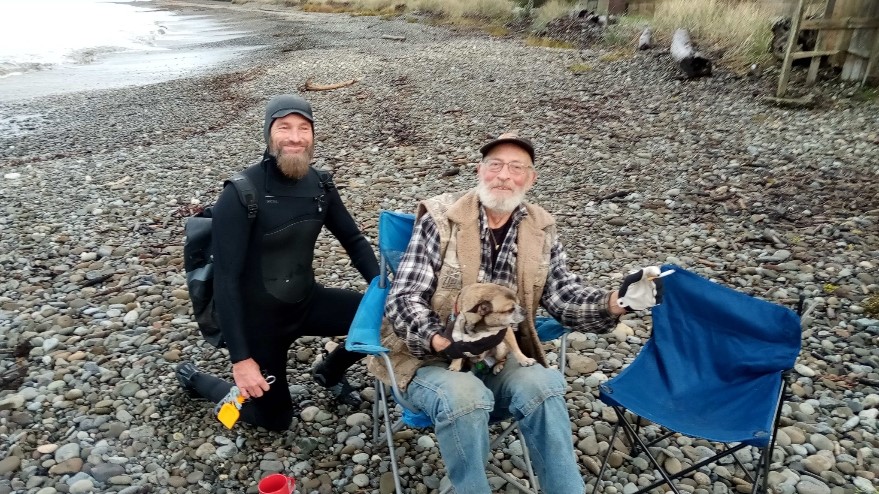
These folks are featured in the previous post. Scroll down to check it out. The two guys are brothers. Formerly of Sequim, they are currently living in Yakima. I didn’t ask why, but I did insist they put the boonie hats back on for the photo. The one on the left helped me with my wetsuit. They were all in the water for at least four hours.

Dreams and Other Stop Gap Measures…

…for dealing with a lack of surf and/or a lack of opportunities to surf. Subtle difference, same result: Surf Withdrawal Syndrome (SWS).

I HAD THIS DREAM last night, so this image coming from “DREAMTIME” copyright theirs, is quite appropriate, though, in my dream, rather than the Great Smokey Mountains (where, incidentally, my mother was raised), and in my dream, that evidently, in a dream-typical way, seemed to sort of tell a story in which I was supposed to go surfing with this guy, possibly based on Olympic Peninsula surf pathfinder Darrell Wood, BUT… THERE WERE COMPLICATIONS; we had to check out some house where the dude there (couldn’t pick him out in a lineup) wanted to add on to his house AND was having trouble with a son who was getting in trouble. The Darrell character had advice on both, but I was aware that I had to call TRISH and give her an update, and that it was getting late, surf trip-wise. SO I ASKED the homeowner if he had a phone. HE DID, but he was on it. LANDLINE. I chased him through a really big house, at one point asking him if there was a bathroom, all while he’s unfurling phone cord behind him. “Do you really need to add on, man?” SUDDENLY, I’m outside, and I’m getting into a vehicle with ADAM “WIPEOUT” JAMES, and I’m asking him if it’s too late to surf. “If you ride with someone else…” he said as we drove toward a setting sun over low mountains, the Pacific Ocean somewhere over them.

“If you ride with someone else… WHAT?”

INCIDENTALLY, 45 years ago, when I first ran into Darrell Wood, he said he’d invite me to go to spots he knew of, but, if he called, I had to be out the door within 15 minutes (or so), his house being 45 Hwy 101 minutes away from mine. So, I got to ride with him… once. I was late, but when we got to waves I thought were spectacular, Darrell turned them down, saying it gets way better. “When?” “Sometimes.”

My guess, my analysis of my dream, based on various couldhavebeen surf attempts in which time ran out is… I don’t know; FRUSTRATION? I’m currently dealing with an injury, knowing I have missed some opportunities, and, looking at the forecast for the STRAIT, ALWAYS IFFY, is not encouraging.

ALSO, I have had SUPER, MAGICAL SESSIONS riding with Trish, with our kids, with friends (including ADAM WIPEOUT) to find surf. It’s not always the SURFING, sometimes it’s the trip.

ENJOY THE TRIP. It is part of the story. AND there’s always a story.

The Usual Surf Season Tragedy

“So, where is the HEAT… ERWIN?”

It’s our cat, ANGELINA, quite disappointed if not super pissed-off, resting on MY pillow (darker blue in real life), in the living room, because it’s the room with (some) heat, that provided by space heaters powered by a very noisy generator.

Not to argue whether or not there is a surf season on the Strait, but… Oh, first, I’m posting this a day later than the days I am trying to get folks used to, Sundays and Wednesdays, due to the power panel in my, hm, hmm, cottage, pieced together and added onto since the 1930s, kind of, um, having an issue.

AN ISSUE is my explanation for reduced power and… I AM working on it.

Not this skinny, of course, but rideable waves and no surfboard… frustrating.

Again, not discussing (potential, possible, hypothetical, possibly imagined) waves I can’t get to for a reason other than the usual, ‘got to work,’ thing. A few years ago it was the water leak between the pump house and the, you know, house I couldn’t find, even cutting holes in the floor to track it down, not finding it leading to the pump fifty feet down going out. Yes, I missed some waves I would have, according to reports that included, “You would have loved it, Dude,” and “Where were you?”

The thing is, these kind of issues, quite a ways outside of my knowledge zone, my limited areas of expertise; OR the use of professionals to solve the issue being way outside of my budget; just make me so… tired. Disappointed, pissed-off, frozen in body and mind. Rather like Angelina.

BUT, I am making some moves. It’s only been about thirty hours with no coffee and inadequate heat. I felt pretty good that I replaced the burnt-out main shutoff switch (not fun). I’ve done testing, possibly closing in on the areas of extended damage. Always tough. Electrical logic is way more involved than painting logic (paint is a liquid, gravity is involved). I have some ideas. YES, I am aware almost any problem is solvable if one throws enough money at it.

YES. This drama, something short of a tragedy, will be a story. Eventually. Not yet.

MEANWHILE, I did discover I can’t run a space heater AND a coffee maker at the same time.

NOW, I DO have some new artwork, several possible t-shirt designs, more from “Swamis” I wanted to post, AND I WILL, once I’m back to full power. So, soon. I’ve got to work.

If you do happen to get a few waves; it’s fine; I’m sure they’re the kind (rideable, possibly makable) I would love, Dude; it’s fine if you let me know. Good luck. May all your breakdowns, breakups, accidents, tragedies, meltdowns, panic attacks, mind freezes, etc., happen when the waves aren’t going off

I will be posting something new on SUNDAY.

A Short Story (Not Directly Connected to Surfing)

A few years ago I wrote a series of stories and, yes, poems that I put together in a collection I titled, “Mistaken for Angels.” Yes, I got a copyright. Vanity. Ego. Just in case. As with everything I have written, my plan for a novel or interconnected stories lost some of the connective-ness, random ideas popping in to complicate matters.

The underlying premise was that the story is more important than the telling, the style and the proper adjectives and structure less memorable than the absolute desire each of us has to tell our story.

It’s not my story; it’s fiction; and my remembering this story caused me to search through multiple thumb drives. The current portion of ancient struggles caused me to remember that I had written it; not about a particular place or time, but of many places and many times.

Tragedy begets tragedy.

I was raised to be a pacifist; yet, turning the channel, turning away, I do nothing. Nothing except, perhaps, to try to calm if not control my own confusion, my own outrage, my own anger.

OH, since the location could be anywhere, on this (new) illustration (sketch if you must), I put in some waves in the background, making, possibly, A GOOD HOUSE that much better.

A Good House

We had a good house. This, you see, was the problem. It was, also, too close to the border. Some, those who think themselves brave, who think others will follow them, they call the disputed land on which the good house sits the ‘frontier.’ I call it ‘bloodlands.’ There has always been trouble. Wars go this way, then back; like waves on a lake.

My Father, he went to war- one of the wars- he pushed forward very bravely (so we were told), but came back very broken. The next wave took him for good.

Wave. Yes. Like a wave. We all knew he was already drowned. He was waiting for the next wave to wash his body away from… This is difficult to explain. “No faith left” he would say, staring toward the horizon.

My Mother, she had faith, and, with it, that certainty… I have heard it called fatalism. Ah, fancy term, that. It’s that knowledge that the darkness comes to each of us, to all of us. Fate and faith, they are, I think, related. “To have faith,” my Mother told us, my Sister and me, after our Brothers went, or were taken, made to fight, “you must have faith.”

This means, I think, that you must believe that having the faith sometimes works. Sometimes what we have the faith in, that things will be all right, can happen. I don’t know if I do believe this. My Mother did. Truly.

The snipers had done damage to the troops from our country. That is why they, our Soldiers, took to the houses. “Like a jar of water,” one of them told my Grandfather, who was weak and old, and had survived, he said, by never flying anyone’s flag, never taking a side. The Soldier held my Grandfather’s head against the rocks of the fireplace. He tapped it with a branch meant for the fire. He, the Soldier, explained this thing to my Mother, who, because she refused to cower as her Mother was, obviously was in charge.

He threw his hands apart to describe how a sniper’s bullet reacted with a soldier’s skull. “pheuuuuuuuh!” Then he laughed and let my Grandfather go.

“Okay,” he said, “your land; you don’t care what country it’s in. Fine.”

There was blood on this Soldier’s uniform. It (blood) dries almost black on the green. He smelled of gunpowder and body odor and death. They all carried sometimes multiple guns, and each had what you might call a machete. They called them something that would be more like ‘sword,’ and attributed a certain righteousness to its use. The Soldiers burned the blood from the blades in our fire, ate our food, complained about my Sister’s crying, and waited.

Soldiers, I now know, spend much time waiting. This is where their brains tell them many stories of why they should be afraid. They tell each other that they are not afraid, should not be afraid, they are and must be men. Yet, I could see these Soldiers had fear. Fear, someone else’s, looks like anger. I could feel my own fear. Like the Soldiers, I would hide it. I made my fear look like calmness. I could see everyone’s fear. Except my mother’s. She had the faith. I wanted to have the faith. I was ashamed to have, instead, the fear.

Fear is like a prayer, I think; or, maybe like a heavy, dark blanket, wrapped like a cloak, ready to be cast off, cast off quickly, when it is bravery that is needed.

Bravery, I’m afraid, is the ability to disregard what is known to be right. Bravery is a vicious thing. I no longer wish to be brave.

For some, it is better to be dead than brave.

Sorry. I must laugh a bit. The brave and cowardly are often thrown into the same grave.

“This is a very nice house,” another of the Soldiers said. He stood close to the window, lit a cigarette. “I think,” he said, “after the war, when we are free, I will take this house.” It was then the sniper’s bullet hit his neck. Both sides at once, it seemed. He was still smiling his dirty smile when his head snapped back. He rocked only a bit, and fell, crumpled, beside me where I sat. The cigarette was still in his mouth.

The first Soldier, and the others, ran outside, then away, leaving the dead one, blood splattered on our walls, making pools on our floor. We could hear guns going off, closer, then farther away. We thought, we hoped we were safe.

Briefly, we were.

These were the, it gets confusing; you might call them counter-insurgents. At dawn the insurgents came closer. Same smell, same uniforms (I thought at the time), different caps. They laughed when they saw how poor we were at trying to drag the body out. They kicked at it, shot it several more times, took things from it, threw it onto a truck with other bodies, some not in uniforms.

You can tell when the soul is gone, when a person becomes a body. Less. Almost nothing.

I don’t know where a soul goes. Somewhere better. I have seen those whose souls are gone, their bodies still…walking, eyes too wide open, too squinted down.

We would have been all right if the war had not slowed, the fighting ‘bogged-down’ in the hills; if the troops of our country had not fought so fiercely; if we had not had such a good house.

We had new guests not of our country. They thought themselves of a better country; bigger, older. This was not actually true, the bigger part, except for this short while. How small and pitiful our country must be, they said, to be so easily conquered.

I have no patience to explain why things went wrong. My Sister cried too much. It became night. Perhaps it was the darkness, the length of the nights. One of the soldiers said his grandfather might have worked on the masonry on our house, back when our country was still grand.

“If so,” my Grandfather said, “I would have paid him well. I always paid the workers well. They ate at our table.”

The mason’s Grandson looked at our table, smiled, but not nicely. Another Soldier, suddenly angry, perhaps because of how his Grandfather was treated, because of where his Grandfather took his meals, grabbed my Grandfather and pulled him outside. My Mother knew what this meant, and begged for her Father’s life. The Soldier slapped her for begging. Because she stood at the door and screamed “Butchers, murderers,” my grandmother was also pulled into the darkness. My Sister, holding onto our mother, kept crying. My Mother did not.

This is the fatalism of which I spoke, the belief that all will be tested.

And most fail.

I also did not cry. This is the faith, faith I had because my Mother had faith. The mason’s Grandson pulled my Sister away, shoved her toward me, told me, in my own language (they are really only slightly different) to keep her quiet. He moved his face close to my Mother’s, touched her breast. He said, Whores beg. Are you, then, a whore?” This was to humiliate her further.

I have learned this from war: To kill is not enough for some. To only, to merely kill is not enough to make the anger and the fear and the hatred cease.

“If I must be,” she said.

At this he laughed. “I am also the whore,” he said.

“My Children,” my Mother said to him. It was like a question. He, and the other Soldiers, now back from outside and leaning against our walls, shrugged and laughed together. The mason’s Grandson took his pistol belt off, holding the pistol in his left hand, moving it close to my Mother’s cheek.

“God will send a miracle,” she said to me. “Turn away,” she said.

I almost cried out at this moment. My Sister did. I put my hand over her mouth and prayed that I could have a man’s strength.

Prayers. Excuse me for laughing; just a little. Prayers are not answered as we expect.

It’s rare, I have learned, that a first mortar round can hit precisely. This one did, precisely where it was intended to land, and when I asked for it. The Soldier’s Grandfather had not been a roofer. No, not at all. Ha!

Like a jar of water, burst.

I kicked at his body when it was over, when the others ran, when more mortars rained down on the houses on the frontier.

Of prayer, I should add, speaking of the partial nature of the realization of prayer; my Mother did not survive this…this…I don’t know what they call this. It’s a tide, a tide, and we are the shore. I carved our Family’s name onto the mantel, underneath, to mark a claim when I return. I took the Soldier’s machete. After I’d chopped him with it; splattered his blood with it, I burned his blood from the blade in the fire.

By the time the Peacekeepers came, the roof was already patched, by my Grandfather and me. We also buried my Mother, dragged the soldiers’ bodies away from the house. My Grandparents would not leave. This was their home. That they were not soldiers was honored. That time. My Sister became one of the many refugees. Refuge means safety, of course. I prayed she would be safe. Yes. I told myself she was safe and fed and happy. That was my hope. Perhaps it is partially true. I became, as you know, a Soldier, a brave one, they say. I am still a Soldier; I wait, but I do not fear. I no longer even hate. I know what bravery is.

Oh, I see you don’t believe there could have been two miracles, two dead Soldiers in one house. Well, perhaps I lie. The results would be the same; the dried blood as black. Prayers answered.

When I was captured that first time, taken like a fool during one of the many truces, they called me John Doe number four hundred and thirty-four. I was, I now guess, eleven years old.

Kooks and Hipsters and Bears, Oh, My!

There’s a lot I am trying to cover today. May as well start with a strained allusion to “The Wizard of Oz.”

STORY: A friend noted that “some dude in a jacked-up Toyota with lots of stickers” was checking it out at a ‘surf spot’ on the Strait. A prominently displayed decal read, “Kooks Only Not Locals.” My friend, as close to being a local at that spot, responded with, “People who complain about locals obviously have never been local anywhere.” I, someone who has been a local and an inland cowboy at various times, am responding with… well, see above.

I KIND OF wanted it to be, “Kooks Rule the lineup… in the parking lot; not as precise, perhaps, but it goes along with, “Every surfer is a badass… on the beach.”

STORY: SUPER BAD ASS SURF RIG in the lineup. I have often pondered the proportion between surf rigs, fancy boards included, and surfing ability, and how much the HIPNESS FACTOR comes into the formula.

“I really wanted to make my car into a van,” this woman said. I really wanted to get a shot of the guy coming out of a sani-can, and I did, his outfit being… well, fun for sure; but this shot might say more. I do bring a thermos and some sort of food when I head out (salad and cookies on this occasion), but I do take note of those who either, one, prepare a full breakfast before surfing, and two, those who see others in the water and automatically suit up. This couple didn’t seem to object to my saying I’m trying to take more photos, particularly of HIPSTERS. Usually those I identify as hipsters deny their hipster-ness.

AGAIN, THE HIPSTER/RIPPER FORMULA.

SPEAKING of which:

The guy on the left, KURT TICE (or Kirk, not sure) is, by any definition, not a local on the Olympic Peninsula. He is a definite ripper. THE OTHER GUY is a definite local at this particular beach. He doesn’t surf, and I have been identifying him for a few years as the TRUMP LOVING, DOPE SMOKING DUDE, mostly because he used to wear a red Trump hat. It’s legal, as is… you know, smoking. Maybe the Trump hat just kind of, you know, wore out. He’s eighty-years old, says he loves being a local. “What do you do when there’s no surf and no surfers?” “Oh, there’s always someone around.” “Okay.”

STORY: KEITH ran into KIRK/KURT and one or both of his sons, also rippers, at a surf spot. Several times, perhaps. Turns out they are from Newport, Oregon, and know some people Keith, originally from the Oregon coast, also knows. THEN they ran into ADAM “WIPEOUT” JAMES. And then, on one of the times Adam and I headed out looking for surf (and BEARS or deer or cougars or mushrooms for Adam), the ripper family ran into us at the pullout for some difficult to access spot.

AND THEN, I’m out trying to make the best of the occasional waves on an outgoing tide when the ripper dad comes running down the beach with a tiny board, waves, paddles out, and… whoa,, a set shows up. “Thank you,” I said. Then his two sons show up. They ripped. One of them asks if I’m a friend of Adam. “Adam James?” “Yeah, from the Hama Hama. I think we saw you guys a couple of months ago.” It was more like ten months, but, “Yeah.” The father and the sons were so polite on a day when, at its most crowded, few surfers were making eye contact. I get it. GHETTO MENTALITY. I already forgot the names of the two kids. Sorry. NEWPORT RIPPERS will have to do for now.

HERE’S MY TAKEAWAY: Attitudes can change the vibe in the water. It’s like watching a surf music with one kind of music, and then changing the tune. There is something very uplifting about surfers who can be polite, friendly, and enthusiastic. Yeah, yeah, yea!

Make no mistake, this trio could dominate a break. So, the STOKE/RIP FORMULA. Hmmm. I’m not a mathamatician, can’t even spell it, but I do believe there’s something there. See you in the parking lot.

Another chapter or sub-chapter from “SWAMIS” will be available on Wednesday. Thanks for reading.