Does this drawing make me look gay? I only ask because, going back to do some work on it, adding the black lines (and I should add that the color, in person, is more intense and the lines that form the border are actually even on all four sides), I asked my wife, Trish, as I usually do, what she thought. “Pretty,” she said. Then she chuckled. “Is it meant to be… um… a gay wave?” “What? No. I just wanted to add some rainbows on a wave and… oh; now I see it.” This started a conversation that made me ask her if the rainbow lei, the faded one that’s been hanging, along with a Saint Christopher medal and a long-worn-out scenty thing, for about a hundred thousand miles, on the mirror in the old work/surf van, which had originally been her mini-van (way cleaner, didn’t smell like paint OR wetsuits)… um, is that a… I mean I always just thought it was, you know, Hawaiian… it’s not… I mean, would someone think that…I mean, it’s not, like, a rainbow coalition-y thing?”

Yesterday, in my new surf/not-work wagon, I was looking for surf on the Straits of Juan de Fuca. There’s been a serious lack of properly-aligned swell for most of February, and, though I’d almost decided to trek the extra hour or so to the coast, it looked like the waves might just cooperate at the second secret spot I checked. So I hung around, thinking how the coast has been the place to go all this winter; offshore winds, reasonably sized waves… no, I’d go out here and catch a few, maybe my timing would seem, once the long peelers started hitting the reef, brilliant.
Didn’t happen. The same east wind that was blowing against the open palms of the broken lines approaching the shores beyond the farthest headland I could see, out where the sun had already broken through the squalls; that same wind was reeling around the little point, ripping scars into the weak energy pockets I was trying to harness. I don’t give up easily. ‘Exercise,’ ‘practice,’ ‘just had to get wet,’ take your choice. ‘Desperate’ is another motivational catch phrase.
And the wind got stronger, soon howling across the swells as they moved past me, sideways, tops blowing off. Once I got my fill of practice and exercise, once I had gotten wet and was no longer as desperate, using my car as a buffer, and just as I was about to lean over to grab my hoodie from the front seat… woosh! Whoa! Head dip! My big ass board flew over me, landed eight feet away.
The duck and tuck was the best surf move I’d made all day. And I did get home in time to check the buoys and the camera at La Push (not a secret spot). Swell up, direction better, and that same east wind that would bring better weather today was grooming the outside peaks. Brilliant.
“Maybe my mistake,” I told Trish about the time I realized the contest at Snapper Rocks had been on line for hours, and Kelly Slater had already lost in round one, “was I went too early.” “Oh,” she said, in sort of a mock-caring tone, “and now it’s almost dark.” By the time we had the discussion about the gayness, real or imagined, of my drawing, the women’s surfing had started. Full screen. Full color.
Trish looked at a replay of a woman in a bright orange bikini bottom bottom-turning into a decent walled-up section. She looked at me. “It’s Hawaiian,” she said. “What? Oh. Uh huh; I thought so.”
Hey, take a few minutes, when you get a chance, and check out ‘Inside Break,’ the novelization, a couple of place down from here. Thanks.





 Real Surfers
Erwin,
If it’s of any value to the surfing community, I’d like to recite some first-hand oral history about Pt. Grenville.
I surfed there from 1967 to -69, when I was in high school. We just showed up with surfboards and camped for the weekend, without any fuss from “authorities.”
Then, in 1969, we showed up as usual, and a truck pulled up and a well-spoken, close-shaved Indian came over to us in an very authoritarian manner, and spoke to us ominously, “Where are you boys from?”
“Bremerton,” we said.
Then he looked at the rock cliffs covered in grafitti, and most of it was the names of various high schools painted in great big letters in a wide variety of colors.
He paused and said, “If I looked up at these rocks and saw ‘West Bremerton,’ or ‘East Bremerton’ written here, I’d arrest you and put you in jail. But as it is, you can just leave.”
So we got kicked out, and never went back. Good thing us Bremerton guys specialize more in thievery and violence, and “school spirit” was for “soces.” Besides, our writing skills were sketchy, anyway.
In 1970 I heard that some friends tried to go there, and the Quinaults confiscated their boards and they had to pay fines. I left the state in 1970, and have not heard anything about it since, except for your piece on this web page.
BTW, concerning Washington surfing at the time, I had the feeling that Pt. Grenville was the only place, because the waves were dependable. I wasn’t part of any big surfing “scene,” because there were so few of us, so I don’t know if there were many guys scouting all the coastline in the state, looking for a good break. In those days, I’d never heard of surfing at Westport. (What’s more, I lived the 1970s in San Francisco, and never heard of Mavericks, though no one else seemed to know about it, either.) People in Bremerton were always going there for more fishing. When we got out of high school, it seemed like everyone went to Hawaii, got jobs, and stayed for awhile.
Aside: We didn’t use wet suits. When I was aged 6 to 9, I spent the summers living in a tent and a beach cabin at La Push, because my father was a commercial fisherman out of there & Neah Bay. My mom told me, “Just wait till you get numb, and you can play in the surf all day.” She was right. Last time I did it was 2010.
Clint Burks
So, I really don’t know anything about Mr. Burks except that he must be about my age, possibly another member of the class of 1969. And I have heard a few stories about Point Grenville in the mid 1960s, some which might explain why the beach was closed. Still, the image of some waves peeling off that point…
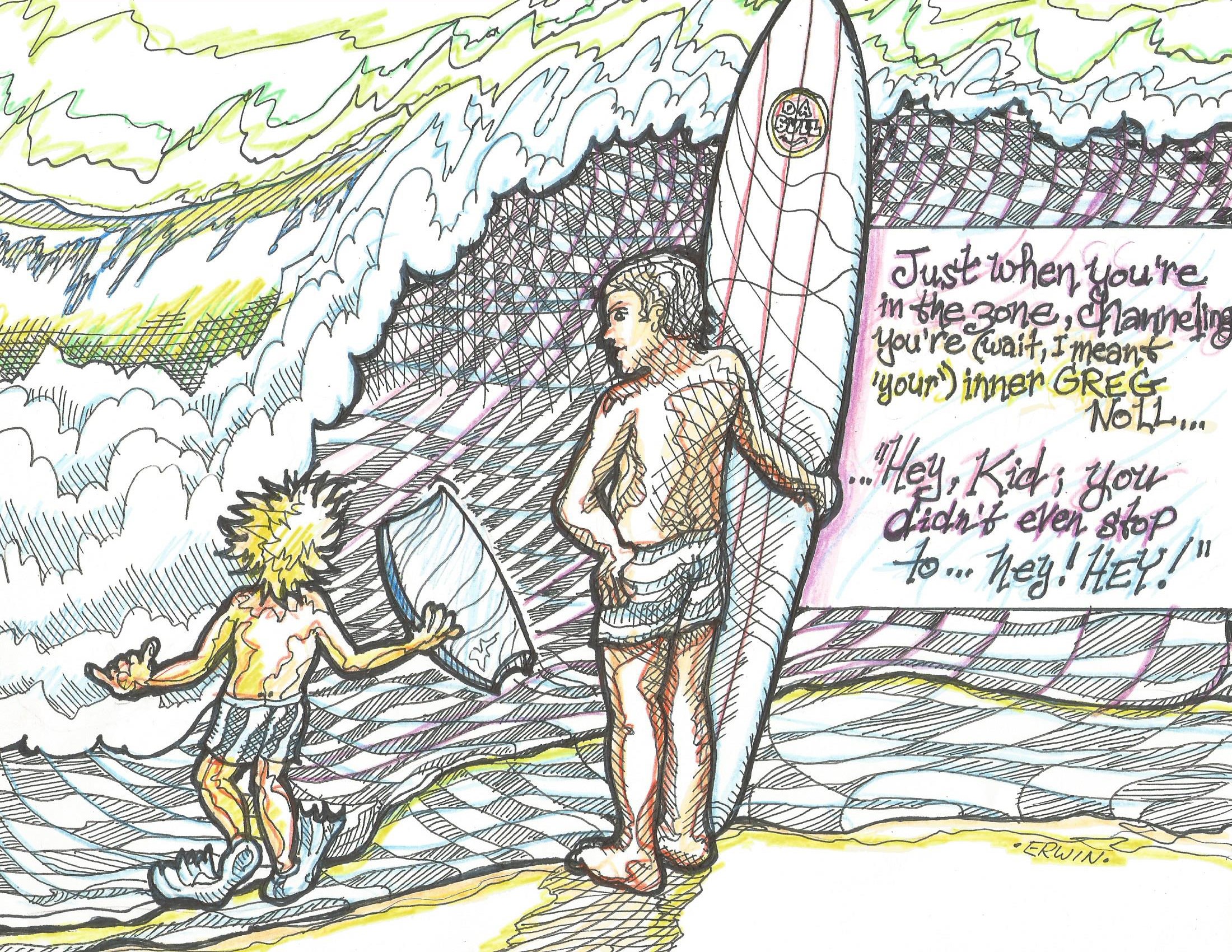
Here’s my latest illustration: