Fergus and His Uncle on Bright Green Rental Soft-tops

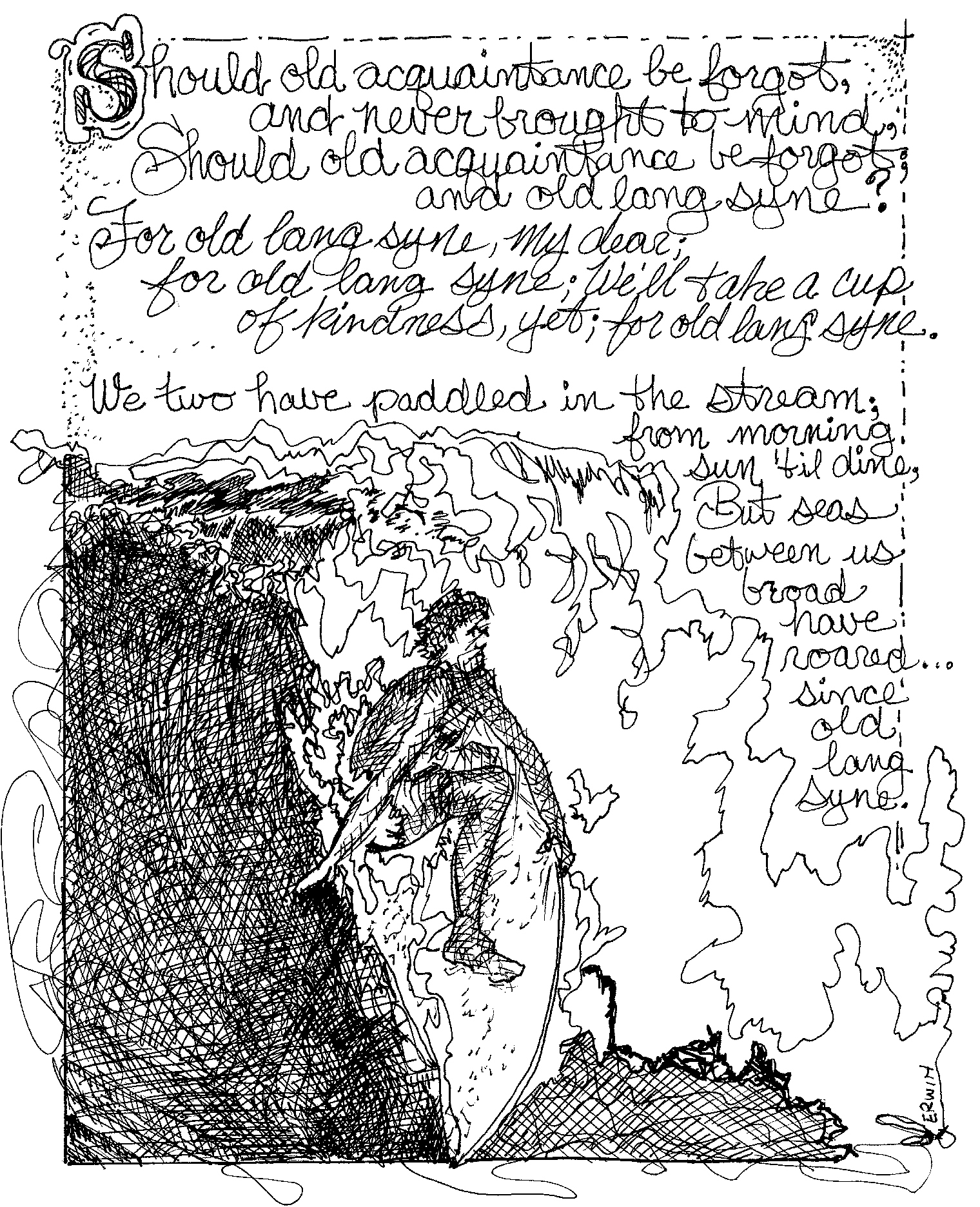
My sister Melissa’s son, Fergus, and his only Uncle who surfs, me, were out at the Cove at Seaside, Oregon. Rather, we were bouncing around on the inside, just past the rocks and before the long, long stretch of beach, looking for a few reforms.

“Go, go, go!” I would yell. And he would go.

He did the classic first-timer thing a few times, jumping to his feet when the wave had already passed. But, considering he had no beach training other than me saying, “Don’t drown,” he did quite well, standing on several waves. Goofy foot. Well.

Meanwhile, his mother and his Aunt Trish were on the beach, watching as the wind that, according to the kid working at the Cleanwater Surf Shop, had blown out the surf daily for the previous week, was calming, becoming almost offshore, and the real break was working. The real surfers were on it, moving down the line

Meanwhile, I was on the inside making sure the mid-west-raised and first-time surf adventurer, on holiday from college, didn’t drown.

Let me tell my joke now: “So, the rental boards are bright day-glo green, with a leash included. Why? So that, when the renter drowns, they can get their board back.” Pause. “Maybe with a body attached.”

“Don’t drown,” I would also yell. “But… paddle!”

ImageYeah, I was also on a rental; something short of an actual soft-top.

This can be explained. My surf/work rig is at some extreme limit of its lifespan, and Trish wouldn’t let me put a board on the softracks on top of the Cadillac she inherited from her father, and it’s quite a ways down to my (and, yeah, Melissa’s) father’s house on the Washington side of the Columbia River.

I did get to put my wetsuit stuff (in a plastic bag) in the trunk, so, and this is important, I could pee in my own gear. Fergus, well, he’s polite, might not have actually urinated in the rented wetsuit.

That would be very polite considering the cute girl at the shop showed a real surfboard (fiberglass and foam, wax…real) as an example of a rental, but, when the guy loaded the boards on Melissa’s rental car (using my softracks), no. Classic bait-and-switch.

Still, with a critical audience watching, I hit a few quick reforms, side-slipped over a section or two on my knees, stood up a few times- not too much more successful than my nephew, he riding all the way to the sand, hands out or pumping.

Great. He didn’t drown. He surfed. This would be Fergus’s story to tell when he met up with another college friend over towards Idaho, they working on an adventure/trip back cross country to school and, well, the Midwest.

“Yeah; I was surfing, man.”

This part of her son’s plan would be a surprise to my sister, kind of a change to her itinerary, but, hey, she was there to witness this part of his future story.

But me, what I wanted, and quite badly, was to paddle the super floaty, poorly balanced, fat-railed pig board out into the lineup.

“Hey, would you call these waves, you know, good?” I imagined myself asking anyone out there. “This is fun. Is this a good wave for surf-boarding?”

And then I’d have to take off, and then, rip.

Maybe that’s why I didn’t try it. Not the taking-off part, the ripping part.

Maybe, but I’ll blame the day-glo board.

Maybe Fergus did pee in the wetsuit. That’ll be part of his story.

I would like to thank Melissa, again, for doing the drawing for my short story, which, sorry to discover, did not win the “Three Minute Fiction” contest that I’d entered it into. Melissa did put our daughter, Dru, up at her house downstate from where Dru works and lives in Chicago recently when her niece had a nasty bout with pneumonia. My sister does promise to do some more drawing, but with less restrictions from her dick-tatorial brother.

Ragged Line


                        Ragged Line


On those mornings when the surf was blown out, or too big, or too small, or too crowded, he would seek treasure along that line of packed wet sand between the south jetty and the much longer string of rocks that protected the harbor from just the type of sudden storm that, south wind still blowing, had pushed dirty wads of feathers and bubbles, ripped-loose strands of seaweed, odd chunks of trees from distant shores, into another line


In the first light of another too-early morning after yet another too-late night, he’d occasionally look up from this map of the farthest reach of gale-pushed waves, high tide and low pressure, eyes following the occasional set wave, from some farther fetch, clean, caught in the chop and windswell; rideable perhaps, in other conditions.


These waves would break into the deeper channel nearer the harbor jetty, the place where the excess force would be relieved in a river. Rip tide.


She was too near that river when he saw her. Or thought he did, rising. She was knocked sideways; trying again, clumsily, to stand, weighed down by pearls and diamonds and her second-best outfit.


Grainy light, everything grey; cutting wind and the remnants of his own fog. He ran, blinked, focused, tried to clear his suddenly-watering eyes. He met her knee deep. She fell upon him, the furthest lengths of her seaweed hair against him; one brief but deep look into his eyes before she, as if he was land, closed hers.


He knew her. Of all the magical gifts he sought along the ragged line, she was the one he most sought.


No, he did know her. Night before last, she was laughing, her hair alive, her shoulders moving so subtly, her eyes glancing away from the man she was with. She had caught his eye through the open window to the kitchen, caught him staring as he wiped a bead of sweat with his white sleeve, pushed another order forward.


He hadn’t looked away, filling in her biography with his own fictions. She wasn’t happy. She was also working; in a way; performing. He believed she recognized him; someone only occasionally free. Occasionally free.

Image 


Wrapped in his sweatshirt and coat, she was mostly walking on her own by the time they reached the parking lot, empty except for his truck, boards mostly hidden in the bed. A break in the clouds to the east put just a bit of gold onto her still gray-green face. She leaned on the passenger door, then forward, puking more of the ocean onto the asphalt.


“I’m sorry,” she said, looking into his eyes with what he took for recognition.


Three vehicles, two with flashing lights, approached on the road from the harbor.


A Coast Guard boat sped from the farthest reach of the north jetty, racing sideways through the troughs and crests; circling back to the churning rip where a body of someone who fell off a pleasure boat caught in a sudden storm, might end up.


So, it was over. He tried to study her face; to remember; treasure found, treasure lost.


“Save me,” she said, shaking, still-cold hands moving from his shoulders to the door. Two bottles fell to the pavement. One broke.


The eyes of the man from the restaurant, from his car, as rescuers ran past him, moved, eventually, to the woman in the hoody in the cab. She looked directly at him; shook her head ever so slightly.


“So…you surf here?”


Opening the truck’s driver’s side door, he looked from the man to the ocean.


“Not today.”    


The illustration is by my sister, Melissa Lynch, professional artist. I hope to convince her to do more. While I started out drawing cartoons and surfing pictures, Melissa started out drawing horses. The story is exactly 600 words in length, and was originally written for the “Three Minute Fiction” competition on National Public Radio’s “Weekend All Things Considered.” I haven’t heard anything from NPR, and had certain boundaries not unlike those I required of my sister. Perhaps because I enjoyed writing the story so much, sort of plugging my friend Stephen into the male character’s part, some part of me thought, maybe, maybe it was good enough. As for Melissa’s drawing; couldn’t imagine one any better.

Wally Blodgett and the Spinning Glass


I first noticed Wally Blodgett in 1968, sharing that same route along the bluffs (Grandview, Beacons, Stone Steps, Swamis) I took, dawn patrol in an older car filled with teenage surfers, always quite a few boards on top.


Wally was like the Dad, the duty driver. But, since most of his passengers were old enough to drive their own cars (as I did), and seemed perfectly unembarrassed by riding with Mr. Blodgett, and since San Dieguito* kids seemed to learn to be cool in grade school, anyone would have to assume Wally Blodgett was cool.   


Unlike most of our dads, off working during surfing hours, Wally went out surfing Always one of the older surfers in the water, he rode a belly board. My lasting image is of him prowling the inside lineup at Swamis, waiting for an empty wave. Or maybe he just wanted that on-the-shoulder water angle for watching and cheering on his son, Buzz, and their mutual friends. Extra coolness points.


As I surfed more frequently without my friends, I would have loved to have been included in that crew.


Someone eventually told me, “Wally Blodgett, he throws pots for a living.” “Throws pots?” “Vases and stuff.” “Oh.” “He gets up super early, throws pots or fires them. When he gets enough, he takes them up to L.A., sells all of them, wholesale.” “Cool. You know, I’m an artist, too.” “Uh huh.”


While the members of the Blodgett Crew did the standard teenager thing (enhanced by being surfers, perhaps) of ignoring anyone else they might be competing for a wave with, Wally was always nice to me in the water and the various parking areas. I was riding boards I’d made myself at the time, usually shaping and glassing blanks gathered from stripped-down longer boards.


“It looks like you make these boards with an ax,” he said one morning, after what was, I thought, a great session at Swamis; “but you seem to ride them pretty well.”


“Um…Thanks.”     


Some time in 1969, at Mira Costa Junior College (Oceanside/Carlsbad) for a surf movie, and glad the circuit had a venue closer than Hoover High School in San Diego, I pointed out a yawning Mr. Blodgett and his Crew, coming in together and fashionably late, to my girlfriend, Trish. Wally was giving the crowd a proper and discerning look-over.


“He throws pots for a living.” “Oh, nice.” “Vases, stuff like that.” “I know.”


My art classes at Palomar were afternoon events; three hours every day except Friday. This gave us allegedly-creative types time to work and hang out and pose all artsy-like. And one could wander from one studio to another, checking-out and ruthlessly critiquing what others were doing


As with surfers, artists judge each other harshly. I confess to having felt a little more artist-like than those Hippie/posers. I had, after all won best Sophomore, Junior, and Senior Boy artist at Fallbrook, though they awarded a scholarship (actual money) to my main male competition, Chester Meck.


And I did most of my art homework at Buddy’s Sign Service, where I was a signpainter’s apprentice, with real brushes and bright enamels, and easels capable of handling four foot by eight foot signs at my disposal.


The former home and printing facility for the Oceanside Blade Tribune newspaper was a space quite dingy enough to be much closer to a true artist’s studio than someone’s Mom’s kitchen counter. There was a huge skylight over an equal-sized hole in the concrete floor, the former home of the printing press.


The building, at First and Tremont, was a block from the Oceanside bus station, suitably dangerous; and a block of train tracks from the beach; perfectly city-surf set. I was working, developing my semi-artistic skills one block from the city version of US 101, where the efforts of hawkers of cheap jewelry, electronics, and available women periodically caused the Command people at nearby Camp Pendleton to declare the area off limits to Marines.    


Just to further set the scene at Palomar Junior College: “Trout Fishing in America” was a must read. Protest signs and posters were everywhere on the campus. One read, “Remember My Lai” (1968 Vietnam massacre). Another read, “If God didn’t exist it would be necessary for man to invent him” While student-made anti-war banners were hung and removed regularly, those two were in the office windows of obviously-tenured professors.


And, freed from dress codes and more direct parental supervision, kids from my high school I knew as dorky suddenly had long hair and other affectations of perceived coolness, and were suddenly aware of social injustice and corporate corruption.

Great. Still, I was busy, just wanted, somewhat desperately, to learn. In art classes, anyway, trying to slide through the academics. Richard Brautigan, in the book I did eventually read, spoke of all that was going on in those hyper-crazy-aware times, the universe screaming at us all, then wrote, “I just wanted to go fishing.”


I could relate**.  


ImageThe poster in the Art Department area I remember most (placed on an approved bulletin board) was of a studio converted from a working barn, all wood and rope, sepia-toned, with a naked model casually leaning against a post, not-really-posing, almost blending into the scene. To me, that was art.


But, there in one of the classroom/work areas, was Wally Blodgett, spinning and blowing glass; heat, spin, blow, heat, spin. “Hey, Kid. You go here, too? Check this out!”


Wally was excited, totally immersed in learning the craft, the art. Not unrelated to the potter’s wheel, this spinning of molten glass must have seemed like a natural progression. And both required fire; clay to a finished vase, sand to glass; so balanced, such a naturally perfect symmetry.


No; few things in nature are perfectly symmetrical. But Wally’s work could approach that. So new, so exciting.


Thirty-five years later (and this was a few years ago now) I googled “Wally Blodgett.” What I discovered is that his son, Buzz, has carried on the glass art tradition, and has carried it way beyond those first steps taken at Palomar J.C.


There is an obvious ocean influence on the works Buzz creates. Handed down, passed on; this is the Wally Blodgett legacy. More likely, it’s part of his legacy.   


Since there was a site, blogettglass.com, I e-mailed Buzz. He wrote back. He didn’t remember me; listed some names of a few Fallbrook surfers he had known, none of which I recognized. Different crews. That’s all right. I mentioned what his father had said about my handmade boards. “That sounds just like him.”


Well, um, yeah; because it was him.


*San Dieguito includes the beach towns of San Diego’s North County; not Fallbrook

**Allegedly frustrated by the lack of success of later books, Richard Brautigan eventually took his own life, something I note here because I noted his passing at the time. Fashions change. He may have forgotten he is separate from his words.

Photo identified as “Blodgett on Surfboard.”

Erwin,
Image
Here’s 3 photo’s that my brother-in-law scanned.  The one with him and the bellyboard with Ed Shumpert’s mermaid I don’t ever remember seeing before. That board is from the time that we were surfing Grandview back in the late 60’s. My Dad gave that board to the Belly Up Tavern and the last time I was there is was still up in the rafters. They had a party there for my Dad after he died. Ed Shumpert later did the sculpture of Duke Kahanamoku in Huntington Beach. He also shaped for Ocean Pacific Surfboards before it became the surf clothing company using the logo designed by Ed. The picture of the three guys on the board must from way before I was born.
Buzz

wally-portrait-from Buzz Blodgett’s-college-photo-class

All right, this shows my lack of computer skills. This is Buzz Blodgett’s photo of his father, Wally.
Buzz is my age, and back when I was cruising the surf spots along the bluffs between Leucadia and Cardiff, Wally was packing his car with boards and kids. The difference between Buzz’s father and mine, and probably yours, is Wally got in the water.
The first irony here is, though I spoke to Wally, I never really spoke to my peers.
I have a story about Wally. This isn’t it.
My story isn’t polished enough. Not yet.
It’s a tale of glass and art and, really, that sort of taking a minute for kindness.
Meanwhile, Buzz sent me this and another great photo. I finally figured out how to get this one from my e-mail to my site. So, here it is.
The second irony is: I was taking a photography class at Palomar Junior College at the same time as Buzz, but, unable to get into the beginners class, I tried to sneak into the advanced group.
Though I was instantly revealed to be a kook in the darkroom, I was allowed to stay. I remember almost wetting myself, refusing and unable to leave as the first images of my first self-developed roll came to life
If you can wait a bit longer, I have to make sure the finished piece is worthy.

alternate arch

alternate arch

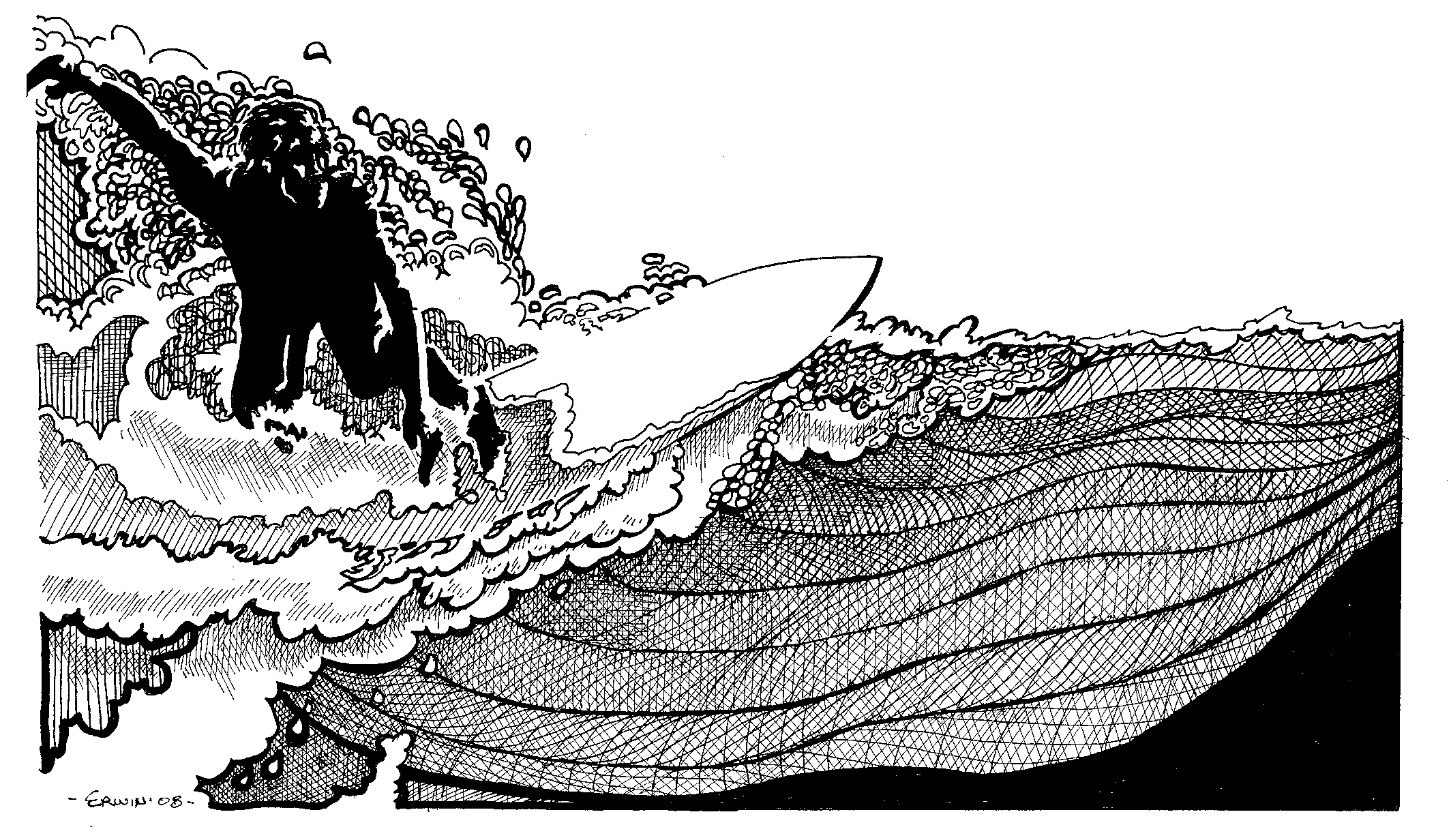
I wasn’t totally pleased with the illustration for the story on the classic Hawaiian Arch. So, here’s another attempt. I’ll wait until my sister, Melissa Lynch, an awesome artist, gives me some imput.
I should mention she’s my younger sister, but, artwise, I’m intimidated by her. And, I have a story that is waiting for her illustration. It’ll be great. No pressure, Melissa.
Whether I use this drawing or the other, or another, I’ll delete the others.
Yeah, my scanner seems to produce those ‘burn marks.’
Not in black and white.

Classic Arch Pose in 1972 Blackball Session

Image                        CLASSIC ARCH POSE IN 1972 BLACKBALL SESSION 

 It would have to be categorized as summer ‘fun surf;’ early afternoon, pre-glassoff texture, the lines broken up enough to offer some peaks with workable shoulders; nothing scary, nothing great, just, fun.

 The surfing area in Pacific Beach gets pushed, each summer, well north of the Crystal Pier, the black ball flags and lifeguards making sure the swimmers have a chance at rolling and tumbling. It was one of those days where the crew of painters I was working with, having finished our day’s assignment, headed for this bar or that strip club. Trish still at work, I headed for the beach.

 The whole purpose of telling this story is to justify the classic Hawaiian arch. Pose? Maybe. Fun? Oh, yes. A tradition worthy of passing on? Indeed.

 I would argue that the move, leaning back, reaching your hands heavenward  to thank God, the Universe, or whatever Deity you recognize for allowing you to be racing across some wave face is a surfer’s praise position, a moving Hallelujah.   

 And it’s a natural reaction to the joy of a particularly enjoyable moment, like rotating your stance just slightly to place your hand into the curl or wall of a breaking wave, maybe out of some sense of respect, maybe just to feel the rush of water.

 But, there is the ‘look at me’ argument. It is a pose. Hang five. Hold it. Backpeddle.

 I don’t know where my ride fits in. I was wailing across a wave, sneaking my left foot forward on my roundy-nosed six foot board… arching, possibly even letting out a ‘eeeooowww!’ as if I were surfing with just a few friends.  I wasn’t. The other surfers out were a couple of school kids, strangers, both of them wading out, witnessing.

 They shared a laugh between themselves. Some grownups. Geez.

 Yet, on the next ride, one of the kids, still laughing his ass off, kind of timidly slid his front foot forward, kind of awkwardly leaned back. “Eeeeeooowwww!”

 Another tradition passed on. Another moment held, held a little longer… and backpedal, drop down, pull back up and onward, rotating just slightly…

Hallelujah!


Cheater Five

Cheater Five

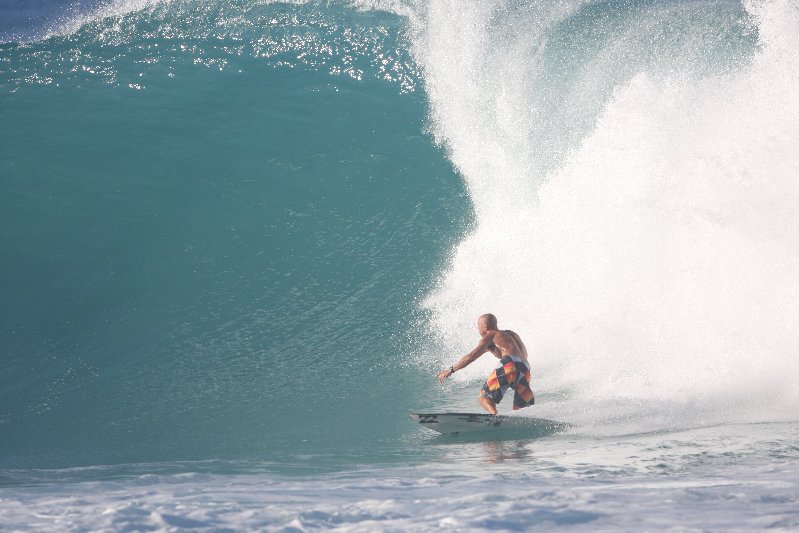
Since I check out magic seaweed.com just about… no, every day, I was struck by this image. Tagged as “Crouching and elegant,” the photo was taken at Cote des Basques, France, by McSnowHammer.
The image is striking in it’s balance between black and white. It’s a well-surfed little tube; might be equally pretty in color, softer.
There are some differences between the drawing, free-handed on scratchboard, and the photo.
Actually, the more I look at the photo the more I wish my drawing could reveal a little more detail. It is, after all, merely scratches on a smooth-but-blank surface.
Yet, we all seek to capture or recapture a moment; a little unexpected inside power pocket.
I may go back, do some more scratching. For now, Thank you McSnowHammer, thank you Miss “Crouching and elegant.”

Joe Roper Surfed Crystal Pier Like it was Pipeline


JOE ROPER SURFED CRYSTAL PIER LIKE PIPELINE

Joe Roper was the standout surfer among a group of kids who hung around and mostly surfed the Pacific Beach (PB) side of Crystal Pier.  By kids, I mean younger than I was when Trish and I got married in November of 1971, moved to a one bedroom apartment within easy walking distance. I was twenty, Trish barely nineteen. Two months later we moved to a two bedroom up Mission Boulevard, easy biking or skateboarding distance.

The stretch of beach from PB Point and Tourmaline Canyon to the pier was my new locale, I was a local; sometimes venturing to the reefs of Sunset Cliffs, sometimes the breaks of La Jolla.  

A Local. It didn’t mean a lot to Trish; meant a whole lot to me.

Joe and his cronies were in the early years of high school. Rather small in stature, driving across or tucking into the lefts off the pier, Joe made it look like getting barreled at the Bonsai Pipeline. And Joe got consistently barreled.

My two years plus tenure in PB seemed to line up with the “Dogtown” resurgence of skateboarding, and, while I was lettering new prices on the menu board for the little sandwich shop that shared space with the P.B. Surf Shop, close to the pier, trading some graphics for a wetsuit vest, trying to sell some original surf art at the Select Surf Shop on Mission, Joe and his buddies were doing low Larry Bertlemann spins on skateboards on the street, one gloved hand centering the turn, scraping across the pavement.

Just to further time stamp this tale, “Maggie Mae” and “American Pie” were hits on the radio, and surf leashes were still called kook straps.

I had yet to purchase one.

To someone who learned to fall on his board if he fell, how to swim in if he couldn’t, it was quite annoying when some grom dropped in, and, when it got hairy, simply bailed.

ROPER STORY ONE:

One afternoon, sitting just a little farther outside, I witnessed Joe, on a left, ride it into the shorebreak. He could have avoided contact with the equally-young surfer approaching on the right. Nope. Rather than kick out, he kicked into a full board-to-body board slam, followed not with an apology but a version of the classic, “Get fucked and go back to the valley.”

I actually asked Joe why he had behaved so violently. It seems the recipient of the slam was guilty of being from Clairemont, just on the other side of I-5, the real setting for fictional “Ridgemont High,” as in “Fast Times At…”

What this meant is the territorially-attacked inland cowboy lived within five miles, ten max, of the beach being so vigorously defended.

ROPER TWO:

I started surfing in Western Surfing Association (Ray Allen, to drop another name, was local head at the time) sanctioned contests, beginning with the first one held early in the 1972 season. Because I did well enough in that contest, I was seeded into the second round of the next event. This, and the contests to follow, featured more contestants, but, being seeded, I could avoid the first round.

Though I never won an event, somehow my surfing was adequate to maintain a somewhere-between-seventh-and-third-place performance level. Oh, yes, I was moving up. 2A, amassing points toward 3A.

Each contest provided another lesson in hurrying-up-and-waiting. On a particular Saturday, the contest was to be held at Crystal Pier. My heat was scheduled for about 10:30, which meant sometime later, I cruised down in Trisha’s VW bug to check it out.

There was Joe Roper, signed up to compete, and two or three of his buddies, standing around, and no contest. “It’s been moved to La Jolla Shores,” one of the kids said. A few minutes later, their boards on the rack, mine secured with my surf leash (yeah, I’d joined the kook strap set), it holding my almost new, custom painted (by me) surfboard.

This particular board was shaped and glassed by the local surf shop, the design pirated/copied/stolen from a photo accompanying an ad in “Surfer” announcing the Tom Morey-designed, Gordon & Smith-built model, the “Waterskate.”  Just like the original, mine featured a concave deck that rose up, side to side, from the stringer, to some thick downrails. It was probably about six-two..  

So, going down that last swooping hill from La Jolla proper to La Jolla Shores, the part of the leash holding the nose of my board popped off, the board sliding down the passenger side, the rail of the nose bouncing on the pavement, once- slow down- twice, three times- “Somebody grab it!”- steady scraping- pull over- Stop. Wince. Re-tie.

“Sorry, man,” Joe said in the parking lot, running off to join his friends.

                 Image

EXTRA ROPER:

After moving into a condo in University City (north of Clairemont and East of I-5- inland cowboy territory) the south end of my surfing grounds was probably Windansea. It was probably sometime after we moved to Encinitas in 1975 that I picked up a copy of “Surfer,” saw a photo of Joe Roper in a Gordon and Smith ad, tucked into a wailing wave at Pipeline that could have been, a bit smaller, one of those lefts off Crystal Pier.

Joe is and has been the owner of a surfboard repair shop in, I think, Mission Beach (other side of the pier). No, he didn’t repair the ripped up rail on my ripped-off/fake Waterskate, but… well, maybe there’s no ironic connection here.

However, in the karma-will-get-you department, the first or second time I waxed the board, climbing over the rocks to go out at Tourmaline, Skip Frye, test rider and surfboard designer and shaper at Gordon & Smith, was heading the other way.

Skip Frye was already a legend who could find a wave between waves in a crowd, who quietly ruled the range between PB Point and Crystal Pier; I was just another after-work-and-weekends surfer, but, this time, I was the weekend warrior with a pirate’s board, trying to hold it so Mr. Frye didn’t see the top. Unsuccessfully, though he didn’t say anything.

Once the board developed dangerous cracks along the spines on the deck, I ripped the glass off (my painting was mostly on the bottom), shaped it down to a saner, flatter shape, reglassed. Along with a board I got back in my Oceanside days, one that had a sort of bad-surgery-technique removal of the mid-section popular in the rush to move into the short board revolution, it was one of my favorite boards of all time.

As, maybe, more irony than karma, and not because I was tying it down with a surf leash, the former fake-waterskate blew off on I-5, nowhere to be found by the time I got back to the area.

It was between the onramp from Grand/Garnett in PB and the first exit to Mission Bay- 1973ish- just in case, maybe…

JOE ROPER SIDEBAR

There’s a guy who I’ve seen many times at my favorite break on the Straits. Big guy, rides, without a paddle, the same SUP model I own. We’ve spoken several times in the water. On this occasion, he was out at my, and his, backup spot.

Just about to get out, the break suddenly crowded (northwest version- 7 or 8 others) with also-skunked-elsewhere-surfers, I must have said something about San Diego. “Where?”

“Different parts,”

It turns out Dave (that’s all the name I’ve gotten so far) was part of that Pacific Beach brat pack. Dave’s father was a chef at Maynard’s, a restaurant near the pier, and, while I was just over 20, Dave, in 1972, was in middle school.

Yes, he knew Joe Roper. Yes, Joe was the best of his contemporaries. No, they didn’t like anyone from east of I-5.  Dave filled me in on a few P.B. details. He said Phil (Italian last name- Dave knows it), the owner of the Select Surf Shop, had died. 

 “Oh. I tried to sell some art work there. You punks didn’t buy any, just pawed through them.”

“We didn’t have money for artwork,” Dave said.

“That’s what Phil told me. Oh, and he tried to pick up on my wife.”

“Well.” Dave smiled and nodded. “Great place to be raised.”

I smiled and nodded. “Great place to be twenty years old.”